

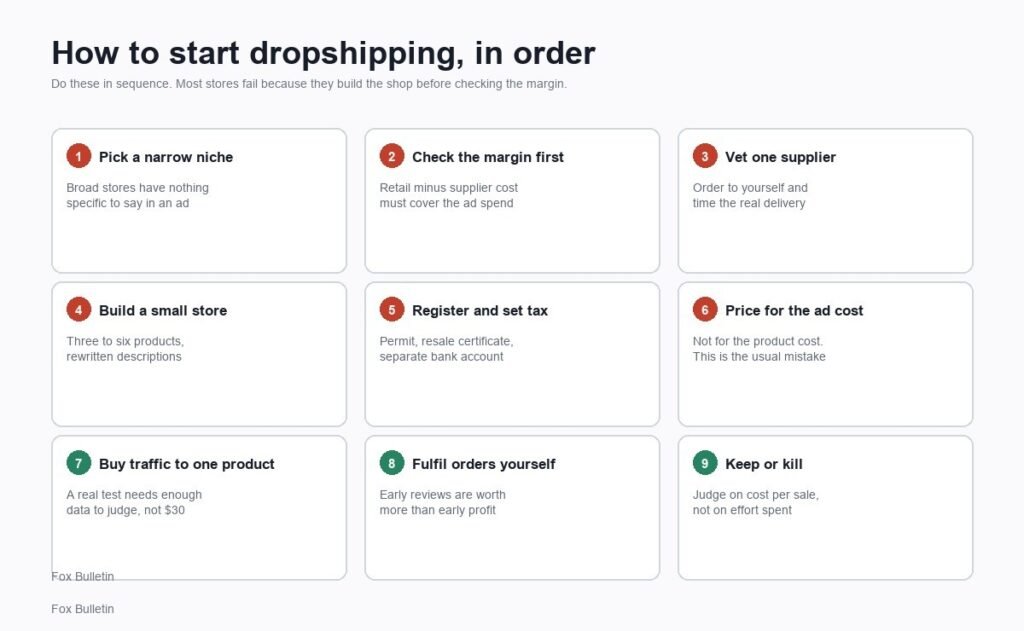
Most guides to starting a dropshipping store put the steps in the wrong order. They begin with picking a theme and importing products, which is the enjoyable part, and reach the arithmetic somewhere near the end. That sequence is why so many stores launch, run ads for a fortnight, and close with nothing to show but an advertising bill.
The order that works puts the margin check before the shop gets built. If a product cannot carry the cost of the advertising needed to sell it, no amount of theme customisation rescues it, and you can find that out in an hour rather than a month. What follows is nine steps in the sequence that catches problems while they are still cheap, with current prices from each vendor’s own page.
What You Need Before You Start
| Requirement | Cost | Needed by |
|---|---|---|
| Store platform | $1 intro, then $29 to $39 a month | Step 4 |
| Domain name | About $11 a year | Step 4 |
| Supplier app | Free tier available | Step 3 |
| Product samples | $20 to $30 each | Step 3 |
| Sales tax permit | Usually free to register | Step 5 |
| Advertising test budget | $300 or so | Step 7 |
| Business registration | Optional, $100 in Wyoming | Step 5 |
That is roughly $430 for a first month that gives the idea a fair test, and about $40 if you strip it to the bone and skip the samples. Our full breakdown of the cost to start dropshipping shows where each figure comes from.
Choosing Something Worth Selling
Step 1: Pick a niche narrow enough to say something specific
A general store has nothing particular to say to anyone, which makes its advertising expensive. A narrow one can write a sentence that a specific person recognises as being about them, and that single fact drives the cost of every visitor you buy.
Narrow does not mean tiny. “Kitchen” is too broad. “Equipment for people who bake sourdough at home” is a real audience with identifiable interests, existing communities and obvious accessories. Choose a niche where you can name the customer, and where repeat purchases or accessories exist so one buyer can be worth more than one order. Our guide to choosing a dropshipping niche covers how to validate one before committing, and our guide to the best products to dropship covers what to put in it.
Step 2: Check the margin before anything else
This is the step that belongs second and usually happens last. Take a product you are considering and do the arithmetic now.
- Retail price you could plausibly charge, based on what comparable items sell for.
- Minus the supplier cost, including their shipping, not the headline unit price.
- Minus payment processing, commonly 2.9% plus 30 cents.
- What remains is everything you have to acquire a customer with, and to keep as profit.
On a $40 product costing $15 delivered, that leaves about $23.50. If acquiring a customer costs $14, the store makes roughly $9.50 an order. If it costs $24, every sale loses money. Products that leave less than about $20 of room are extremely hard to advertise profitably, and knowing that before you build saves the month.
Setting Up Supply and the Store
Step 3: Line up a supplier and order from them yourself
Choose the supplier before the shop, because the supplier determines your delivery promise and your delivery promise shapes the whole store. Connect AliExpress through the free DSers plan if you are testing, or pay from $39.99 a month for a network such as Spocket if your suppliers need to be in the United States or Europe.
Then order the product to your own address as a normal customer. Time the dispatch and the delivery separately, open the parcel, and check whether the supplier’s paperwork is inside. That single order tells you more than any review page, and our guide to finding dropshipping suppliers covers the full vetting process.
Step 4: Build a small store rather than a big one
Three to six products with genuinely good pages beat sixty imported listings every time. Take the introductory offer rather than committing to a year, use a free theme, register the domain separately so it stays yours, and rewrite every product description, because imported supplier copy is shared with every other store selling the same item.
Put the delivery window on the product page itself, not only in a policy link. Our Shopify setup guide goes through the build in order and the settings that quietly cost sales.
Step 5: Register the business and sort out tax
You are a sole proprietor by default, which is lawful, so this step is about tax and liability rather than permission. Register for a sales tax permit in your state and get the resale certificate that stops the same item being taxed twice. Open a separate bank account. Decide whether an LLC is worth its filing fee, which is $100 in Wyoming with a $60 minimum annual report.
Read the shipping rules while you are here, because the FTC requires you to ship within the time you state or within 30 days by default, and to offer a delay or refund if you cannot. Slow suppliers make that a live issue, as our guide to dropshipping legality and tax explains.
Pricing, Launching and the First Sales
Step 6: Price for the advertising, not for the product
The most common pricing mistake is doubling the supplier cost. A $15 product priced at $30 leaves about $14 after processing, which is roughly what one customer costs to acquire, so the store works flat out to make nothing.
Price instead from the other direction. Decide what you need to keep per order, add your expected cost per customer, add the supplier cost and the processing fee, and see whether the resulting number is credible for that product. If it is not, the product is wrong rather than the price.
Step 7: Buy traffic to one product, properly
Send your first budget to one product rather than spreading it across six. Advertising platforms need enough conversions to optimise and you need enough of a sample to draw a conclusion, which is why a $300 test tells you something and a $30 test tells you nothing.
What you are buying is information: whether this product, at this price, sells to this audience. Most first tests come back negative. That is a normal and useful result rather than a failure, provided you learn the number rather than just feeling discouraged.
Step 8: Handle the first orders like they matter
Fulfil early orders manually even though automation exists, because doing it by hand shows you every friction point before it scales. Reply to messages the same day. Refund quickly when something goes wrong rather than defending a $20 sale into a chargeback. Early reviews and a clean dispute record are worth more than the profit on the first ten orders.
Deciding Whether It Is Working
After a real test you will have numbers, and the decision should follow them rather than how much effort you have invested.
- Cost per purchase against your margin. This is the only number that decides viability. Below your margin, scale. Above it, change something.
- Add-to-cart rate. Traffic arriving and not adding to cart is a price, photo or trust problem, not an audience problem.
- Checkout completion. Losses at the final step usually mean shipping cost or delivery time revealed too late.
- Refund and dispute rate. Rising refunds almost always trace back to the supplier rather than the marketing.
If the cost per purchase is close to your margin, the fixes are raising average order value, improving the page, or narrowing the audience. If it is double your margin, the product is wrong and the honest move is to test another one rather than optimise a losing position.
The Mistakes That End Most Stores in the First Month
- Building before checking the margin. Everything else on this list follows from skipping step 2.
- Importing sixty products. It looks like progress and splits your attention across items you have not tested.
- Leaving supplier descriptions in place. Duplicate machine-translated copy tells the customer exactly what your store is.
- Hiding the delivery time. It converts marginally better and produces refunds, chargebacks and a legal exposure.
- Stopping a test halfway. Turning ads off after two days gives you the cost without the information.
- Spending on courses before making a sale. The same money spent on ad testing at least produces data about your own product.
Frequently Asked Questions
How do you start dropshipping as a complete beginner?
Pick a narrow niche, check that a product leaves enough margin to pay for advertising, vet one supplier by ordering from them yourself, build a small store with three to six rewritten product pages, register for sales tax, then spend a real test budget on traffic to a single product. The order matters more than any individual step.
How much money do you need to start dropshipping?
About $40 to open a store using introductory pricing and free tiers, and around $400 to $600 to give it a fair test including samples and a meaningful advertising budget. The software is the small part. Advertising is roughly 70% of a realistic first-month budget.
How long does it take to set up a dropshipping store?
The store itself takes an afternoon. The steps that decide whether it works take longer: a week or two to order and receive supplier samples, and several weeks of advertising tests to find a product that converts profitably. Treat anyone promising profit in seven days as selling you something.
Is dropshipping still worth starting?
It is worth starting if you are willing to become competent at paid advertising, and not worth starting if you expect the product to sell itself. Margins are thin and competition on generic products is intense, but the model still lets you test retail ideas without buying stock, which is its genuine and unchanged advantage.
Related Articles

Get the Fox Bulletin briefing
The stories that matter, in your inbox. No spam, unsubscribe anytime.
Newsletter signup will be available soon.
Related stories
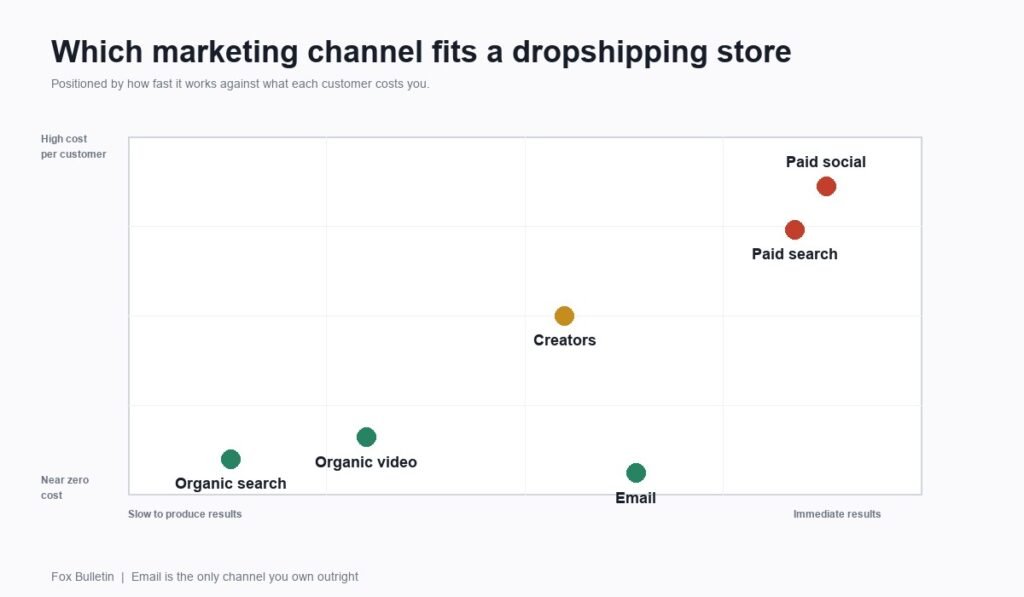
Dropshipping Marketing: The Numbers That Decide Every Channel
Dropshipping marketing is arithmetic, not creativity. The two numbers that decide everything, what each channel costs and delivers, and why scaling is usually an order-value problem.
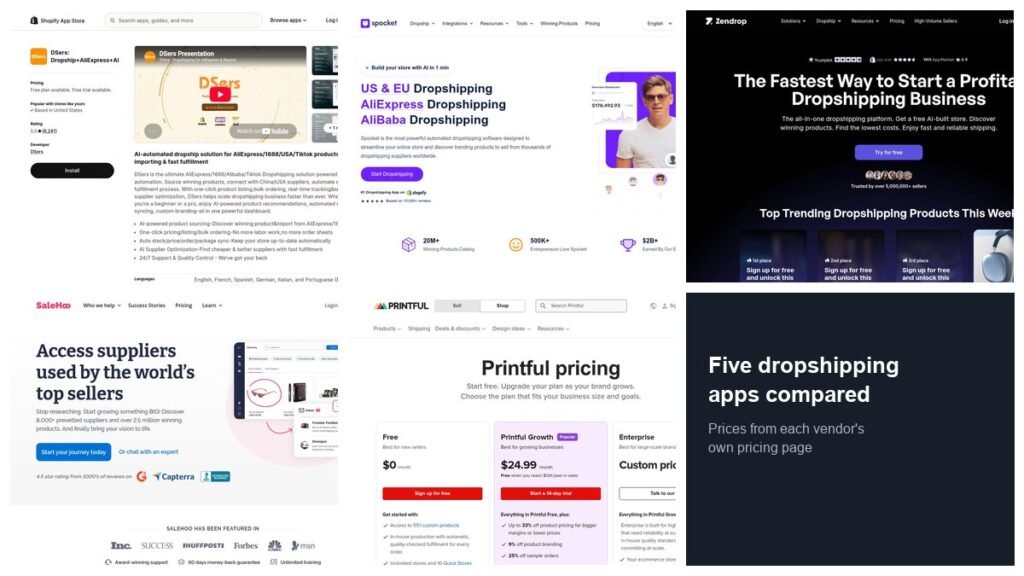
Dropshipping Apps: What Each One Does and What It Costs
Dropshipping apps do four different jobs and most stores need one, not four. Five apps compared on current pricing, what each is actually for, and how many you really need.
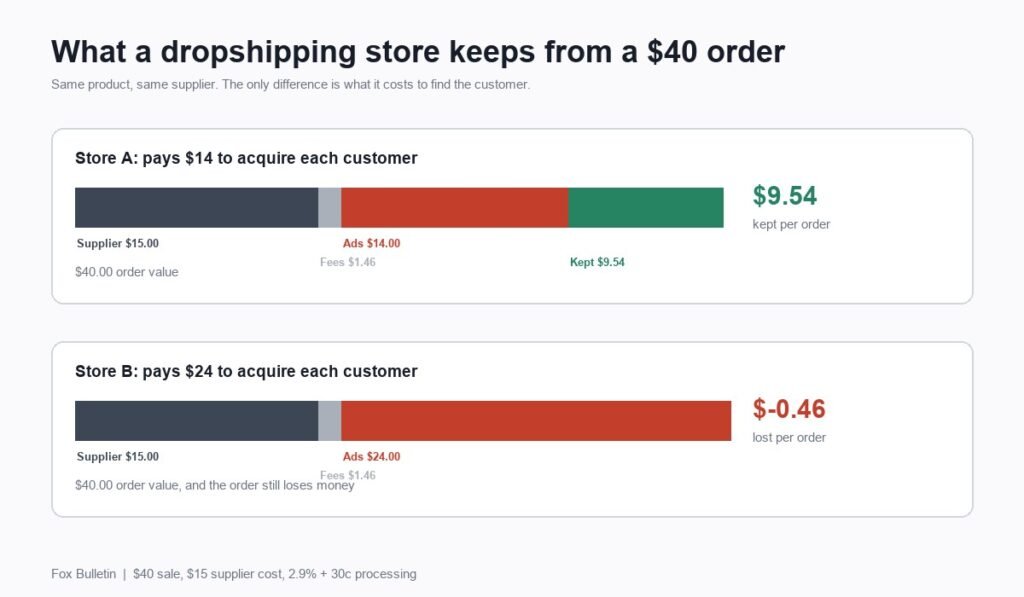
Is Dropshipping Profitable? The Numbers Behind the Answer
Dropshipping is profitable and most dropshipping stores are not. The margin arithmetic that decides which, what stores really earn, the costs that eat it, and the four levers that fix it.