

The phrase “winning product” has done a lot of damage. It implies that somewhere there is a list, and that copying the list is the work. What actually decides whether a product can be dropshipped profitably is arithmetic you can do in two minutes, and it rules out most of what appears on those lists.
A product works when the gap between what someone will pay and what it costs you to deliver is wide enough to also pay for reaching that person. That is it. Everything else, the trend data, the competitor research, the supplier ratings, is refinement on top of a test most candidate products fail immediately. This guide covers the arithmetic, the traits that widen that gap, where to look for candidates, and how to test one without spending a month on it.
The Test Every Candidate Product Has to Pass
Take the product you are considering and work through it with real numbers rather than optimistic ones.
- Retail price: what comparable items genuinely sell for, not what you hope to charge.
- Supplier cost: the unit price plus their shipping, which people routinely leave out.
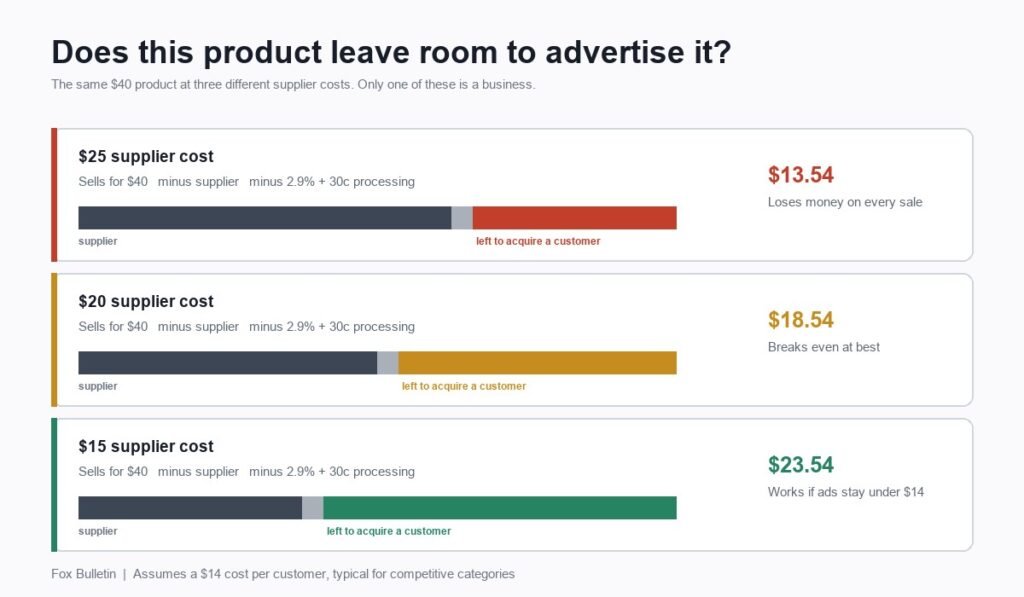
- Payment processing: commonly 2.9% plus 30 cents, so $1.46 on a $40 order.
- What is left is the whole budget for acquiring a customer, plus whatever you keep.
On a $40 product, a $15 supplier cost leaves $23.54 and a $25 supplier cost leaves $13.54. In competitive categories the cost of acquiring one customer through paid advertising commonly lands between $10 and $20. The first product can work. The second one loses money on every sale while appearing to be a functioning store.
This is why “find a cheap product and mark it up” is bad advice. The number that matters is not the markup percentage, it is the absolute dollars left over, because advertising is priced in dollars rather than percentages. A 300% markup on a $3 item leaves $8.54 and cannot be advertised. A 60% markup on a $60 item leaves $34.54 and can.
Traits That Widen the Gap
Certain characteristics reliably produce more room, and they have nothing to do with how novel the item is.
- It solves a specific, irritating problem. Problem-solving products are bought on relief rather than price comparison, which supports a higher price.
- It is hard to price-check. Something available under fifty identical listings invites comparison. Something bundled, branded or slightly modified does not.
- It is not sold in supermarkets. If the item is on a shelf at the local shop, online convenience is worth nothing.
- It photographs and demonstrates well. Paid social advertising rewards products whose benefit is visible in three seconds.
- It has attachments or refills. A product whose buyer predictably needs something else next is worth more than its first order.
- It sits between $25 and $80. Below that the absolute margin is too thin to advertise. Above it, impulse purchasing drops sharply and the sale needs more persuasion.
- It ships small, light and robust. Shipping cost comes out of the same margin, and breakages come out of your reviews.
Trending Products Versus Evergreen Ones
Both can work, and they are different businesses that fail in different ways.
A trending product can produce fast revenue because demand arrives before the competition does. It also has a short window, and by the time a product is measurably trending in public data, the margin has usually already been competed away. Building a store on a trend means committing to finding the next one continuously, which is a job rather than an asset.
An evergreen product sells at a steadier rate to people whose need does not expire. Growth is slower, but the advertising you learn keeps working, the content you write keeps ranking, and the store accumulates value instead of resetting. For someone building something to keep, evergreen with occasional trend products layered on top is the more defensible structure.
Where to Look for Candidate Products
- Marketplace best-seller lists. Amazon’s best seller charts update constantly and show what is genuinely selling by category rather than what someone says is hot.
- Search interest over time. Google Trends separates a rising product from one already past its peak, which is the single most useful check on any candidate.
- Supplier catalogues sorted by orders. AliExpress and similar platforms let you sort by order volume, which shows what other sellers are already moving.
- Communities complaining about something. Forums and interest groups describe unsolved problems in the customer’s own words, which is both product research and advertising copy.
- Your own niche knowledge. If you already understand a hobby or trade, you know which products are irritating to buy, and that is a better signal than any tool.
Whichever source you use, the shortlist then goes through the margin test above, and most of it will not survive. That is the tool working correctly.
How to Test a Product Without Wasting a Month
- Order one to yourself. Quality, packaging, dispatch time and whether supplier paperwork is inside. This is not optional, because your refund rate depends on it.
- Build one good product page rather than a catalogue. Real photographs, rewritten description, stated delivery window, visible returns policy.
- Run a single focused advertising test with enough budget to generate meaningful data. A few dollars a day produces neither sales nor a conclusion.
- Judge on cost per purchase against your margin. Not on impressions, clicks or how much you like the product.
- Change one variable at a time if it is close, and move on if it is not. A product costing double your margin to sell is not fixable by a new headline.
Expect most tests to fail. A product that fails cleanly and cheaply has done its job, because the alternative is discovering the same thing after three months of building around it.
Pricing a Product Once You Have One
Price from the margin you need rather than from the supplier’s cost. Start with what you want to keep per order, add your observed cost per customer, add the supplier cost and the processing fee, and check whether the resulting figure is believable for that item. If it is not, the product is wrong.
Two adjustments reliably help. Raising the average order value through bundles, multi-packs or a genuine accessory offer spreads one acquisition cost across more revenue, which is usually easier than lowering the acquisition cost. And building the shipping cost into the product price, then offering free shipping, converts better than the same total split into two numbers at checkout.
How Much Room the Market Leaves You
It is worth keeping the scale in view while filtering candidates. The US Census Bureau put retail e-commerce at $340.2 billion in the second quarter of 2026, 17.1% of all retail sales and up 12.2% year on year. Demand is not the scarce resource.
What is scarce is margin on products anyone can list. Those two facts together explain why product selection is the highest-leverage decision in the business: the buyers exist in enormous numbers, and the only question is whether the specific item you chose leaves enough per order to reach them.
Mistakes That Waste Testing Budget
- Testing five products at once. The budget is split too thin to learn anything about any of them.
- Selling something you have not held. The refunds cost more than the sample would have.
- Choosing items under $20. The absolute margin cannot cover paid acquisition, whatever the percentage says.
- Copying a product from an advertisement you saw. If it is being advertised at scale, you are entering an auction against someone with more data and better economics.
- Ignoring shipping weight. A heavy item quietly eats the margin the arithmetic said you had.
- Stopping a test after two days. You pay for the test and then decline to collect the result.
Product selection sits inside a larger decision about who you are selling to, which is covered in our guide to choosing dropshipping niches, and the supplier behind it determines whether any of it holds together, which our guide to finding reliable suppliers covers.
Frequently Asked Questions
What products sell best for dropshipping?
Products between roughly $25 and $80 that solve a specific problem, ship small and light, are not available in supermarkets, and have accessories or refills. The category matters less than those characteristics, because they are what create enough absolute margin to pay for advertising.
How do you find winning dropshipping products?
Generate candidates from marketplace best-seller charts, supplier catalogues sorted by order volume, and communities discussing unsolved problems. Then filter them through the margin test: retail minus supplier cost minus processing should leave at least $20. Test the survivors one at a time with a real budget.
Should you dropship trending products?
They can work, but treat them as revenue rather than as a business. By the time a trend is visible in public data the margin is usually being competed away, and a store built entirely on trends has to keep finding new ones. Evergreen products with occasional trend items layered on top is the more durable structure.
How many products should you test before one works?
Plan on several, and budget accordingly. Most tested products fail, which is normal rather than a sign you are doing it wrong. What matters is that each test is cheap, conclusive and judged on cost per purchase rather than on how promising the product felt.
Related Articles
- How Does Dropshipping Work? The Model, the Margins and the Catch
- Shopify Dropshipping: Setting Up a Store That Takes Orders
- Amazon Dropshipping: The Policy, the Fees and What Gets You Suspended
- How to Start Dropshipping: The Nine Steps in the Right Order
- Is Dropshipping Profitable? The Numbers Behind the Answer

Get the Fox Bulletin briefing
The stories that matter, in your inbox. No spam, unsubscribe anytime.
Newsletter signup will be available soon.
Related stories
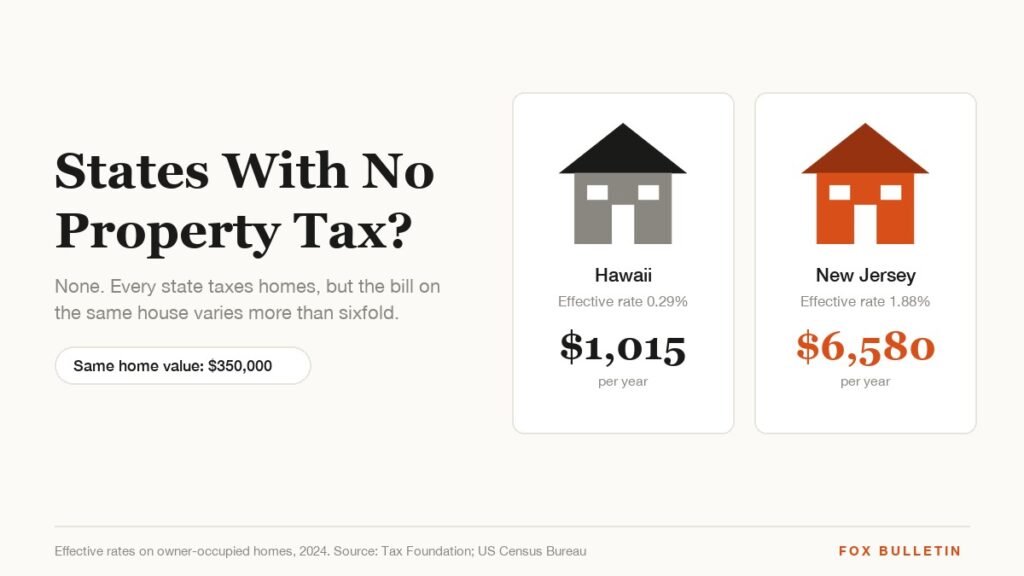
States With No Property Tax: Why None Exist, Plus Property Tax by State
There are no states with no property tax. Effective rates run from 0.29% in Hawaii to 1.88% in New Jersey and Illinois. Every state's rate, and the exemptions that can cut a bill to zero.
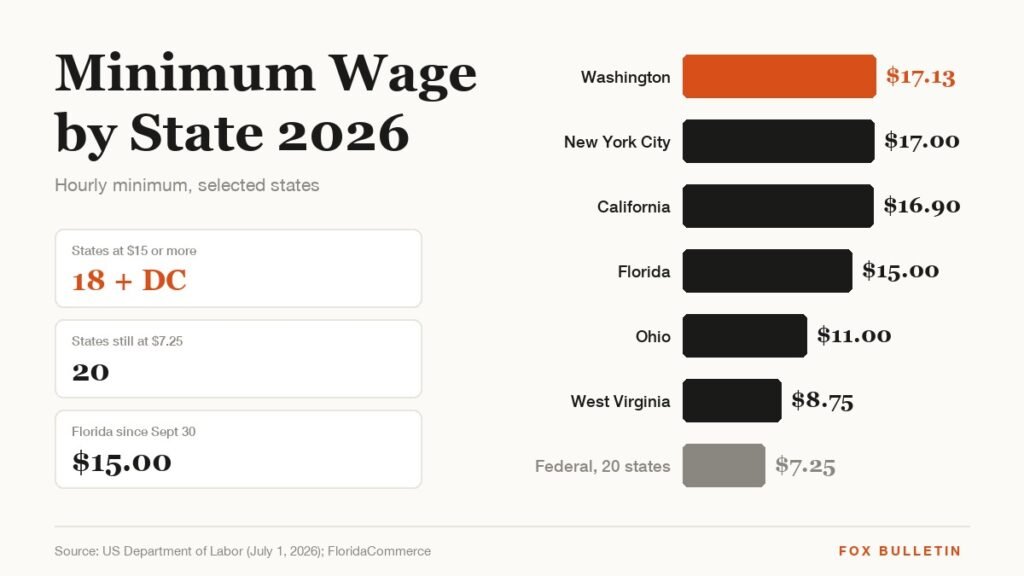
Minimum Wage by State 2026: Every State’s Rate, Plus Tipped Wages
The federal minimum wage is still $7.25, but 30 states and DC set higher rates, from $8.75 in West Virginia to $17.13 in Washington. Every state's rate and tipped wage for 2026.
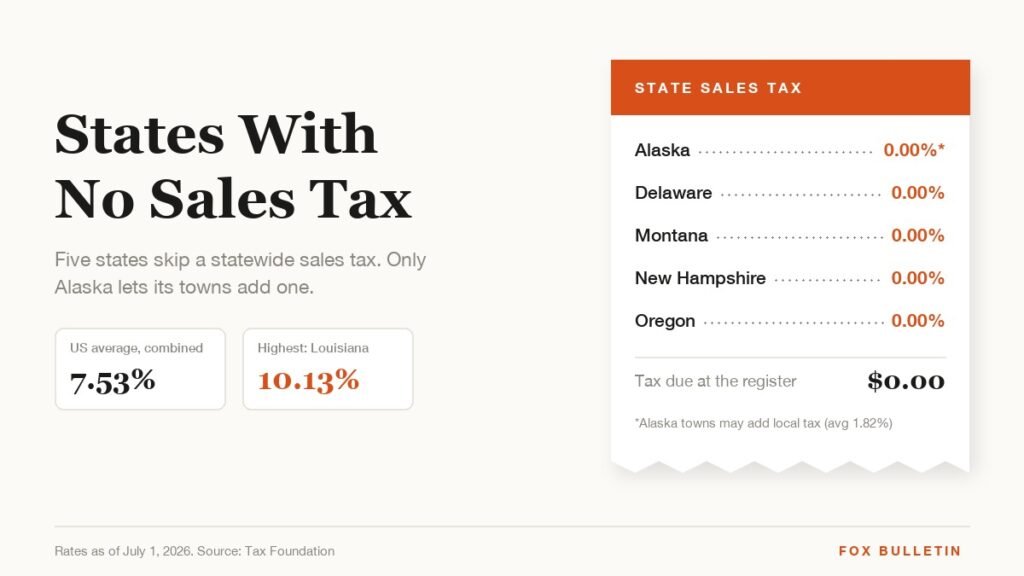
States With No Sales Tax: All 5, Plus Sales Tax by State
Alaska, Delaware, Montana, New Hampshire and Oregon have no statewide sales tax. What each one taxes instead, and the 2026 sales tax rate in every other state.