

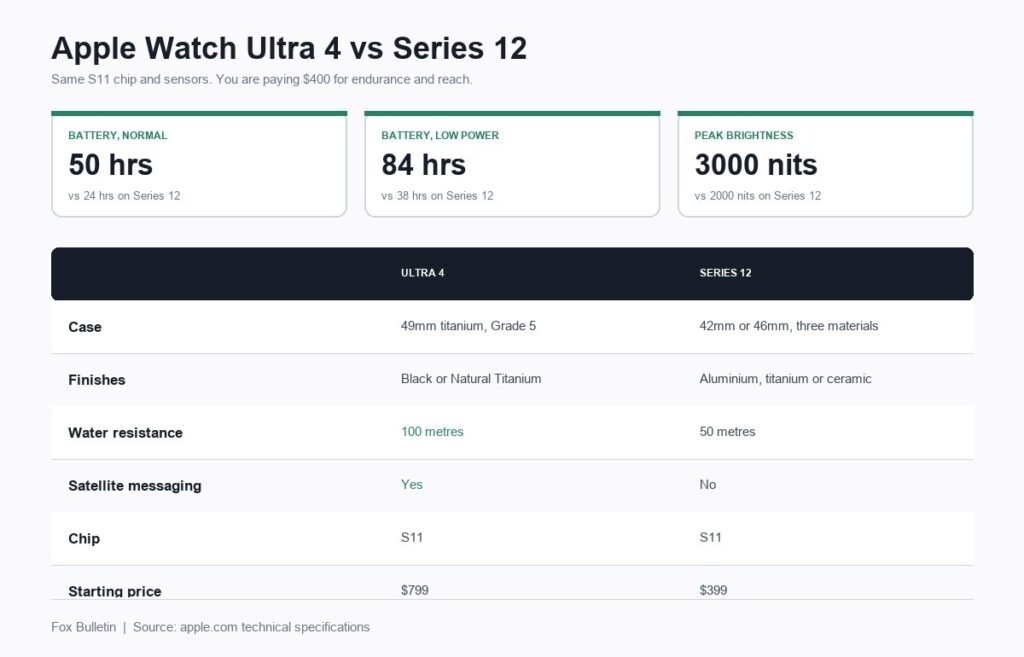
Apple Watch Ultra 4 costs $799, comes only in a 49mm titanium case, and was listed as available from 18 September 2026. It uses the same S11 chip and very nearly the same sensor array as the $399 Apple Watch Series 12, which makes the $400 gap between them look absurd until you read two numbers: 50 hours of battery against 24, and 84 hours in Low Power Mode against 38.
That is what the Ultra is. It is not a faster watch or a smarter one. It is the same watch built to keep working when you are a long way from a charger, a phone signal or the surface of the water. This guide covers the full specification, what the extra money genuinely buys, and the specific situations where paying it makes sense.
Apple Watch Ultra 4 Price and Finishes
| Detail | Apple Watch Ultra 4 |
|---|---|
| Starting price | $799 |
| Case size | 49mm, one size only |
| Case material | Titanium, Grade 5 |
| Finishes | Black Titanium, Natural Titanium |
| Availability | From 18 September 2026 |
| Trade-in credit | $30 to $430 against an existing Apple Watch |
There is no cheaper configuration and no smaller case. Cellular is included rather than optional, which is part of why the entry price sits where it does. Grade 5 titanium is the aerospace alloy rather than commercially pure titanium, which is harder and holds an edge better on a case that is expected to be knocked about.
Full Specifications
Every figure below is from Apple’s published technical specifications.
| Specification | Apple Watch Ultra 4 |
|---|---|
| Case dimensions | 49mm x 44mm x 12mm |
| Display resolution | 422 by 514 pixels |
| Peak brightness | 3000 nits |
| Chip | S11 with 64-bit dual-core processor |
| Battery, normal use | Up to 50 hours |
| Battery, Low Power Mode | Up to 84 hours |
| Water resistance | 100 metres |
| Satellite | Yes |
| Heart sensors | Second-generation electrical heart sensor, always-on optical heart sensor |
| Other sensors | Blood oxygen, temperature, depth gauge, water temperature, compass, always-on altimeter, high-g accelerometer, high dynamic range gyroscope, ambient light |
Fifty Hours Is the Whole Argument
Every other Apple Watch is a one-day device. You charge it daily, usually out of habit rather than necessity, and a forgotten charge means a flat watch by evening. The Ultra 4’s 50-hour rating breaks that pattern, and 84 hours in Low Power Mode breaks it properly.
Translated into ordinary use, that means a full weekend away without packing a charger, or two nights of sleep tracking with the days in between. For anyone doing something longer, Low Power Mode stretches to three and a half days while still recording workouts and heart rate, just with the always-on display and some background sensing dialled back.
This matters more than it sounds. Battery anxiety is the reason a lot of people stop wearing a smartwatch to bed, which is the reason they never get sleep data, which is the reason the health features never quite deliver on the promise. A watch that runs for two days solves that by removing the decision.
Satellite Is the Feature Series 12 Cannot Match
The Ultra 4 supports satellite connectivity. Series 12 does not, and no amount of paying for cellular changes that, because cellular still requires a network to be present.
The practical scope is narrow and the value is concentrated. If you hike, sail, ski, ride or run somewhere without coverage, the Ultra can reach emergency services and send messages when there is no cell signal at all. If you never leave coverage, it is a feature you will never use and should not pay for.
That is the honest framing of this whole watch. The satellite radio, the 100 metre rating and the 50-hour battery are all insurance against circumstances most people never encounter, which is why the Ultra is simultaneously the best watch Apple makes and the wrong purchase for the majority of buyers.
The 3000-Nit Display and the 49mm Case
At 3000 nits the Ultra 4’s display is half again as bright as the Series 12’s 2000 nits, and that figure only pays off outdoors. On a snowfield, on water, or on a bike in direct midday sun, the difference between 2000 and 3000 nits is the difference between glancing at your pace and stopping to shade the screen.
The case is 49mm by 44mm by 12mm, and this is the specification most likely to rule the watch out. It is a large, thick object. On a slim wrist it overhangs, and under a shirt cuff it catches. Anyone considering an Ultra should try one on physically before ordering, because no amount of battery life compensates for a watch you find uncomfortable to wear all day and all night.
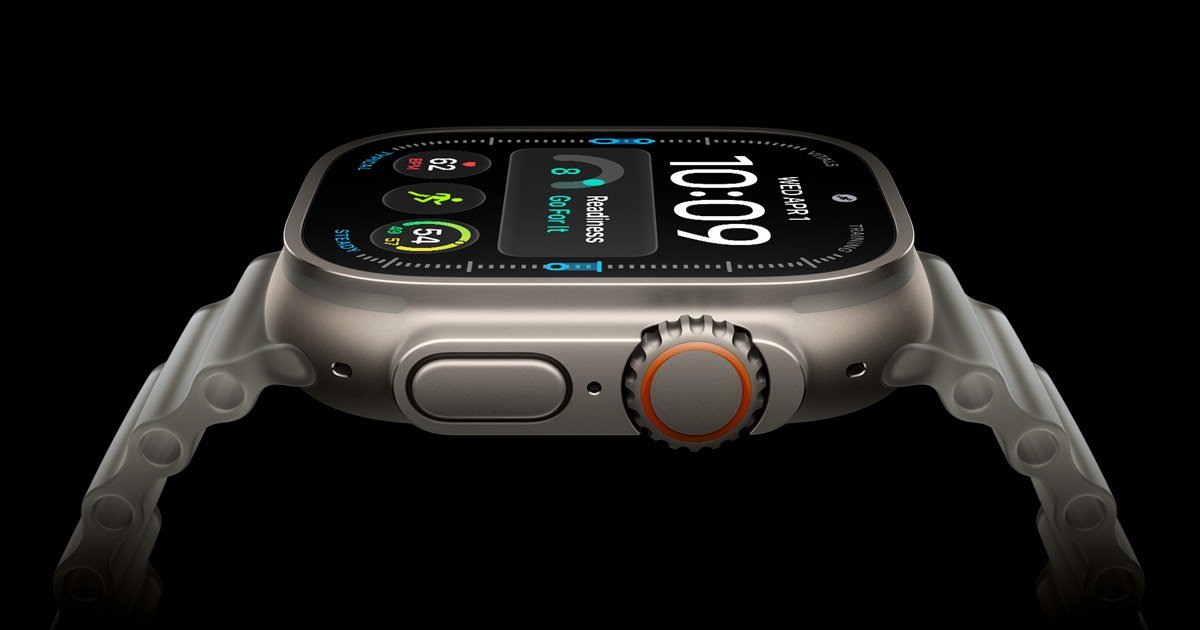
The flat sapphire front and the raised titanium lip around it are functional rather than decorative: the case is designed so the glass does not make first contact when you catch your wrist on rock or a door frame.
Diving, Depth and the 100 Metre Rating
The Ultra 4 is water resistant to 100 metres, against 50 metres on Series 12, and carries both a depth gauge and a water temperature sensor.
The distinction between the two ratings is not really about depth in the way people assume. A 50 metre rating covers swimming and snorkelling comfortably. The 100 metre rating, combined with the depth gauge, is what makes the watch usable for recreational diving, where you need a live depth reading and a temperature the dive computer can use rather than just a promise that water will not get in.
Series 12 does now include a depth gauge to 6 metres and a water temperature sensor, which narrows this gap for snorkellers. It is diving specifically where the Ultra remains the only option in Apple’s range.
Ultra 4 vs Series 12: Who Should Pay the Extra $400
Both watches run the S11 chip and carry nearly identical sensors, so nobody should buy an Ultra expecting better health tracking or faster apps. The differences are endurance and environment.
- Buy the Ultra 4 if you regularly go two days without charging, spend time beyond mobile coverage, dive, or work outdoors where screen brightness is a daily problem.
- Buy Series 12 if you want a watch for fitness, notifications and health tracking in ordinary life. It is $400 cheaper, comes in two sizes, and does the same job for the same use.
- Buy the SE 3 at $249 if the watch is mostly for notifications and basic activity tracking, and the display and battery are not where you want to spend.
The trap is buying the Ultra for the idea of the outdoors rather than the reality of it. If the last time you were out of phone coverage was a tunnel, the satellite radio is decoration. Our roundup of the best smartwatches covers the non-Apple options for people whose priority is battery rather than ecosystem.
What the Ultra 4 Is Not Good At
- Fitting a small wrist. One 49mm size, no alternative, and it is 12mm thick.
- Looking discreet. The industrial design is deliberate and it does not disappear under a cuff.
- Being cheap to replace. $799 is a lot of money to strap to the outside of your body while climbing.
- Justifying itself on performance. The chip and sensors are shared with a watch costing half as much.
Frequently Asked Questions
How much does the Apple Watch Ultra 4 cost?
$799, in one 49mm titanium case with a choice of Black Titanium or Natural Titanium finishes. Cellular is included rather than sold as an upgrade. Apple lists trade-in credit of $30 to $430 against an existing Apple Watch.
How long does the Apple Watch Ultra 4 battery last?
Up to 50 hours in normal use and up to 84 hours in Low Power Mode. That is roughly double the Series 12, which is rated at 24 hours and 38 hours respectively, and it is the main reason to choose the Ultra.
Is the Apple Watch Ultra 4 good for diving?
It is water resistant to 100 metres and includes a depth gauge and a water temperature sensor, which is what separates it from the rest of the range for diving. Series 12 is rated to 50 metres with a depth gauge that reads to 6 metres, which covers swimming and snorkelling but not diving.
Does the Apple Watch Ultra 4 work without a phone signal?
Yes, for emergency and messaging purposes, because it supports satellite connectivity. Series 12 does not, and its cellular option still depends on a mobile network being available. If you spend time beyond coverage, this is the feature that justifies the Ultra over anything else Apple sells.
Is the Apple Watch Ultra 4 worth it over the Series 12?
Only for specific reasons. Both use the same S11 chip and share most sensors, so the Ultra is not faster or better at health tracking. The $400 buys roughly double the battery, a 3000-nit display against 2000, a 100 metre rating against 50, satellite messaging and a titanium case. If none of those describe your week, Series 12 is the better purchase.
Related Articles

Get the Fox Bulletin briefing
The stories that matter, in your inbox. No spam, unsubscribe anytime.
Newsletter signup will be available soon.
Related stories
Apps Gone Free for Mac Today: October 7, 2026
Which paid Mac apps are free in the US Mac App Store today, why Mac price cuts are so much rarer than iPhone ones, and the Apple apps that went free for good.
Apps Gone Free for iPhone and iPad Today: October 7, 2026
Every paid iPhone and iPad app that is free in the US App Store today, with the price it normally costs, what it does, who it suits, and whether it carries in-app purchases.

Best AirPods Pro Ear Hooks: 7 Compared on Fit and Models
Seven AirPods Pro ear hooks compared on fit, material and model compatibility, including which ones work with the Pro 3 and why none of them charge.