
Apple’s foldable iPhone exists, it is called iPhone Duo, and it costs $1,999. Pre-orders open at 5:00am PT on 16 October 2026 and it goes on sale on 23 October, which puts it more than a month behind the iPhone 18 Pro rather than launching alongside it.
It has a 7.6-inch inner display, a 5.4-inch outer one, the same A20 Pro chip as the iPhone 18 Pro, and a titanium hinge that Apple says is 3D printed from fully recycled material. It is also heavier and thicker than the Samsung foldable it is competing with, which is the most honest thing anyone can say about a first-generation product entering a category its rival has iterated on for eight years.
iPhone Duo Price and Release Date
| Detail | iPhone Duo |
|---|---|
| Starting price | $1,999 |
| Monthly | From $83.29 a month for 24 months |
| Lease | From $57.99 a month for 24 months with Apple Upgrade |
| Pre-orders | From 5:00am PT on 16 October 2026 |
| On sale | 23 October 2026 |
| Finishes | Star White, Night Sky |
| Trade-in credit | $35 to $885 |
At $1,999 the Duo is $700 more than the iPhone 18 Pro Max and the most expensive iPhone Apple sells. It is worth noting the launch gap: the rest of the 2026 iPhone line went on sale on 18 September, and the Duo arrives five weeks later.
Full Specifications
Every figure below is from Apple’s published technical specifications.
| Specification | iPhone Duo |
|---|---|
| Inner display | 7.6-inch Super Retina XDR, OLED |
| Outer display | 5.4-inch Super Retina XDR, OLED |
| Chip | A20 Pro |
| Cameras | 48MP Dual Fusion camera system |
| Battery | Up to 24 hours |
| Folded dimensions | 3.31 x 4.64 x 0.44 inches |
| Unfolded dimensions | 6.48 x 4.64 x 0.21 inches |
| Weight | 8.96 ounces (254 grams) |
| Storage | 256GB, 512GB, 1TB, 2TB |
| Enclosure | 85% recycled titanium |
| Hinge cover | 100% recycled titanium, 3D printed |
| Price | From $1,999 |
The Hinge Is the Interesting Engineering
Apple’s environmental disclosures are unusually specific about this phone, and they reveal where the engineering effort went. The enclosure is 85% recycled titanium. The hinge cover is 100% recycled titanium and 3D printed. The battery uses 100% recycled cobalt and 95% recycled lithium, and the printed circuit boards use 100% recycled gold plating and tin solder.
The 3D-printed titanium hinge is the notable entry. Additive manufacturing in titanium is expensive and slow compared with machining, and companies do not choose it for decoration. It is chosen when a part needs internal geometry that cannot be machined, which in a folding phone means a hinge that is both stiff enough to hold the halves flat and compact enough not to add thickness. That single component is where a large share of the $1,999 goes.
Two Screens, and What Each Is For
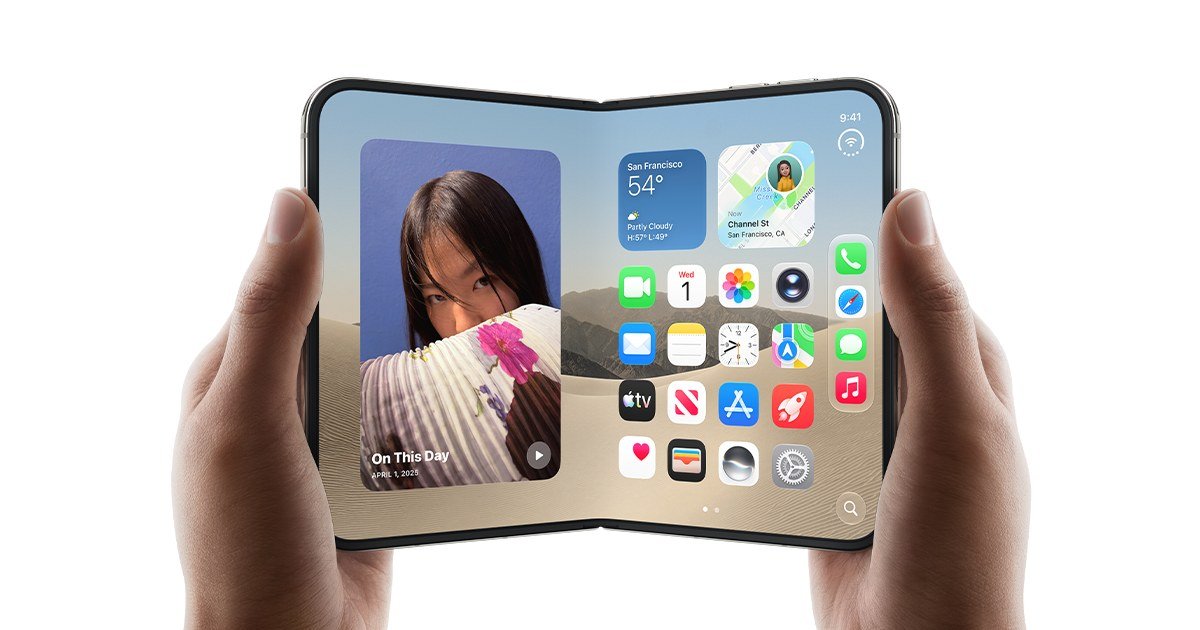
The Duo pairs a 7.6-inch inner display with a 5.4-inch outer one, both Super Retina XDR OLED panels.
That 5.4-inch cover screen is the number that decides whether a foldable works day to day. It is roughly the size of an older iPhone, which means the closed phone is usable as a phone: messages, calls, maps, music and payments without unfolding. Foldables with narrow cover strips force you to open the device for trivial tasks, which is where the format stops feeling convenient.
Unfolded, 7.6 inches puts it between an iPhone 18 Pro Max at 6.9 inches and an iPad mini. The practical gain is not watching video, it is having two applications side by side at a usable width, and reading documents without pinching.
How It Compares With the Galaxy Z Fold8
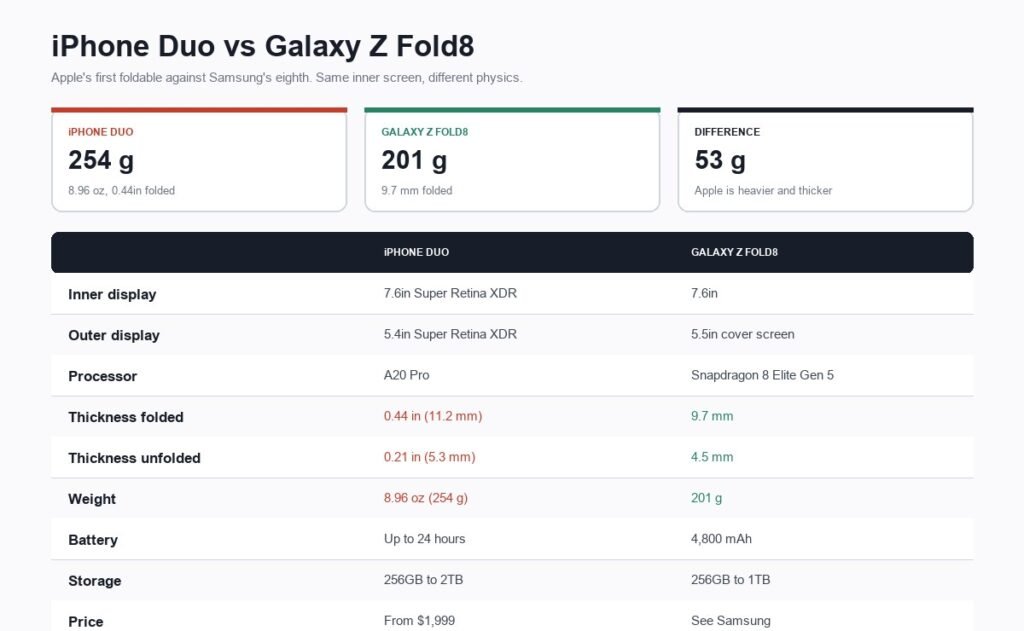
Samsung is eight generations into this category, so the comparison is the fairest test of where Apple’s first attempt lands.
| iPhone Duo | Galaxy Z Fold8 | |
|---|---|---|
| Inner display | 7.6in Super Retina XDR | 7.6in |
| Outer display | 5.4in Super Retina XDR | 5.5in cover screen |
| Processor | A20 Pro | Snapdragon 8 Elite Gen 5 for Galaxy |
| Folded thickness | 0.44 in (about 11.2 mm) | 9.7 mm |
| Unfolded thickness | 0.21 in (about 5.3 mm) | 4.5 mm |
| Weight | 8.96 oz (254 g) | 201 g |
| Battery | Up to 24 hours | 4,800 mAh |
| Storage | 256GB to 2TB | 256GB to 1TB |
The inner screens are the same size and the cover screens are within a tenth of an inch of each other. Where they separate is physics. The Galaxy Z Fold8 is 201 grams and Apple’s Duo is 254 grams, a difference of 53 grams, and Samsung is thinner both folded and unfolded. Samsung markets the Fold8 as the lightest book-style foldable, and on these figures that claim holds against Apple.
Samsung also sells a larger Galaxy Z Fold8 Ultra with an 8-inch main screen and a 6.5-inch cover screen at 215 grams, with a 5,000 mAh battery and a 10MP telephoto lens offering 3x optical zoom. Apple has no equivalent tier.
None of that settles which is better to use. Weight and thickness are measurable; software, camera processing, app behaviour on a square-ish screen and how the crease looks after a year are not, and they matter more in daily use than 53 grams does.
Battery and the Cost of Two Screens
Apple rates the iPhone Duo at up to 24 hours of battery life. For context, the iPhone 18 Pro is rated at up to 24 hours of typical use and the 18 Pro Max at up to 30 hours, so the foldable matches the smaller Pro rather than the larger one despite being physically bigger.
That is the structural cost of the format. A folding phone gives up internal volume to the hinge mechanism and has to power a second display, so the battery cannot simply scale with the outside dimensions. Anyone moving from a Pro Max should expect to charge more often, not less, which is the opposite of what the size of the device suggests.
Storage Matters More on This Phone
The Duo runs from 256GB to 2TB, and the case for going beyond the base tier is stronger here than on a normal iPhone. A larger screen encourages the behaviours that consume storage: keeping documents on the device, reading and annotating rather than skimming, running two apps side by side with their own caches.
There is no expandable storage on any iPhone, so the tier you choose is permanent for the life of the device. On a $1,999 phone intended to replace both a phone and, occasionally, a tablet, 256GB is the configuration most likely to be regretted.
What Apple Has Not Said
Several things a buyer would want to know are absent from the published specifications, and it is worth being clear about which they are.
- No hinge durability rating. Samsung has historically published fold-cycle counts. Apple’s specification page does not state one.
- No IP rating in the specification summary. Water resistance is a known weak point for folding designs.
- No detail on the inner display’s crease or the material covering it, which is the most common long-term complaint with every foldable.
- The camera is described only as a 48MP Dual Fusion system, with fewer lenses than the three-camera iPhone 18 Pro.
Those gaps are not necessarily bad news, but a $1,999 phone with a moving part is exactly where you would want them answered before ordering rather than after.
Should You Buy the Foldable iPhone?
- Buy it if you genuinely want a tablet-sized screen in your pocket, you are committed to iOS, and the novelty and the larger canvas are worth $700 over an iPhone 18 Pro Max.
- Wait if you have owned a foldable before and know that hinge longevity and crease visibility are what actually decide satisfaction. A first-generation product in a mature category is the one with the least field data.
- Skip it if what you want is the best iPhone. That is the iPhone 18 Pro Max at $1,299, with three 48MP cameras against the Duo’s two and a longer battery rating.
- Consider Samsung if weight and thinness are your priority. The Galaxy Z Fold8 is 53 grams lighter and slimmer in both states.
If you are choosing between the Duo and the rest of Apple’s 2026 range, our guide to the iPhone 18 Pro covers the model most people should actually be comparing it against.
Frequently Asked Questions
Is there a foldable iPhone?
Yes. It is called iPhone Duo, it starts at $1,999, and it has a 7.6-inch inner display and a 5.4-inch outer display. Pre-orders opened at 5:00am PT on 16 October 2026 and it went on sale on 23 October, five weeks after the rest of the 2026 iPhone line.
How much does the foldable iPhone cost?
$1,999 for the 256GB model, with 512GB, 1TB and 2TB options above it. Apple lists financing from $83.29 a month over 24 months and leasing from $57.99 a month, plus trade-in credit of between $35 and $885. That makes it $700 more than the iPhone 18 Pro Max.
Is the iPhone Duo better than the Galaxy Z Fold8?
On measurable specifications, Samsung wins on size and weight: 201 grams against 254, 9.7mm folded against roughly 11.2mm, and 4.5mm unfolded against roughly 5.3mm. The inner displays are both 7.6 inches. Apple’s advantages are the A20 Pro chip, iOS, and up to 2TB of storage against Samsung’s 1TB ceiling.
What colours does the iPhone Duo come in?
Two: Star White and Night Sky. That is a narrower choice than the four finishes offered on the iPhone 18 Pro.
How durable is the iPhone Duo’s hinge?
Apple has not published a fold-cycle rating in its specifications. What it does disclose is that the hinge cover is 3D printed from 100% recycled titanium, which points to a stiff and compact design, and that the enclosure is 85% recycled titanium. Without a published durability figure, long-term reliability is an open question on a first-generation folding device.
Related Articles
- How to Update to iOS 27: Step by Step, Plus Fixes if It Won’t Install
- AirPods 5: Price, Specs and How They Compare to AirPods Pro 3
- Apple Watch Ultra 4: Price, Specs and Whether It Beats the Series 12
- iPhone 18 Pro Max Cases: Every Option Available at Launch
- Best iPhone Duo Screen Protector: 7 Compared on Glass and Glare
- iOS 27 Supported Devices: iPhone List and Which Models Get Siri AI
- Best iPhone Duo Cases: 7 Compared on Hinge, Magnets and Stands
- Forgot iPhone Passcode? Here Is How to Get Back In

Get the Fox Bulletin briefing
The stories that matter, in your inbox. No spam, unsubscribe anytime.
Newsletter signup will be available soon.
Related stories
Apps Gone Free for Mac Today: October 7, 2026
Which paid Mac apps are free in the US Mac App Store today, why Mac price cuts are so much rarer than iPhone ones, and the Apple apps that went free for good.
Apps Gone Free for iPhone and iPad Today: October 7, 2026
Every paid iPhone and iPad app that is free in the US App Store today, with the price it normally costs, what it does, who it suits, and whether it carries in-app purchases.

Best AirPods Pro Ear Hooks: 7 Compared on Fit and Models
Seven AirPods Pro ear hooks compared on fit, material and model compatibility, including which ones work with the Pro 3 and why none of them charge.