
Choosing a dropshipping niche is usually described as a search for what is trending. It is not. It is a search for a group of people you can describe in one sentence, selling them something that leaves enough money in each order to pay for reaching them. Trends are the least durable part of that, and the part most guides spend all their time on.
The market itself is not the constraint. The US Census Bureau reported retail e-commerce sales of $340.2 billion in the second quarter of 2026, 17.1% of all retail and up 12.2% on the year before. There is no shortage of people buying online. The constraint is whether your particular slice of it can absorb an advertising cost, and that is decided before you list a single product.
The Five Tests a Niche Has to Pass
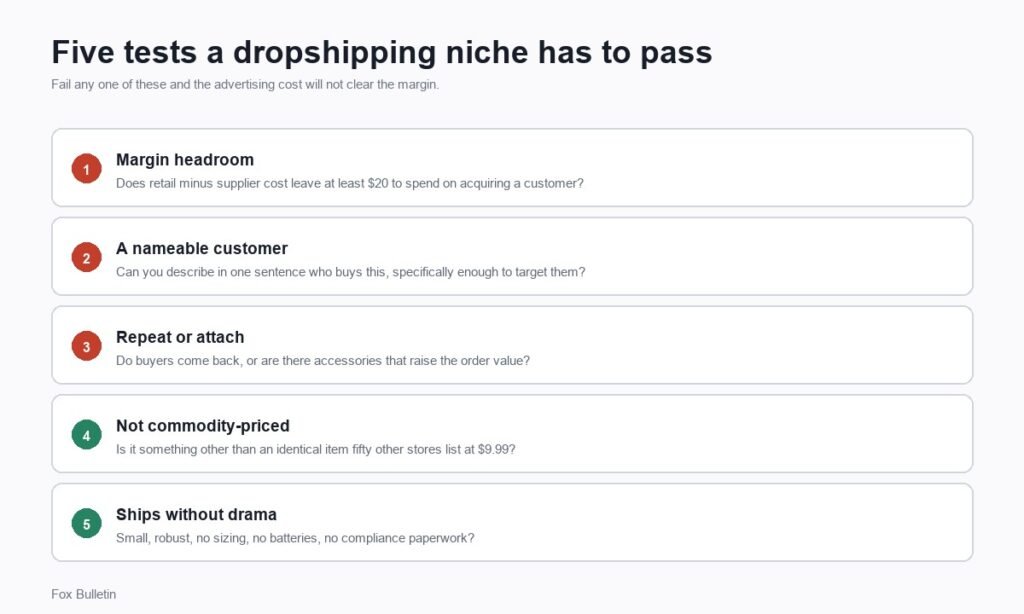
Run any niche you are considering through these before going further. Failing one is a warning; failing two means move on.
- Margin headroom. Retail price minus supplier cost minus payment processing should leave at least $20 to spend acquiring the customer. Below that, paid advertising cannot work and you are relying on traffic you do not have.
- A nameable customer. If you cannot finish the sentence “this is for people who…” with something specific, you cannot write an advertisement that anyone recognises as being about them.
- Repeat purchases or attachments. A niche where one customer buys once forever means paying the full acquisition cost for every single sale. Consumables, accessories and upgrades change the arithmetic completely.
- Not commodity-priced. If fifty stores list the identical item from the same catalogue, the only remaining lever is price, and someone will always go lower.
- Ships without drama. Small, robust, no sizing to get wrong, no batteries or liquids to complicate shipping, no safety certification to worry about.
Why Narrow Beats Broad, in Numbers
The argument for a narrow niche is usually made on branding grounds. The real argument is financial.
A general “home and kitchen” store advertising a garlic press is competing for attention with every other kitchen advertiser, using a message that is true for everyone and compelling to nobody. A store selling only equipment for home sourdough baking can name the customer, reference their actual problem, and advertise to interest groups that already exist. The second store pays less per customer for the same product, and paying less per customer is the entire game.
Narrow also changes what a customer is worth. Sell one garlic press and the relationship ends. Sell a banneton to someone who bakes weekly and the lame, the scraper, the flour and the proofing box are all natural follow-ups to a person who already trusts you. When one customer can be worth three orders, you can afford to pay three times more to get them, and that is usually the difference between a store that scales and one that stalls.
Niche Categories That Suit the Model
These categories work because they combine an identifiable buyer with margin and a reason to come back.
- Hobby equipment with a serious following. Baking, aquariums, model building, birdwatching, home coffee. Enthusiasts research, spend and buy accessories continually.
- Pet supplies for a specific animal or situation. Not “pets”, but senior dogs, reptiles, or anxious cats. Consumables drive repeat orders.
- Problem-solving items for a defined group. Products for new parents, people who work standing, campervan owners, wheelchair users. The problem writes the advertisement for you.
- Home and garden items that are awkward to warehouse. Bulky goods are expensive for competitors to stock, which is genuinely where dropshipping has an advantage rather than a disadvantage.
- Professional and trade supplies. Buyers with a business reason to purchase are less price-sensitive and order repeatedly.
Categories That Look Attractive and Are Not
- Consumer electronics. Thin margins, high customer expectations on delivery, warranty obligations, and competition with retailers who buy at volumes you cannot.
- Generic viral gadgets. They work briefly and then every store has them, which turns the category into a price race within weeks.
- Fashion and footwear. Sizing produces return rates that dropshipping return logistics handle badly. Returns come to you, not to the supplier.
- Anything fragile or heavy. Damage in transit is your cost and your review problem, and you never inspected the packaging.
- Branded goods. Sourcing brands through unverified channels invites counterfeit and intellectual property complaints, which our guide to dropshipping legality covers in more detail.
- Supplements, cosmetics and anything ingested or applied. Regulatory exposure and substantiation requirements that a small store is not equipped for.
How to Validate a Niche in an Afternoon
You do not need a month of research. You need four checks.
- Price the arithmetic. Find three candidate products, get real supplier costs including shipping, and work out what is left after processing. If the answer is under $20 on any of them, stop here.
- Look for existing communities. Active forums, subreddits and interest groups mean both a targetable audience and people already talking about their problems in their own words.
- Check who is already selling. No competition usually means no demand. Heavy competition from large retailers on identical products means no room. What you want is existing demand served mostly by generalists.
- Test the sentence. Write one plain line describing who this is for and why they would buy from you rather than a marketplace. If you cannot write it, no advertisement will write itself later.
Once the niche passes, the next question is which specific products inside it to list, which is a separate discipline covered in our guide to finding products worth dropshipping. The supplier decision follows from both, and our guide to finding reliable suppliers covers vetting whoever will actually ship them.
Where to Research a Niche Before Committing
Three free sources tell you most of what you need, and none of them require a subscription.
- Search interest over time. Google Trends shows whether interest in a category is growing, flat or already past its peak. A niche in structural decline is a bad place to build regardless of current volume.
- What is actually selling. Amazon’s best seller charts break down by category and update constantly, which reveals both demand and how crowded each sub-category already is.
- How the customer talks. Forums and interest communities give you the vocabulary, the recurring complaints and the products people recommend to each other, which is the raw material for both product choice and advertising copy.
Spend an hour in each before spending anything. A niche that looks promising in a product catalogue and has no active community behind it is usually a niche with no targetable audience, which makes every customer expensive to reach.
Niche Mistakes That Sink Stores
- Choosing a niche you find boring. You will write descriptions, answer questions and pick products in it for months. Indifference shows in the copy.
- Choosing purely on trend data. By the time a product is measurably trending, the margin has usually already gone.
- Going broad to keep options open. Optionality feels safe and makes every advertisement more expensive.
- Picking a niche with no repeat purchase. Mattresses and luggage are bought once a decade, so every sale costs full price to acquire.
- Ignoring the delivery expectation. Some niches tolerate a three-week wait and some do not. Gifts and anything seasonal do not.
- Picking a niche on margin alone. A category with wide margins and no identifiable community is still expensive to advertise into, because there is nobody specific to target.
Frequently Asked Questions
What is the most profitable dropshipping niche?
There is no single answer, and any article naming one is describing a niche that is already crowded by the time you read it. Profitability comes from the combination of margin headroom, a targetable audience and repeat purchases. Hobby equipment, specific pet categories and trade supplies tend to have all three, which matters more than the category label.
How narrow should a dropshipping niche be?
Narrow enough that you can name the customer in one sentence, and broad enough to support several related products. “Kitchen” is too broad to advertise. “Sourdough baking equipment” is right. “Left-handed sourdough lames” is too narrow to build a store on.
Should you pick a niche you know nothing about?
You can, but it costs you time rather than money. Knowing a niche means you already understand the vocabulary, the common problems and where those people gather, all of which you would otherwise have to learn before you can write an advertisement that works. Unfamiliar niches are workable if you are willing to do that research first.
How many products should a niche store sell?
Start with three to six and expand based on what sells. A large catalogue at launch looks like a general store, splits your attention and slows the site down. Stores usually grow by finding one product that works and adding what its buyers want next.
Related Articles

Get the Fox Bulletin briefing
The stories that matter, in your inbox. No spam, unsubscribe anytime.
Newsletter signup will be available soon.
Related stories
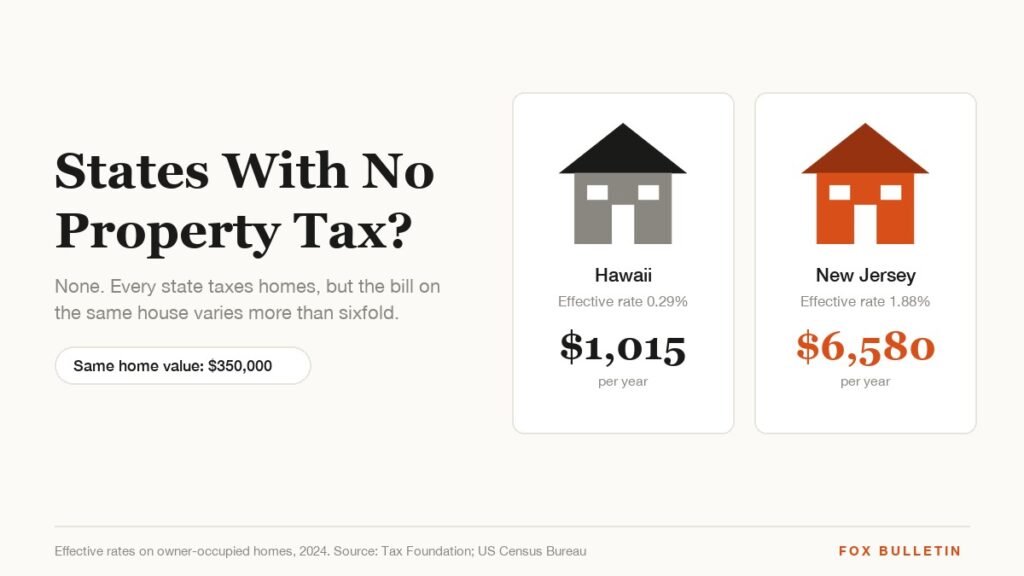
States With No Property Tax: Why None Exist, Plus Property Tax by State
There are no states with no property tax. Effective rates run from 0.29% in Hawaii to 1.88% in New Jersey and Illinois. Every state's rate, and the exemptions that can cut a bill to zero.
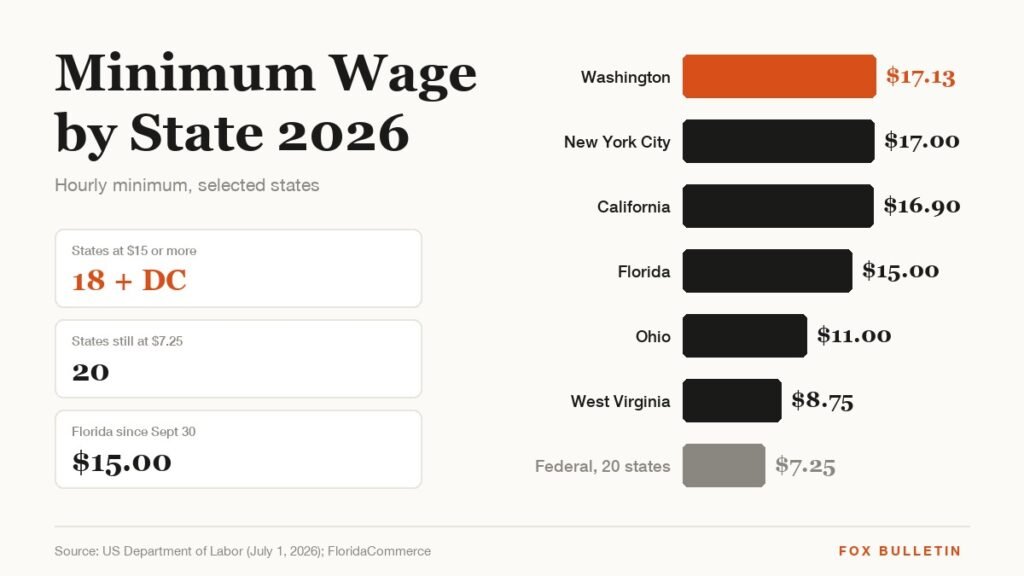
Minimum Wage by State 2026: Every State’s Rate, Plus Tipped Wages
The federal minimum wage is still $7.25, but 30 states and DC set higher rates, from $8.75 in West Virginia to $17.13 in Washington. Every state's rate and tipped wage for 2026.
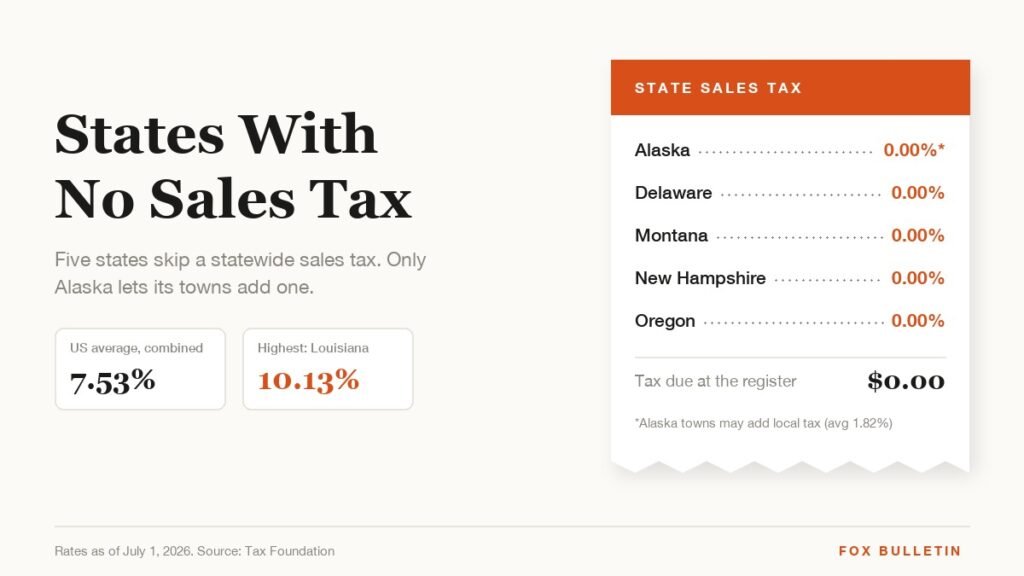
States With No Sales Tax: All 5, Plus Sales Tax by State
Alaska, Delaware, Montana, New Hampshire and Oregon have no statewide sales tax. What each one taxes instead, and the 2026 sales tax rate in every other state.