

Morse code represents every letter, digit and punctuation mark as a pattern of short and long signals, written as dots and dashes. The modern version is defined by the International Telecommunication Union in Recommendation ITU-R M.1677-1, which fixes 26 letters, one accented letter, ten digits and a set of punctuation marks and procedural signals.
Below is the complete chart from that standard, the timing rules that turn the chart into a rhythm you can actually send, and the reason a letter like E takes one signal while Q takes four.
Every Letter in Morse Code
The letters are the part of the code almost everyone means when they ask for a chart. The third column is the spoken code word for the same letter, which operators use to confirm a character by voice when the signal is poor.
| Letter | Morse | Spoken as |
|---|---|---|
| A | .- | Alfa |
| B | -… | Bravo |
| C | -.-. | Charlie |
| D | -.. | Delta |
| E | . | Echo |
| F | ..-. | Foxtrot |
| G | –. | Golf |
| H | …. | Hotel |
| I | .. | India |
| J | .— | Juliett |
| K | -.- | Kilo |
| L | .-.. | Lima |
| M | — | Mike |
| N | -. | November |
| O | — | Oscar |
| P | .–. | Papa |
| Q | –.- | Quebec |
| R | .-. | Romeo |
| S | … | Sierra |
| T | – | Tango |
| U | ..- | Uniform |
| V | …- | Victor |
| W | .– | Whiskey |
| X | -..- | X-ray |
| Y | -.– | Yankee |
| Z | –.. | Zulu |
The official standard also carries one accented letter, written as an e with an acute accent and sent as two dots, a dash and two dots. It is a survival from the code’s European origins and the only character in the letter list that does not appear in written English.
Plain letters are only half of what gets spelled out. When a message has to be read back for accuracy, operators switch to the spoken code words in that third column, the same set covered in our guide to the military alphabet.
The Ten Digits
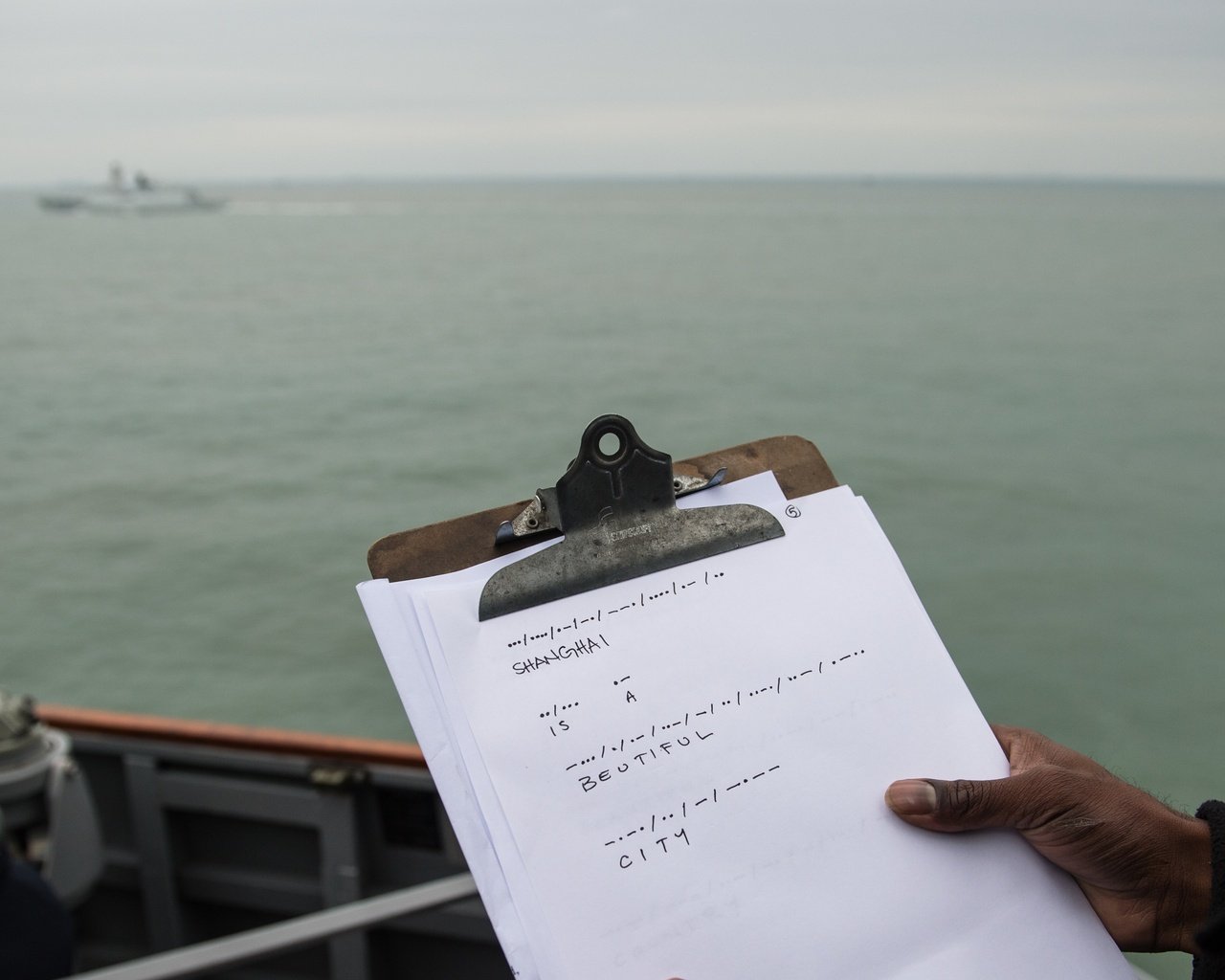
Numbers are the most orderly part of the code. Each digit is exactly five signals long, and the pattern walks in a straight line from one end to the other.
| Digit | Morse |
|---|---|
| 1 | .—- |
| 2 | ..— |
| 3 | …– |
| 4 | ….- |
| 5 | ….. |
| 6 | -…. |
| 7 | –… |
| 8 | —.. |
| 9 | —-. |
| 0 | —– |
Read the table downwards and the system is obvious. The digit 1 is one dot followed by four dashes, 2 is two dots and three dashes, and so on until 5 is five dots. From 6 the dashes come back, leading with one dash and four dots, until 0 is five dashes. Learn the rule and you never have to memorise an individual number.
Punctuation and Symbols
Punctuation marks are longer than letters, usually five or six signals, because they are rarer and the code gives its short patterns to the characters that appear most.
| Mark | Symbol | Morse |
|---|---|---|
| Full stop (period) | . | .-.-.- |
| Comma | , | –..– |
| Colon or division sign | : | —… |
| Question mark | ? | ..–.. |
| Apostrophe | ‘ | .—-. |
| Hyphen or subtraction sign | – | -….- |
| Fraction bar or division sign | / | -..-. |
| Left-hand bracket | ( | -.–. |
| Right-hand bracket | ) | -.–.- |
| Inverted commas | ” “ | .-..-. |
| Double hyphen | = | -…- |
| Multiplication sign | x | -..- |
| Cross or addition sign | + | .-.-. |
| Commercial at | @ | .–.-. |
Two entries overlap with letters on purpose. The multiplication sign is the same pattern as X, and the standard states plainly that the signal for the letter X is what gets sent for it. There is no percent sign at all: to send a percentage, an operator transmits the figure zero, the fraction bar and another zero, so 2 per cent goes out as 2-0/0.
The commercial at sign is the newest character in the whole code. It was added in the 2004 revision of the recommendation, more than a century after the rest of the set was fixed, because email addresses needed a way through.
Procedural Signals
A handful of patterns are not characters at all. They are instructions between two operators, and they do the work that punctuation and formatting do on a page.
| Signal | Meaning | Morse |
|---|---|---|
| Starting signal | Precedes every transmission | -.-.- |
| Invitation to transmit | Your turn to send | -.- |
| Wait | Stand by | .-… |
| Understood | Message received | …-. |
| Error | Disregard, eight dots | …….. |
| End of work | Nothing further | …-.- |
The error signal is worth knowing because it sounds like nothing else: eight dots in a row, with no dash to break them up. Anything sent before it in that word is thrown away, and the operator starts the word again.
Dots, Dashes and the Spaces Between Them
A chart on its own will not let you send anything, because Morse carries meaning in silence as much as in sound. Every length in the code is a multiple of one unit, the length of a single dot.
| Element | Length | What it does |
|---|---|---|
| A dot | 1 unit | The shortest element, and the unit everything else is measured in |
| A dash | 3 units | Exactly three times the length of a dot |
| Gap inside a letter | 1 unit | Separates the dots and dashes of a single character |
| Gap between letters | 3 units | The same length as a dash, which is why clean spacing matters |
| Gap between words | 7 units | The longest silence in normal sending |
The consequence catches most beginners. A gap between two letters is three units, the same length as a dash, so sloppy spacing inside a character turns one letter into two. Send a dot, a gap that runs slightly long, and then a dash, and a receiving operator hears E followed by T rather than the letter A.
Speed is quoted in words per minute, measured against the word PARIS. That word, sent correctly and followed by a word gap, comes to exactly 50 units, so 20 words per minute means 1,000 units a minute and a dot lasting 60 milliseconds. Every speed in Morse is derived from that one measurement.
Why E Is One Dot and Q Is Four Signals
The code is not arbitrary. Its lengths were set roughly in inverse proportion to how often each letter appears in English, so the characters you send most cost the least time.
- E is a single dot and T a single dash. They are the two most common letters in written English, and they are the two cheapest characters in the code.
- A, I, M and N take two signals. All four are high-frequency letters.
- Q, Y, X and Z all take four. They are among the rarest letters in English, and they are among the most expensive to send.
- Alfred Vail is credited with the measurement, having counted the movable type in a New Jersey newspaper’s cases to find out which letters printers kept most of.
The effect is large. A message in ordinary English sends far faster in Morse than the same message would if every letter cost the same, which is the whole reason the weighting exists. The same logic shapes writing systems far beyond English, as our look at the most spoken languages in the world shows.
From One Telegram to an International Standard
Samuel Morse sent the first public telegraph message on 24 May 1844, from the Supreme Court chamber in Washington to a railroad depot in Baltimore, where Alfred Vail received it. The text was a phrase from the Book of Numbers: what hath God wrought.
That original code is not the one in the chart above. American Morse used dashes of different lengths and gaps inside some characters, which worked on a wire but travelled badly. In 1848 Friedrich Clemens Gerke rebuilt it for a telegraph line between Hamburg and Cuxhaven, stripping it back to two element lengths and nothing else. Germany and Austria adopted his version in 1851.
The split was settled at an international telegraph conference in Paris in 1865, which took up most of Gerke’s code as the international standard. American Morse carried on in United States railroad and commercial telegraphy for decades afterwards, which is why old operators sometimes described themselves as fluent in two codes. The ITU recommendation in force today traces directly back to the 1865 decision.
SOS Was Never an Abbreviation

The distress call is three dots, three dashes, three dots, sent as one unbroken run with no letter gaps. It is written SOS only because that run happens to look like those three letters when it is broken up, and it was chosen for being short, symmetrical and impossible to mistake for anything else.
Germany had already put the sequence into its national radio regulations in 1905. The Berlin radiotelegraph convention of 3 November 1906 adopted it internationally, and it took effect on 1 July 1908. The older British distress call CQD stayed in use for several years after that, which is why both appear in accounts of early maritime emergencies.
Nothing in the signal stands for save our ship or save our souls. Those readings were attached long afterwards, and they are memory aids rather than the origin.
Where Morse Code Is Still Used

Commercial maritime Morse ended on 1 February 1999, the deadline for ships to switch to the Global Maritime Distress and Safety System. The United States Coast Guard had already stopped its own Morse watch in 1995. The code did not disappear with it.
- Amateur radio. Continuous wave operation remains one of the most popular modes on the amateur bands, largely because a Morse signal gets through at power levels and noise floors that defeat voice.
- Navigation beacons. Aviation and marine beacons identify themselves by transmitting their identifier in Morse on a loop, which is how a pilot confirms the station actually tuned in.
- Signal lamps at sea. Warships still pass messages between hulls with a shuttered lamp when radio silence matters.
- Military training. Manual Morse remains part of the curriculum for signals and cryptologic specialists.
- Assistive technology. Morse input is built into both major mobile operating systems as an accessibility keyboard, letting someone type with two switches.
The United States dropped its last regulatory requirement on 23 February 2007, when a Federal Communications Commission order removing the Morse examination for all amateur licence classes took effect. Technician applicants had already been exempt since 1991.
Learning the Code Without Memorising a Chart
The chart above is a reference, not a teaching method. Anyone who learns Morse visually ends up translating in their head, which caps them at a few words a minute for good.
- Learn sounds, never shapes. A is not a dot and a dash, it is a short note followed by a long one. Say it as dit-dah and the pattern sticks as rhythm.
- Start with characters already at full speed. Sending individual letters slowly teaches you to count elements, which is the habit that has to be unlearned later.
- Stretch the gaps instead. The Farnsworth method keeps each character at its target speed and lengthens the silence between them, so the rhythm is right from the first day.
- Add characters a few at a time. The Koch method begins with two characters at full speed and introduces another only once accuracy holds, which keeps every session near the edge of ability.
- Practise whole words early. Common words become single sounds the way they do in reading, and that is where real speed comes from.
Progress is uneven by design. Most learners sit at one speed for weeks and then jump, because the brain switches from assembling characters to recognising them whole. Alphabets that work by shape rather than sound, like the ASL alphabet, are learned the opposite way round.
Frequently Asked Questions
What is SOS in morse code?
Three dots, three dashes, three dots, sent as one continuous sequence with no gaps between the groups. It was adopted internationally at the Berlin convention of 1906 and came into force in 1908.
Is morse code still used today?
Yes, though not commercially at sea since 1999. It remains in daily use on the amateur radio bands, in aviation and marine navigation beacons that broadcast their identifiers, in naval signal lamp work, in military signals training and as an accessibility input method on phones.
How long does it take to learn morse code?
Most people can recognise all 26 letters within a few weeks of short daily practice. Reaching a conversational speed of around 20 words per minute usually takes several months, because the skill that takes time is hearing whole characters rather than counting dots.
Why is E a single dot?
Because E is the most common letter in written English, and the code gives its shortest patterns to its most frequent characters. The rarest letters, including Q, X, Y and Z, all take four signals.
Related Articles

Get the Fox Bulletin briefing
The stories that matter, in your inbox. No spam, unsubscribe anytime.
Newsletter signup will be available soon.
Related stories
Military Alphabet: All 26 Letters, Spelled and Pronounced
Alfa, Bravo, Charlie: the military alphabet is a set of 26 code words that keep letters apart over a noisy radio. Here is every letter, how to say it, and the history behind the list.
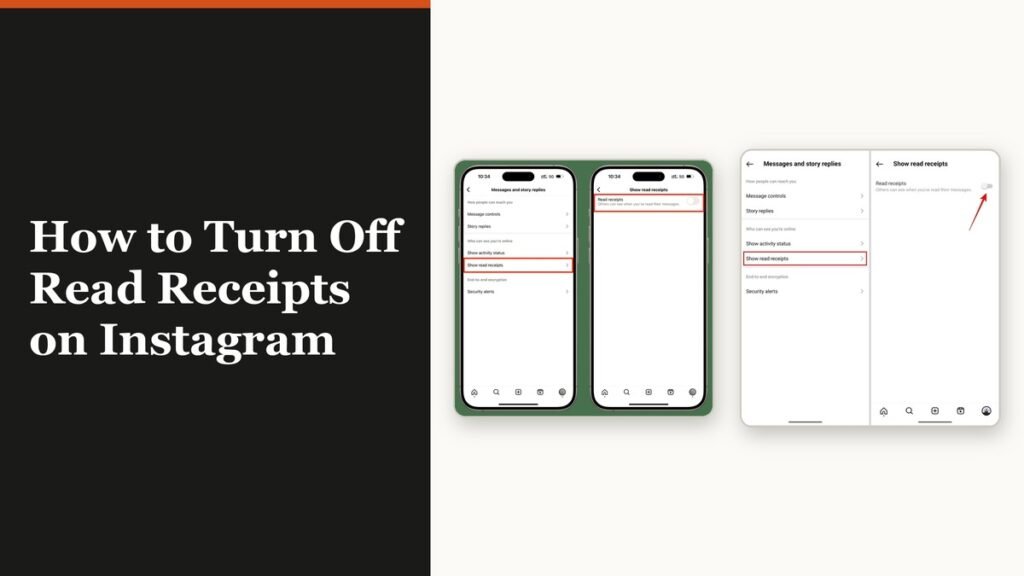
How to Turn Off Read Receipts on Instagram DMs
The global switch does not sweep up chats you have already set by hand. That one rule explains almost every case of Seen still appearing.
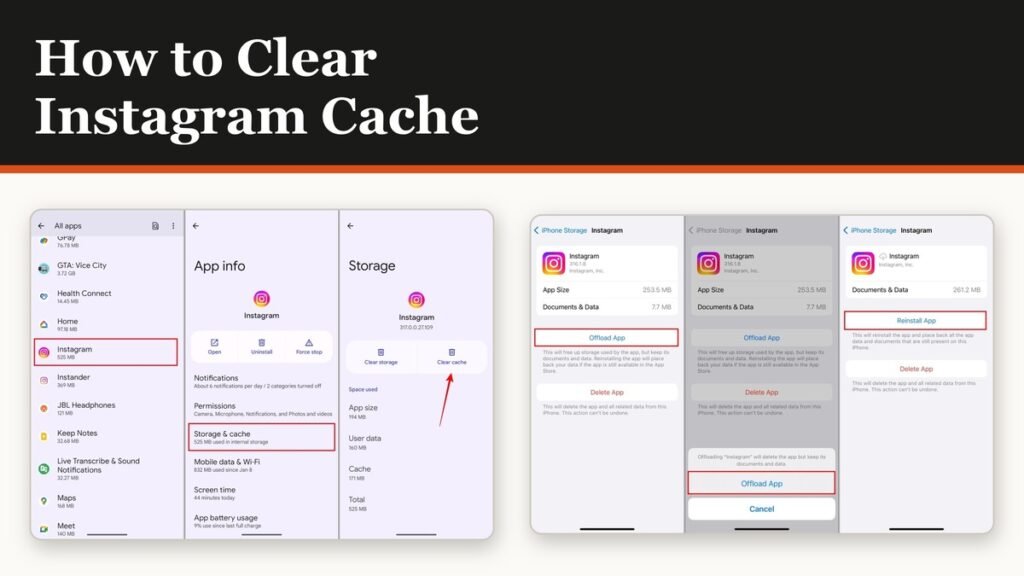
How to Clear Instagram Cache on Android and iPhone
Android has a real cache button and iPhone does not. The important part is telling it apart from the button next to it, which signs you out of everything.