

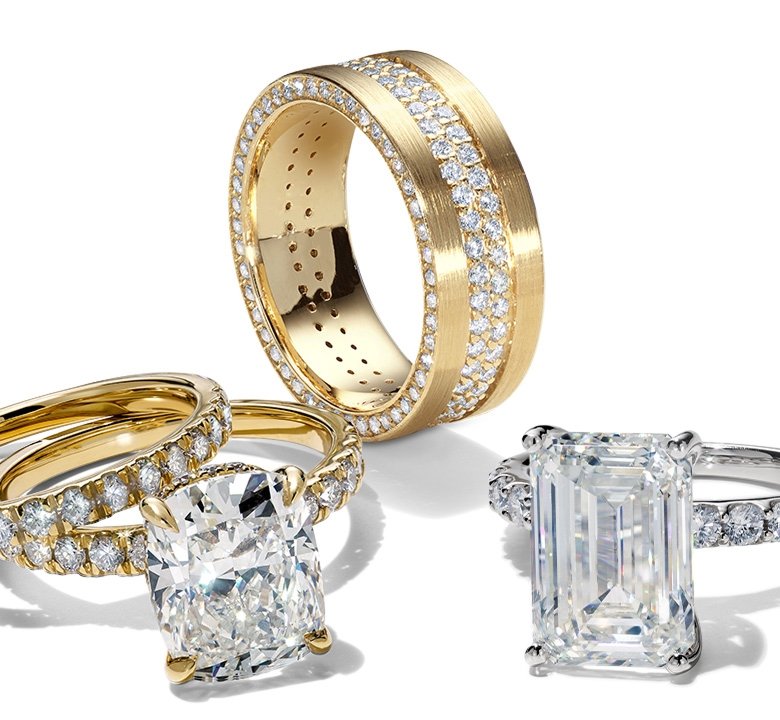
A ring size chart converts a US size number into the measurement that actually matters: the inside of the ring. A US size 7 has an inside diameter of 17.3 millimetres and an inside circumference of 54.4 millimetres, and every other size follows the same fixed step.
The full chart runs below in millimetres and inches, followed by the two ways to measure at home, the reasons a finger reads differently from one hour to the next, and what a jeweller can and cannot do once a ring is already made.
Ring Size Chart in Millimetres and Inches
Inside diameter is the measurement across the opening. Inside circumference is the distance all the way round it, which is the figure the international standard actually defines.
| US size | Inside diameter (mm) | Inside circumference (mm) | Circumference (in) |
|---|---|---|---|
| 3 | 14.1 | 44.2 | 1.74 |
| 3.5 | 14.5 | 45.5 | 1.79 |
| 4 | 14.9 | 46.8 | 1.84 |
| 4.5 | 15.3 | 48.0 | 1.89 |
| 5 | 15.7 | 49.3 | 1.94 |
| 5.5 | 16.1 | 50.6 | 1.99 |
| 6 | 16.5 | 51.9 | 2.04 |
| 6.5 | 16.9 | 53.1 | 2.09 |
| 7 | 17.3 | 54.4 | 2.14 |
| 7.5 | 17.7 | 55.7 | 2.19 |
| 8 | 18.1 | 57.0 | 2.24 |
| 8.5 | 18.5 | 58.3 | 2.29 |
| 9 | 18.9 | 59.5 | 2.34 |
| 9.5 | 19.4 | 60.8 | 2.39 |
| 10 | 19.8 | 62.1 | 2.44 |
| 10.5 | 20.2 | 63.4 | 2.49 |
| 11 | 20.6 | 64.6 | 2.54 |
| 11.5 | 21.0 | 65.9 | 2.59 |
| 12 | 21.4 | 67.2 | 2.65 |
| 12.5 | 21.8 | 68.5 | 2.70 |
| 13 | 22.2 | 69.7 | 2.75 |
The steps never change. Each full size adds 0.81 millimetres of diameter and 2.55 millimetres of circumference, or about one thirty-second of an inch across. A half size is half of that, which is why half sizes are the smallest step most retailers stock.
What the Number Is Measuring
Under the international standard for ring sizes, a ring size is defined as the circumference of the largest cylinder that fits inside the ring, expressed in millimetres. That is why European sizes look like 54 or 57: they are the circumference itself, with no conversion involved.
The American scale is a numbering system laid over the same physical measurement. Size 3 sits at 44.2 millimetres of circumference and size 13 at 69.7, with the fixed step above between them. Knowing that, any chart can be checked against any other, because the underlying millimetres do not move.
It also means a millimetre measurement is more useful than a size number when ordering. A size quoted as 7 is 7 everywhere in the United States, but a ring bought abroad may be marked with its circumference instead, and 54 is the figure that tells you it fits.
Measuring a Ring You Already Own
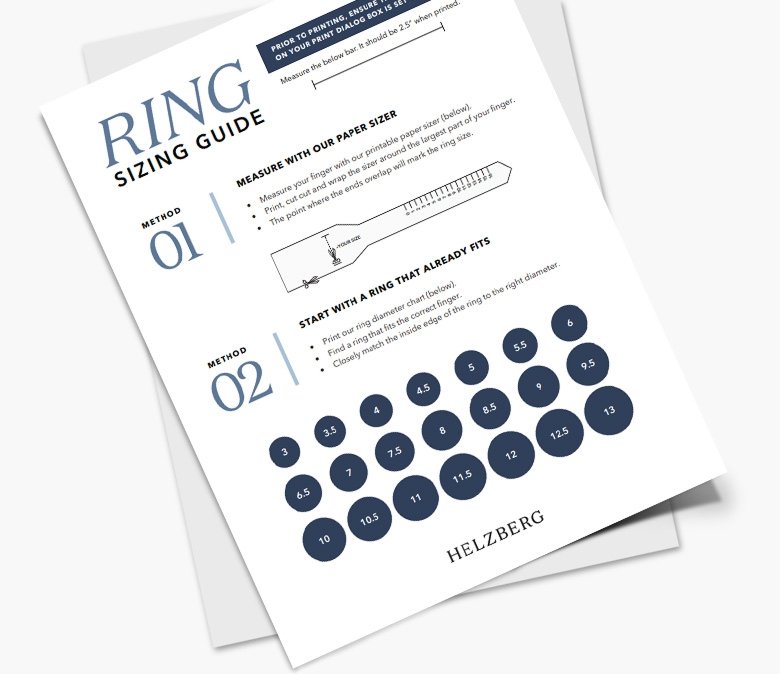
The most reliable home method uses a ring that already fits the correct finger. You are measuring the ring, not the finger, which removes every variable in the next section.
- Pick a ring worn on the right finger. A ring from a different finger will be the wrong size, often by two sizes or more.
- Measure the inside diameter at the widest point. Lay the ring on a ruler with millimetre markings and read across the inside edges, not the outside.
- Start from the ruler’s zero mark, not from the end of the plastic, which on many rulers sits a millimetre or two before the scale begins.
- Read to the nearest tenth. The difference between a size 7 and a size 7.5 is four tenths of a millimetre, so rounding to the nearest whole number loses the answer.
- Find the nearest diameter in the chart above. If the reading falls between two rows, the larger one is the safer order.
A printed sizer does the same job more directly. Most jewellers publish one as a sheet of circles to lay a ring over, and it has to be printed at exactly 100 per cent with no page scaling, which is the step that goes wrong most often.
Measuring a Finger With Paper or String
Measuring the finger itself is less accurate, but it is the only option when there is no existing ring. It measures circumference directly, so read the circumference column rather than the diameter one.
- Cut a strip of paper about 6 millimetres wide. String stretches and thread cuts in, and both read small.
- Wrap it round the base of the finger snugly, without pulling it tight enough to compress the skin.
- Mark where the strip overlaps with a pen, then unwrap it and measure to the mark with a millimetre ruler.
- Check it clears the knuckle. Slide the loop over the knuckle before marking. If the knuckle is the wider point, the ring has to pass it, and that measurement wins.
- Repeat three times and take the largest reading, because the first attempt is almost always the tightest.
Where the knuckle is much wider than the base, a ring sized to pass it will spin once it is on. Sizing beads or a fitted bar on the inside of the band solve that without changing the size, and a jeweller fits them in minutes.
Why the Same Finger Measures Differently
Finger size is not a fixed number. It moves through the day and through the year, and a chart reading taken at the wrong moment is the commonest reason a ring arrives wrong.
| When you measure | Reading | Why |
|---|---|---|
| First thing in the morning | Smallest | Fingers are at their coolest and least swollen |
| Late afternoon | Largest | The usual peak, which is why jewellers prefer this window |
| After exercise | Larger | Blood flow and heat both increase finger volume |
| In cold weather | Smaller | A ring that is normally snug can slide off outdoors |
| After a salty meal | Larger | Fluid retention shows up in the hands within hours |
| During pregnancy | Larger | Often by a full size or more, and usually temporary |
The practical rule is to measure at the end of a normal day at normal room temperature, and never straight after a run, a hot bath or a long flight. Measure the same finger on three separate days if the readings disagree.
The dominant hand also tends to measure slightly larger than the other, so a ring sized for the left ring finger will not necessarily fit the right one.
Band Width Changes the Fit
Two rings of the same stated size can fit completely differently if one band is much wider than the other. A wide band covers more of the finger and grips along its whole width, so it feels tighter at the same number.
| Band width | Usual adjustment | What happens at this width |
|---|---|---|
| 2 mm or less | No change | Too narrow to affect the fit |
| 3 mm to 5 mm | Consider a quarter size up | Noticeable on a snug finger |
| 6 mm to 7 mm | Half a size up | The width most people first feel tight |
| 8 mm and wider | A full size up | Covers enough of the finger to change the fit outright |
A comfort fit band complicates it again. Its inside surface is domed rather than flat, so less metal touches the finger and it slides on more easily than a flat band of the same width. Makers who sell comfort fit bands publish their own sizing advice for them, and that advice governs.
Stacking has the same effect. Three narrow bands worn together behave like one wide one, which matters when a wedding band sits permanently against an engagement ring. Sizing for the stack rather than each ring alone is the usual fix, in the same way a worn band’s fit decides comfort on a wrist, as our picks for the best Apple Watch bands set out.
Being Sized at a Jeweller

A professional sizing uses a set of metal rings on a loop, called a ring sizer set, each machined to an exact size. The jeweller tries sizes until one passes the knuckle with resistance and then sits without spinning.
- It is free almost everywhere, and takes a couple of minutes.
- The metal gauge is wider than most plastic sizers, which makes it a better match for how a real band will feel.
- Ask for the width you intend to buy. A good jeweller keeps gauges in more than one width for exactly this reason.
- Have both hands measured. They differ more often than people expect.
- Note the number and the millimetres. The millimetre figure survives any chart you later order from.
If the ring is a surprise, a worn ring borrowed for an hour and measured against the chart above beats every indirect method. Guessing from a glove size or a hand photograph does not work. Where the size genuinely cannot be obtained, a gift tied to the wearer’s birth month, such as one of the 12 birth flowers, carries the same thought without needing a measurement.
When a Ring Can and Cannot Be Resized
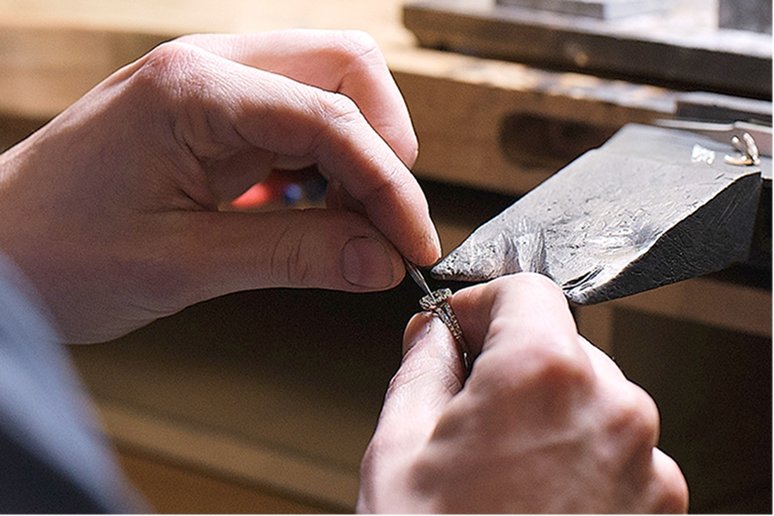
Most plain and solitaire rings in gold, silver or platinum can be resized, by cutting the band and either removing metal or soldering in a piece. What a jeweller can do depends on the metal and the setting rather than on the size difference alone.
- Gold, silver and platinum resize readily. These are the metals the whole trade is built around.
- Full eternity bands generally cannot be resized. Stones run the entire way round, so there is no plain section to cut.
- Tungsten cannot be resized. It is too hard to work, and the usual remedy is an exchange for a different size.
- Titanium is limited. Some jewellers will stretch it slightly; many decline to touch it at all.
- Channel and pave settings add risk. Changing the circumference shifts the metal that holds the stones, so the setting has to be checked afterwards.
Sizing up stretches the band and thins it; sizing down leaves a soldered join. Both are routine, but neither is free, and getting the size right first is cheaper than either. For a ring bought as a gift, pairing it with a month stone is a safer way to personalise it than guessing a measurement, and the stones are listed in our guide to birthstones by month.
Frequently Asked Questions
What is the most common ring size?
There is no single answer, because it depends on the finger and the person. What a chart can tell you is the spacing: each full size changes the inside diameter by 0.81 millimetres, so neighbours on the chart are closer together than most people assume.
How do I measure my ring size at home?
Measure a ring that already fits across its inside diameter with a millimetre ruler and read the chart, or wrap a 6 millimetre paper strip round the finger, mark the overlap and read the circumference column. The existing ring is the more accurate of the two.
Should I size up or down between two sizes?
Up, in almost every case. A ring that is slightly loose can be fitted with sizing beads or resized down; a ring that will not pass the knuckle cannot be worn at all while you wait.
Does a ring size chart work for European sizes?
Yes, through the circumference column. European sizes are the inside circumference in millimetres, so a ring marked 54 has a 54 millimetre circumference, which the chart above places at a US 7.
Related Articles

Get the Fox Bulletin briefing
The stories that matter, in your inbox. No spam, unsubscribe anytime.
Newsletter signup will be available soon.
Related stories

Cloud Types: All Ten and How to Tell Them Apart
All ten basic cloud types, the three altitude bands they divide into, what each looks like overhead, and which ones actually produce precipitation.

Military Ranks: Every Pay Grade in All Six Branches
Every US military rank by pay grade, across the Army, Marine Corps, Navy, Air Force, Space Force and Coast Guard, and the title traps that catch people out.

Birth Flowers by Month: All 12 and What They Mean
Every month has a birth flower, and most have two. Here are all twelve photographed, the meanings attached to them, and why the pairings were never standardised.