

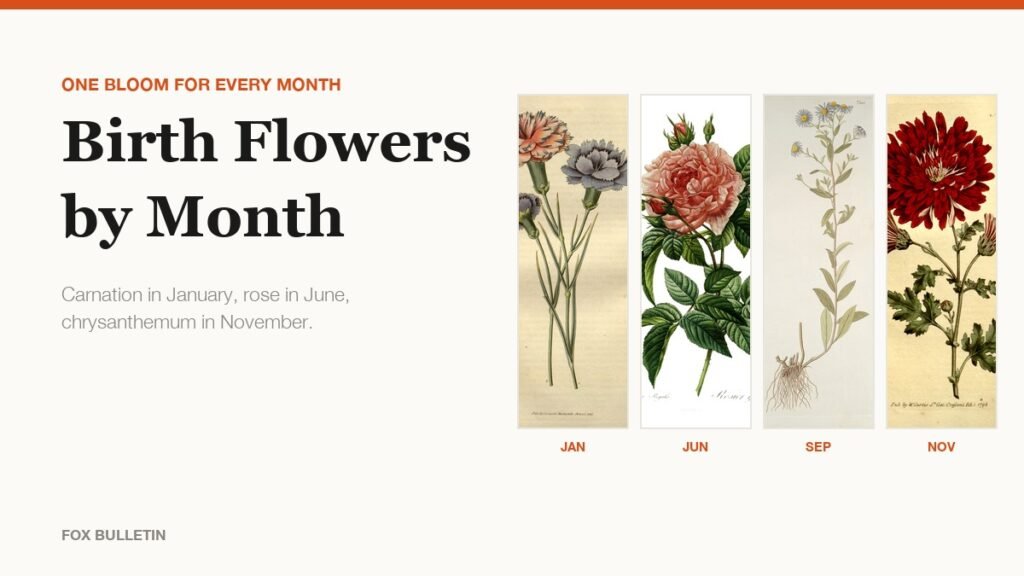
Birth flowers by month run carnation in January, violet in February, daffodil in March and on through to narcissus in December. Most months carry a second flower as well, because the tradition grew up in several places at once and never settled into one agreed list. The table below gives both flowers for every month along with the meaning each has picked up.
The pattern behind the list is seasonal. The flower assigned to a month is usually one that blooms then in a temperate northern climate, which is why snowdrops belong to January and asters to September rather than the other way round.
Birth Flowers by Month: The Full List
| Month | Primary flower | Second flower | Meaning |
|---|---|---|---|
| January | Carnation | Snowdrop | Love, fascination, hope |
| February | Violet | Primrose | Modesty, loyalty, youthfulness |
| March | Daffodil | Jonquil | New beginnings, rebirth, prosperity |
| April | Daisy | Sweet pea | Innocence, purity, gratitude |
| May | Lily of the valley | Hawthorn | Happiness, sweetness, hope |
| June | Rose | Honeysuckle | Love, passion, affection |
| July | Larkspur | Water lily | Positivity, lightness, purity |
| August | Gladiolus | Poppy | Strength, remembrance, peace |
| September | Aster | Morning glory | Patience, love, affection |
| October | Marigold | Cosmos | Creativity, passion, joy |
| November | Chrysanthemum | None | Friendship, loyalty, honesty |
| December | Narcissus | Holly | Rebirth, hope, protection |
November is the only month with a single flower. Every other month has a pair, and which of the two is called primary varies between florists.
January to April

The first four months are built from flowers that appear while most of the garden is still bare.
- January, carnation. A Dianthus, and one of the few flowers available fresh in midwinter. Its meanings cluster around love and fascination. The snowdrop takes the second place, for the obvious reason that it pushes through frozen ground.
- February, violet. A low, early-flowering Viola. Modesty and loyalty are the usual readings, which fits a flower that grows close to the ground and is easy to miss. Primrose is the second.
- March, daffodil. A Narcissus, and the clearest signal in the calendar that winter has ended. New beginnings and rebirth follow directly from that. The jonquil listed alongside it is not a separate flower but a type of daffodil.
- April, daisy. A Bellis, the flower children are given first and chain together. Innocence and purity are the attached meanings, with sweet pea second for gratitude.
May to August

The summer months get the showiest flowers, and the two with the longest cultural histories.
- May, lily of the valley. A Convallaria, strongly scented and short-lived. Happiness and sweetness. Its partner, hawthorn, was known as Mary’s Flower of May.
- June, rose. The one nobody argues about. Love, passion and affection, with honeysuckle second. Rose meanings split further by colour, which is a tradition of its own.
- July, larkspur. A tall spike of a flower, carrying positivity and lightness. Water lily is the second, for purity.
- August, gladiolus. Named from the Latin for sword, after the shape of its leaves, and read as strength. The poppy alongside it carries remembrance.
September to December

The last four are autumn and winter flowers, and three of the four have strong associations with remembrance and the turning of the year.
- September, aster. A late daisy-like flower whose name comes from the Greek for star. Patience and love.
- October, marigold. A Tagetes, and the flower that carries creativity and joy. It also has a specific role at the end of October, when marigolds mark the altars and paths of the Day of the Dead.
- November, chrysanthemum. The only month with one flower and no second. Friendship, loyalty and honesty, though in much of Europe the chrysanthemum is a funeral flower rather than a gift.
- December, narcissus. Specifically the paperwhite, which can be forced indoors in midwinter. Rebirth and hope, with holly second for protection.
Why Most Months Have Two Flowers
There is no governing body for birth flowers. The pairing exists because different cultures, climates and florists settled on different blooms, and both options survived rather than one winning.
- Availability decided a lot of it. A flower that could not be grown or imported in a given region was quietly replaced by one that could.
- The Victorian language of flowers formalised the meanings rather than inventing the associations, many of which are far older.
- December is the clearest case. Narcissus and holly are both long established for that month, and poinsettia is used in its place in parts of North America.
- Birthstones went the same way before being standardised, and the two traditions are often published side by side, as in our guide to birthstones by month.
None of this makes any version wrong. It means the list is a tradition rather than a specification, and the sensible approach is to pick whichever flower of the two suits the person or the occasion.
Where the Tradition Came From
Assigning a flower to a month is an old practice. Flowers carried meaning in classical and medieval Europe long before anyone wrote the pairings down, usually through religious association or through the season in which a plant appeared.
What the nineteenth century added was a system. The Victorian language of flowers, floriography, set out what individual blooms were understood to say, and the month-by-month list hardened in that period alongside the fashion for sending coded bouquets. Most of the meanings in the table above reached print then, even where the association behind them is much older.
That history is also the reason the list is loose. A convention that spread through etiquette books and florists rather than through any single authority will produce variation, and it did.
Birth Flower and Birthstone, Month by Month
The two traditions are usually published together because they answer the same question. The stones were standardised in 1912 and revised since; the flowers never were, which is the main difference between them.
| Month | Birth flower | Birthstone |
|---|---|---|
| January | Carnation | Garnet |
| February | Violet | Amethyst |
| March | Daffodil | Aquamarine, bloodstone |
| April | Daisy | Diamond |
| May | Lily of the valley | Emerald |
| June | Rose | Pearl, alexandrite, moonstone |
| July | Larkspur | Ruby |
| August | Gladiolus | Peridot, spinel, sardonyx |
| September | Aster | Sapphire |
| October | Marigold | Opal, tourmaline |
| November | Chrysanthemum | Topaz, citrine |
| December | Narcissus | Tanzanite, turquoise, zircon |
Three months line up unusually well. The red garnet sits beside the carnation, the green emerald beside lily of the valley foliage, and the deep blue sapphire beside the aster, which is one reason jewellery that combines the two sells best for those months.
Using a Birth Flower as a Gift
- Check what is actually in season. A birth flower is tied to its month, so buying it in that month is usually both cheaper and fresher.
- Use the second flower when the first is wrong. November chrysanthemums read as funeral flowers in much of Europe, so a different bloom is safer for a birthday abroad.
- Pair it with the month’s stone if you want the gift to work as a set.
- Consider the plant rather than the cut stem. Lily of the valley, violets and daffodils all come back every year if they are planted.
- Tattoos and jewellery lean on the drawing, not the bloom, which is why botanical plates of these twelve are reproduced so often.
Birth flowers also pair naturally with the other month-based systems people use to describe themselves, including the dates and traits set out in our guide to the zodiac signs.
Growing the Twelve Yourself
A birth flower makes a better planted gift than a cut one, and the twelve fall into three groups that are handled completely differently in a garden.
- Bulbs, planted in autumn. Daffodil, narcissus and snowdrop go in while the soil is still workable and come up without further attention. Gladiolus is also a bulb but is planted in spring and lifted in cold regions.
- Perennials, planted once. Violet, lily of the valley, aster and chrysanthemum return each year and spread. Lily of the valley spreads enthusiastically enough that it is usually given its own corner.
- Annuals, sown each season. Larkspur, marigold, cosmos and sweet pea are grown from seed and finish in one year. They are the cheapest of the twelve to raise and the easiest to start from a packet.
- Shrubs and climbers. Rose, honeysuckle, hawthorn and holly are long-term plants rather than seasonal ones, and are worth siting carefully.
Planting time tracks the bloom month in reverse. Anything that flowers in late winter or early spring goes into the ground the previous autumn, and anything that flowers in high summer is started in spring.
Frequently Asked Questions
What is my birth flower?
It depends only on your birth month, not the date. January is carnation, February violet, March daffodil, April daisy, May lily of the valley, June rose, July larkspur, August gladiolus, September aster, October marigold, November chrysanthemum and December narcissus.
Why do some months have two birth flowers?
Because the tradition developed separately in different places, and the flowers available differed by region and climate. Both options stayed in circulation instead of one replacing the other. November is the exception with a single flower.
Are birth flowers the same everywhere?
No. The pairings are a tradition rather than a standard, and they differ between countries. December is the clearest example, appearing as narcissus, holly or poinsettia.
What is the difference between a daffodil and a jonquil?
A jonquil is a type of daffodil, not a separate flower. Both belong to the genus Narcissus, which is also why the December birth flower shares the name.
Related Articles

Get the Fox Bulletin briefing
The stories that matter, in your inbox. No spam, unsubscribe anytime.
Newsletter signup will be available soon.
Related stories
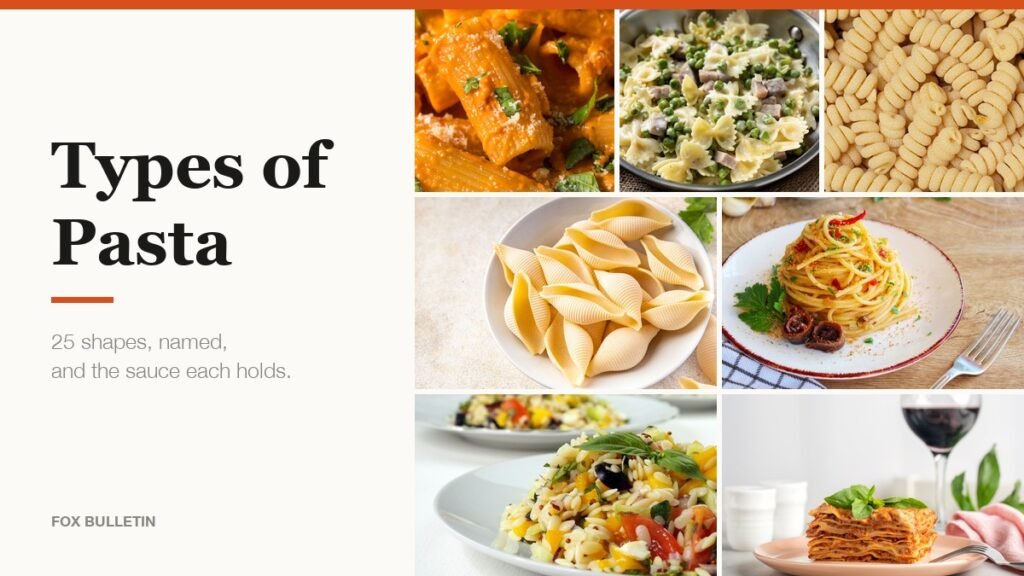
Types of Pasta: 25 Shapes and What Each One Suits
Long strands, tubes, twists and soup shapes: 25 types of pasta shown and named, with the cooking time for each and the kind of sauce its surface is built to hold.
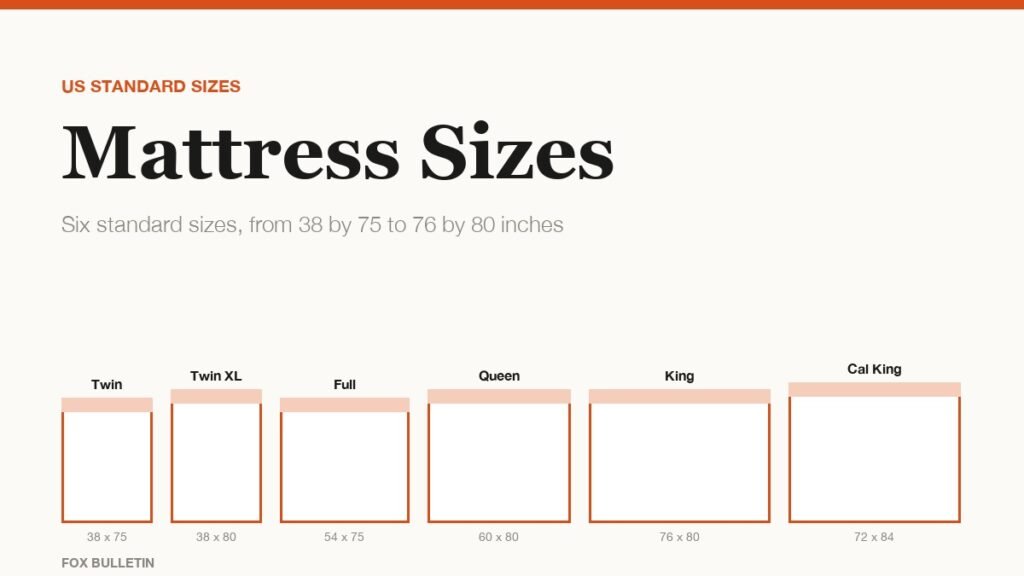
Mattress Sizes: All Six Standard Beds, Measured
Twin through California King, measured in inches and square feet, with the room each size needs and the gap between the size on the label and the mattress that turns up.

ASL Alphabet: All 26 Hand Signs and How to Form Them
The ASL alphabet is 26 handshapes made with one hand. This guide shows every letter, explains the six that are all variations of a fist, and covers the two that need movement.