
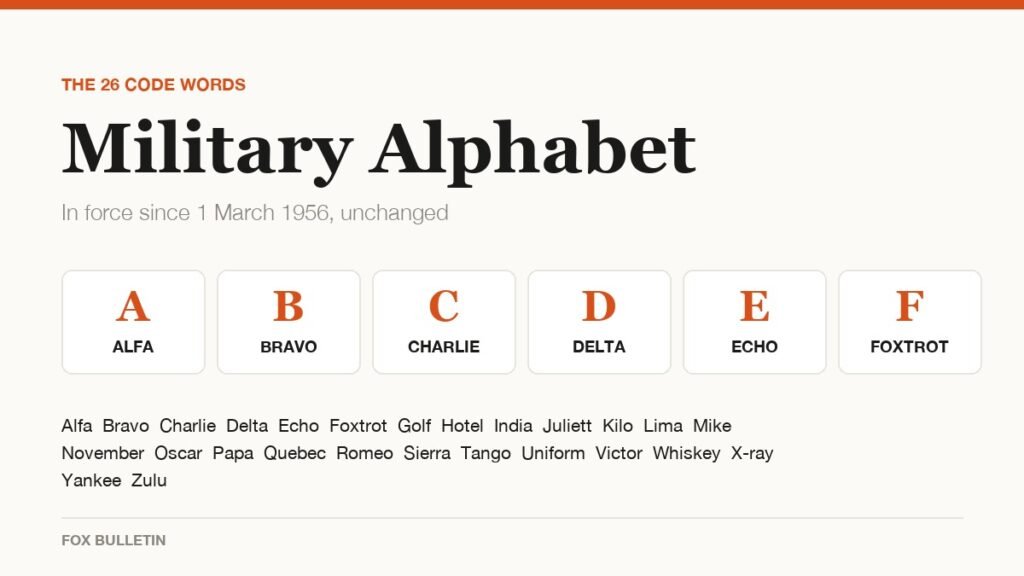
The military alphabet is a set of 26 code words, one for each letter, that stops a listener confusing B for P or M for N when a radio signal is weak. Alfa stands for A, Bravo for B, Charlie for C, and the list runs through to Zulu for Z. It has been in force since 1 March 1956 and is used unchanged by NATO forces, airline pilots, air traffic controllers, ships and amateur radio operators.
Below is every letter with its official code word, the pronunciation written the way the Federal Aviation Administration prints it for pilots, and the Morse code equivalent. The digits follow, then the reason two of the words are spelled oddly, and the thirty years of argument that produced the list.
Military Alphabet Chart: Every Letter From Alfa to Zulu
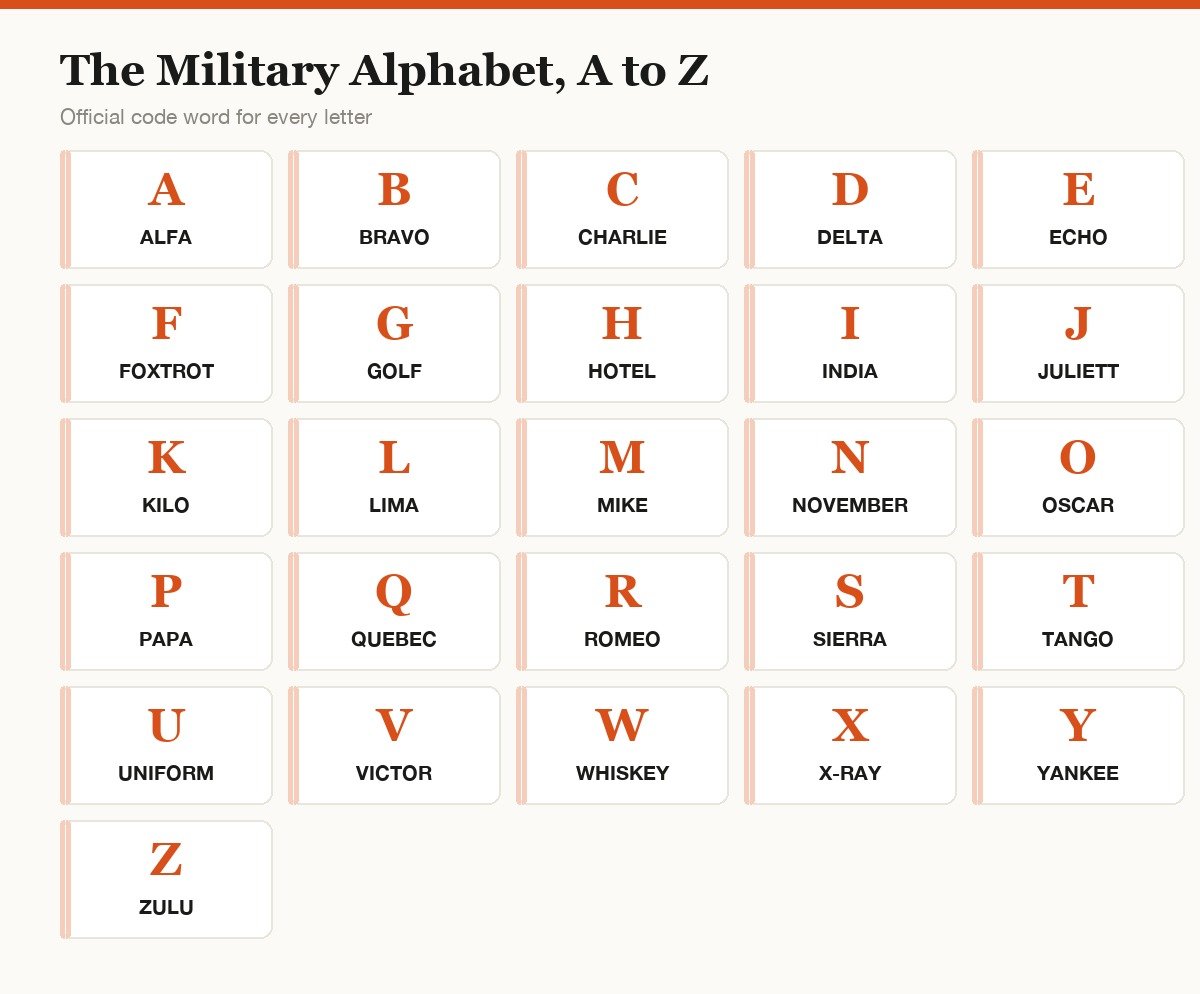
Read the pronunciation column out loud. The stressed syllable is the one that survives a bad connection, which is why the spellings look nothing like ordinary English.
| Letter | Code word | Pronunciation | Morse code |
|---|---|---|---|
| A | Alfa | AL-FAH | .- |
| B | Bravo | BRAH-VOH | -… |
| C | Charlie | CHAR-LEE or SHAR-LEE | -.-. |
| D | Delta | DELL-TAH | -.. |
| E | Echo | ECK-OH | . |
| F | Foxtrot | FOKS-TROT | ..-. |
| G | Golf | GOLF | –. |
| H | Hotel | HOH-TEL | …. |
| I | India | IN-DEE-AH | .. |
| J | Juliett | JEW-LEE-ETT | .— |
| K | Kilo | KEY-LOH | -.- |
| L | Lima | LEE-MAH | .-.. |
| M | Mike | MIKE | — |
| N | November | NO-VEM-BER | -. |
| O | Oscar | OSS-CAH | — |
| P | Papa | PAH-PAH | .–. |
| Q | Quebec | KEH-BECK | –.- |
| R | Romeo | ROW-ME-OH | .-. |
| S | Sierra | SEE-AIR-RAH | … |
| T | Tango | TANG-GO | – |
| U | Uniform | YOU-NEE-FORM or OO-NEE-FORM | ..- |
| V | Victor | VIK-TAH | …- |
| W | Whiskey | WISS-KEY | .– |
| X | X-ray | ECKS-RAY | -..- |
| Y | Yankee | YANG-KEY | -.– |
| Z | Zulu | ZOO-LOO | –.. |
Four letters carry an alternative pronunciation because the alphabet was built to work across English, French and Spanish speakers. Charlie is said CHAR-LEE or SHAR-LEE, and Uniform is YOU-NEE-FORM or OO-NEE-FORM. Both versions are correct and both are published side by side.
Numbers 0 to 9 and Why Pilots Say Niner
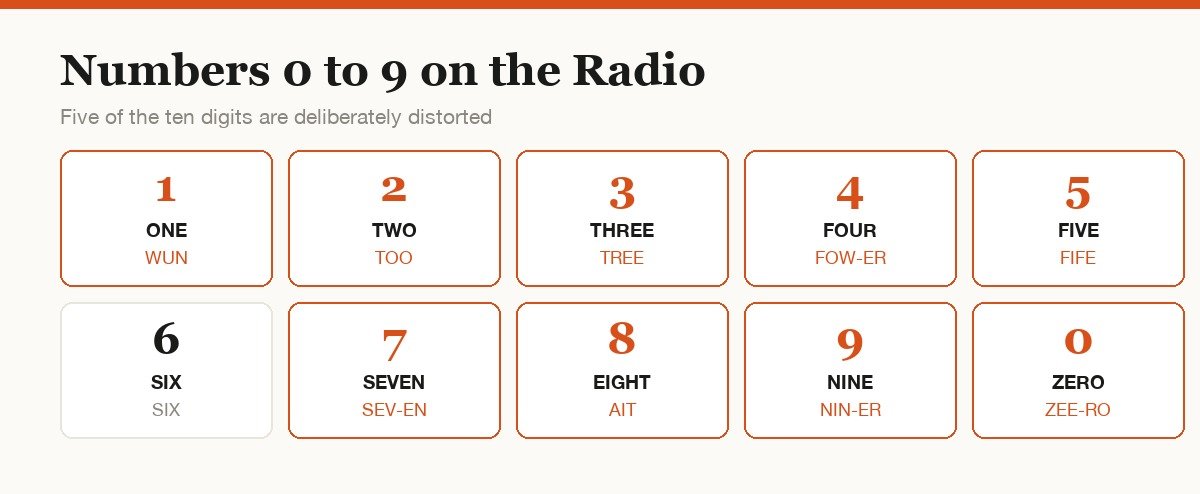
Digits get the same treatment as letters. Five of the ten are deliberately distorted so they cannot be mistaken for each other or for a similar-sounding word in another language.
| Digit | Spoken as | Pronunciation | Morse code |
|---|---|---|---|
| 1 | One | WUN | .—- |
| 2 | Two | TOO | ..— |
| 3 | Three | TREE | …– |
| 4 | Four | FOW-ER | ….- |
| 5 | Five | FIFE | ….. |
| 6 | Six | SIX | -…. |
| 7 | Seven | SEV-EN | –… |
| 8 | Eight | AIT | —.. |
| 9 | Nine | NIN-ER | —-. |
| 0 | Zero | ZEE-RO | —– |
Nine becomes NIN-ER so it is not heard as the German nein. Three becomes TREE and five becomes FIFE because the “th” and “v” sounds are the first casualties of a poor signal. Four stretches to FOW-ER and zero hardens to ZEE-RO so neither collapses into a single clipped syllable.
Numbers are always read digit by digit. A runway heading of 270 is “two seven zero”, never “two hundred and seventy”, and a flight number of 1549 is “one five four niner”.
Why It Is Alfa and Juliett, Not Alpha and Juliet
Two code words are spelled against normal English on purpose. Alfa is written with an f because a reader whose first language is French or Spanish would not know that the English “ph” makes an f sound and might say it as a p.
Juliett carries two t endings for the opposite reason. A French speaker reading Juliet would treat the final t as silent, so the second t was added to force it to be sounded. Both spellings are official, and both are routinely corrected to Alpha and Juliet by people who have only ever heard the words.
The same logic runs through the whole list. Every code word was chosen to survive being pronounced by someone who does not speak the language of the person they are talking to, which is a harder test than simply being distinct in English.
How to Use the Military Alphabet on a Call
Spelling a word aloud follows a fixed pattern in aviation and in any call centre that has borrowed the alphabet. Say the letter, then the code word, then move on without pausing.
- Give the plain word first. “My surname is Hayes.”
- Signal that you are about to spell it. “I spell.”
- Say each letter and its code word. “Hotel, Alfa, Yankee, Echo, Sierra.”
- Read digits one at a time. Postcode 3085 is “three zero eight five”, not “thirty eighty-five”.
- Repeat the whole thing once. A single pass is where errors hide.
Mixed strings of letters and numbers are the reason the alphabet exists at all. A booking reference such as B7X2M is unreadable over a bad line and unambiguous as “Bravo, seven, X-ray, two, Mike”. The same principle shows up in other naming systems built for clarity under pressure, from the plug shapes in our guide to USB types to the way moves resolve in the Pokemon type chart.
Where the Military Alphabet Came From
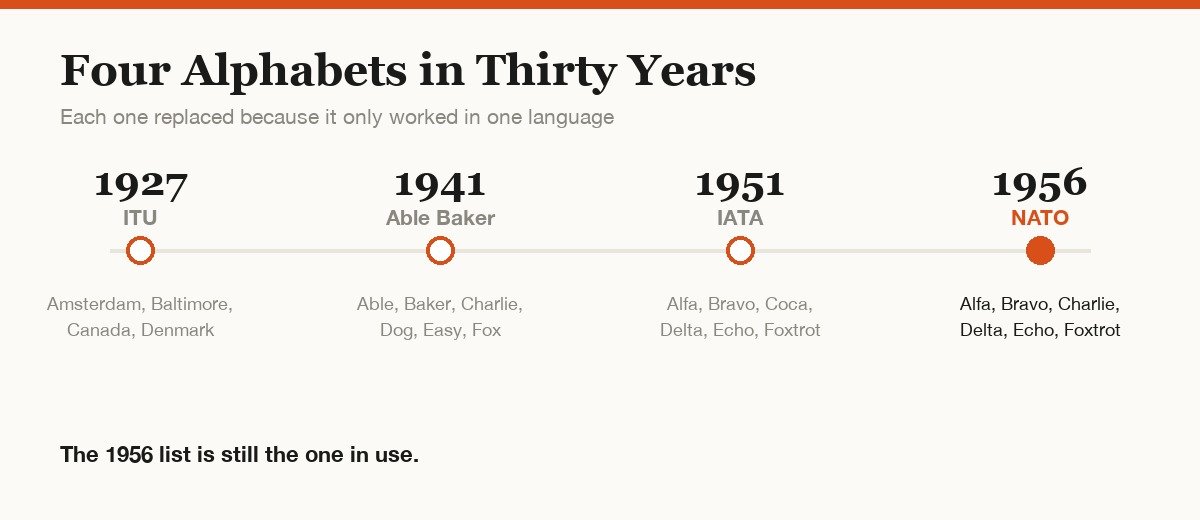
The 1956 list is the fourth attempt. Each earlier version failed the same test: it worked for the people who wrote it and fell apart in anyone else’s mouth.
1927 and 1932: the ITU city alphabets
The International Telecommunication Union produced the first internationally recognised phonetic alphabet in 1927, built almost entirely from place names: Amsterdam, Baltimore, Canada, Denmark, Eddystone, Francisco, Gibraltar, Hanover, Italy, Jerusalem, Kimberley, Liverpool, Madagascar, Neufchatel, Ontario, Portugal, Quebec, Rivoli, Santiago, Tokio, Uruguay, Victoria, Washington, Xantippe, Yokohama, Zululand. A 1932 revision swapped in Casablanca, Florida, New York, Oslo, Paris and Zurich among others, but the approach was the same.
1941: Able Baker
The United States adopted a Joint Army/Navy alphabet across every branch in 1941, known as Able Baker after its first two words: Able, Baker, Charlie, Dog, Easy, Fox, George, How, Item, Jig, King, Love, Mike, Nan, Oboe, Peter, Queen, Roger, Sugar, Tare, Uncle, Victor, William, X-ray, Yoke, Zebra. The Royal Air Force took it up in 1943, which made it the standard across the English-speaking allies for the rest of the Second World War.
1951: the IATA alphabet
The complaint against Able Baker was that it was shaped by English. The International Air Transport Association proposed a replacement built from sounds common to English, French and Spanish, and it took effect for civil aviation on 1 November 1951: Alfa, Bravo, Coca, Delta, Echo, Foxtrot, Gold, Hotel, India, Juliett, Kilo, Lima, Metro, Nectar, Oscar, Papa, Quebec, Romeo, Sierra, Tango, Union, Victor, Whiskey, eXtra, Yankee, Zulu.
1956: one alphabet for everyone
Militaries kept using Able Baker while civil aviation used the IATA list, which is exactly the split the whole exercise was meant to avoid. NATO ran a review of the IATA alphabet in the mid-1950s, led by the United Kingdom and the United States, and proposed changing five of its words: Coca, Metro, Nectar, Union and eXtra.
On 8 April 1955 the North Atlantic Military Committee Standing Group ruled that the new alphabet would take effect for NATO on 1 January 1956 whether or not the International Civil Aviation Organization approved it. ICAO did approve it, settling a long argument over the letter N in favour of November rather than Nectar, and on 21 February 1956 NATO told its allies the alphabet was to be effective from 1 March 1956. The ITU adopted it a few years later, which is what made it universal.
Who Uses the Alphabet Today
It is no longer only a military list, which is why “NATO phonetic alphabet” and “international radiotelephony spelling alphabet” describe the same 26 words.
- Aviation. The FAA prints the table in its Aeronautical Information Manual for pilots and controllers, alongside the Morse code column. Callsigns, runways and squawk codes all use it.
- Shipping and coastguards. Vessel names and positions are spelled with it on marine VHF.
- Amateur radio. Operators exchange callsigns with it worldwide, which is the use the ITU adoption was aimed at.
- Emergency services and call centres. Reference numbers, surnames and addresses get spelled back to the caller.
- Everyday speech. Bravo Zulu, Charlie Mike and Oscar Mike all started as radio shorthand and left the radio.
A booking agent spelling your surname back at you is running the same procedure a controller uses to clear an aircraft, which is a fair measure of how well it works. It is one of the few communication standards adopted almost everywhere, in the way that a handful of the most spoken languages in the world cross every border.
A Quick Way to Learn All 26
Nobody memorises the list alphabetically in one sitting. Break it into the four groups the words already fall into and the job takes about twenty minutes.
- Places: India, Lima, Quebec, Sierra. Four of the 26 are geography.
- Names: Charlie, Juliett, Mike, Oscar, Papa, Romeo, Victor.
- Things you can picture: Golf, Hotel, Tango, Uniform, Whiskey, X-ray, Kilo.
- The odd handful: Alfa, Bravo, Delta, Echo, Foxtrot, November, Yankee, Zulu.
Then spell things you already know. Your own name, your car registration and the last confirmation code in your inbox will cover most of the alphabet inside a week, and the four letters that keep catching people out are usually J, Q, X and Y.
Frequently Asked Questions
Is the military alphabet the same as the NATO phonetic alphabet?
Yes. The same 26 code words are called the military alphabet, the NATO phonetic alphabet, the ICAO alphabet and the international radiotelephony spelling alphabet. The name changes with who is using it; the words do not.
Is it Alpha or Alfa?
The official spelling is Alfa. The f is there so that speakers who do not use English spelling conventions do not read “ph” as a p. Alpha is extremely common in print and is understood everywhere, but it is not the published form.
Why do pilots say niner for nine?
To keep it apart from the German nein, and to give the word a second syllable so it cannot be clipped into silence by a weak signal. Three, four, five and zero are distorted for the same reason.
What was the military alphabet before 1956?
Able Baker, adopted by the US armed forces in 1941 and by the Royal Air Force in 1943. It ran Able, Baker, Charlie, Dog, Easy, Fox and so on to Zebra. Only Charlie, Mike, Victor and X-ray survived into the modern list.
Related Articles

Get the Fox Bulletin briefing
The stories that matter, in your inbox. No spam, unsubscribe anytime.
Newsletter signup will be available soon.
Related stories
How to Turn Off Read Receipts on Instagram DMs
The global switch does not sweep up chats you have already set by hand. That one rule explains almost every case of Seen still appearing.
How to Clear Instagram Cache on Android and iPhone
Android has a real cache button and iPhone does not. The important part is telling it apart from the button next to it, which signs you out of everything.
How to See Who Unfollowed You on Instagram
Instagram keeps no record of who left. There is still an accurate way to find out, and it does not involve handing your password to anyone.