
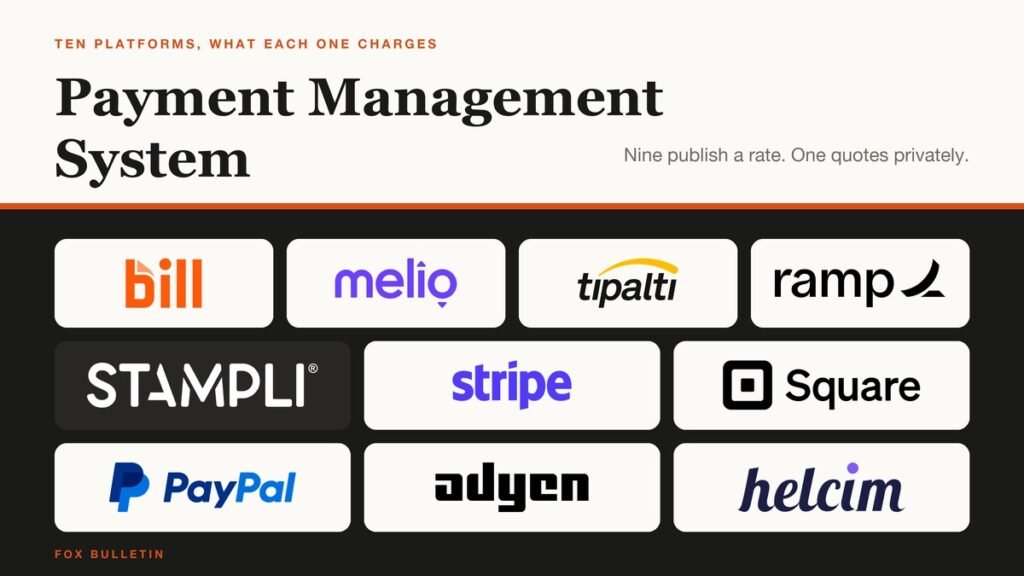
A payment management system is the software that moves business money in one of two directions, and the direction decides almost everything about what you pay for it. Tools that send money out to suppliers and contractors charge by the user, by the month. Tools that bring money in from customers charge by the transaction, and the monthly fee is often zero.
Nine of the ten platforms below publish a rate you can check before you talk to anyone. Only Stampli keeps every number behind a form. That split, rather than the feature list, is the fastest way to work out which of these is built for a business your size.
What a Payment Management System Covers
The phrase gets stretched across three products that do not compete with each other. Accounts payable software captures a supplier invoice, routes it for approval and releases the payment. Payment acceptance software puts a card or bank debit through the networks and settles the money into your account. Spend platforms sit across both and add corporate cards.
Buying the wrong one is a common and expensive mistake, because the marketing language is close to identical. If your problem is a pile of unpaid supplier invoices, a card processor will not help. If your problem is a checkout, an approval workflow will not help either. Work out which side of the ledger hurts before you compare prices.
The compliance floor differs too. Anything that stores or transmits card data has to meet the PCI Data Security Standard, which is why several acceptance platforms advertise that they absorb the annual assessment. Payables software never touches a card number, so that cost does not arise.
Payment Management Platforms Compared: Price and Transaction Cost
All ten appear here with the entry price and the per-transaction charge each one publishes. A blank would be misleading, so where a vendor states no figure the cell says so.
| # | Platform | What it handles | Entry price | Per transaction | Free tier |
|---|---|---|---|---|---|
| 1 | BILL | Accounts payable and receivable | $49 per user / month | ACH $0.59, mailed check $1.99, card 2.9% | No |
| 2 | Melio | Supplier and contractor payments | $0 (Go), then $25 / month | 5 free ACH a month on the free tier | Yes |
| 3 | Ramp | Cards, expenses, AP and AR | $0 per user / month | Free wires and same-day ACH through Bill Pay | Yes |
| 4 | Tipalti | Global AP and mass payouts | $99 / month (AP) | Per-invoice and per-payment fees on top | No |
| 5 | Stampli | Procure-to-pay and invoice approvals | Quote only | Not published | No |
| 6 | Stripe | Online payment acceptance | $0 / month | 2.9% + 30c online, 2.7% + 5c in person | Yes |
| 7 | Square | In-person and online selling | $0 / month per location | 2.6% + 15c tapped, 3.3% + 30c online | Yes |
| 8 | Helcim | Interchange-plus card processing | $0 / month | Interchange + 0.50% + 25c | Yes |
| 9 | Adyen | Enterprise acceptance and payouts | $0 / month | $0.13 + Interchange++ 0.60% on US cards | No |
| 10 | PayPal | Checkout with a consumer wallet | $0 / month | 3.49% + $0.49 on PayPal Checkout | Yes |
The Ten Platforms in Detail
1. BILL: The Fee Schedule Nobody Else Publishes
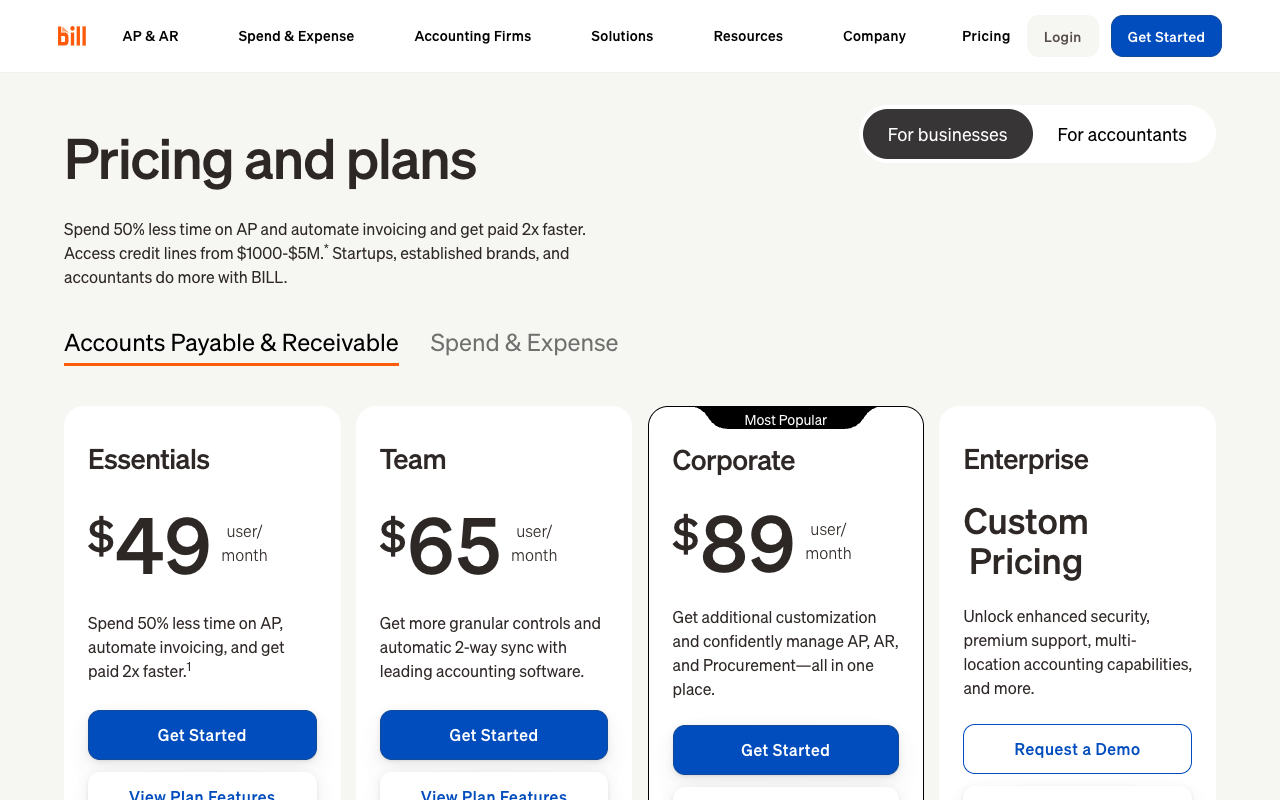
Handles: Accounts payable and receivable. Entry price: $49 per user / month. Per transaction: ACH $0.59, mailed check $1.99, card 2.9%.
BILL runs accounts payable and accounts receivable on the same login, and it is the only platform here that prints a full fee table next to its plan prices. Essentials is $49 per user a month, Team $65 and Corporate $89, with Enterprise on request. A bank-funded ACH payment costs $0.59, a mailed paper check $1.99, a virtual card nothing, and an international wire in the recipient currency nothing beyond the exchange rate.
The speed options are priced separately and are worth reading before you promise a supplier a date. Pay Faster ACH is $11.99 and has to be scheduled by 10:00 am Pacific for same-day settlement, an overnight check is $24.99, and an Instant Payment costs 1.0 percent with a $9.99 minimum and a $100 ceiling. Funding a payment by credit card rather than bank adds 2.9 percent on every method.
2. Melio: A Free Tier That Actually Pays Suppliers
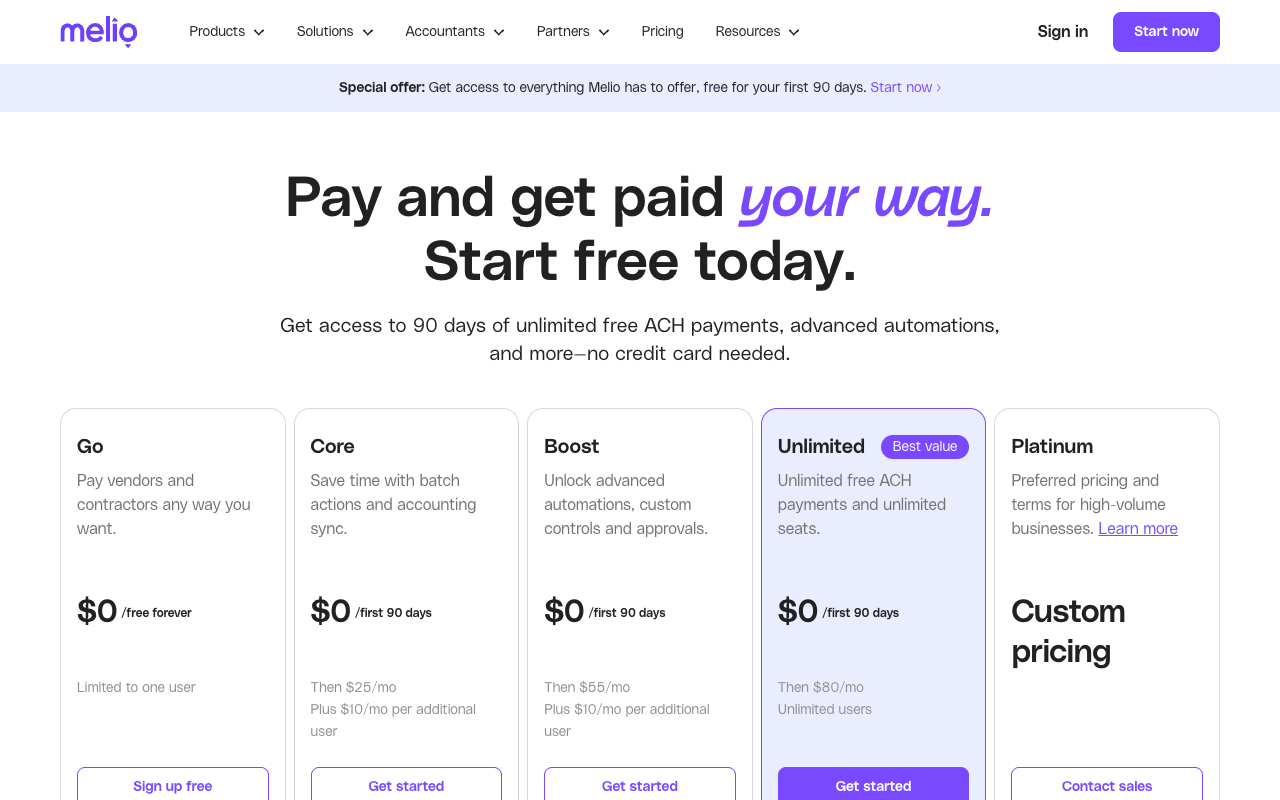
Handles: Supplier and contractor payments. Entry price: $0 (Go), then $25 / month. Per transaction: 5 free ACH a month on the free tier.
Melio is the one platform on this list whose free plan sends real money rather than trialling the interface. The Go tier costs nothing permanently, carries one user and includes five free ACH payments a month, with invoicing and payment links thrown in. Paid tiers are Core at $25 a month, Boost at $55 and Unlimited at $80, and the first three add $10 a month for each extra user.
The free ACH allowance is the real ladder: five a month on Go, 20 on Core, 50 on Boost and no cap on Unlimited, which also drops the per-seat charge entirely. Accounting sync follows the same pattern, with QuickBooks Online and Xero from Core, QuickBooks Desktop from Boost and NetSuite only on Unlimited. A business paying forty suppliers a month lands on Boost.
3. Ramp: Corporate Cards and Bill Pay at No Monthly Cost
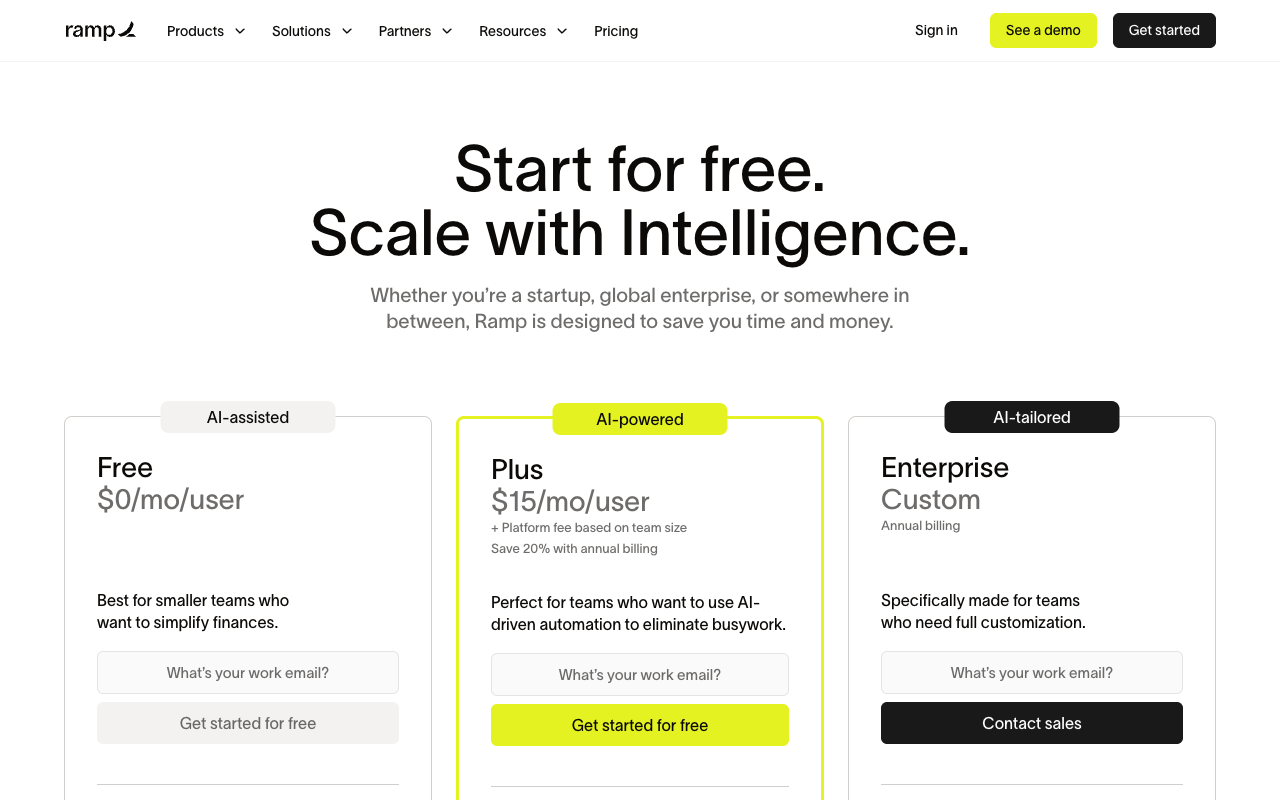
Handles: Cards, expenses, AP and AR. Entry price: $0 per user / month. Per transaction: Free wires and same-day ACH through Bill Pay.
Ramp gives away a surprising amount. The free tier is $0 per user and already includes invoice capture, approval workflows, automated fraud checks, payment by ACH, card, check and wire, plus accounts receivable, unlimited corporate cards and travel booking. Plus is $15 per user a month on top of a platform fee scaled to team size, and adds AI coding and NetSuite or Sage Intacct sync.
Payments are funded from a Ramp account rather than billed as fees, which is how the economics work. The site states 2 percent on cash held in its FDIC-insured checking account, 4.57 percent in a Ramp Investment Account, and free wires and same-day ACH through Bill Pay. Ramp says 85,000 finance teams use it. The trade is that your treasury moves to the same vendor as your software.
4. Tipalti: Built for Paying Thousands of People Abroad
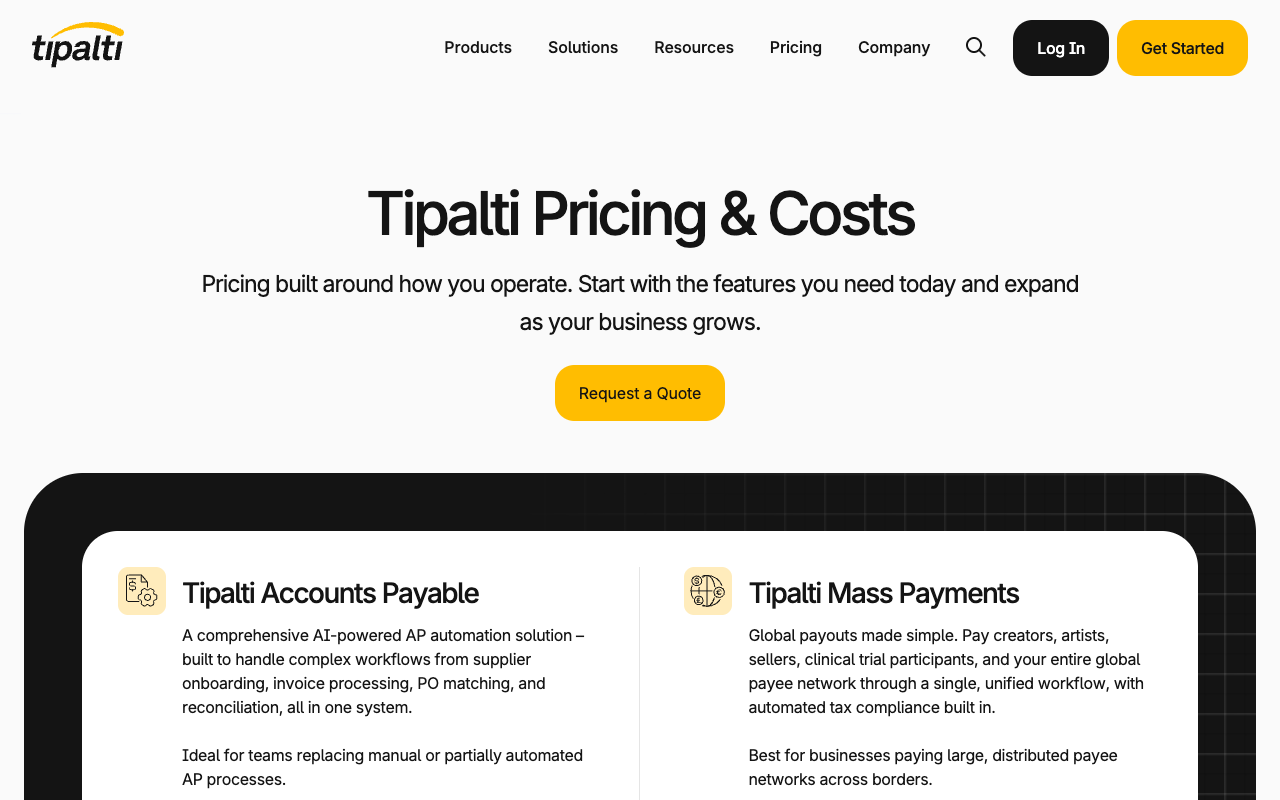
Handles: Global AP and mass payouts. Entry price: $99 / month (AP). Per transaction: Per-invoice and per-payment fees on top.
Tipalti starts at $99 a month for Accounts Payable and $249 a month for Mass Payments, both with unlimited users, and both carry per-invoice and per-payment charges the published page does not quantify. That makes it the only platform here with a visible floor and an invisible ceiling, so the quote matters more than the headline.
What the money buys is reach. Suppliers onboard themselves in 27 languages, invoices are read in 146, and tax compliance runs inside the payout rather than beside it. Two and three-way purchase order matching and automated ledger reconciliation come as standard, which is why the platform turns up at marketplaces paying creators, sellers and clinical trial participants across borders.
5. Stampli: Strong Approvals, No Price in Public
Handles: Procure-to-pay and invoice approvals. Entry price: Quote only. Per transaction: Not published.
Stampli is the exception on transparency. Its pricing page carries no figure at all, only a comparison claiming what other providers charge extra for. What it does publish is a volume threshold: its own qualifying form says Stampli is typically a strong fit for teams at 300 or more invoices a month, which is a clearer sizing signal than most rivals give.
The product is built around the invoice rather than the ledger. Every approval conversation, including messages to the vendor, sits on the invoice itself, with unlimited entities, vendors and invoice capture on every deal. Direct Pay covers domestic check and ACH, global ACH and wire, and virtual cards, and the Stampli credit card is free to customers. Support answers in under 90 seconds.
6. Stripe: The Default for Taking Card Payments Online
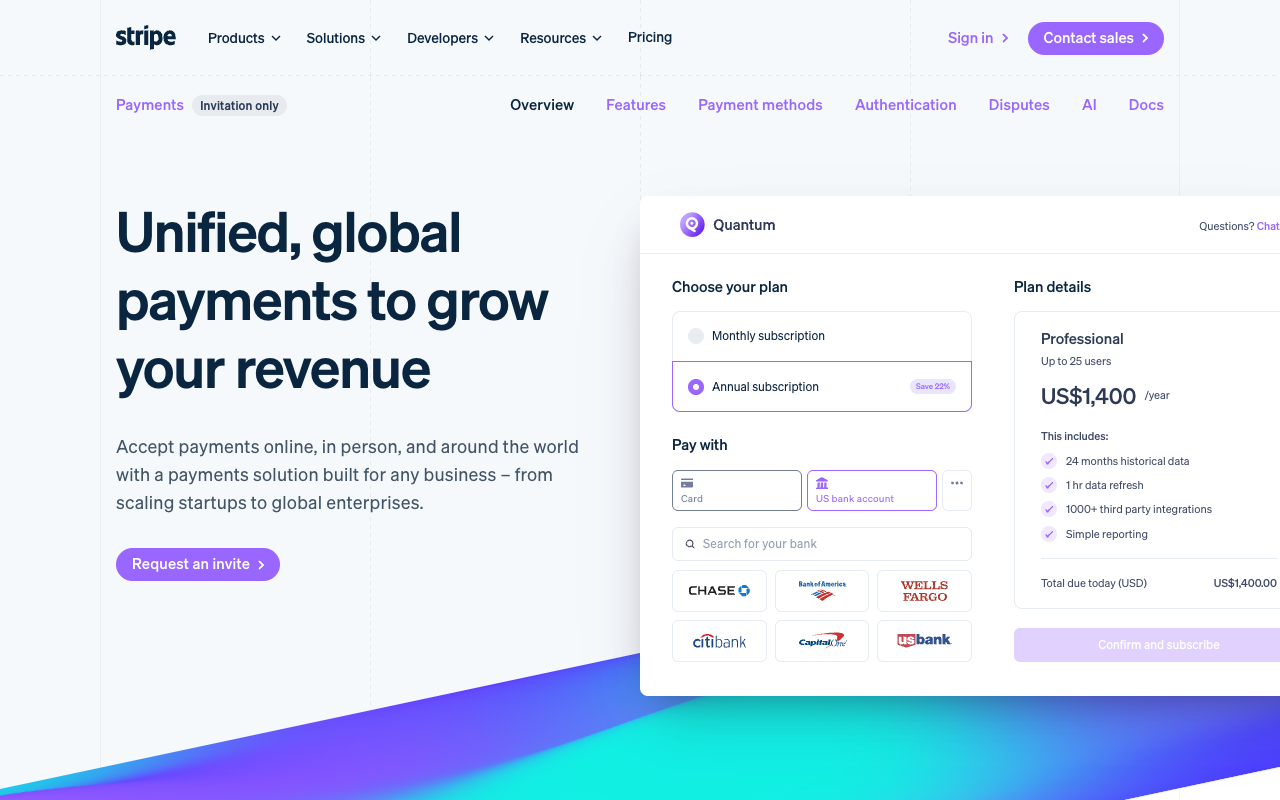
Handles: Online payment acceptance. Entry price: $0 / month. Per transaction: 2.9% + 30c online, 2.7% + 5c in person.
Stripe charges nothing to set up and nothing monthly, then takes 2.9 percent plus 30 cents on a domestic card online. Manually keyed cards add 0.5 percent, international cards add 1.5 percent and a currency conversion adds 1 percent, so a European customer paying in euros costs meaningfully more than the headline suggests. Card-present trade is cheaper at 2.7 percent plus 5 cents.
Bank debits are where the saving sits. ACH Direct Debit runs at 0.8 percent capped at $5.00, so a $4,000 invoice costs $5.00 rather than $116.30 on a card. Access to more than 125 payment methods comes with the same integration, disputes cost $15.00 each, and high-volume accounts move to interchange-plus pricing on a custom contract.
7. Square: Pay a Subscription to Cut the Card Rate
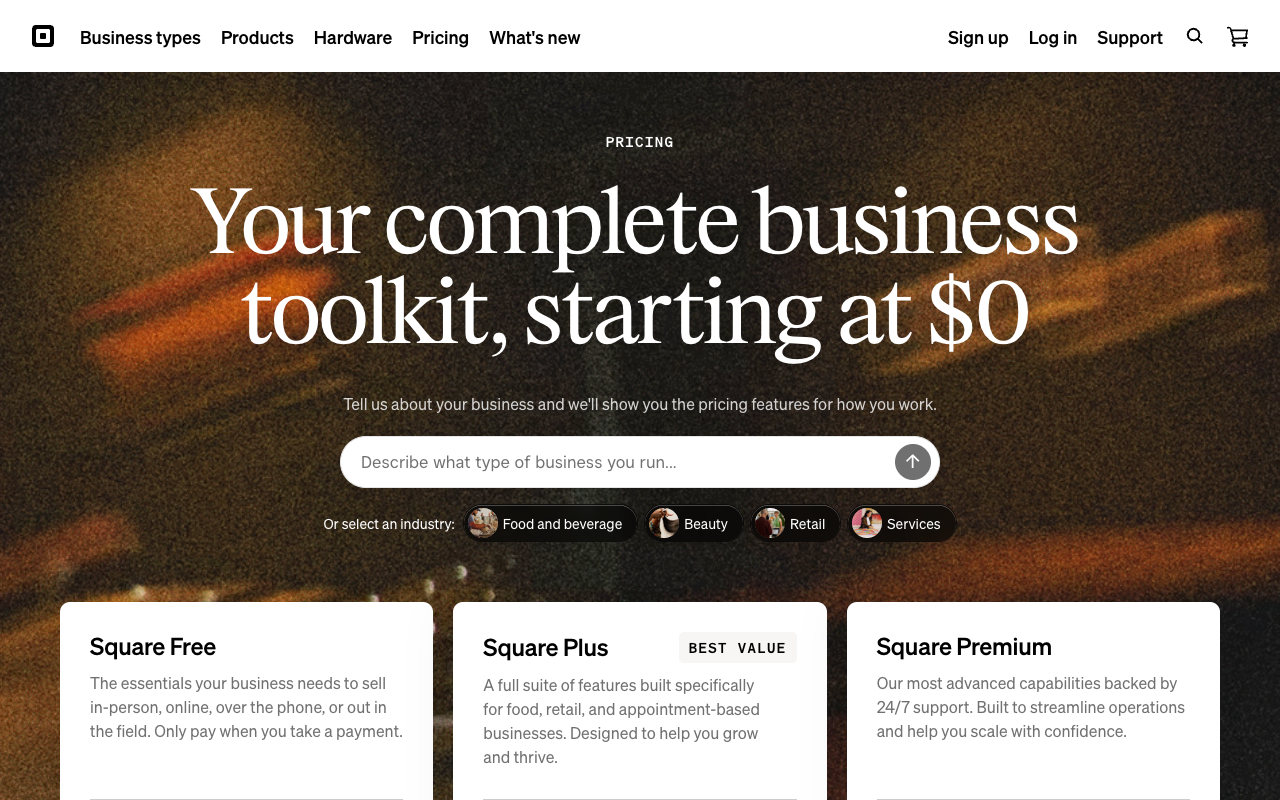
Handles: In-person and online selling. Entry price: $0 / month per location. Per transaction: 2.6% + 15c tapped, 3.3% + 30c online.
Square inverts the usual deal. The free plan costs nothing per location and charges 2.6 percent plus 15 cents on a tapped, dipped or swiped card and 3.3 percent plus 30 cents online. Square Plus at $49 a month per location drops those to 2.5 percent plus 15 cents and 2.9 percent plus 30 cents, and Premium at $149 takes the in-person rate to 2.4 percent plus 15 cents.
The subscription pays for itself at a predictable point: $49 buys a 0.1 percent saving in person, so about $49,000 of monthly card-present volume. Businesses above $250,000 a year can ask about the custom Square Pro tier. Every plan includes next-day transfers, offline payments and fraud prevention, hardware starts at $59, and payroll is a separate $35 a month plus $6 per person paid.
8. Helcim: The Only One That Prints Its Own Margin
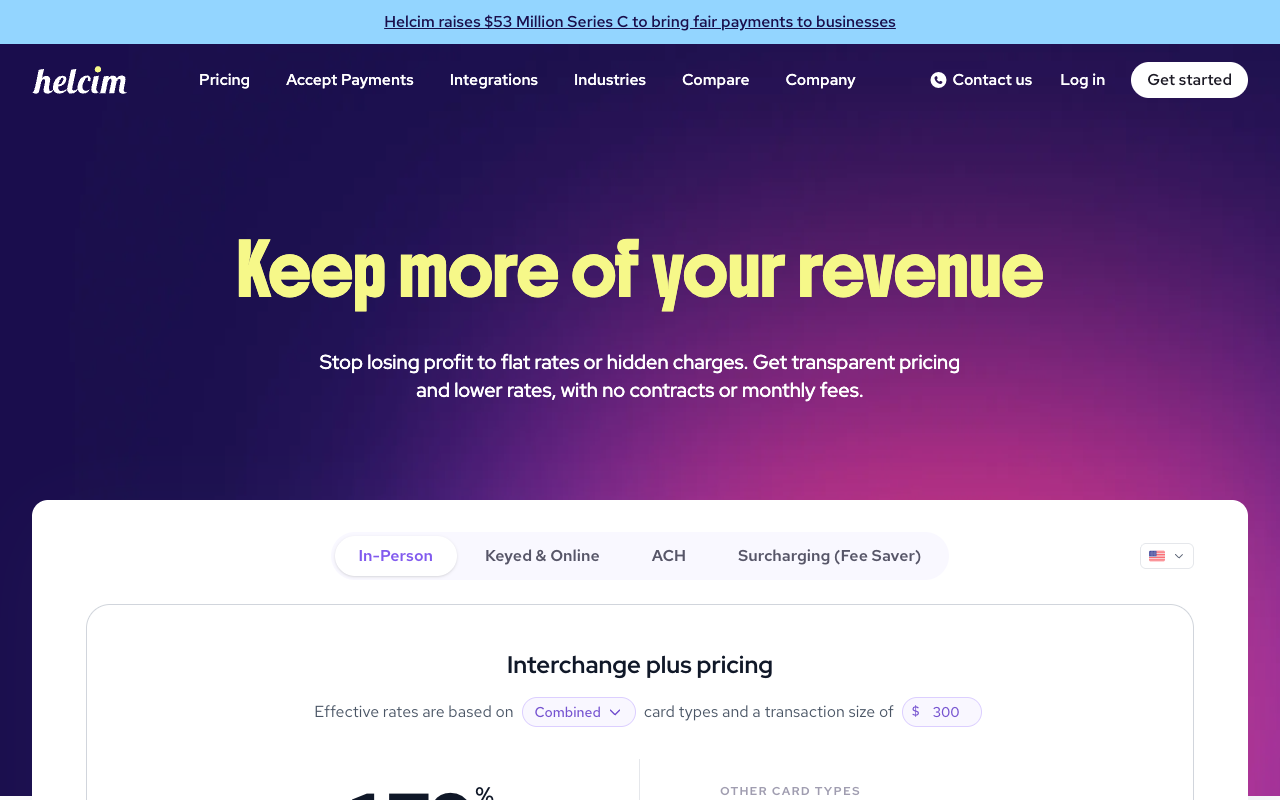
Handles: Interchange-plus card processing. Entry price: $0 / month. Per transaction: Interchange + 0.50% + 25c.
Helcim publishes the number almost every processor hides. Its margin on card processing is interchange plus 0.50 percent plus 25 cents, shown on the page rather than buried in a statement, which is what makes a quote comparable at all. The rates it displays for online payments work out at 2.31 percent plus 25 cents, rising to 2.99 percent plus 25 cents on other card types.
The absent fees matter as much as the present ones. There is no monthly account fee, no signup fee, no annual PCI compliance charge, no cancellation fee and no cost to migrate card and customer data in. A chargeback costs nothing if it is resolved in your favour and $15 if it is lost, recurring billing adds 0.4 percent, and the Smart Terminal is $349 outright or $32 a month over a year.
9. Adyen: Interchange-Plus by Construction, Not by Request
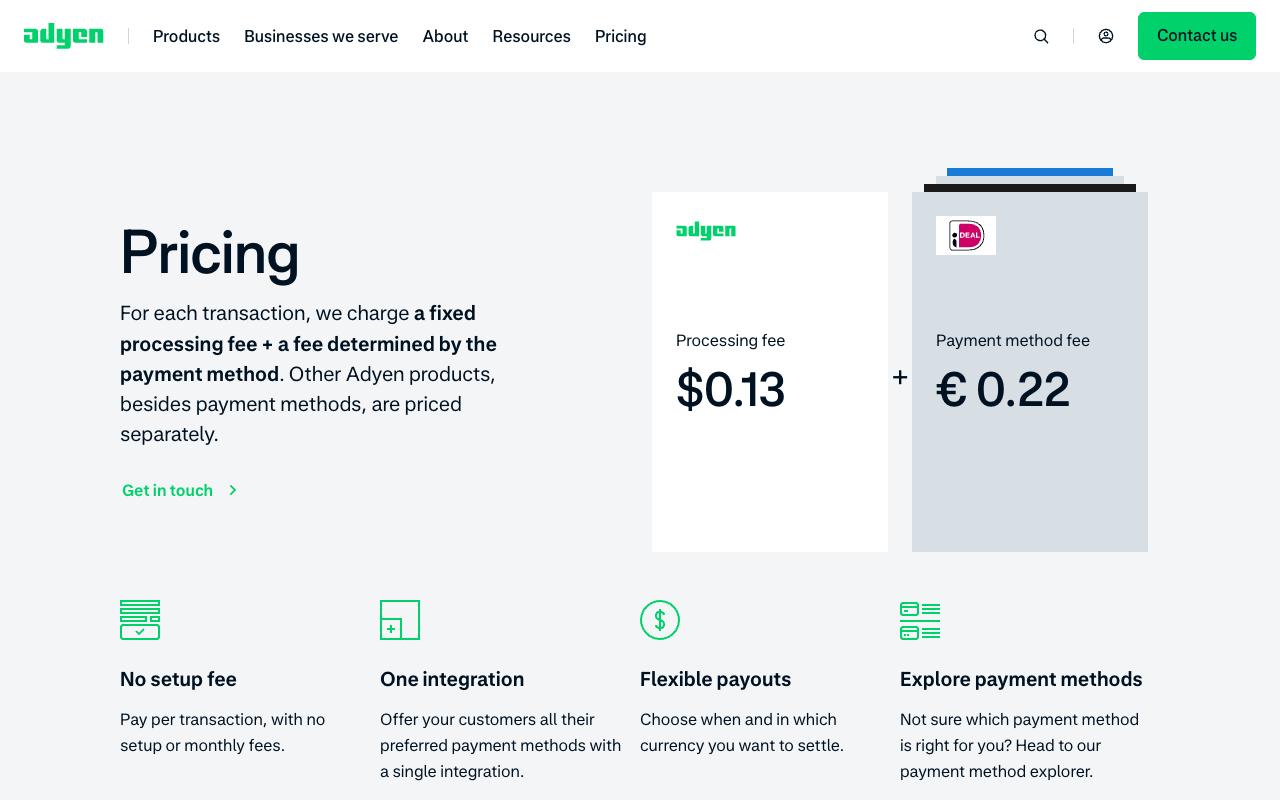
Handles: Enterprise acceptance and payouts. Entry price: $0 / month. Per transaction: $0.13 + Interchange++ 0.60% on US cards.
Adyen does not sell a blended rate at all. Every transaction is a fixed $0.13 processing fee plus a payment-method fee, and for the major US card schemes that fee is interchange plus 0.60 percent. American Express, Diners and Discover are charged at a flat 3.95 percent, Apple Pay and Google Pay take the rate of the underlying card, and US ACH Direct Debit is a flat $0.27.
There is no setup fee and no monthly fee, and settlement currency and timing are selectable rather than fixed. The catch is scale: a business doing a few thousand dollars a month will not clear the integration work, and the pricing table assumes you already know your interchange profile. This is the platform large retailers move to when the blended rate stops making sense.
10. PayPal: Reach That Costs More Per Sale
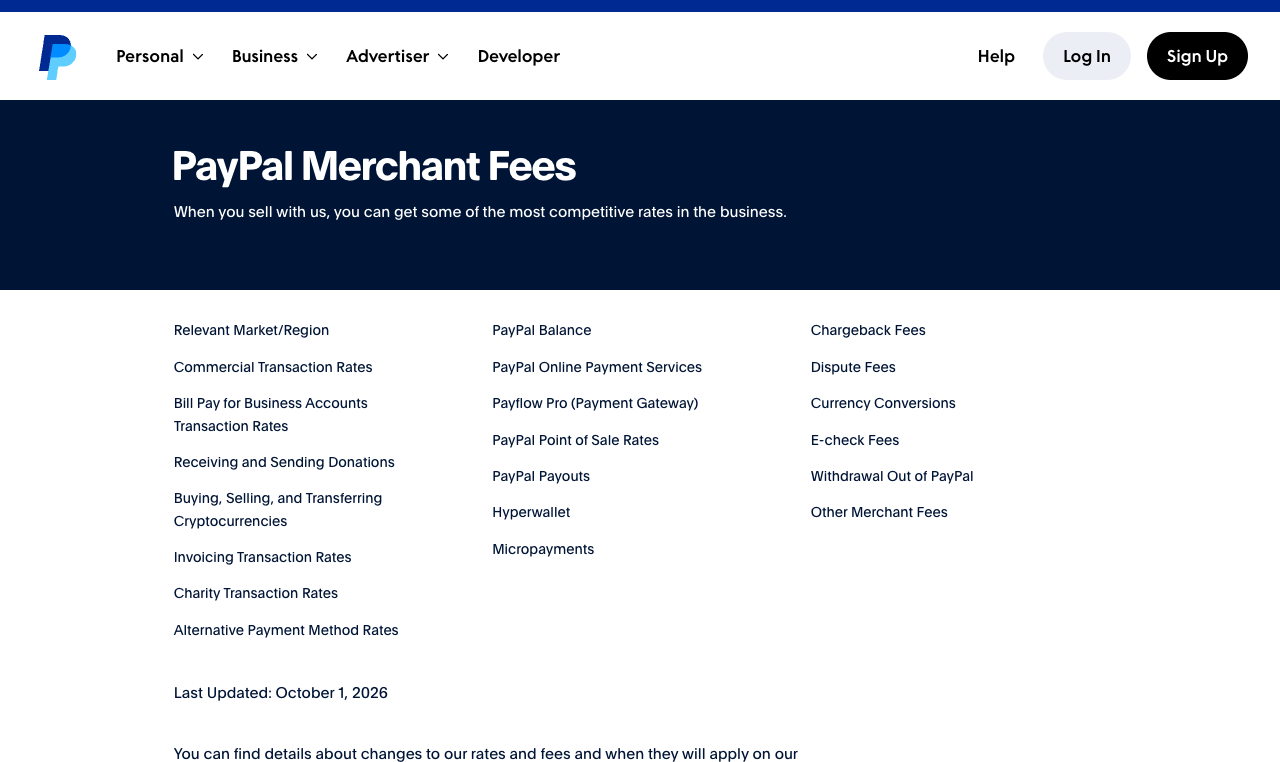
Handles: Checkout with a consumer wallet. Entry price: $0 / month. Per transaction: 3.49% + $0.49 on PayPal Checkout.
PayPal carries the highest headline rate here. PayPal Checkout and Guest Checkout both cost 3.49 percent plus a $0.49 fixed fee in the United States, as does a payment taken with Venmo. Taking a card directly through Standard Credit and Debit Card Payments is cheaper at 2.99 percent plus the fixed fee, and the Advanced service is 2.89 percent plus fixed.
Cross-border sales add 1.50 percent on top of the domestic fee, Pay Later costs 4.99 percent plus fixed and a Virtual Terminal transaction is 3.39 percent plus fixed. Two routes bring it down sharply: a QR code payment is 2.29 percent plus fixed, and ACH Services runs at 0.80 percent capped at $5.00. Confirmed charities pay 1.99 percent plus fixed on Payments Pro after approval.
What a $4,000 Payment Costs on Each Route
Rates only become comparable once you put a number through them. Take a single $4,000 payment and the published rates diverge by more than a hundred dollars.
- BILL, bank-funded ACH: $0.59 flat.
- Melio on a paid tier: $0, inside the monthly ACH allowance.
- Stripe or PayPal bank debit: $5.00, the capped 0.8 percent.
- Adyen US ACH debit: $0.40, being $0.27 plus the $0.13 processing fee.
- Stripe card online: $116.30 at 2.9 percent plus 30 cents.
- Square card online, free plan: $132.30 at 3.3 percent plus 30 cents.
- PayPal Checkout: $140.09 at 3.49 percent plus $0.49.
The spread between a bank debit and a card on the same platform is roughly 23 times. That is why every acceptance platform here sells ACH separately, and why a business invoicing other businesses should price card payments as a convenience rather than a default. Consumers are different, because a card is what they expect at a checkout.
How Business Money Actually Moves in the United States
Card rails get the attention, but the bulk of business payment value never touches one. Nacha reported that the ACH Network handled 9.3 billion payments worth $25.9 trillion in the second quarter of 2026, up 6.2 percent by count and 11.1 percent by value against the same quarter a year earlier. Business-to-business payments made up 2.2 billion of those, a rise of 9.9 percent.
Speed is the part that changed. Same Day ACH ran 435.7 million payments in that quarter, worth $1.3 trillion, growing 29.5 percent by count. Across the first half of 2026 the network carried 18.2 billion payments worth close to $50 trillion. The $11.99 that BILL charges for a same-day ACH buys access to that window, not a different network.
Running alongside it, the Federal Reserve now operates the FedNow Service, which lets participating banks and credit unions settle transactions in seconds, 24 hours a day and seven days a week. Instant options inside these platforms, such as the 1.0 percent BILL charges with a $100 ceiling, are priced against that expectation rather than against a wire.
Choosing Between Them
Start from the direction of the money. Paying suppliers on fewer than fifty invoices a month points at Melio, where the free tier sends real payments and the top tier is $80 flat. Past a few hundred invoices, Stampli and Tipalti are the serious options, and Tipalti is the only one here designed to pay people in other countries at volume.
Taking money in splits by venue. Selling online with developers on staff means Stripe. Selling across a counter means Square, where paying $49 a month makes sense above roughly $49,000 of monthly card volume. Helcim suits anyone who wants the processor margin written down, and Adyen starts to pay once interchange-plus beats a blended rate on your mix.
Mixed businesses are the awkward case, and this is where Ramp and BILL earn their place by covering payables and receivables in one system. Software choices tend to arrive together, so it is worth reading these alongside our guides to inventory management apps and internal communication tools.
Whatever you pick, get the quote in writing with the volume it assumes. Tiered pricing moves when you grow, and a business that also carries trade credit should read how a lender will see it in our explainer on what a credit score actually measures.
Frequently Asked Questions
What is the difference between a payment management system and a payment gateway?
A gateway is one component: it passes card details from a checkout to the processor. A payment management system is the wider software around the money, which may mean supplier invoices, approvals and scheduled payouts, or may mean acceptance, settlement and reporting. Stripe and Adyen include a gateway. BILL, Melio, Tipalti and Stampli do not need one.
Which payment platforms have a genuinely free plan?
Melio Go is free permanently for one user with five ACH payments a month. Ramp has a free tier that includes accounts payable, accounts receivable and unlimited cards. Stripe, Square, Helcim and PayPal charge no monthly fee at all and take their money per transaction. Square Plus and Premium are optional subscriptions that lower the card rate.
Is ACH always cheaper than a card?
For large amounts, yes, because the percentage is capped. Stripe and PayPal both charge 0.8 percent on bank debit with a $5.00 ceiling, so anything above roughly $625 is cheaper by bank. On a $20 sale the flat components make a card competitive. Outbound ACH is cheaper still, at $0.59 a payment on BILL and free inside the Melio allowance.
How much does accounts payable software cost per month?
Melio starts at $25 a month for the Core plan, Tipalti at $99 for Accounts Payable, and BILL at $49 per user a month on Essentials. Ramp includes accounts payable on a plan that costs nothing per user. Stampli publishes no figure and sizes its deals around teams processing at least 300 invoices a month.
Related Articles

Get the Fox Bulletin briefing
The stories that matter, in your inbox. No spam, unsubscribe anytime.
Newsletter signup will be available soon.
Related stories
Best Home Care Software: 10 Platforms Compared
Home care software compared across 10 platforms: care lines, EVV, mobile apps and what each one actually publishes about price. Only two name a figure.
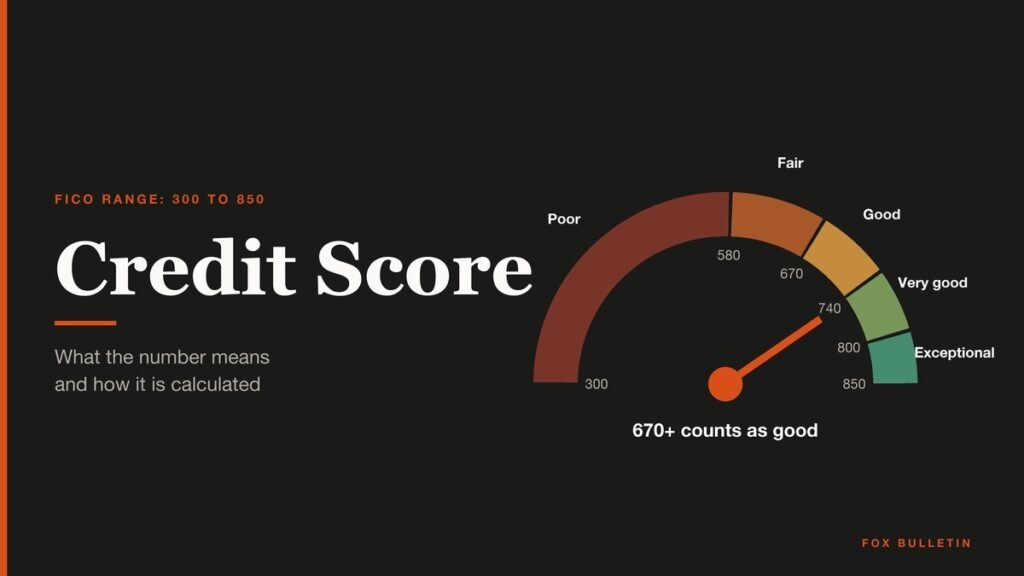
Credit Score: What the Number Means and How It Is Calculated
A credit score predicts how likely you are to repay. Here are the FICO and VantageScore tiers, the five factor weights, the versions lenders use and the 2026 mortgage changes.
Best Free Video Interview Software: 8 Ranked by Free Limit
Eight free ways to interview candidates on video, ranked by how far each free plan stretches for a small team hiring one role at a time.