

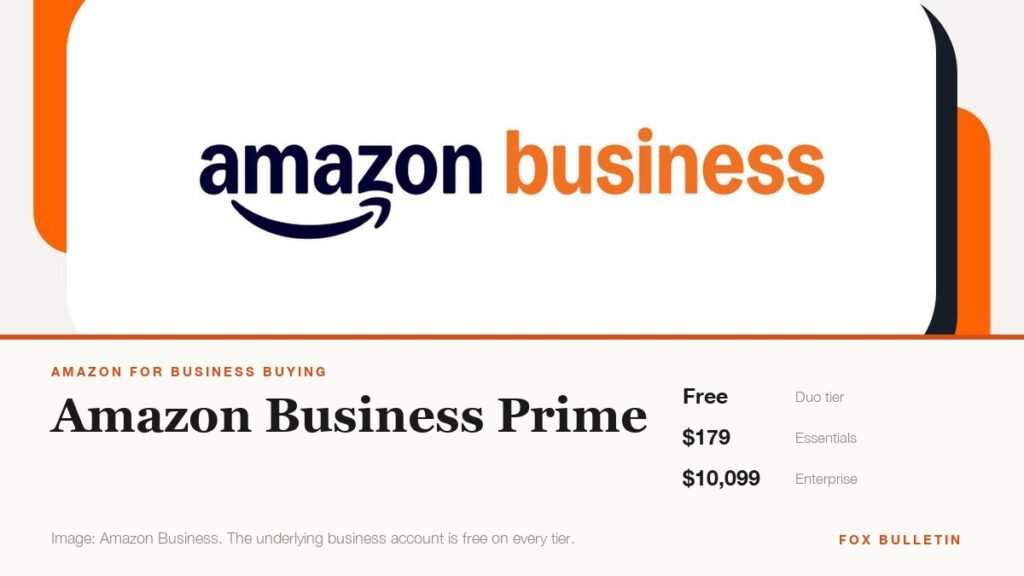
Amazon Business Prime runs from nothing to $10,099 a year, which is a wider spread than any other Amazon subscription and the reason the pricing page confuses people. The spread exists because the plans are sold on how many people need to buy, not on what they can buy.
The part worth understanding first is that two separate things share the name. An Amazon Business account is free and always has been. Prime Business is the paid membership that sits on top of it, and most small operations never need to move past the free tier. Here is what each plan costs, what it adds, and how to work out whether the shipping alone covers the fee.
What Amazon Business Prime Costs
Five plans, priced annually, separated almost entirely by user count rather than by feature access at the lower end.
| Plan | Annual Cost | Users | Who It Is Built For |
|---|---|---|---|
| Duo | Free with personal Prime | 1 | Sole traders and single buyers |
| Essentials | $179 | 5 | A small team with one approver |
| Small | $499 | 20 | A growing company with real procurement |
| Medium | $1,299 | 200 | Departmental buying and analytics |
| Enterprise | $10,099 | Unlimited | Organisations needing spend controls at scale |
Every paid tier opens with a 30 day free trial, and the Duo tier costs nothing at all if you already hold a personal Prime membership. Creating the underlying Amazon Business account is free regardless of which membership you do or do not buy.
The Free Account and the Paid Membership Are Different Things
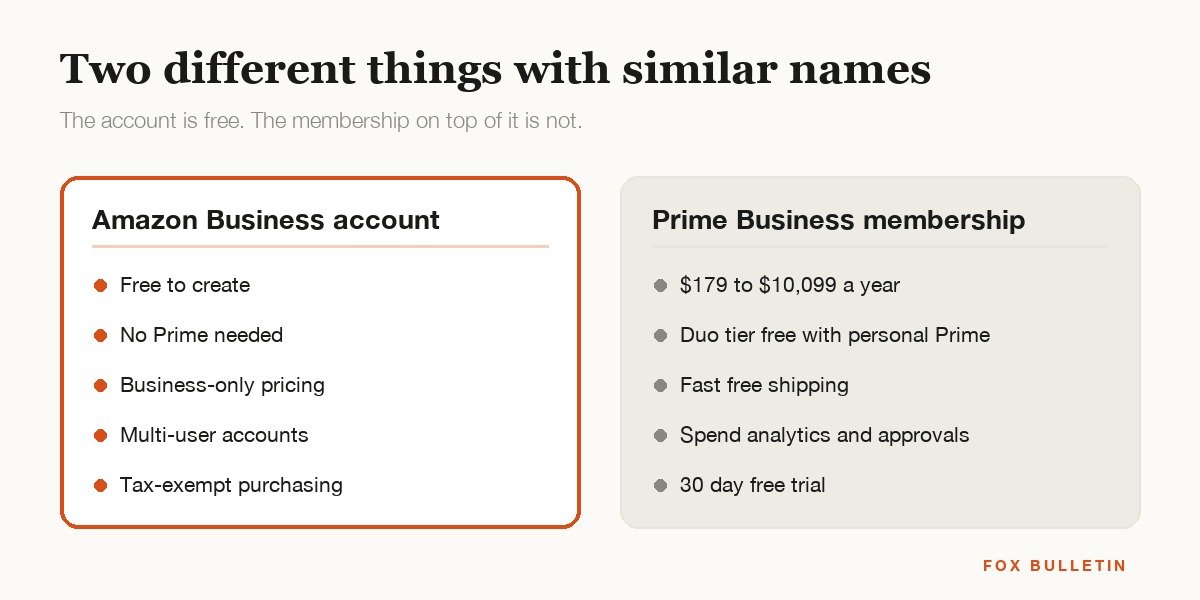
This is the distinction that decides whether you need to spend anything. The free Amazon Business account already carries most of what people assume they are paying for.
- Business-only pricing on a large share of the catalogue, which is a discount off the consumer price rather than a membership perk.
- Multi-user accounts so colleagues buy under one organisation instead of expensing personal orders.
- Tax-exempt purchasing for eligible organisations, which is often worth more than the membership fee by itself.
- Quantity discounts and quotes on bulk orders, with no subscription attached.
What the paid membership adds on top is fast free shipping and the procurement machinery: spending analytics, guided buying policies, approval workflows and extended payment terms. If nobody in your organisation needs to approve anybody else’s purchases, you are probably looking at a shipping subscription rather than a procurement system.
Which Tier Fits How Many People
User count is the main axis, and the jumps are large enough that picking by headcount gets most buyers to the right answer immediately.
- One buyer: Duo, free if you hold personal Prime. There is no reason to pay anything.
- Two to five buyers: Essentials at $179, which works out at about $36 a head and adds basic approval rules.
- Six to twenty: Small at $499, roughly $25 a head, and the first tier with real spend visibility.
- Up to two hundred: Medium at $1,299, about $6.50 a head, where the analytics start to justify themselves.
- Beyond that: Enterprise at $10,099 for unlimited users and the full control set.
Per-head cost falls sharply as you climb, which is the opposite of how most software is priced and worth noting if you are near a boundary. A twenty-five person team pays less per person on Medium than a five person team pays on Essentials.
What Business Prime Adds Beyond Shipping
The shipping is the headline and the controls are the actual product. According to Amazon’s own figures, members saved more than $750 million in shipping fees globally during 2024, and over 70 percent of United States orders arrived the same or next day.
- Spend visibility showing what was bought, by whom, under which budget line.
- Guided buying that steers purchasers toward preferred suppliers and blocks restricted categories.
- Approval workflows that hold orders above a threshold until someone signs off.
- Extended payment terms on eligible orders at the higher tiers, which is a cash flow benefit rather than a discount.
Those features only pay back where uncontrolled spending is an actual problem. For a business that already tracks purchasing properly through dedicated accounting software, the overlap may be considerable.
What Business Pricing and Tax Exemption Are Worth
Two benefits sit on the free account and get overlooked because they are not framed as membership perks. Both can be worth more annually than any of the paid tiers cost.
Business-only pricing is a separate price shown on a large share of the catalogue once you are signed in to a business account. It is not a coupon or a sale. The same item carries one price for consumers and another for organisations, and the gap widens on the categories businesses actually buy repeatedly: paper, packaging, cleaning supplies, cables, basic tools. Quantity discounts stack on top, so the price falls again at five or ten units.
Tax exemption is the one that quietly dwarfs everything else. Eligible organisations, including many non-profits, schools and resellers, can enrol so qualifying orders are placed without sales tax rather than reclaimed afterwards. On a business spending $30,000 a year in a state charging around 7 percent, that is roughly $2,100 never paid, against an Essentials membership costing $179. The enrolment is paperwork rather than a purchase, and it applies to the free account.
Neither benefit requires a paid tier. If you take nothing else from the pricing table, take this: the account is where the money is, and the membership is where the convenience is.
Where the Free Duo Tier Is Enough
Most small operations stop here, and should. Duo costs nothing when you already hold personal Prime, covers a single buyer, and carries the business pricing and tax exemption that make the account worth having at all.
One condition is worth knowing before you rely on it. Duo is free because it is attached to an active personal Prime membership rather than being free outright, so cancelling personal Prime ends the Duo benefits too. Anyone planning to drop Prime should work out whether Duo was doing real work for them first, because the replacement is Essentials at $179 rather than nothing.
You have outgrown it when a second person needs to buy, when you need someone to approve purchases before they happen, or when you need to see spending broken down rather than as a list of orders. Until one of those is true, the paid tiers are selling you controls you do not need. Sellers running a dropshipping operation through Amazon face a different calculation again, since their costs sit on the selling side rather than the buying side.
Working Out Whether the Shipping Alone Pays for It
The simplest test ignores every feature and looks only at delivery, because that is the one benefit with a number attached.
- Total what you paid in shipping on business orders over the last three months.
- Multiply by four for an annual figure.
- Compare against $179 for Essentials or $499 for Small.
- Only if shipping alone falls short, ask whether the approval and analytics features close the gap.
A business spending $20 a month on delivery is nowhere near Essentials on shipping alone and needs the procurement features to justify it. One spending $60 a month has already covered Essentials before a single other benefit is counted. Pair that against whatever you pay for inventory management and payment processing, since those tools often cover the reporting side already.
Use the 30 day trial rather than modelling it. One month of real orders answers the question better than an estimate, and the Small Business Administration publishes general guidance on managing business costs that is worth reading alongside it.
Frequently Asked Questions
How much is Amazon Business Prime?
Five plans: Duo is free for existing Prime members and covers one user, Essentials is $179 a year for five users, Small is $499 for twenty, Medium is $1,299 for two hundred, and Enterprise is $10,099 for unlimited users. All paid tiers include a 30 day free trial.
Is an Amazon Business account free?
Yes. Creating an Amazon Business account costs nothing and does not require a Prime membership of any kind. It carries business-only pricing, multi-user access and tax-exempt purchasing on its own. Prime Business is the optional paid layer on top.
What is the difference between Amazon Business and Amazon Prime?
Amazon Prime is a consumer membership covering personal orders, video and music. Amazon Business is a separate account type for organisations, with business pricing, multiple users and tax exemption. Holding one does not give you the other, although personal Prime does unlock the free Duo tier of Prime Business.
Can you use a personal Amazon account for business purchases?
You can, but you lose business-only pricing, tax-exempt purchasing, consolidated invoicing and any ability to separate who bought what. For anything beyond occasional orders the free business account is strictly better, which is why the paid membership is the only real decision here.
Related Articles

Get the Fox Bulletin briefing
The stories that matter, in your inbox. No spam, unsubscribe anytime.
Newsletter signup will be available soon.
Related stories
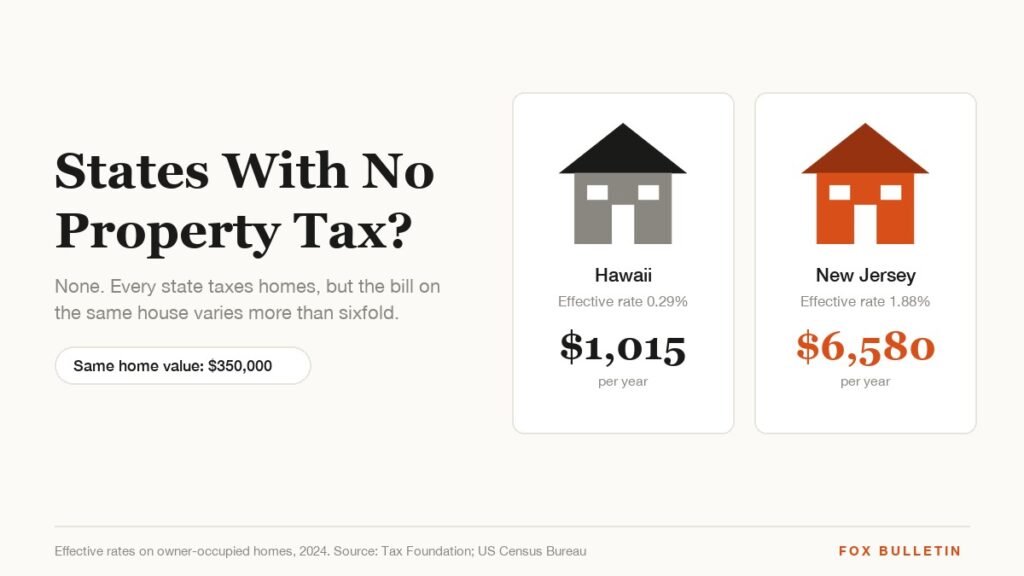
States With No Property Tax: Why None Exist, Plus Property Tax by State
There are no states with no property tax. Effective rates run from 0.29% in Hawaii to 1.88% in New Jersey and Illinois. Every state's rate, and the exemptions that can cut a bill to zero.
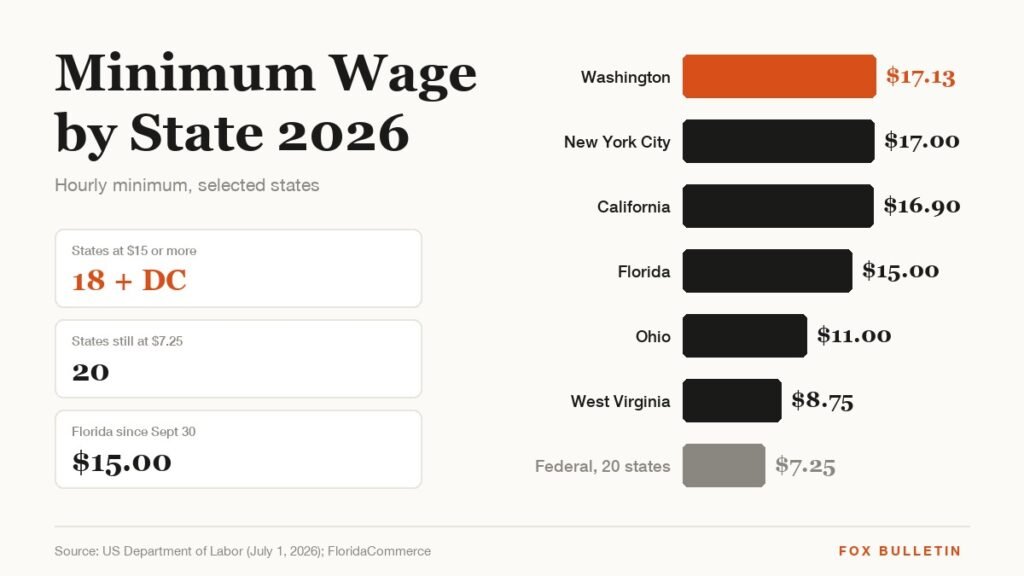
Minimum Wage by State 2026: Every State’s Rate, Plus Tipped Wages
The federal minimum wage is still $7.25, but 30 states and DC set higher rates, from $8.75 in West Virginia to $17.13 in Washington. Every state's rate and tipped wage for 2026.
States With No Sales Tax: All 5, Plus Sales Tax by State
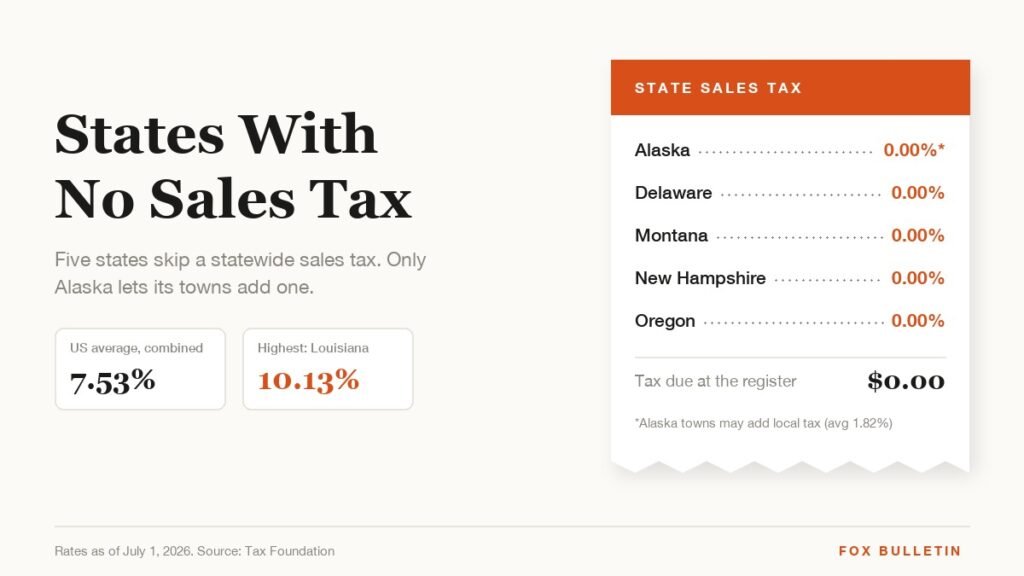
Alaska, Delaware, Montana, New Hampshire and Oregon have no statewide sales tax. What each one taxes instead, and the 2026 sales tax rate in every other state.