
There are nine main types of business insurance that a company in the United States is likely to be asked about, and two of them are required by law almost everywhere: workers’ compensation once you employ anyone, and auto insurance for any vehicle the business runs. The rest are optional in law but often compulsory in practice, because landlords, lenders and clients write them into contracts.
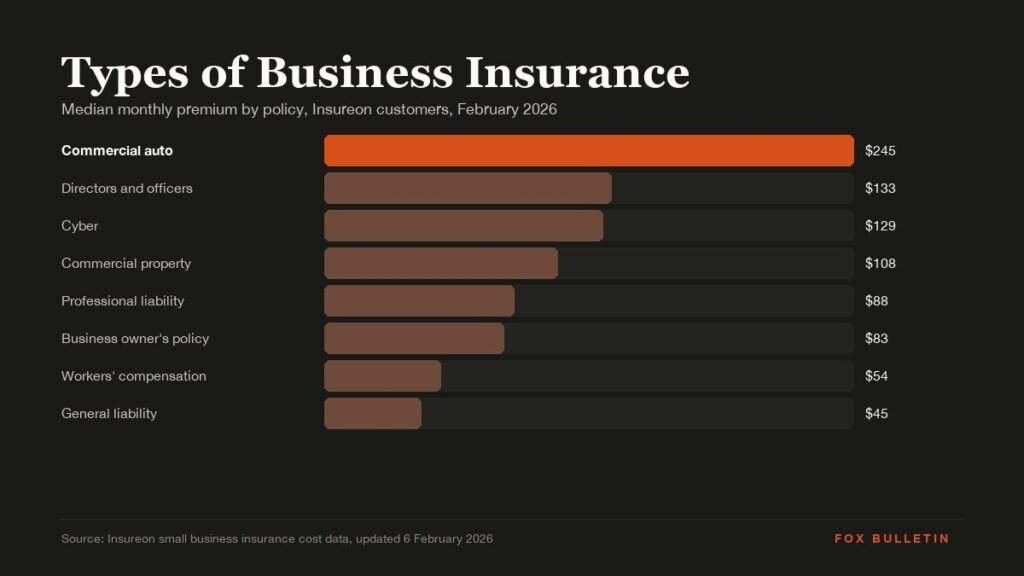
This guide explains what each policy covers, using the definitions published by the Small Business Administration and the Insurance Information Institute, where the legal requirements come from, and what small businesses typically pay. The cost column is Insureon’s median monthly premium across its customers, updated in February 2026, and it is a starting point rather than a quote.
| Policy | What it covers | Required by law? | Median monthly cost |
|---|---|---|---|
| General liability | Injury, property damage, libel and slander claims by others | Not by law, but by most leases and contracts | $45 |
| Professional liability (E&O) | Negligence, errors and malpractice in services | Some states, for lawyers and medical professionals | $88 |
| Workers’ compensation | Medical care and lost wages for injured employees | Every state except Texas, once you have employees | $54 |
| Commercial property | Buildings, equipment and stock | Not by law, usually by lenders | $108 |
| Business owner’s policy (BOP) | Property plus general liability in one package | Not by law | $83 |
| Cyber | Breach response, ransomware, resulting lawsuits | Not by law | $129 |
| Commercial auto | Vehicles owned or used by the business | Every state, at the state minimum | $245 |
| Product liability | Injury or damage caused by a product you make or sell | Not by law | Priced with general liability |
| Directors and officers (D&O) | Claims against board members and executives | Not by law | $133 |
The Nine Types of Business Insurance
1. General Liability Insurance
Covers: Bodily injury, property damage, medical payments, libel and slander, legal defence | Excludes: Employee injuries, professional mistakes, pollution unless added | Median cost: $45 a month
General liability is the policy almost every business buys first. The Small Business Administration describes it as protection against financial loss from bodily injury, property damage, medical expenses, libel, slander, the cost of defending lawsuits, and settlements or judgments. A customer who slips in your shop, a contractor who damages a client’s floor, or a competitor who claims your advertising defamed them are all general liability claims.
It does not cover your own employees’ injuries, which is workers’ compensation, or mistakes in professional advice, which is professional liability. Insureon’s median is $45 a month, NEXT quotes policies from $19 a month and says 45 percent of its customers pay $45 or less, and Hiscox’s illustrative starting price is $30.
2. Professional Liability Insurance
Also called: Errors and omissions, or malpractice | Covers: Negligence, errors and omissions in services, plus legal defence | Median cost: $88 a month
Professional liability pays the cost of defending claims that your advice or service caused a client financial loss, and any judgment up to the policy limit. The Insurance Information Institute notes that most policies are written on a claims-made basis, meaning the policy must be in force both when the work was done and when the claim is filed, which matters when switching insurers. Some states require it for lawyers and medical professionals; for consultants, accountants, architects and IT firms it is usually a client requirement instead.
3. Workers’ Compensation Insurance
Covers: Medical care and part of lost wages for employees hurt at work | Required: All states except Texas, thresholds vary | Median cost: $54 a month
Workers’ compensation is state law, not federal. The Department of Labor directs private employers to their state board, and the rules differ sharply. California’s Labor Code section 3700 requires cover from the first employee, and the state’s Division of Workers’ Compensation warns that operating without it is a misdemeanour with fines of at least $10,000. New York requires virtually all employers to carry it. Texas is the one state where private employers may opt out, though non-subscribers must report that choice to the state and lose certain legal defences if sued.
Premiums are set by payroll and the risk class of the work, so a bookkeeper pays far less than a roofer for the same headcount. The SBA notes that any business with employees also needs unemployment and disability insurance, which are separate programmes.
4. Commercial Property Insurance
Covers: Buildings, equipment, inventory and furniture against fire, theft, storms and similar events | Excludes: Floods and earthquakes without separate cover | Median cost: $108 a month
Property insurance replaces what the business owns after a covered event. Lenders require it on any mortgaged building, and landlords usually require tenants to insure their own contents. Business interruption cover, which replaces lost income while premises are unusable, is often bundled with it or with a BOP.
5. Business Owner’s Policy
Combines: Commercial property, general liability and business interruption | For: Small and mid-sized businesses | Median cost: $83 a month
A BOP packages the two most common policies into one contract at a lower combined price, which is why Insureon’s median for a BOP is below the sum of its parts. The Insurance Information Institute is specific about what a BOP leaves out: professional liability, auto insurance, workers’ compensation, and health and disability cover all need separate policies. It suits shops, offices and small contractors with a premises to protect.
6. Cyber Insurance
First-party cover: Ransomware payments, customer notification, legal fees, lost income | Third-party cover: Lawsuits from customers and partners after a breach | Median cost: $129 a month
Cyber insurance is the fastest-growing line on this list and the one most often required by larger clients before they sign. The Institute splits it into first-party cover for the business’s own costs, including ransomware or extortion payments and notifying affected customers, and third-party cover for claims brought by others. Insurers increasingly demand controls such as multi-factor authentication before they will quote.
7. Commercial Auto Insurance
Covers: Vehicles owned by or driven for the business | Required: Every state, at that state’s minimum | Median cost: $245 a month
A personal auto policy generally excludes business use, so any vehicle used for deliveries, site visits or client transport needs a commercial policy. State minimums are written as three numbers: Texas requires 30/60/25, meaning $30,000 per injured person, $60,000 per accident and $25,000 for property damage, according to the Texas Department of Insurance; California’s minimum is 30/60/15. Interstate carriers face federal rules under 49 CFR 387.9, which set $750,000 for for-hire trucks over 10,001 pounds and up to $5 million for hazardous cargo. Insureon’s premiums run from under $375 to more than $16,000 a year depending on the fleet.
8. Product Liability Insurance
Covers: Injury, death or property damage caused by a product | Who needs it: Anyone who designs, makes, distributes or sells a physical product | Cost: Usually rated within general liability
The SBA defines product liability as protection against loss from a defective product that causes injury or bodily harm, and the Institute extends it to any company in the chain from designer to retailer. Many general liability policies include products-completed operations cover, so a separate policy is mainly for manufacturers and importers; Insureon does not publish a distinct median for it.
9. Directors and Officers Insurance
Covers: Personal liability of board members and executives for decisions made in office | Structure: Side A for individuals, Side B reimbursing the company, Side C for the entity | Median cost: $133 a month
D&O protects the people who run a company against claims from shareholders, employees, regulators or competitors over management decisions. The three-part structure the Institute describes matters when the company cannot or will not indemnify an individual, which is when Side A pays. Non-profits and start-ups raising outside money are the usual buyers; experienced board members will not serve without it. Insureon’s range runs from $525 to more than $12,000 a year.
Which Policies the Law Requires
Only two are mandatory in the general case. Workers’ compensation is required in 49 states once an employee threshold is crossed, and that threshold is one employee in California and New York but three to five in some others. Commercial auto is required wherever the business registers a vehicle, at that state’s liability minimum. Professional liability is compulsory only for specific licensed professions in specific states.
Everything else is contractual. A commercial lease will demand general liability with the landlord named as an additional insured, a bank will demand property cover on anything it lends against, and a large customer will demand cyber and professional liability before onboarding a supplier. Those requirements are why a firm with no legal obligation to carry a policy usually ends up with four or five of them.
What Small Businesses Actually Pay
Insureon’s medians, drawn from more than 100,000 policies, range from $45 a month for general liability to $245 for commercial auto, with a BOP at $83 and cyber at $129. Hiscox’s advertised starting prices are lower, at $30 for general liability, $42 for a BOP and $23 for professional liability, because starting prices describe the smallest, lowest-risk customers. Premiums rise with payroll, revenue, claims history and industry, so a restaurant and a software consultancy with the same headcount will see very different figures.
The cheapest way to buy is usually a BOP plus workers’ compensation, adding cyber or professional liability only when a contract calls for it. The same logic applies to the other recurring costs of a small firm, which is why our guides to business phone systems and payment processors lead with the entry price and what it leaves out.
Frequently Asked Questions
What insurance is legally required for a small business?
Workers’ compensation in every state except Texas once you have employees, with thresholds that vary by state, and commercial auto insurance for any business vehicle at the state minimum. Some states also require professional liability for licensed professions such as law and medicine.
What is the difference between general liability and professional liability?
General liability covers physical harm to other people or their property and claims such as libel. Professional liability covers financial loss caused by mistakes, negligence or poor advice in the service you provide. A consultant whose client trips in the office needs the first; one whose report contained an error needs the second.
What does a business owner’s policy include?
Commercial property, general liability and usually business interruption cover in one contract. It does not include professional liability, auto, workers’ compensation or health and disability insurance, which must be bought separately.
How much does business insurance cost per month?
Insureon’s February 2026 medians are $45 for general liability, $54 for workers’ compensation, $83 for a BOP, $88 for professional liability, $108 for property, $129 for cyber, $133 for D&O and $245 for commercial auto. Advertised starting prices from insurers such as Hiscox and NEXT are lower, from $19 to $42 a month.
Related Articles

Get the Fox Bulletin briefing
The stories that matter, in your inbox. No spam, unsubscribe anytime.
Newsletter signup will be available soon.
Related stories
States With No Property Tax: Why None Exist, Plus Property Tax by State
There are no states with no property tax. Effective rates run from 0.29% in Hawaii to 1.88% in New Jersey and Illinois. Every state's rate, and the exemptions that can cut a bill to zero.
Minimum Wage by State 2026: Every State’s Rate, Plus Tipped Wages
The federal minimum wage is still $7.25, but 30 states and DC set higher rates, from $8.75 in West Virginia to $17.13 in Washington. Every state's rate and tipped wage for 2026.
States With No Sales Tax: All 5, Plus Sales Tax by State
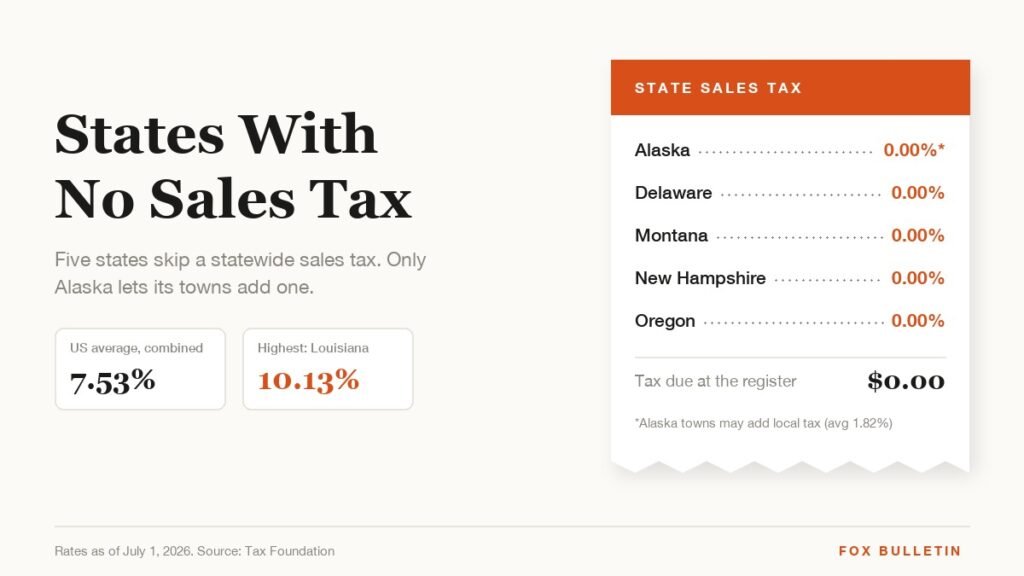
Alaska, Delaware, Montana, New Hampshire and Oregon have no statewide sales tax. What each one taxes instead, and the 2026 sales tax rate in every other state.