

Dropshipping is profitable, and most dropshipping stores are not. Both of those are true at once, and the reason is a single number that has nothing to do with the product: what it costs to get one customer through the door.
The model’s margins are known and unremarkable. Gross margins of 15% to 30% are typical, which is a normal retail range, and the fee side is published: Amazon and Shopify both list theirs. What is not normal is that a new dropshipping store has no traffic of its own, so it buys every visitor, and that purchase comes out of the same margin. Whether the business works is entirely decided by whether customer acquisition costs less than the gross margin, and the honest answer is that for a large share of stores it does not.
Where the Money Goes on a Single Order
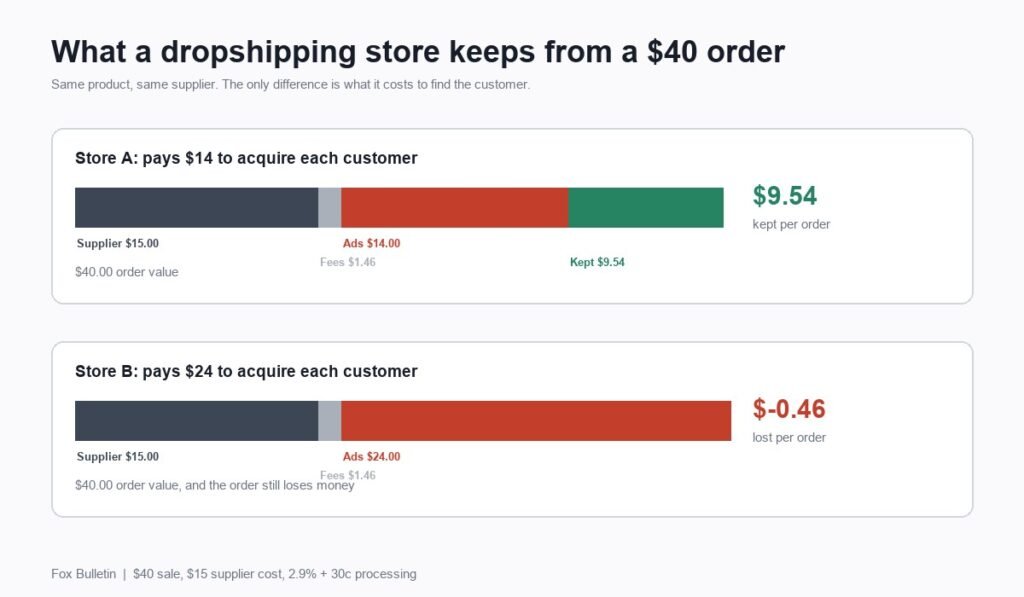
Take a $40 product that costs $15 delivered from the supplier, with card processing at the common 2.9% plus 30 cents.
- Order value: $40.00
- Supplier cost: $15.00
- Payment processing: $1.46
- Gross margin: $23.54, which is 58.9% and looks excellent
Then advertising arrives. A store paying $14 to acquire each customer keeps $9.54 an order, a net margin of about 24%, which is a genuinely good business. A store paying $24 loses 46 cents on every sale while its revenue graph goes up and to the right. The two stores are identical in every other respect.
That is the whole answer to the profitability question. It is not about the niche, the theme or the supplier. It is whether your cost per purchase sits below your gross margin, and everything else is a way of moving one of those two numbers.
What Dropshipping Stores Actually Earn
Realistic expectations help more than aspirational ones.
- Gross margin: 15% to 30% is normal. Above 40% usually means either a higher-priced product or a supplier relationship most beginners do not have.
- Net margin after advertising: commonly single digits. A store netting 10% is doing well, and 20% is unusual.
- What that means in money: a store turning over $10,000 a month at a 10% net margin keeps $1,000. The revenue figures people post are not income.
- Timeline: the first months normally cost money, because early advertising is buying information about which products convert, and most tested products fail.
Anyone quoting profit as a percentage of revenue without naming their advertising cost is describing gross margin, which is the number that makes unprofitable stores look healthy.
The Costs That Quietly Eat the Margin
Beyond the supplier and the ads, five costs land on the same $23.54 and are routinely left out of the arithmetic.
- Refunds and replacements. You refund the customer in full, and you often cannot recover the item from an overseas supplier. One refund erases the profit on two or three orders.
- Chargebacks. More expensive than a refund, and a rising rate threatens your ability to take payments at all.
- Platform and app subscriptions. A store on Shopify Basic with a paid supplier app carries roughly $50 to $60 a month before it sells anything, which at $9.54 an order is six orders a month just to stand still.
- The third-party gateway fee. Using a processor other than Shopify Payments adds 2% of revenue on the Basic plan, which is around a fifth of a typical net margin.
- Your own time. Not a cash cost, but a store netting $600 a month for twenty hours a week is paying below minimum wage for the privilege.
Our breakdown of the cost to start dropshipping puts current figures against each of these.
The Four Ways to Make a Dropshipping Store Profitable
There are only two variables, so there are only four levers. Every genuine improvement is one of these.
- Raise the average order value. The single most effective lever, because one acquisition cost is spread across more revenue. Bundles, multi-packs and genuine accessory offers all do this, and none of them require cheaper advertising.
- Sell to the same customer twice. A repeat order carries no acquisition cost at all. This is why niches with consumables or accessories outperform one-off purchases so heavily, as our guide to choosing a dropshipping niche sets out.
- Lower the cost per customer. Better targeting, better creative, narrower audiences. Real but slow, and it has a floor set by the competition in your category.
- Build traffic you do not pay for. Email lists, search rankings and an audience are the only routes to a margin that is not rented. They take months and they compound.
Cutting the supplier cost is the lever people reach for first and it is usually the weakest, because a dollar off a $15 product is worth far less than a $20 bundle that lifts the order value.
When Dropshipping Is Not Profitable
Some situations do not become profitable with better execution, and recognising them early saves months.
- Products under about $20. The absolute margin is too small to cover paid acquisition at any markup.
- Generic items dozens of stores list. The competition drives both price down and advertising costs up simultaneously.
- Categories where large retailers compete directly. Consumer electronics is the classic case, with thin margins and buyers who compare instantly.
- Anything with a high return rate. Clothing sizing is the usual culprit, and returns come to you rather than to your supplier.
- Stores that cannot state a delivery time honestly. Slow shipping produces refunds and disputes that consume the margin, and creates the shipping-rule exposure our guide to dropshipping legality covers.
Why Marketplace Selling Changes the Arithmetic
Selling through Amazon rather than your own store replaces the advertising cost with a referral fee, and that swap often improves the numbers rather than worsening them.
On the same $40 order, Amazon takes a referral fee of 15% in most categories, which is $6.00, plus a share of the $39.99 monthly Professional plan. Against a $15 supplier cost that leaves around $18 an order, noticeably more than the $9.54 left after paying $14 for a customer on your own store. You are effectively renting Amazon’s traffic at a fixed, predictable rate instead of bidding for attention.
The cost is ownership. You get no email address, no repeat purchase you control and no brand the buyer remembers, so the margin is better while the asset you are building is worse. A suspension also removes the entire business at once, which our guide to Amazon dropshipping rules covers in detail. Neither route is universally right, but a store struggling with acquisition costs should price the marketplace option before concluding the model does not work.
How to Tell Whether Your Own Store Is Working
Three numbers answer it, and none of them is revenue.
- Cost per purchase versus gross margin. Below it, you have a business. Above it, you have an expensive hobby, regardless of how much money is moving.
- Average order value over time. Flat AOV means you are relying entirely on cheaper ads, which is the hardest lever to move.
- Share of orders from repeat customers. If this stays near zero after several months, every future sale will cost full price to acquire and the store cannot compound.
Track those weekly and the profitability question answers itself long before the bank balance does.
Frequently Asked Questions
Is dropshipping still profitable?
Yes, for stores where the cost of acquiring a customer sits comfortably below the gross margin. Gross margins of 15% to 30% are normal and net margins after advertising are usually in single digits. The model is not dead, but it no longer works by simply listing a cheap product and running ads at it.
What is a good profit margin for dropshipping?
A gross margin above 40% gives you room to work with, and a net margin of 10% after all advertising and fees is a healthy result. What matters more than the percentage is the absolute figure: advertising is priced in dollars, so a product that leaves $23 per order is far more workable than one leaving $8, whatever the percentages say.
How much do dropshippers actually make?
Far less than the revenue screenshots suggest. A store turning over $10,000 a month at a 10% net margin keeps $1,000 before tax. Most stores never reach consistent profit at all, because they stop at the point where testing costs money and has not yet found a product that converts below its margin.
Why do most dropshipping stores fail?
Because they pay more to acquire a customer than the order leaves them. That usually traces back to one of three earlier decisions: a product too cheap to carry an ad cost, a category too competitive to advertise into, or a store that never tested properly and ran out of budget before it learned anything.
How long does it take a dropshipping store to become profitable?
Longer than the revenue screenshots imply. The first weeks are spent testing products, and most tests lose money by design, because you are paying for the information that a product does not convert. Stores that reach consistent profit usually do so after several rounds of testing rather than on the first product, and the ones that fail generally ran out of budget before they ran out of ideas.
Related Articles

Get the Fox Bulletin briefing
The stories that matter, in your inbox. No spam, unsubscribe anytime.
Newsletter signup will be available soon.
Related stories
Dropshipping Marketing: The Numbers That Decide Every Channel
Dropshipping marketing is arithmetic, not creativity. The two numbers that decide everything, what each channel costs and delivers, and why scaling is usually an order-value problem.
Dropshipping Apps: What Each One Does and What It Costs
Dropshipping apps do four different jobs and most stores need one, not four. Five apps compared on current pricing, what each is actually for, and how many you really need.
How to Start Dropshipping: The Nine Steps in the Right Order
Most guides put the steps in the wrong order and reach the margin arithmetic last. Nine steps in the sequence that catches problems while they are still cheap, with current vendor prices.