

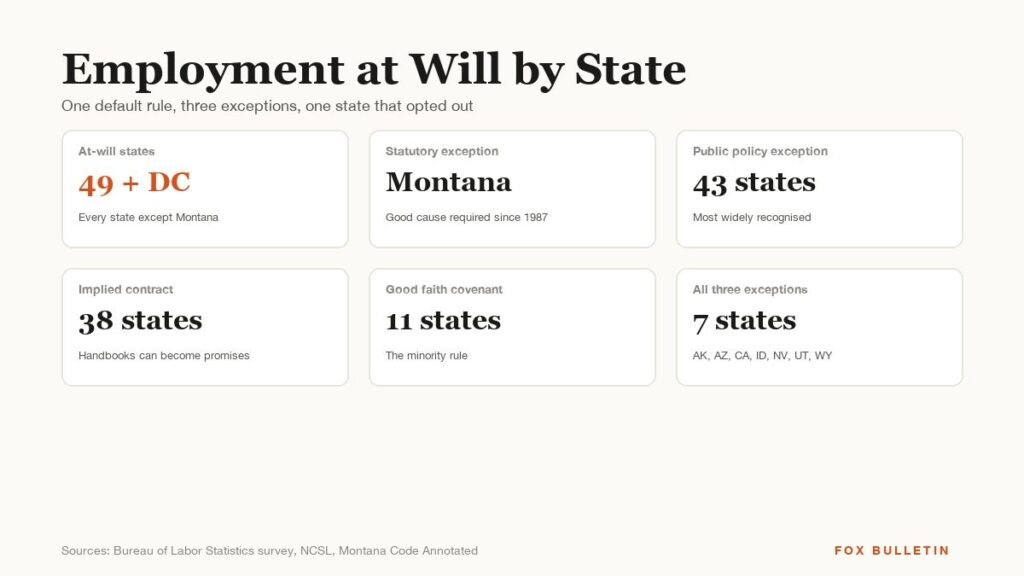
Employment at will is the default rule in every US state except Montana: an employer may dismiss an employee at any time, for any reason or no reason, and the employee may quit on the same terms, so long as the reason is not one the law forbids. That last clause is where the state-by-state differences live. Courts in most states have carved out exceptions that turn some at-will firings into wrongful ones, and which exceptions apply depends on where the job is.
This guide sets out the rule, the three common-law exceptions, Montana’s statutory alternative, and a table of which exceptions each state’s courts have recognised. The table comes from the Bureau of Labor Statistics’ survey of state law and is the most complete official one published; its date and limits are explained below it.
What Employment at Will Means
Cornell Law School’s Legal Information Institute defines at-will employment as an arrangement in which the employee may quit at any time and the employer may fire the employee for any reason and at any point, provided the dismissal is not for an unlawful reason. The National Conference of State Legislatures puts it the same way and adds that the presumption applies in all states except Montana. Unlawful reasons include discrimination on grounds covered by federal or state law, retaliation for protected activity such as filing a complaint, and anything a written contract or collective agreement rules out.
At will is a presumption, not a guarantee. An employer can give it away by signing a contract with a fixed term or a for-cause clause, and in most states can lose it by accident through a handbook or a verbal promise. Employees covered by union agreements are almost never at will. Federal law also sits on top of every state’s rule: Title VII of the Civil Rights Act, the Age Discrimination in Employment Act and the Americans with Disabilities Act forbid dismissals on protected grounds whatever the state doctrine says, and they apply in Florida and Georgia exactly as they do in California. The state-by-state differences below concern only the additional protections that state courts have added on top of that federal floor, which is where an otherwise lawful at-will dismissal can still become a wrongful one.
The Three Exceptions and Where They Apply
Courts in all but four states, plus the District of Columbia, have adopted at least one of three exceptions. Which ones apply is a matter of state case law, which the Bureau of Labor Statistics catalogued in its Monthly Labor Review; the counts below are from that survey.
- Public policy: an employee cannot be fired for refusing to break the law, for reporting a violation, for performing a public duty such as jury service, or for exercising a legal right such as filing a workers’ compensation claim. Recognised in 43 states, it is the most widely accepted exception
- Implied contract: an employer’s handbook, written policies or a supervisor’s verbal assurances can create an enforceable promise not to dismiss without cause, even with no signed contract. The BLS counted 38 states; the NCSL’s later brief put it at 41 plus the District of Columbia
- Implied covenant of good faith and fair dealing: a minority of 11 states read a duty of fair dealing into every employment relationship, which in its strongest form requires just cause for dismissal and in its weaker form bars firings made in bad faith or out of malice
Seven states apply all three: Alaska, Arizona, California, Idaho, Nevada, Utah and Wyoming. Four apply none: Florida, Georgia, Louisiana and Rhode Island. Seven have rejected the public policy exception outright, including New York, which recognises only implied contract, and Alabama, which recognises implied contract and good faith but not public policy.
Montana, the One State Without At-Will Employment
Montana replaced the doctrine in 1987 with the Wrongful Discharge from Employment Act, sections 39-2-901 to 39-2-915 of the Montana Code. Under section 39-2-904 a dismissal is wrongful if it was in retaliation for refusing to violate or for reporting a violation of public policy, if it was not for good cause after the employee completed the probationary period, if the employer materially violated an express provision of its own written personnel policy, or if it was based solely on the employee’s lawful free speech.
Good cause is defined in section 39-2-903 as reasonable job-related grounds: failure to perform duties satisfactorily, disruption of the employer’s operation, material or repeated violation of written policy, or other legitimate business reasons. The default probationary period, if the employer sets none, is 12 months. Remedies are capped at four years of lost wages and benefits, with punitive damages only on clear and convincing evidence of actual fraud or malice. The NCSL describes Montana as the only state to have passed a law with such far-reaching effect.
Exceptions Recognised in Each State
The table records the position as of 1 October 2000, the date of the BLS survey, which remains the only complete official state-by-state list. Courts have moved since, mostly toward recognising more exceptions, and Montana is shown as a statute because its act replaces the common-law exceptions rather than adding to them. Treat the table as a map of where to look, not as legal advice for a specific dismissal.
| State | Public policy | Implied contract | Good faith |
|---|---|---|---|
| Alabama | No | Yes | Yes |
| Alaska | Yes | Yes | Yes |
| Arizona | Yes | Yes | Yes |
| Arkansas | Yes | Yes | No |
| California | Yes | Yes | Yes |
| Colorado | Yes | Yes | No |
| Connecticut | Yes | Yes | No |
| Delaware | Yes | No | Yes |
| District of Columbia | Yes | Yes | No |
| Florida | No | No | No |
| Georgia | No | No | No |
| Hawaii | Yes | Yes | No |
| Idaho | Yes | Yes | Yes |
| Illinois | Yes | Yes | No |
| Indiana | Yes | No | No |
| Iowa | Yes | Yes | No |
| Kansas | Yes | Yes | No |
| Kentucky | Yes | Yes | No |
| Louisiana | No | No | No |
| Maine | No | Yes | No |
| Maryland | Yes | Yes | No |
| Massachusetts | Yes | No | Yes |
| Michigan | Yes | Yes | No |
| Minnesota | Yes | Yes | No |
| Mississippi | Yes | Yes | No |
| Missouri | Yes | No | No |
| Montana | Statute | Statute | Statute |
| Nebraska | No | Yes | No |
| Nevada | Yes | Yes | Yes |
| New Hampshire | Yes | Yes | No |
| New Jersey | Yes | Yes | No |
| New Mexico | Yes | Yes | No |
| New York | No | Yes | No |
| North Carolina | Yes | No | No |
| North Dakota | Yes | Yes | No |
| Ohio | Yes | Yes | No |
| Oklahoma | Yes | Yes | No |
| Oregon | Yes | Yes | No |
| Pennsylvania | Yes | No | No |
| Rhode Island | No | No | No |
| South Carolina | Yes | Yes | No |
| South Dakota | Yes | Yes | No |
| Tennessee | Yes | Yes | No |
| Texas | Yes | No | No |
| Utah | Yes | Yes | Yes |
| Vermont | Yes | Yes | No |
| Virginia | Yes | No | No |
| Washington | Yes | Yes | No |
| West Virginia | Yes | Yes | No |
| Wisconsin | Yes | Yes | No |
| Wyoming | Yes | Yes | Yes |
What the Exceptions Mean in Practice
For employers, the implied contract exception is the one most often triggered by accident. A handbook that lists disciplinary steps, a manager who promises job security, or an offer letter that talks about a career can all be read as a promise not to fire without cause in the 38 or more states that recognise it. The standard defence is a clear at-will disclaimer in the handbook and offer letter, signed by the employee, which courts in most of those states will honour.
For employees, the public policy exception is the practical protection. A dismissal that follows closely on a refusal to falsify records, a safety complaint, a workers’ compensation claim or jury duty is challengeable in 43 states, and separate federal and state whistleblower statutes often apply regardless of the at-will rule. The good faith exception is rarely the deciding factor outside the seven all-three states, and even there courts read it narrowly. Firms building their first HR policies will find the same read-the-state-law rule in our guide to the types of business insurance, where workers’ compensation thresholds also vary by state, and in our comparison of business phone systems, where the advertised price and the invoice also differ by state and term.
Frequently Asked Questions
Which states are not at-will employment states?
Only Montana. Its Wrongful Discharge from Employment Act requires good cause to dismiss an employee who has completed a probationary period. Every other state and the District of Columbia presume employment at will, subject to the exceptions in the table above.
Can an at-will employee be fired for no reason?
Yes, for no reason or any lawful reason. The dismissal becomes unlawful if the real reason is discrimination, retaliation for protected activity, a breach of a written or implied contract, or, in states that recognise it, a violation of public policy.
Does an employee handbook override at-will employment?
It can, in the states that recognise the implied contract exception. A handbook that promises progressive discipline or dismissal only for cause may be enforced as a contract. A clear, signed at-will disclaimer usually prevents that.
Which states recognise all three exceptions?
Alaska, Arizona, California, Idaho, Nevada, Utah and Wyoming, according to the BLS survey. Florida, Georgia, Louisiana and Rhode Island recognise none of the three.
Related Articles

Get the Fox Bulletin briefing
The stories that matter, in your inbox. No spam, unsubscribe anytime.
Newsletter signup will be available soon.
Related stories
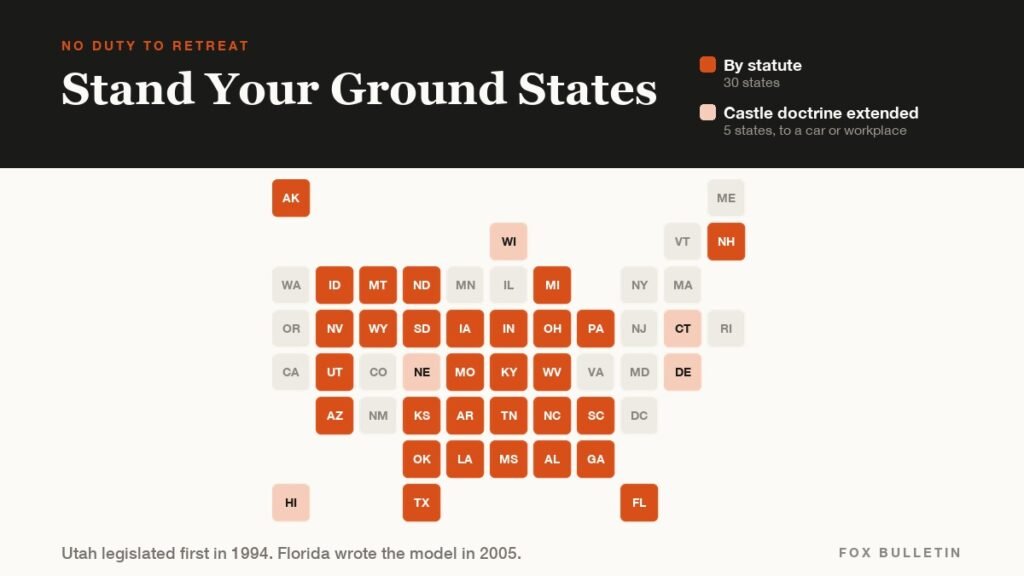
Stand Your Ground States: All 30 and the 5 In Between
Thirty states have removed the duty to retreat by statute. Here is each one with its code section, the five that went partway, and how the doctrine differs from castle doctrine.
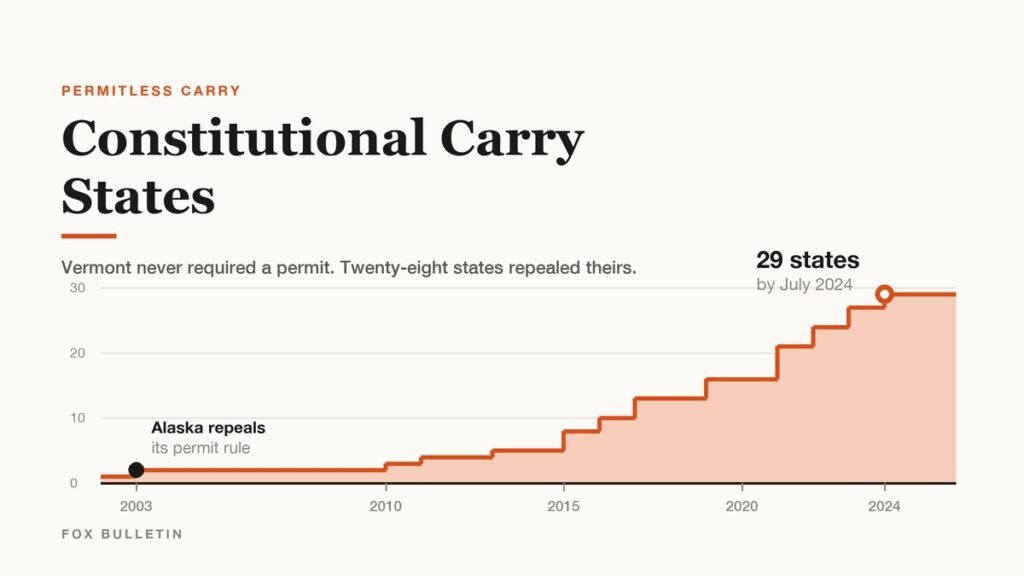
Constitutional Carry States: All 29 and the Limits
Twenty-nine states let a qualifying adult carry a concealed handgun without a permit. Here is when each law took effect, what it does not change, and why permits still matter.
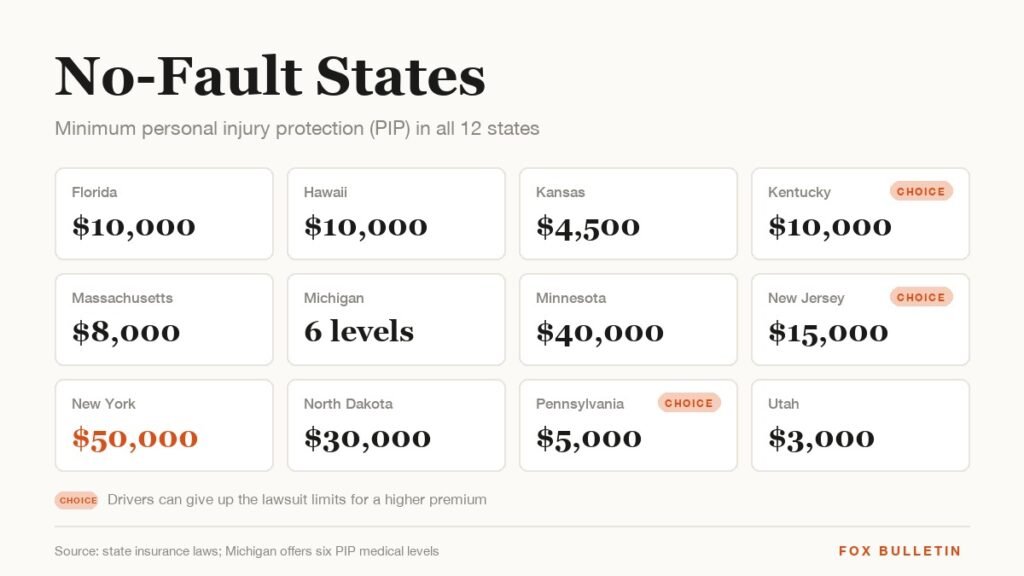
No-Fault States: All 12, With PIP Minimums and Lawsuit Rules
Florida, Hawaii, Kansas, Kentucky, Massachusetts, Michigan, Minnesota, New Jersey, New York, North Dakota, Pennsylvania and Utah use no-fault car insurance. What each requires and when you can still sue.