

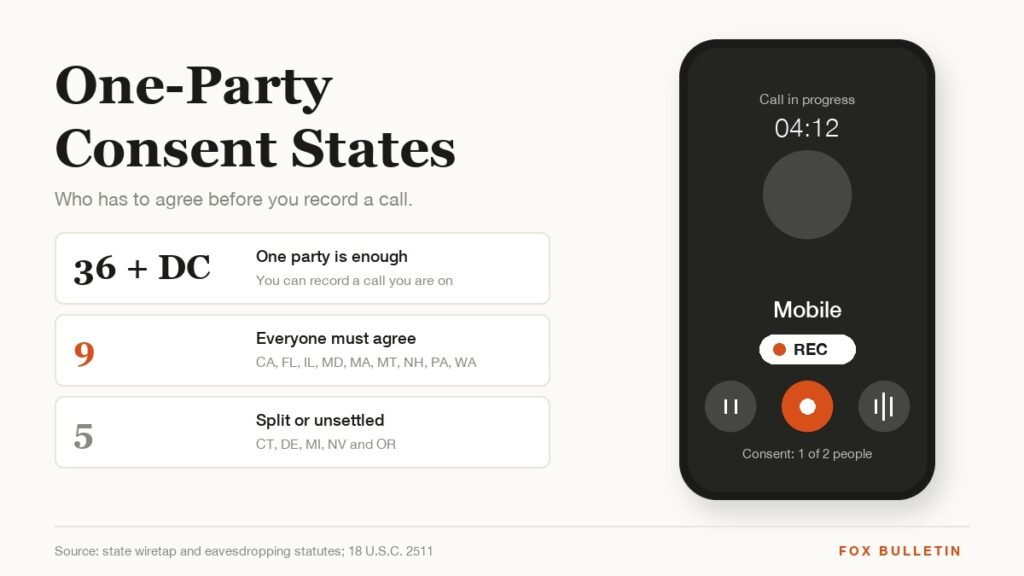
One-party consent states let you record a phone call or conversation as long as one person taking part agrees, and that person can be you. Thirty-six states and the District of Columbia follow this rule. Nine states, including California, Florida, Illinois and Pennsylvania, require the consent of everyone in the conversation, and five more have split or unsettled rules.
Federal law is one-party as well, so the state where the recording happens usually decides whether you need everyone’s permission. The table shows the rule for phone calls and for private in-person conversations in all 50 states and DC; the sections below explain the 14 states that do not follow the simple one-party rule.
| State | Phone calls | In-person private conversations |
|---|---|---|
| Alabama | One party | One party |
| Alaska | One party | One party |
| Arizona | One party | One party |
| Arkansas | One party | One party |
| California | All parties | All parties |
| Colorado | One party | One party |
| Connecticut | All parties (civil law) | One party |
| Delaware | Conflicting statutes | Conflicting statutes |
| District of Columbia | One party | One party |
| Florida | All parties | All parties |
| Georgia | One party | One party |
| Hawaii | One party | One party; all parties for devices in a private place |
| Idaho | One party | One party |
| Illinois | All parties | All parties |
| Indiana | One party | One party |
| Iowa | One party | One party |
| Kansas | One party | One party |
| Kentucky | One party | One party |
| Louisiana | One party | One party |
| Maine | One party | One party |
| Maryland | All parties | All parties |
| Massachusetts | All parties (secret recording) | All parties (secret recording) |
| Michigan | Unsettled; participants may record | Unsettled; participants may record |
| Minnesota | One party | One party |
| Mississippi | One party | One party |
| Missouri | One party | One party |
| Montana | All parties | All parties (hidden devices) |
| Nebraska | One party | One party |
| Nevada | All parties | One party |
| New Hampshire | All parties | All parties |
| New Jersey | One party | One party |
| New Mexico | One party | One party |
| New York | One party | One party |
| North Carolina | One party | One party |
| North Dakota | One party | One party |
| Ohio | One party | One party |
| Oklahoma | One party | One party |
| Oregon | One party | All parties must be informed |
| Pennsylvania | All parties | All parties |
| Rhode Island | One party | One party |
| South Carolina | One party | One party |
| South Dakota | One party | One party |
| Tennessee | One party | One party |
| Texas | One party | One party |
| Utah | One party | One party |
| Vermont | No state statute | No state statute |
| Virginia | One party | One party |
| Washington | All parties | All parties |
| West Virginia | One party | One party |
| Wisconsin | One party | One party |
| Wyoming | One party | One party |
What One-Party Consent Means Under Federal Law
The baseline is the federal Wiretap Act. Under 18 U.S.C. 2511(2)(d), a person who is not acting for the government may record a call or conversation if they are a party to it, or if one of the parties has given prior consent. The exception disappears if the recording is made to commit a crime or a tort, such as blackmail.
One-party consent has limits that are easy to miss:
- You must be a participant, or have a participant’s consent. Secretly recording a conversation you are not part of, such as leaving a phone recording in an empty room, is illegal unless a participant agreed
- Purpose still matters: a recording made to commit a crime or tort is not protected
- State law can be stricter, and when it is, the state rule applies on top of the federal one
Most state laws protect conversations where people expect privacy. A speech at a public meeting or a shouted exchange on a crowded street is generally not a private conversation, which is why the all-party states below still allow recording in many public settings.
The 9 States That Require Everyone’s Consent
These states require the consent of all parties for both phone calls and private in-person conversations. In most of them, consent does not have to be written: telling everyone at the start of the call that it is being recorded, and continuing only if nobody objects, is the standard way to comply.
1. California
Statute: Penal Code 632 · Penalty: fine up to $2,500 and up to a year in jail
California bars recording a “confidential communication” without the consent of all parties, defined as one carried on in circumstances suggesting a party wants it confined to the people taking part. Under Penal Code section 632, a first violation carries a fine of up to $2,500 per violation, up to a year in county jail, or both.
California’s rule also reaches calls from outside the state. In Kearney v. Salomon Smith Barney (2006), the California Supreme Court applied it to an Atlanta brokerage that recorded calls with California clients, even though Georgia law allowed the recordings.
2. Florida
Statute: Fla. Stat. 934.03 · Penalty: third-degree felony
Florida allows interception only when all parties to the communication have given prior consent, and a violation is a third-degree felony. The statute covers phone calls, electronic communications and oral conversations where the speakers expect privacy.
3. Illinois
Statute: 720 ILCS 5/14-2 · Penalty: felony
Illinois requires the consent of all parties to record a private conversation, meaning one in which at least one participant reasonably intended it to be private. Recording is a felony, with tougher penalties when the person recorded is a police officer, lawyer or judge carrying out official duties.
4. Maryland
Statute: Cts. & Jud. Proc. 10-402 · Penalty: up to 5 years and a $10,000 fine
Maryland makes interception lawful only when all parties have given prior consent. A criminal conviction carries up to five years in prison and a fine of up to $10,000, and the person recorded can also sue for actual and punitive damages.
5. Massachusetts
Statute: G.L. c. 272, sec. 99 · Key word: secret
Massachusetts bans secret recording, so the question is whether everyone knew, not whether everyone said yes. The state’s Supreme Judicial Court confirmed in 2021 that affirmative consent is unnecessary when all parties are aware the conversation is being recorded.
In 2020 the federal First Circuit held that the law cannot be used to stop people from secretly recording police officers doing their jobs in public places.
6. Montana
Statute: Mont. Code 45-8-213 · Key word: hidden device
Montana prohibits recording a conversation with a hidden electronic or mechanical device without the knowledge of all parties. The law exempts recordings of public officials and employees doing their jobs, people speaking at public meetings, and recordings where one party has given a warning that the conversation is being recorded.
7. New Hampshire
Statute: RSA 570-A:2 · Penalty: felony for recording without consent
New Hampshire requires the consent of all parties before a call or private conversation is recorded, and recording without it can be charged as a felony. It is one of the stricter states, applying the rule to telephone calls and in-person conversations alike.
8. Pennsylvania
Statute: 18 Pa.C.S. 5704(4) · Penalty: felony, up to 7 years and $15,000
Pennsylvania requires that all parties give prior consent, and illegal recording is a felony punishable by up to seven years in prison and a $15,000 fine. Its courts have found consent implied when the other person knew, or reasonably should have known, the call was being recorded.
9. Washington
Statute: RCW 9.73.030 · Consent by announcement: yes
Washington bars recording a private communication without first obtaining the consent of all participants. Under RCW 9.73.030, consent is obtained when one party announces to everyone, in any reasonably effective manner, that the conversation is about to be recorded, and the announcement itself has to be captured on the recording.
Connecticut, Nevada and Oregon Split Calls From Conversations
Three states apply one rule to phone calls and a different one to people talking face to face.
10. Connecticut: All-Party for Calls, One-Party in Person
Connecticut’s civil statute makes anyone who records a phone call liable for damages unless all parties consent in writing or on the recording, or a warning tone or announcement is used. Its criminal eavesdropping law needs only one participant’s consent for in-person conversations.
11. Nevada: All-Party for Calls, One-Party in Person
Nevada requires the consent of all parties to record telephone calls under NRS 200.620, and the Nevada Supreme Court in Lane v. Allstate held that the statute’s emergency exception is mainly for law enforcement. For in-person conversations, NRS 200.650 needs only one party’s authorization.
12. Oregon: One-Party for Calls, Everyone Informed in Person
Oregon reverses Nevada’s pattern. A call can be recorded with one participant’s consent, but an in-person conversation can be recorded only if all participants are specifically informed that it is being recorded.
Delaware and Michigan Remain Unsettled
13. Delaware: Two Statutes That Disagree
Delaware’s wiretapping law permits recording with the consent of one party, while its privacy law requires the consent of all parties. A federal court has held that a participant may record without the others’ consent, but with both statutes carrying penalties, getting everyone’s agreement is the cautious course.
14. Michigan: An All-Party Statute With a Participant Exception
Michigan’s eavesdropping statute requires the consent of all parties, but the Michigan Court of Appeals held in Sullivan v. Gray (1982) that a participant does not need anyone else’s consent to record their own conversation. Federal courts have followed that reading, though the Michigan Supreme Court has not ruled on it.
Vermont sits apart from both groups. It has no state statute on recording conversations at all, so the federal one-party rule is the baseline there. Hawaii is one-party for calls and conversations, but installing a recording device in a private place needs the consent of everyone entitled to privacy there.
Recording a Call Across State Lines
When the people on a call are in different states, assume the stricter state’s law applies. The Kearney case shows why: a recording that was legal where it was made still broke California law because the person on the other end was in California.
The simplest safe practice works everywhere:
- Announce the recording at the start of the call, before anything substantive is said
- Capture the announcement on the recording itself, which Washington requires
- Let anyone who objects end the call; continuing after notice is how implied consent is usually shown
- Keep the recording private unless you are sure sharing it is lawful, since some statutes also penalize disclosure
Recording at Work, on Video Calls and in the Car
The same rules cover workplace conversations. Secretly recording a meeting with a manager in an all-party state can be a crime even when the recording captures something useful, and it can give an employer a separate reason to discipline you. Whether a dismissal itself is lawful is a different question, covered in our guide to employment at will by state.
Video-meeting apps usually show participants a notice when recording starts, and in Washington an announcement made to everyone counts as consent under the statute. The notice does not change anything for a third person listening in off camera, whichever of the free VoIP services you are using.
Silent video falls outside most wiretap statutes, which are written around sound. Cabin audio does not, so a dash cam recording passengers’ conversations raises the same consent question, and some models in our dash cam comparison let you mute the microphone by voice command.
This is a summary of statutes and court decisions, not legal advice, and recording laws change. If a recording matters to a lawsuit, a custody case or a job, ask a lawyer licensed in the state involved before you rely on it.
Frequently Asked Questions
Which states are two-party consent states?
California, Florida, Illinois, Maryland, Massachusetts, Montana, New Hampshire, Pennsylvania and Washington require everyone’s consent for calls and private conversations. Connecticut and Nevada require it for phone calls, Oregon for in-person conversations, and Delaware and Michigan are unsettled.
Is Texas a one-party consent state?
Yes. Under Texas Penal Code section 16.02, a person who is a party to an in-person, telephone or electronic conversation, or who has one party’s consent, can lawfully record it. Recording a conversation you are not part of without consent is a felony there.
Can I record a phone call without telling the other person?
In a one-party consent state, yes, if you are on the call and are not recording to commit a crime or tort. If the other person is in an all-party state such as California or Florida, tell them first, because that state’s law may apply to the call.
Does “this call may be recorded” count as consent?
Usually, if you stay on the line. Washington’s statute treats an announcement to all parties as consent, Connecticut accepts a recorded warning, and Pennsylvania courts have found consent implied when a caller knew or should have known about the recording.
Related Articles
- Right-to-Work States: All 26 Listed and Explained
- Common Law Marriage States: Where It Still Exists
- Community Property States: All 9, Plus the 5 Opt-In States
- Constitutional Carry States: All 29 and the Limits
- Stand Your Ground States: All 30 and the 5 In Between
- Open Carry States
- Best Free Video Interview Software: 8 Ranked by Free Limit
- Small Claims Court: Limits in Every State and How It Works

Get the Fox Bulletin briefing
The stories that matter, in your inbox. No spam, unsubscribe anytime.
Newsletter signup will be available soon.
Related stories

Lemon Law: How a Car Qualifies and What You Get Back
A lemon law makes the manufacturer buy back or replace a new car it cannot fix. Here are the real tests in nine states, the refund formulas, and the steps to file a claim.
Statute of Limitations: What It Means and How Long You Have
A statute of limitations is the legal deadline to sue or bring charges. Here are the real time limits in four big states, the crimes with no limit, and how old debts work.
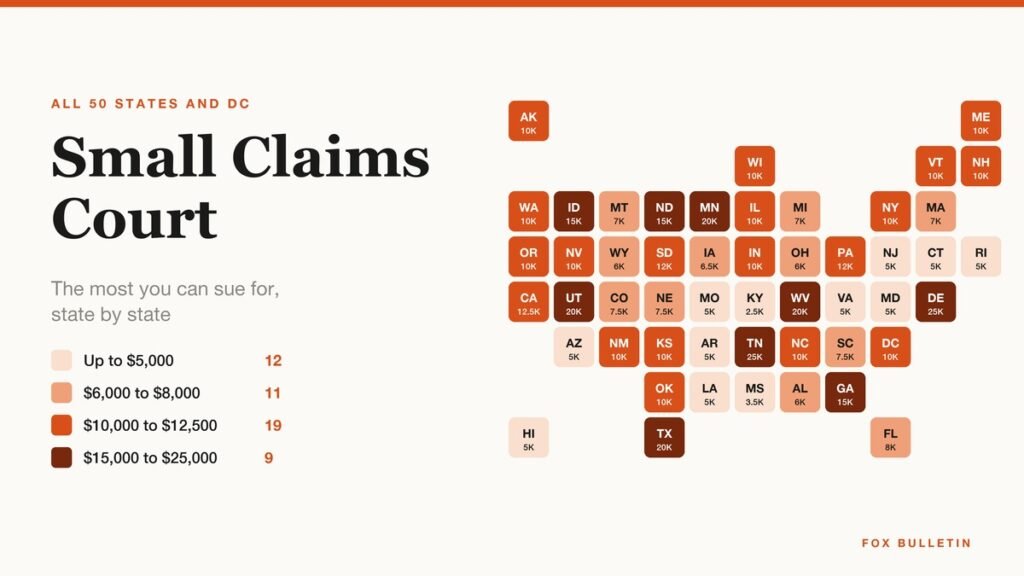
Small Claims Court: Limits in Every State and How It Works
Small claims court settles money disputes quickly and cheaply. Here is the dollar limit in every state, what it costs to file, who can bring a lawyer, and how collection works.