

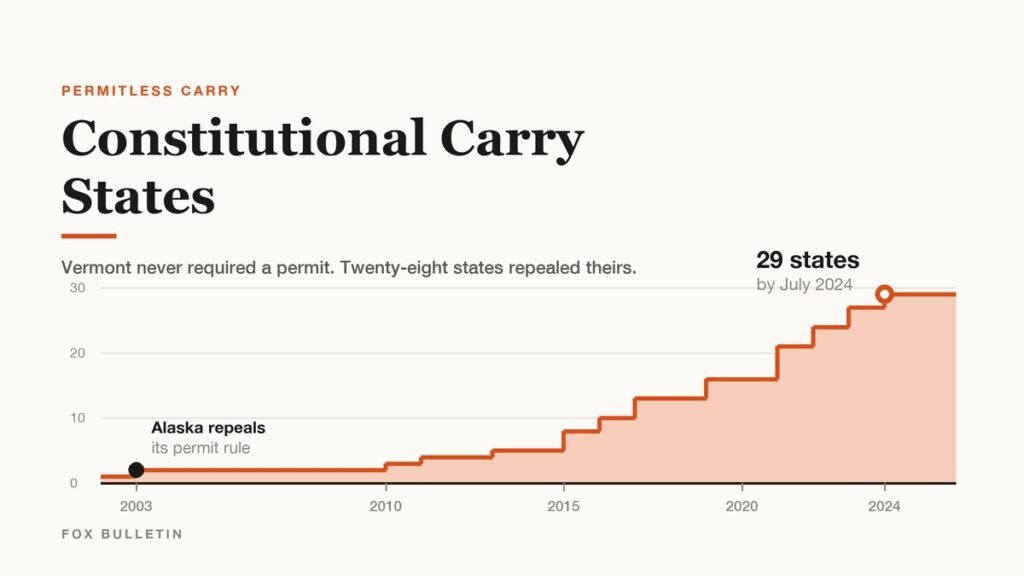
Twenty-nine states now let a qualifying adult carry a concealed handgun without a permit. The constitutional carry states range from Vermont, which never required a permit at all, to Louisiana and South Carolina, which both changed their law in 2024. The term is informal: the statutes are usually called permitless carry, and none of them removes the rest of a state firearm code.
What changes is narrow. A person who could already lawfully possess a handgun no longer needs a state permit to carry it concealed within that state. Everything else, from federal prohibitions to posted buildings, still applies. Here is every state and when its law took effect:
| State | Permitless carry since | Note |
|---|---|---|
| Vermont | Longstanding | Never required a carry permit |
| Alaska | September 9, 2003 | First state to repeal its permit requirement |
| Arizona | July 29, 2010 | |
| Wyoming | July 1, 2011 | |
| Arkansas | August 16, 2013 | |
| Kansas | July 1, 2015 | Concealed carry at 21 and over |
| Maine | October 15, 2015 | Age 21 and over |
| Mississippi | July 1, 2015 | Defined by how the handgun is carried |
| Idaho | July 1, 2016 | |
| West Virginia | May 24, 2016 | |
| Missouri | January 1, 2017 | |
| New Hampshire | February 22, 2017 | |
| North Dakota | August 1, 2017 | Concealed only, with a valid ID from your state of residence |
| Kentucky | June 27, 2019 | |
| Oklahoma | November 1, 2019 | |
| South Dakota | July 1, 2019 | |
| Iowa | July 1, 2021 | |
| Montana | February 18, 2021 | |
| Tennessee | July 1, 2021 | Handguns only |
| Texas | September 1, 2021 | |
| Utah | May 5, 2021 | Age 21 and over |
| Georgia | April 12, 2022 | |
| Indiana | July 1, 2022 | |
| Ohio | June 13, 2022 | Age 21 and over |
| Alabama | January 1, 2023 | |
| Florida | July 1, 2023 | |
| Nebraska | September 2, 2023 | |
| South Carolina | March 7, 2024 | |
| Louisiana | July 4, 2024 | Age 18 and over |
How the 29 Constitutional Carry States Got There
Vermont is the outlier and the origin of the nickname. It never enacted a permit requirement to repeal, which is why the arrangement was called Vermont carry long before any other state copied it. Alaska was the first to actually repeal a requirement, in 2003, and Arizona followed seven years later.
The pace changed after 2015. Kansas, Maine, Mississippi, Idaho and West Virginia all acted within two years, and the run from 2021 to 2024 added eleven more states, including Texas, Florida, Georgia, Ohio and Alabama. South Carolina in March 2024 and Louisiana in July 2024 were the most recent, which is why older summaries of this subject are usually two or three states out of date.
What Permitless Carry Does Not Change
The single most common misreading of these laws is treating them as a general permission. They are a narrow repeal of one requirement, and six categories of rule survive untouched:
- Federal prohibitions. Anyone barred from possessing a firearm under federal law, including people with felony convictions, certain domestic violence convictions and others, gains nothing from a permitless carry statute.
- Federal location rules. School zones, federal buildings, post offices, military installations and the secure areas of airports are governed by federal law, which these state statutes do not touch.
- State location bans. Every one of the 29 keeps a list of places where carry remains unlawful, typically courthouses, police stations, jails, polling places, schools and licensed premises.
- Private property. A business or a homeowner can still prohibit firearms, and in many states a posted sign carries the force of law.
- Background checks at dealers. Buying from a licensed dealer still requires the federal form and a check, whatever the carry rule is.
- Intoxication and conduct rules. Carrying while impaired, brandishing and reckless handling remain offenses.
Mississippi is a useful example of how specific the statutes get. State law there provides that no license is required for a pistol or revolver carried in a sheath, belt or shoulder holster, or in a purse, handbag, satchel, similar bag, briefcase or fully enclosed case, provided the person is not engaged in criminal activity, is not otherwise prohibited from possessing it and is not in a prohibited location. The exemption is defined by the manner of carry rather than by a blanket right.
The Limits Inside the 29
Permitless carry is not one rule repeated 29 times. The differences decide real cases:
- Age is the most common divider. Most of the 29 set the floor at 21, a few at 18, and Louisiana wrote 18 into its 2024 act. Federal law separately limits handgun purchases from licensed dealers to 21 and over, so an 18-year-old may be able to carry a handgun lawfully in a state and still not be able to buy one from a dealer there.
- Method of carry can be the operative rule. Mississippi does not frame its law around who you are but around how the pistol is carried, and North Dakota applies to concealed carry rather than to open carry.
- Some states cover handguns only. Tennessee wrote its statute around handguns, so it does not extend to long guns in the way a general carry right would.
- Residency and identification can matter. North Dakota requires a valid driver license or state identification card from your state of residence.
- Local pre-emption varies. Most of these states bar cities from writing their own carry ordinances, but the strength of that pre-emption differs.
North Dakota shows how precise the drafting is. Chapter 62.1-04 of the Century Code lets an individual who is not otherwise precluded from holding a class 2 firearm and dangerous weapon license, and who has a valid driver license or non-driver identification card from their state or territory of residence, carry a firearm concealed. That is a different structure from a statute that simply says no permit is required.
Why People Still Get a Permit
Permit applications did not stop in these states, and the reasons are practical rather than symbolic:
- Reciprocity. A permit is what other states recognize. Permitless carry applies only inside the state that passed it, so the moment you cross a line you are back to whether your permit is honored there.
- Dealer purchases. In several states a carry permit substitutes for the federal background check at the point of sale, which shortens the transaction.
- Posted and restricted places. Some state statutes carve out exceptions for permit holders that do not apply to everyone else.
- Proof of status. A permit is a document that answers the question quickly during a traffic stop, which is worth something in states with a duty to inform.
- Training. Permit courses cover the use-of-force law that decides whether a defensive act was lawful, and no permitless carry statute teaches that.
Reciprocity is the decisive one for anyone who drives. Permitless carry has no effect across a state line, and the states that do not have it include most of the Northeast and the West Coast. A resident of a permitless state who travels with a handgun and no permit is relying entirely on the law of whichever state they are standing in.
Bruen Reshaped the Permit Rules in the Other States
The states without permitless carry changed too, through litigation rather than legislation. In 2022 the Supreme Court decided New York State Rifle and Pistol Association v. Bruen, and held that New York proper-cause requirement violates the Fourteenth Amendment by preventing law-abiding citizens with ordinary self-defense needs from exercising their Second Amendment right to bear arms in public.
The practical result was the end of may-issue permitting, under which an official could refuse a permit to an applicant who could not show a special need. States that had operated that way moved to shall-issue systems, several of them while adding training requirements and long lists of sensitive places where carry remains prohibited. Bruen also replaced the two-step test the courts of appeals had developed with an inquiry into whether a regulation is consistent with the historical tradition of firearm regulation, which is why so much carry litigation is still working through the courts.
Carrying Across State Lines
Three rules govern a trip. Inside a permitless state, no permit is needed. Inside a state that requires one, your permit works only if that state recognizes it, and reciprocity agreements differ for every pair of states. In transit, federal law provides a narrow safe-passage protection for transporting an unloaded firearm, locked away from the passenger compartment, between two places where you may lawfully have it.
That safe-passage rule covers transport, not carry, and it does not override a state that prohibits possession at your destination. The patchwork is the point: carry law is state law, in the same way that recording consent rules and right to work laws are, and the answer changes at the border rather than at the airport.
Frequently Asked Questions
How many constitutional carry states are there?
Twenty-nine. Vermont never required a permit, Alaska was the first to repeal one in 2003, and South Carolina and Louisiana were the most recent to join, in March and July 2024.
Does constitutional carry mean anyone can carry a gun?
No. It applies only to people who may already lawfully possess a firearm. Federal prohibitions, state location bans, private property rules and conduct offenses all continue to apply, and several states set the age floor at 21.
Do you still need a permit in a constitutional carry state?
Not to carry inside that state. Many residents keep one anyway for reciprocity when traveling, for faster purchases from dealers where the permit substitutes for the point-of-sale check, and for exceptions that some statutes grant only to permit holders.
Is open carry the same as constitutional carry?
No. Open and concealed carry are regulated separately in many states, and some permitless carry statutes address only one of them. North Dakota, for example, frames its provision around carrying concealed.
A Note on Legal Advice
This article is general information rather than legal advice, and firearm law changes frequently. The details that decide a specific situation, including prohibited locations, age thresholds and any duty to inform an officer, are set state by state and sometimes revised in a single legislative session.
Anyone carrying a firearm, and particularly anyone carrying across state lines, should check the current statute and the state police or attorney general guidance for each state involved, and consult an attorney licensed there about anything turning on the specifics.
Related Articles

Get the Fox Bulletin briefing
The stories that matter, in your inbox. No spam, unsubscribe anytime.
Newsletter signup will be available soon.
Related stories
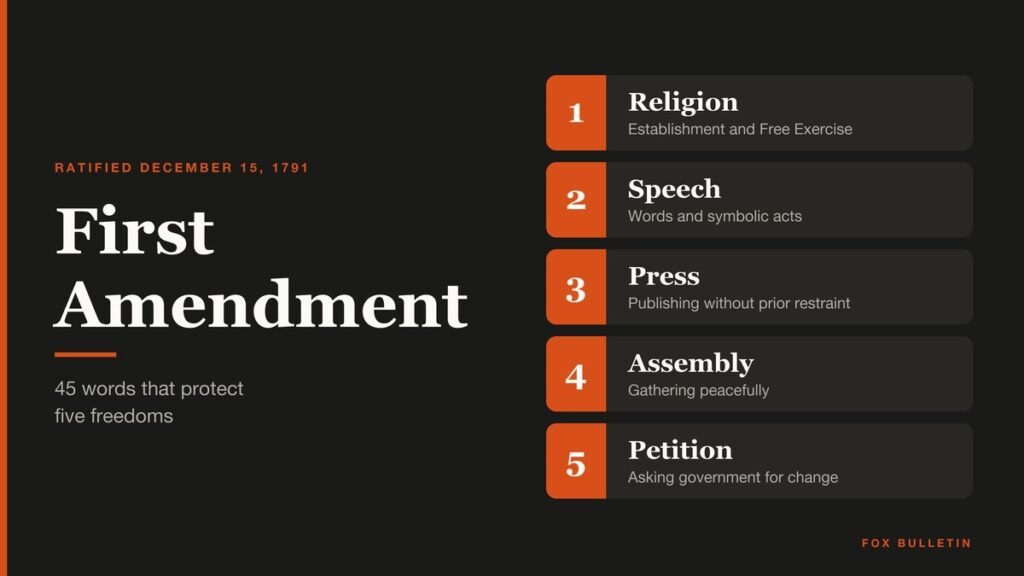
First Amendment: The 5 Freedoms and the Cases Behind Them
The 45 words of the First Amendment cover five freedoms. Here is the exact text, how it was ratified, and the landmark Supreme Court cases behind each freedom.

Lemon Law: How a Car Qualifies and What You Get Back
A lemon law makes the manufacturer buy back or replace a new car it cannot fix. Here are the real tests in nine states, the refund formulas, and the steps to file a claim.
Statute of Limitations: What It Means and How Long You Have
A statute of limitations is the legal deadline to sue or bring charges. Here are the real time limits in four big states, the crimes with no limit, and how old debts work.