

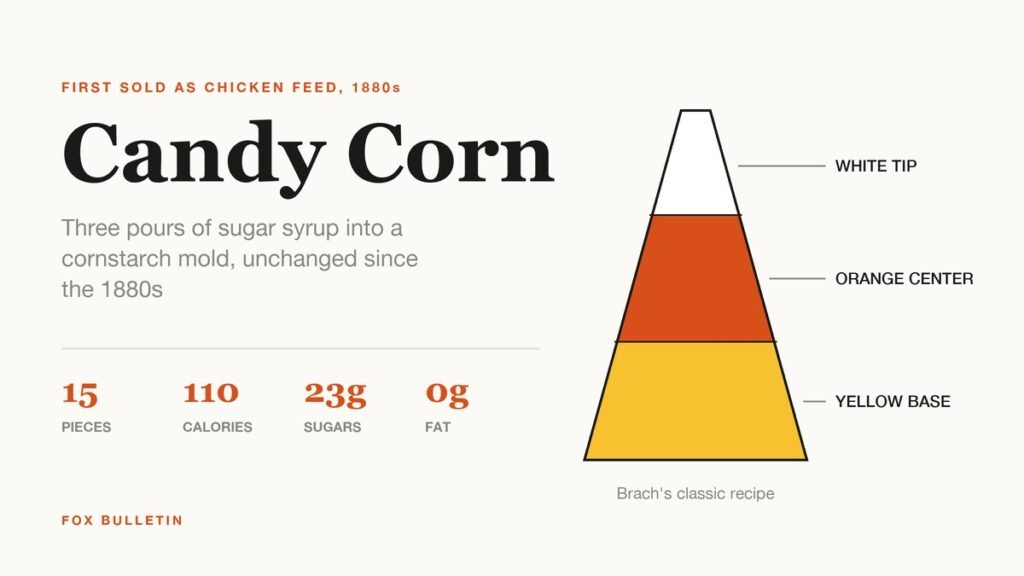
Candy corn is a three-layer sugar kernel with a white tip, an orange middle and a yellow base, and it has been made in essentially the same way since the 1880s. It was invented in Philadelphia, it was originally sold as Chicken Feed, and it was a year-round penny candy for fifty years before anyone thought of it as a Halloween sweet.
The kernel is sugar, corn syrup and binders, cooked and poured into cornstarch molds in three passes. Everything below comes from the makers’ own ingredient panels and from the two trade bodies that publish seasonal confectionery figures.
| Question | Answer |
|---|---|
| First made | Late 1880s, Philadelphia |
| Original name | Chicken Feed |
| Credited inventor | George Renninger, Wunderle Candy Company |
| First mass producer | Goelitz Confectionery Company, from 1898 |
| Goelitz today | Jelly Belly Candy Company |
| Largest maker now | Brach’s, owned by Ferrara Candy Company |
| Core ingredients | Sugar, corn syrup, confectioner’s glaze, salt, dextrose, gelatin, sesame oil, honey |
| Serving | 15 pieces, 110 calories, 0g fat, 23g sugars, 65mg sodium |
| Named day | National Candy Corn Day, October 30 |
Who Invented Candy Corn and Why It Was Called Chicken Feed
Production started in the late 1880s, and the recipe is credited to George Renninger, an employee of the Wunderle Candy Company in Philadelphia. Wunderle was the first company to sell the tri-colored kernel. The Goelitz Confectionery Company picked it up in 1898 and became the first large-scale producer, selling it under the name Chicken Feed.
The name was a sales pitch rather than a joke. American confectioners in the late nineteenth century were aiming at a largely rural market, and they molded butter cream candies into farm and field shapes: chestnuts, turnips, clover leaves. What made this one stick was the three-color layering, which no other molded candy of the period had.
Goelitz is still in business under a different name. It is now the Jelly Belly Candy Company, and the original kernel is still part of its range. The volume, though, has moved elsewhere: Brach’s, a Ferrara Candy Company brand, is now the dominant producer.
What Is Actually in Candy Corn
The ingredient panel is short and has not changed much in a century. Brach’s lists its Classic Candy Corn as sugar, corn syrup, confectioner’s glaze (shellac), salt, dextrose, gelatin, sesame oil, artificial flavor, honey, Yellow 6, Yellow 5 and Red 3.
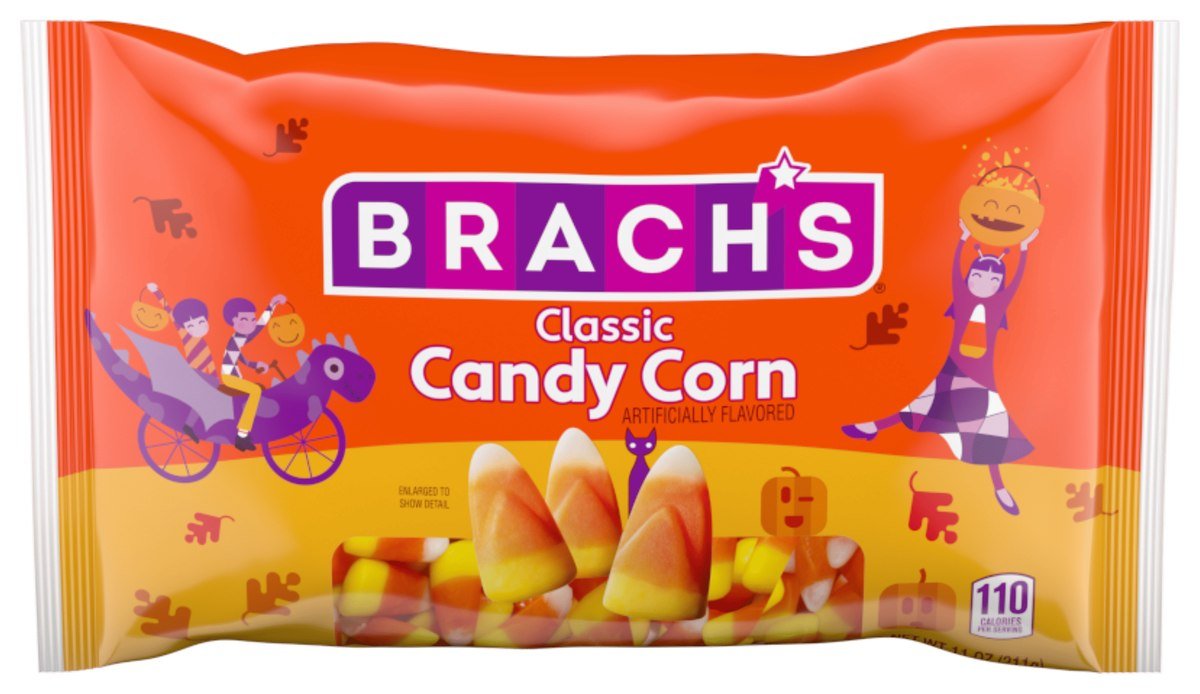
Two of those deserve a note. Confectioner’s glaze is shellac, a resin secreted by the lac insect, which is what gives the kernel its faint sheen and its slightly waxy bite. Gelatin is an animal product, which is why the classic recipe is not vegetarian. The flavor people recognize is built on honey, sugar and vanilla notes rather than anything corn-derived.
The nutrition panel is the same across the range: a serving of 15 pieces carries 110 calories, no fat, 23 grams of sugars and 65 milligrams of sodium. Brach’s sells the classic bag in 3.5, 4.2, 11, 20 and 34 ounce sizes, which is worth knowing if you are filling a bowl rather than a lunchbox.
How Candy Corn Is Made in Cornstarch Molds
The method is called cornstarch modeling, and it predates the candy. Sugar, corn syrup and water are cooked into a slurry, fondant is added for texture and marshmallow for a softer bite, then the hot syrup is poured into kernel-shaped impressions pressed into trays of cornstarch.
The three colors are three separate pours into the same impression, white first at what becomes the tip, then orange, then yellow. Each layer sets before the next goes in, which is why the bands are sharp rather than blended. The trays go through a starch mogul, the machine that stamps the molds and fills them in sequence. Originally all of this was done by hand.
The finished kernels are tumbled with glaze to seal them. That is the whole process, and it is the reason the candy survives months in a bag: there is almost no water left in it.
Harvest Corn, Reindeer Corn and the Other Seasonal Variants
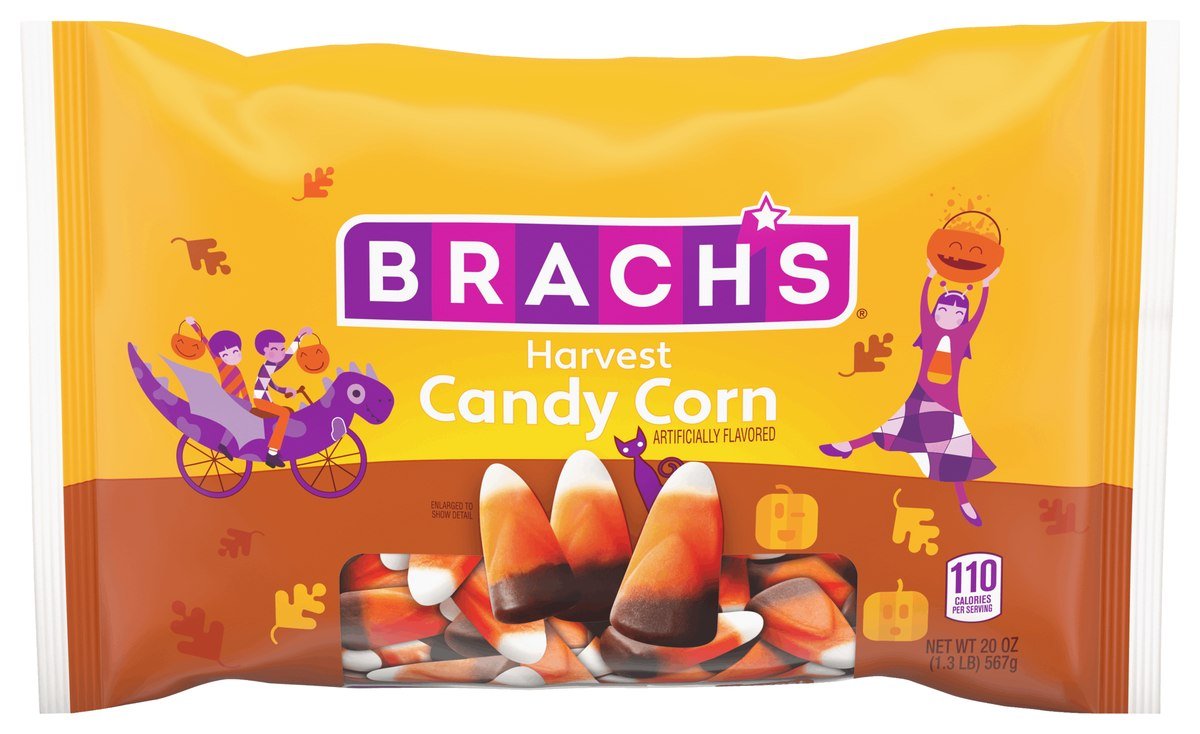
The best known variant swaps the autumn palette for a chocolate one. Brach’s Harvest Corn adds cocoa powder, giving a brown wide end, an orange center and a white tip, and it sells in 11 and 20 ounce bags. The ingredient list differs from the classic in a few places: cocoa powder, hydrogenated palm kernel oil and soy lecithin go in, and the bag carries a soy allergen warning.
The rest of the calendar gets its own colorways, all built on the same kernel:
- Reindeer corn: red wide end, green center, white tip, sold at Christmas.
- Cupid corn: red wide end, pink center, for Valentine’s Day.
- Bunny corn: pastel bases in pink, green, yellow and purple with white tips, for Easter.
- Freedom corn: blue, white and red, sold around Independence Day.
Flavored runs come and go, including caramel apple, green apple, s’mores, pumpkin spice and birthday cake. In 2022 Brach’s put out a tailgate mix with fruit punch, vanilla ice cream, popcorn, hot dog and hamburger pieces, which is the point at which the format stopped being about corn at all.
How Much Candy Corn America Buys Each Fall
Candy corn sits inside a much larger seasonal number. The National Confectioners Association puts chocolate, candy, gum and mint sales at more than $4.5 billion during the eight-week Halloween season, with an estimated 89 percent of shoppers buying confectionery in that window.
The National Retail Federation’s 2026 survey, which polled 7,889 consumers between September 1 and 9 with a margin of error of plus or minus 1.1 percentage points, expects $13.5 billion in total Halloween spending this year, or $115.14 per person, with 74 percent of people celebrating. Candy alone accounts for $4.1 billion of that, and 96 percent of consumers say they plan to buy sweets, a higher share than for costumes or decorations.
Production figures are harder to pin down, because makers rarely publish them. The industry figure in circulation since 2016 is roughly 35 million pounds a year, close to 9 billion individual kernels. Our guide to the most popular Halloween candy covers which brands actually move the most volume on Halloween night.
Why Candy Corn Divides People
Two things about the candy explain most of the argument. The first is texture: shellac and a very low moisture content give it a dense, slightly waxy chew that has no real equivalent in a chocolate bar. The second is sweetness with almost nothing to cut it, since there is no fat, no salt to speak of and no cocoa.
It also carries a seasonal load that most sweets do not. Candy corn was a year-round penny candy for the first half of the twentieth century and only became a Halloween fixture in the 1950s, when households switched to handing out individually wrapped sweets to trick-or-treaters. If you are filling bags for a trunk or treat, a bowl of kernels reads as decoration as much as it does as candy.
The National Confectioners Association marks October 30, the day before Halloween, as National Candy Corn Day, which is about as close to an official position as the industry takes.
Cooking and Baking With Candy Corn
The kernels melt, which is the basis of most things people do with them beyond eating from the bowl. Low heat turns them into a thick honey-colored syrup that sets hard again as it cools, so they work folded into bark, pressed into cookie dough before baking, or melted into frosting for color.
Three rules save most attempts:
- Melt them slowly and in short bursts, because the sugar scorches well before it bubbles.
- Add them to cookie dough on top rather than mixed through, or they dissolve into holes in the crumb.
- Keep opened bags sealed, since the kernels take on moisture from the air and go sticky.
For a seasonal snack that is not sugar, the same oven session can handle roasted pumpkin seeds, which uses the part of the pumpkin most people throw away.
Frequently Asked Questions
Is candy corn vegetarian or vegan?
The classic recipe is neither. Brach’s lists gelatin, an animal-derived ingredient, and confectioner’s glaze, which is shellac from the lac insect. Some smaller makers produce gelatin-free versions, so the ingredient panel on the specific bag is the only reliable check.
Does candy corn contain real corn?
Only as corn syrup and dextrose. The name and shape come from the kernel it was molded to resemble, not from corn as a flavor. The taste people identify is built on honey, sugar and vanilla.
How long does candy corn last?
Longer than most candy, because it holds very little moisture once it leaves the mold. Unopened bags keep until the best-by date printed on the pack. Once a bag is open the kernels pick up humidity from the air and clump together, so an airtight container matters more than the date does.
What is the difference between candy corn and harvest corn?
Harvest corn adds cocoa powder and reverses the palette, with a chocolate brown wide end instead of a yellow one. The shape, the molding method and the nutrition panel are the same. It is usually sold closer to Thanksgiving than to Halloween.
Related Articles

Get the Fox Bulletin briefing
The stories that matter, in your inbox. No spam, unsubscribe anytime.
Newsletter signup will be available soon.
Related stories

Best Vacuum Cleaner: 7 Uprights and Sticks Compared
Seven vacuum cleaners compared on type, weight and filtration, with the difference between HEPA, cyclonic and washable filters explained.
Best Mattresses: 7 Boxed Queens Compared on Feel and Cooling
Seven boxed queen mattresses compared on feel, cooling and support, with the foam certifications and the federal fire rule explained.
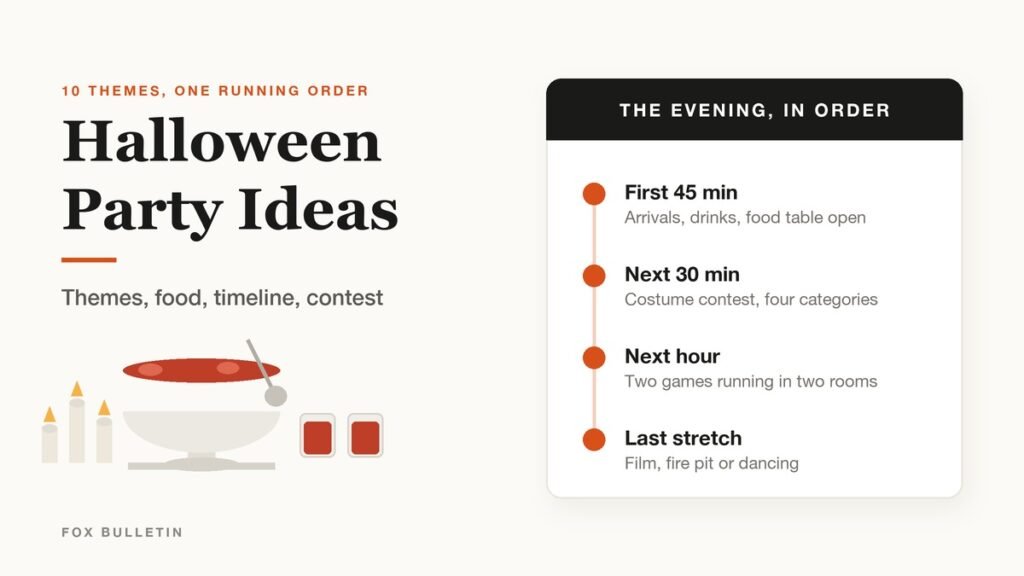
Halloween Party Ideas: 10 Themes, Food and a Timeline
Ten party themes with the decor, food and costume rule for each, a running order for the evening, and the food, drink and budget decisions that make or break a Halloween party.