

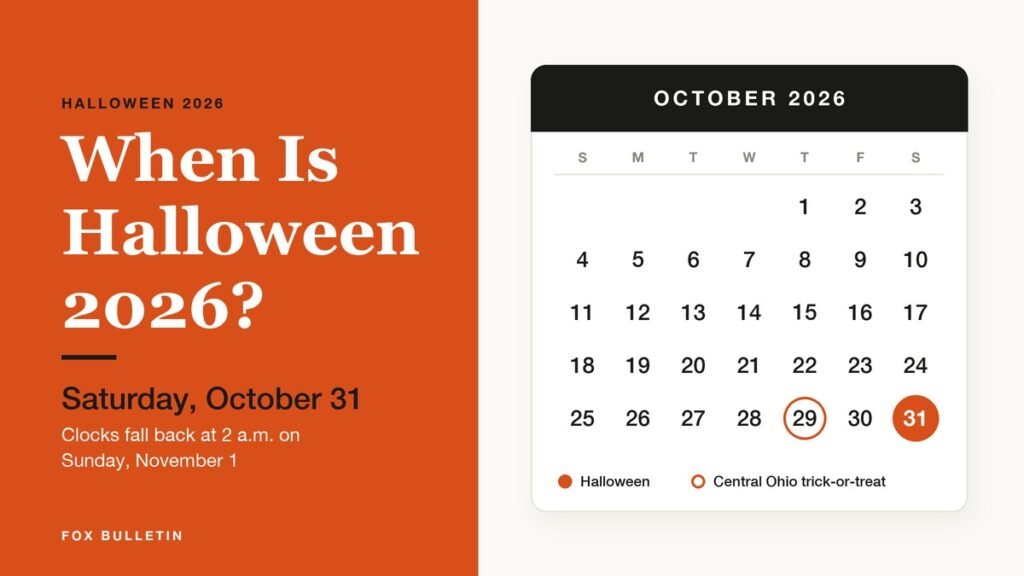
When is Halloween in 2026? It falls on Saturday, October 31, the same calendar date it lands on every year, and it is the first Saturday Halloween since 2020. Clocks then fall back one hour at 2 a.m. the next morning, so Halloween night is the last evening of daylight saving time this year.
With Halloween on a weekend, most towns that have announced hours are trick-or-treating on the 31st itself, though not all. Central Ohio’s regional guideline moves it to Thursday, October 29, and a few Wisconsin suburbs pick an afternoon or the Sunday before. The dates around the holiday, from the last federal day off before it to Day of the Dead, fall like this:
| Date (2026) | What happens |
|---|---|
| Monday, Oct. 12 | Columbus Day, the last federal holiday before Halloween |
| Thursday, Oct. 29 | Recommended trick-or-treat night across Central Ohio |
| Saturday, Oct. 31 | Halloween; trick-or-treat night in most US towns |
| Sunday, Nov. 1 | All Saints’ Day; daylight saving time ends at 2 a.m.; Day of the Dead begins |
| Monday, Nov. 2 | All Souls’ Day; second day of Day of the Dead |
| Wednesday, Nov. 11 | Veterans Day, the next federal holiday |
Why Halloween Is Always on October 31
Halloween is a fixed-date holiday, not one pinned to a weekday the way Thanksgiving is pinned to the fourth Thursday of November. Its date comes from the Christian calendar. The name is a contraction of All Hallows’ Eve, the evening before All Hallows’ Day, better known as All Saints’ Day, on November 1. “Hallow” is an old word for a saint, and the Scots shortened “even” (evening) to “e’en,” which is how All Hallows’ Even became Hallowe’en.
Major Christian feasts have long opened with a vigil the night before, and All Saints’ was no exception. Together with All Souls’ Day on November 2, the three days form Allhallowtide, a stretch of the Western church year set aside for remembering saints, martyrs and the dead. November 1 itself was settled in 835, when the Frankish Empire adopted it as the date of All Saints’ Day.
Because the date never moves, the only thing that changes from year to year is the weekday. That is what decides whether trick-or-treat lands on a school night, whether towns shift it, and how close it sits to the clock change.
When Is Halloween From 2026 to 2031? The Weekday by Year
Halloween moves forward one weekday each year and jumps two after a February 29, which is why it skips Monday in 2028, a leap year. Here are the next six years, with the date clocks fall back each year under the current federal rule:
| Year | Halloween (Oct. 31) falls on | Clocks fall back |
|---|---|---|
| 2026 | Saturday | Sunday, Nov. 1 |
| 2027 | Sunday | Sunday, Nov. 7 |
| 2028 | Tuesday | Sunday, Nov. 5 |
| 2029 | Wednesday | Sunday, Nov. 4 |
| 2030 | Thursday | Sunday, Nov. 3 |
| 2031 | Friday | Sunday, Nov. 2 |
Three patterns stand out. Halloween 2026 and 2027 both fall on a weekend, then the holiday returns to weeknights from 2028 to 2031. After this year, the next Saturday Halloween is in 2037. And because daylight saving time ends on the first Sunday of November, which is always between November 1 and 7, Halloween night always falls on daylight time under the current rule. In 2026 the gap shrinks to its minimum: the change comes just hours after the last trick-or-treaters head home.
Is Halloween a Federal Holiday?
No. Halloween is not a federal holiday. Federal holidays are set by law in 5 U.S.C. 6103, and the Office of Personnel Management’s schedule for 2026 contains 11 dates:
- New Year’s Day: Thursday, January 1
- Birthday of Martin Luther King, Jr.: Monday, January 19
- Washington’s Birthday: Monday, February 16
- Memorial Day: Monday, May 25
- Juneteenth National Independence Day: Friday, June 19
- Independence Day: observed Friday, July 3
- Labor Day: Monday, September 7
- Columbus Day: Monday, October 12
- Veterans Day: Wednesday, November 11
- Thanksgiving Day: Thursday, November 26
- Christmas Day: Friday, December 25
Columbus Day on October 12 and Veterans Day on November 11 bracket Halloween, but nothing in between is a federal day off. The question matters less than usual in 2026, since the 31st falls on a weekend. In 2028, 2029 and 2030, when Halloween falls midweek, it will be a regular weekday with no federal day off.
Trick-or-Treat Hours for Halloween 2026 in US Cities
Trick-or-treat hours are set locally. Each city, town, village or township decides for itself, usually through the mayor’s office or town officials, and many publish the times as recommended hours, as Lockport and MORPC describe theirs. Announcements tend to land between late August and early October. These are the 2026 hours already set by the communities below:
| Community | Day | Hours |
|---|---|---|
| Milwaukee, Wisconsin | Saturday, Oct. 31 | 5 to 7 p.m. |
| Normal, Illinois | Saturday, Oct. 31 | 5 to 8 p.m. |
| Lockport, Illinois | Saturday, Oct. 31 | 4 to 7 p.m. |
| Bedford, Indiana | Saturday, Oct. 31 | 5:30 to 8:30 p.m. |
| Lawton, Oklahoma | Saturday, Oct. 31 | 6 to 9 p.m. |
| Shorewood, Wisconsin | Saturday, Oct. 31 | 1 to 4 p.m. |
| Perry Township, Ohio | Thursday, Oct. 29 | 6 to 8 p.m. |
| Tallmadge, Ohio | Thursday, Oct. 29 | 5:30 to 7 p.m. |
| Wauwatosa, Wisconsin | Sunday, Oct. 25 | 1 to 4 p.m. |
The common window is two to three hours starting between 4 and 6 p.m., which in most of the country spans sunset. Milwaukee’s 5 to 7 p.m. slot straddles its 5:45 p.m. sunset. The Town of Normal’s announcement pairs its 5 to 8 p.m. hours with a simple rule repeated by many towns: approach only homes with an exterior light on.
Shorewood, along with River Hills and Whitefish Bay, keeps trick-or-treat in the afternoon from 1 to 4 p.m. Wauwatosa goes earlier still, on Sunday, October 25, so families there should not wait for the 31st.
Why Central Ohio Trick-or-Treats on Thursday, October 29
The Mid-Ohio Regional Planning Commission (MORPC) publishes a recommended date that most Columbus-area communities follow. Its rule is fixed: when October 31 falls on a Friday, Saturday or Sunday, trick-or-treat moves to the Thursday before; on any other weekday it stays on the 31st. That puts Central Ohio’s 2026 night on Thursday, October 29, and the date does not change for bad weather.
Locally the night is still called Beggar’s Night. Each community picks its own hours, which is why Perry Township runs 6 to 8 p.m. Tallmadge follows its own version of the custom and always holds it on the last Thursday of October, which this year is also the 29th.
Des Moines Now Trick-or-Treats on Halloween Night
The Des Moines metro retired its Beggars’ Night in 2025 after nearly 90 years. The custom began in 1938, when police logged more than 550 vandalism reports in one Halloween night and city leaders moved trick-or-treating to October 30, asking children to earn candy with a joke or riddle. A survey of more than 4,300 residents favored Halloween itself, and by 2026, with the 31st on a Saturday, every metro community is expected to celebrate on the same night. The jokes are staying.
How to Find Your Town’s Official Hours
Because the decision is local, the fastest way to confirm your hours is to check the people who set them:
- Look for a news post on your city, village or township website. Many post the hours as a news flash with safety reminders.
- Read the mayor’s or council’s announcement if your town has no news page.
- In Central Ohio, check MORPC’s recommended date, then confirm your community kept it.
- Scan your local newspaper or TV station’s area list, which pulls many towns into one roundup.
Daylight Saving Time Ends the Morning After Halloween 2026
According to the National Institute of Standards and Technology, daylight saving time in 2026 runs from March 8 to November 1, ending at 2 a.m. local time, when clocks go back to 1 a.m. and that hour repeats. The current rule, ending on the first Sunday in November, dates to 2007, when the Energy Policy Act of 2005 lengthened daylight saving time by about a month.
Halloween night therefore keeps its later sunset, and the evening after it gets dark an hour earlier on the clock. Sunset times from the US Naval Observatory show the jump:
| City | Sunset on Sat., Oct. 31 | Sunset on Sun., Nov. 1 |
|---|---|---|
| New York City | 5:53 p.m. EDT | 4:52 p.m. EST |
| Chicago | 5:46 p.m. CDT | 4:45 p.m. CST |
| Milwaukee | 5:45 p.m. CDT | 4:43 p.m. CST |
| Los Angeles | 6:01 p.m. PDT | 5:00 p.m. PST |
Not everyone changes clocks. Daylight saving time is not observed in Hawaii, American Samoa, Guam, Puerto Rico, the US Virgin Islands or Arizona, except on the Navajo Nation, so trick-or-treaters there see no shift on Sunday.
Congress has not changed the rule for this year. The House passed the Sunshine Protection Act of 2025 (H.R. 139), which would make daylight saving time permanent, on July 14, 2026, but the bill still needs the Senate, so the November 1 change goes ahead unless that happens first.
All Saints’ Day, All Souls’ Day and Day of the Dead in 2026
The two church days that follow Halloween fall on a Sunday and Monday this year:
- All Saints’ Day: Sunday, November 1, 2026. It honors all saints and martyrs and is the feast that gives Halloween its name.
- All Souls’ Day: Monday, November 2, 2026, a day of prayer for all the faithful departed, observed by Christians on November 2.
- Day of the Dead (Día de Muertos): traditionally November 1 and 2, with some places adding October 31 or November 6.
Day of the Dead is a separate holiday from Halloween, centered on Mexico. Families build home altars called ofrendas with the favorite food and drink of relatives who have died, decorate graves with cempazúchitl marigolds, and share pan de muerto. UNESCO added it to its list of the Intangible Cultural Heritage of Humanity in 2008. The Library of Congress notes that the longer name, Día de los Muertos, was rarely used in Latin America before the 1960s; both versions are common now.
Planning Halloween Week 2026 Around a Saturday
Door-to-door hours are only one slot in a town’s Halloween calendar. Many community events run across the two weeks before the 31st. Normal, Illinois, shows how a single town spreads things out in 2026:
- Haunted Trail: a not-so-scary version from 6 to 8 p.m. on October 15 to 17 and a scary version from 6:30 to 9 p.m. on October 23 and 24, on the Constitution Trail
- Halloween Hoopla: 6 to 8 p.m. on Friday, October 23, at the Children’s Discovery Museum
- Treat Feast: business-district trick-or-treating in Uptown Normal from 5 to 6:30 p.m. on Thursday, October 29
- Neighborhood trick-or-treat: 5 to 8 p.m. on Saturday, October 31
With Halloween on a Saturday, families get the afternoon to get ready instead of rushing home from school. If a costume is still undecided, our Halloween costume guide sorts picks for adults, kids, couples and pets.
Games mark the weekend too. Pokémon GO removes its daily limit on GO Points from 12:00 a.m. on Saturday, October 31, to 11:59 p.m. on Sunday, November 1, local time, one of several late-October dates in our Pokémon GO events calendar.
Frequently Asked Questions
What day is Halloween 2026?
Halloween 2026 is on Saturday, October 31. It falls on October 31 every year, and the next time it lands on a Saturday after this year is 2037.
Is Halloween a federal holiday in the US?
No. The 11 federal holidays are set by 5 U.S.C. 6103, and Halloween is not among them. The nearest federal holidays in 2026 are Columbus Day on October 12 and Veterans Day on November 11.
What time does trick-or-treating start on Halloween 2026?
Each town sets its own hours, and typical windows start between 4 and 6 p.m. on Saturday, October 31, and last two to three hours. Milwaukee runs 5 to 7 p.m. and Normal, Illinois, 5 to 8 p.m., while much of Central Ohio trick-or-treats on Thursday, October 29.
Do the clocks change on Halloween weekend in 2026?
Yes. Daylight saving time ends at 2 a.m. on Sunday, November 1, 2026, the morning after Halloween, when clocks go back one hour. Hawaii and most of Arizona do not change their clocks.
Related Articles
- How to Carve a Pumpkin: Step by Step, Plus How to Make It Last
- How to Roast Pumpkin Seeds: Oven Times, Temperatures and Seasonings
- Halloween Horror Nights 2026: Dates, Houses and Ticket Prices
- Trunk or Treat Ideas: 12 Themes, Games and Setups
- Ted Kaczynski: The Unabomber Case Explained
- Zodiac Signs: All 12 Dates, Meanings and Constellations
- When Is Thanksgiving? This Year’s Date and the Next 10 Years

Get the Fox Bulletin briefing
The stories that matter, in your inbox. No spam, unsubscribe anytime.
Newsletter signup will be available soon.
Related stories

Indoor Plants: 15 Easy Houseplants and How to Keep Them Alive
Fifteen easy indoor plants with the light level, watering rhythm, temperature and pet safety for each, plus how to measure your light and what NASA really tested.

Birthstones by Month: Every Stone, Color and Meaning
Every month's birthstone, its color and Mohs hardness, where it comes from, how to care for it, and how jewelers built the list in 1912 and kept adding to it.
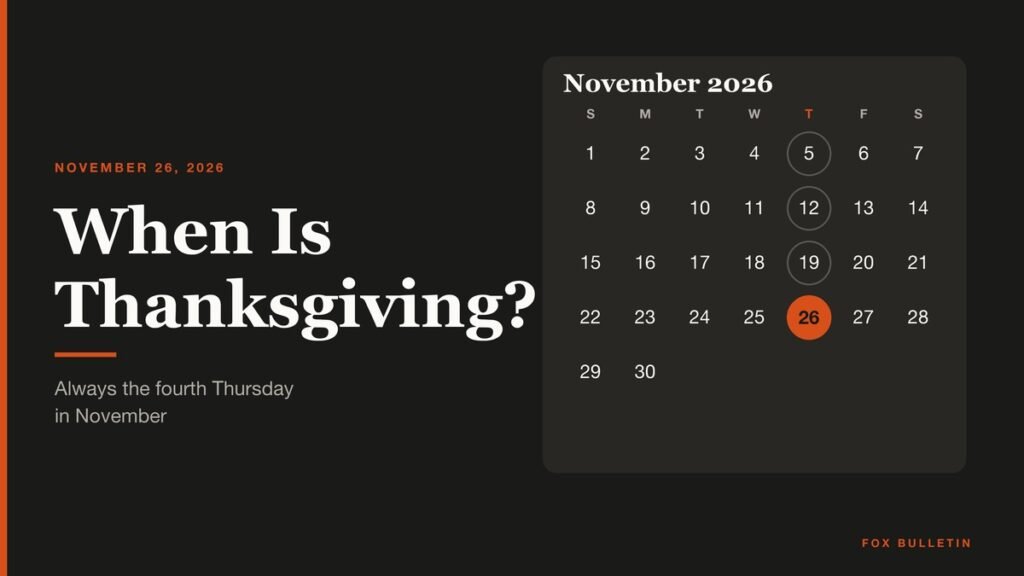
When Is Thanksgiving? This Year’s Date and the Next 10 Years
Thanksgiving 2026 falls on Thursday, November 26. Here is every date through 2035, the 1941 law behind the fourth-Thursday rule, and what happens that week.