

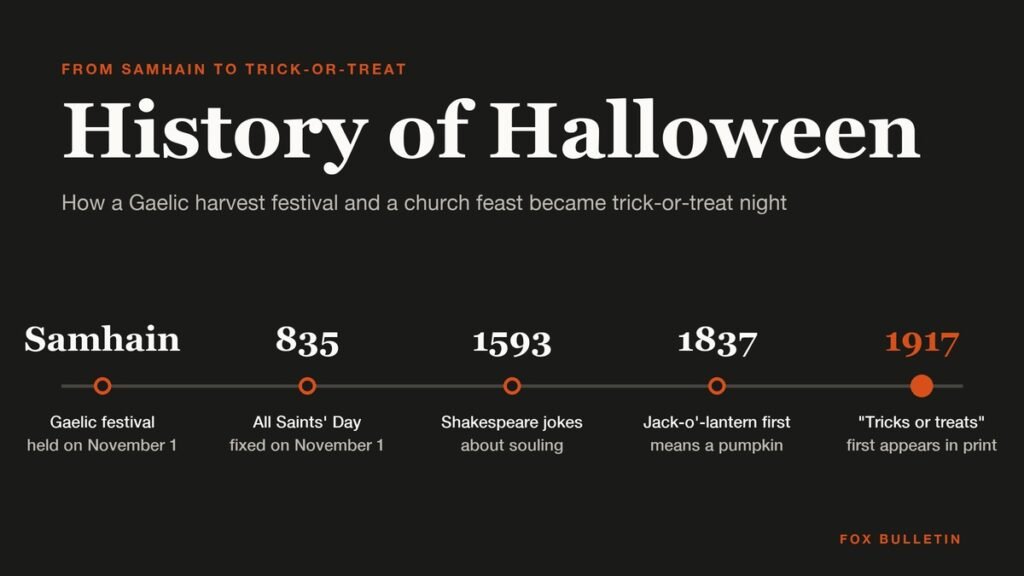
The history of Halloween begins with Samhain, a Gaelic festival on November 1 that marked the end of the harvest and the start of winter, and with the Christian feast of All Hallows on the same date, whose eve on October 31 gave the holiday its name. Over the following centuries the two traditions mixed into bonfires, disguises, door-to-door begging and carved lanterns.
Irish and Scottish immigrants carried those customs to North America in the 19th century. There the turnip lantern became a pumpkin, the phrase “tricks or treats” first reached print in Ontario in 1917, and a night once known for pranks turned into a children’s celebration, with US spending projected at $13.5 billion in 2026. The key dates run in this order:
| When | What happened |
|---|---|
| From the 9th century | Samhain, the Gaelic festival of November 1, appears in the earliest Irish literature |
| May 13, 609 or 610 | Pope Boniface IV dedicates the Pantheon in Rome to Mary and all the martyrs |
| 731 to 741 | Pope Gregory III dedicates an oratory in St. Peter’s to all saints |
| 835 | Louis the Pious, at Pope Gregory IV’s request, makes November 1 All Saints’ Day across the Frankish Empire |
| 12th century | All Souls’ Day on November 2 becomes widespread |
| 15th century | Souling: the poor go door to door for soul cakes in return for prayers |
| 16th century | Guising, going house to house in disguise for food, is part of Halloween in Scotland and Ireland |
| 1785 | Robert Burns publishes the poem “Halloween” |
| 1837 | “Jack-o’-lantern” is first used for a carved pumpkin in American English |
| 1845 to 1852 | Ireland’s Great Famine; more than a million people emigrate |
| 1866 | A Kingston, Ontario, newspaper links carved pumpkins to Halloween |
| November 1, 1917 | “Tricks or treats” appears in The Sault Daily Star in Ontario |
| 1920 | Anoka, Minnesota, holds a citywide Halloween celebration to curb pranks |
| 1928 | The phrase reaches a US newspaper, the Bay City Daily Times in Michigan |
| 1942 to 1947 | Wartime sugar rationing stalls trick-or-treating |
| 2026 | US Halloween spending is projected at $13.5 billion |
Samhain and the Earliest History of Halloween
Samhain was celebrated in Ireland, Scotland and the Isle of Man on November 1, with festivities starting the evening before because the Celtic day began and ended at sunset. It closed the harvest and opened the “darker half” of the year. Wales, Cornwall and Brittany kept a kindred festival whose names, such as Calan Gaeaf in Welsh, mean “first day of winter.”
It was also a turning point in the farming year. Cattle came down from the summer pastures and livestock were slaughtered for winter. Samhain was a threshold time too, when the boundary between this world and the Otherworld was believed to thin and the aos sí, the spirits or fairies, could cross more easily. The festival’s customs included:
- Bonfires: special fires were lit, and their flames, smoke and ashes were thought to protect and cleanse.
- Offerings: food and drink were left out for the aos sí so people and animals would survive the winter.
- Places for the dead: the souls of dead relatives were said to visit home, and a place was set for them at the table.
- Divination: games with apples and nuts, including apple bobbing, were played to foretell marriage and death.
Samhain is mentioned in the earliest Irish literature, from the 9th century, but it was not described in detail until the early modern era. The popular idea that it was a “Celtic New Year” comes from scholars John Rhys and James Frazer in the late 19th century and is disputed.
How All Saints’ Day Came to November 1
Halloween’s name is Christian. Early churches honored all martyrs together on various dates, mostly in spring. On May 13, 609 or 610, Pope Boniface IV dedicated the Pantheon in Rome to the Virgin Mary and all the martyrs, and that May date was kept in Rome for centuries.
The move to November came in two steps. Pope Gregory III, who led the church from 731 to 741, dedicated an oratory in Old St. Peter’s Basilica to all saints; some sources say he did so on November 1, which is why he is usually credited with the date, though others place the dedication in April 732. Then in 835 Emperor Louis the Pious, Charlemagne’s son, made November 1 a holy day of obligation across the Frankish Empire at the request of Pope Gregory IV, fixing the date that Halloween still hangs on.
Churches in Ireland and Northumbria were already marking all saints on November 1 by about 800, and Irish clerics or Alcuin of Northumbria may have pushed the date at Charlemagne’s court. All Souls’ Day on November 2 became widespread in the 12th century, completing the three-day Allhallowtide. The Library of Congress’s Halloween research guide describes the Christian feasts as intended to substitute for Samhain, with the two belief systems mingling instead. Other academics argue Halloween began independently as the vigil of All Hallows’ Day.
The word itself is Scots. “Hallow” meant holy, used for a saint, and the Scots contracted “even,” their word for evening, to “e’en,” so All Hallows’ Even became Hallowe’en. Robert Burns wrote about the night in his 1785 poem “Halloween,” influenced by John Mayne’s 1780 verses on Halloween pranks.
Souling and Guising: The Roots of Trick-or-Treating
Three older door-to-door customs, one from the church calendar and two from Britain and Ireland’s folk year, fed into trick-or-treating:
- Souling: from at least the 15th century, poor people, often children, went door to door at Allhallowtide asking for soul cakes and offering to pray for the household’s dead. It was recorded in parts of Britain, Flanders, southern Germany and Austria.
- Guising: in Scotland and Ireland, people went house to house in costume or disguise, reciting verses or songs in exchange for food, a custom recorded from at least the 16th century.
- Mumming: since the Middle Ages, parts of Britain and Ireland had door-to-door performances of short plays for food or drink.
Shakespeare knew souling well enough to joke about it. In The Two Gentlemen of Verona (1593), Speed accuses his master of “puling like a beggar at Hallowmas.” Soulers sang verses such as “Soul, souls, for a soul-cake,” and the cakes were often marked with a cross to show they were baked as alms.
Guising carried the mischief. Scottish youths went out with masked, painted or blackened faces and often threatened trouble if they were not welcomed, and by the 18th century the urge to imitate malignant spirits had turned into pranks in Ireland and the Scottish Highlands. An 1895 account from Scotland describes masqueraders carrying scooped-out turnip lanterns from house to house for cakes, fruit and money. Irish children asked for help with the “Halloween party” rather than saying “trick or treat,” a phrase that only became common there in the 2000s.
From Turnip Lanterns to Pumpkin Jack-o’-Lanterns
Before pumpkins, Halloween lanterns were turnips or mangel-wurzels, hollowed out and often carved with grotesque faces. In the 19th century they were common in parts of Ireland and the Scottish Highlands and in Somerset, England, and they were said either to represent spirits or to keep them away.
The name is older than the carving. “Jack-o’-lantern” first described will-o’-the-wisp, the strange lights over peat bogs, with records from the 1660s. An Irish folktale later attached it to Stingy Jack, a drinker who tricked the Devil, was refused entry to both heaven and hell, and wandered with a coal in a hollowed turnip to light his way.
In North America, immigrants switched to the native pumpkin, which is larger and softer and so easier to carve than a turnip. American English first used “jack-o’-lantern” for a carved pumpkin in 1837, but at first the pumpkin belonged to the harvest season in general. John Greenleaf Whittier’s 1850 poem “The Pumpkin” describes carving faces lit by candles and mentions Thanksgiving, not Halloween. The link to October 31 shows up in a Kingston, Ontario, newspaper on November 1, 1866, which reported “a great sacrifice of pumpkins” for lit faces the night before. The modern version is set out in our step-by-step pumpkin carving guide, and the seeds scooped from the middle are a snack of their own, covered in our guide to roasting pumpkin seeds.
How Irish and Scottish Immigrants Brought Halloween to America
Halloween was not a colonial American holiday. Anglican colonists in the South and Catholic colonists in Maryland kept All Hallows’ Eve in their church calendars, but the Puritans of New England opposed it, as they opposed Christmas, and almanacs of the late 18th and early 19th centuries give no sign that it was widely celebrated.
That changed with mass Irish and Scottish immigration in the 19th century. Ireland’s Great Famine, from 1845 to 1852, killed roughly one million people and drove more than a million to emigrate, and at least 2.1 million people left Ireland between 1845 and 1855. Most American Halloween traditions came from these Irish and Scottish arrivals. At first they stayed inside immigrant communities, but by the early 20th century Halloween was celebrated coast to coast by people of every background.
By 1919 the holiday had its first book-length American history, Ruth Edna Kelley’s The Book of Hallowe’en, written in Lynn, Massachusetts, a town with about 4,500 Irish, 1,900 English and 700 Scottish immigrants in 1920. Kelley wrote that every American Halloween custom was “borrowed directly or adapted” from other countries. Costume parties for adults and children were catching on at the same time.
When “Trick or Treat” First Appeared in Print
The phrase started in Canada. The earliest known printed version is “tricks or treats,” in The Sault Daily Star of Sault Ste. Marie, Ontario, on November 1, 1917, describing gangs of youngsters who left a house alone once the owner paid up. A day later, on November 2, 1917, the Owen Sound Sun reported children in Chatsworth, Ontario, greeting a householder with “treat or trick.”
Variants spread west through Alberta and Saskatchewan in the 1920s, including “treat up or tricks” in Edmonton in 1922. The exact words “trick or treat” ran in the Calgary Daily Herald on November 3, 1927, and the Lethbridge Herald the next day, both describing children in Blackie, Alberta. The phrase reached a US newspaper in 1928, in the Bay City Daily Times in Michigan, and its first known use in a national publication came in 1939.
Pranks, Parades and the Turn to a Children’s Halloween
Early 20th-century Halloween in the US had a vandalism problem, and towns answered it in different ways. Anoka, Minnesota, is believed to be the first US city to put on a Halloween celebration: in 1920 local merchants and citizens organized a party for children with free candy and entertainment to stop the pranks. Anoka has held it every year since, except for two years during World War II, and calls itself the “Halloween Capital of the World.”
Des Moines took a different route. In 1938, after police fielded more than 550 vandalism reports on a single Halloween night, city leaders moved trick-or-treating to October 30 and asked children to earn treats with jokes, riddles and songs. Beggars’ Night lasted nearly 90 years before the metro returned trick-or-treating to October 31 in 2025.
Trick-or-treating itself became widespread in the 1930s, then stalled when sugar rationing ran from April 1942 to June 1947. After the war it took off quickly in popular culture:
- 1947: the children’s magazines Jack and Jill and Children’s Activities covered trick-or-treating in their October issues.
- 1948: Halloween episodes of The Jack Benny Show and The Adventures of Ozzie and Harriet featured it on network radio.
- 1951: the Peanuts comic strip showed trick-or-treating.
- 1952: Walt Disney released the cartoon Trick or Treat, and the custom was firmly established.
Not everyone approved at first. Adults in newspaper reports from the mid-1930s to the mid-1950s typically saw it as extortion, and in 1948 members of the Madison Square Boys Club in New York carried a parade banner reading “American Boys Don’t Beg.”
Halloween Spending Today: $13.5 Billion in 2026
The National Retail Federation’s annual Halloween survey, released on September 22, 2026, projects Halloween spending of $13.5 billion this year, against last year’s record $13.1 billion. The average shopper plans to spend $115.14, close to $114.45 in 2025, and 74% of consumers plan to celebrate, up from 68% in 2019.
Candy is the most common purchase, but not the biggest bill. The survey of 7,889 consumers, conducted from September 1 to 9, breaks spending down this way:
- Costumes: $4.4 billion, bought by 71% of shoppers
- Decorations: $4.3 billion, bought by 78%
- Candy: $4.1 billion, bought by 96%
- Greeting cards: $0.8 billion, with 42% planning to buy, up from 38% in 2025
Handing out candy leads the ways people plan to mark the night: 61% plan to hand out candy, 50% to dress in costume, and 42% each to decorate, carve pumpkins and watch scary movies. The season also starts earlier, with 49% of shoppers beginning in September or before, compared with 34% in 2016. For children, Spider-Man is the top costume at 4.6 million; for adults, the witch, at 4.8 million, followed by the vampire at 4.2 million.
Frequently Asked Questions
What is the origin of Halloween?
Halloween comes from two sources: Samhain, a Gaelic festival on November 1 that marked the start of winter in Ireland, Scotland and the Isle of Man, and the Christian feast of All Hallows (All Saints’ Day) on the same date. The name is a Scots contraction of All Hallows’ Eve, the night before the feast.
Why is Halloween celebrated on October 31?
October 31 is the eve of All Saints’ Day, which the Frankish Empire fixed on November 1 in 835 at the request of Pope Gregory IV. Samhain festivities also began on the evening of October 31, because the Celtic day started at sunset.
Why do people carve pumpkins for Halloween?
In Ireland, Scotland and parts of England, people carved turnips and mangel-wurzels into lanterns with faces, said to represent spirits or ward them off. Immigrants in North America switched to the native pumpkin, which is easier to carve, and a carved pumpkin was linked to Halloween in print by 1866.
When did trick-or-treating start in America?
The phrase first appeared in Canada, as “tricks or treats” in an Ontario newspaper on November 1, 1917, and reached a US newspaper in 1928. Trick-or-treating became widespread in the 1930s, paused during sugar rationing from 1942 to 1947, and was firmly established by 1952.
Related Articles
- Best Halloween Costumes 2026: 13 Picks for Adults, Kids, Couples and Pets
- Pokémon GO Events (October 2026): Dates, Raids and Bonuses
- Day of the Dead (Día de los Muertos): Dates, Traditions and Meaning
- Trunk or Treat Ideas: 12 Themes, Games and Setups
- Halloween Movies in Order
- Lizzie Borden: What the Record Actually Shows
- When Is Thanksgiving? This Year’s Date and the Next 10 Years

Get the Fox Bulletin briefing
The stories that matter, in your inbox. No spam, unsubscribe anytime.
Newsletter signup will be available soon.
Related stories

Indoor Plants: 15 Easy Houseplants and How to Keep Them Alive
Fifteen easy indoor plants with the light level, watering rhythm, temperature and pet safety for each, plus how to measure your light and what NASA really tested.
Birthstones by Month: Every Stone, Color and Meaning
Every month's birthstone, its color and Mohs hardness, where it comes from, how to care for it, and how jewelers built the list in 1912 and kept adding to it.
When Is Thanksgiving? This Year’s Date and the Next 10 Years
Thanksgiving 2026 falls on Thursday, November 26. Here is every date through 2035, the 1941 law behind the fourth-Thursday rule, and what happens that week.