

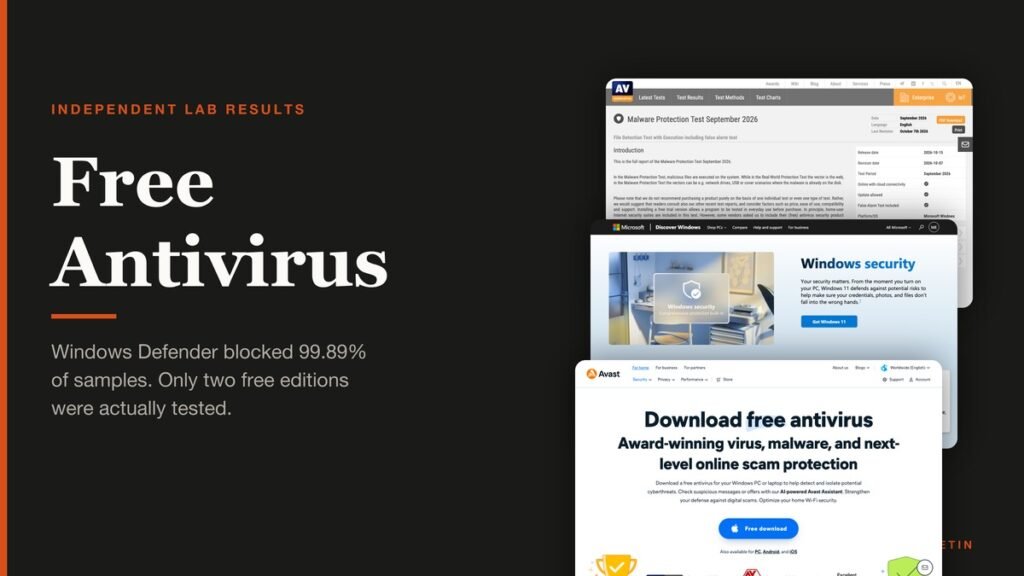
Free antivirus is no longer a compromise, and for most Windows users the right answer is the one already installed. Microsoft Defender blocked 99.89% of samples in the most recent independent malware protection test, within a tenth of a percent of suites costing eighty dollars a year.
The scores attached to these products are not all measuring the same software. Laboratories mostly test the paid editions, so a figure quoted for a free antivirus usually belongs to its paid sibling. Each entry below names the exact edition that was put through the test.
Why Most Free Antivirus Scores Are Borrowed
Testing an antivirus properly means running thousands of live malware samples against it in a controlled environment. Two organisations do this at scale, and vendors submit products to them, usually their flagship paid suites rather than the cut-down free versions.
That produces the quiet distortion in this category. A free product inherits a number earned by software with more layers in it, and readers reasonably assume the number describes what they downloaded.
In the September 2026 Malware Protection Test, only two of the products here were tested as free editions: Avast One Free Antivirus and AVG AntiVirus Free. Microsoft Defender is a third case, since the free built-in product is the only version there is.
One more detail from that report explains a coincidence below: it states that AVG and Norton use the Avast engine, which is why Avast and AVG post identical figures down to the false alarm count.
Free Antivirus Compared: Protection Scores and What Was Tested
All ten products below. The fourth column matters most: it names the exact edition the laboratory ran.
| # | Product | Free tier | Real-time | Edition tested by the lab | Result |
|---|---|---|---|---|---|
| 1 | Microsoft Defender | Included with Windows | Yes | Microsoft Defender Antivirus 4.18, the free built-in product | 99.89% protection, 28 false alarms, 82.2% offline detection |
| 2 | Avast Free Antivirus | Free tier with upsell prompts | Yes | Avast One Free Antivirus 26.8, the free edition itself | 99.96% protection, 15 false alarms, 95.4% offline detection |
| 3 | AVG AntiVirus Free | Free tier with upsell prompts | Yes | AVG AntiVirus Free 26.8, the free edition itself | 99.96% protection, 15 false alarms, 95.4% offline detection |
| 4 | Bitdefender Antivirus Free | Free tier, essentials only | Yes | Bitdefender Total Security 27.0, the PAID suite, not the free tier | 99.98% protection, 1 false alarm (paid edition) |
| 5 | Avira Free Security | Free tier with bundled extras | Yes | Not included in the September 2026 Malware Protection Test | No score in the latest round |
| 6 | ESET Online Scanner | Free one-time scan, no resident protection | No | ESET HOME Security Essential 19.2, the PAID product | 99.89% protection, 3 false alarms (paid edition) |
| 7 | Malwarebytes Free | On-demand scanning only | No | Malwarebytes Premium 5.6, the PAID product | 99.65% protection, 32 false alarms, 84.2% offline detection (paid edition) |
| 8 | ClamAV | Free and open source | Linux only | Not submitted to consumer lab testing | No consumer lab score |
| 9 | Sophos Home | Free tier closed to new sign-ups | Yes | Sophos Home Premium 2025.2, the PAID product | 99.83% protection, 49 false alarms (paid edition) |
| 10 | Panda Dome Free | Free tier with real-time protection | Yes | Panda Dome Advanced 23.1, the PAID product | 98.39% protection, 91 false alarms, 40.2% offline detection (paid edition) |
The 10 Free Antivirus Options, Ranked
1. Microsoft Defender: Doing nothing at all
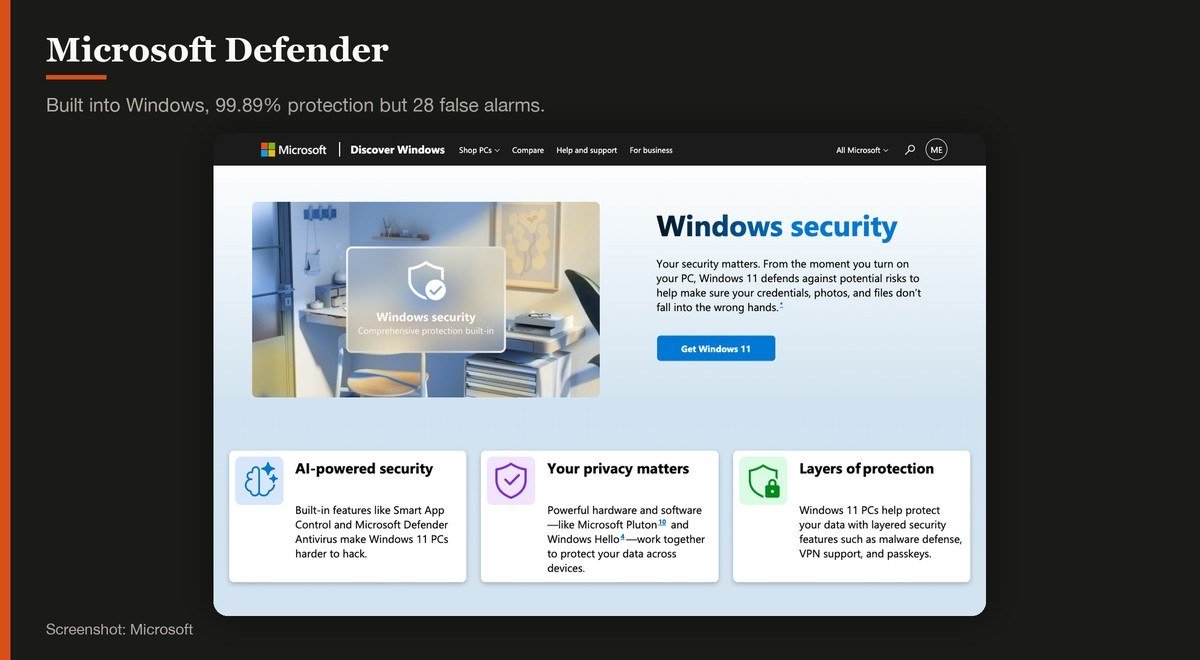
Platforms: Windows · Free tier: Included with Windows · Real-time protection: Yes · Edition the lab tested: Microsoft Defender Antivirus 4.18, the free built-in product · Result: 99.89% protection, 28 false alarms, 82.2% offline detection
The antivirus argument is largely over for most people, because Windows ships with one that works. In the September 2026 Malware Protection Test, Defender blocked 99.89% of samples, within a tenth of a percent of the best paid suites.
Two numbers temper that. It raised 28 false alarms, more than any free rival here, and its offline detection rate was 82.2% against 95.4% for Avast, which matters on a laptop that spends time off the network. It is also the only product on this list the lab tested in exactly the form you would use.
2. Avast Free Antivirus: The best-evidenced free protection
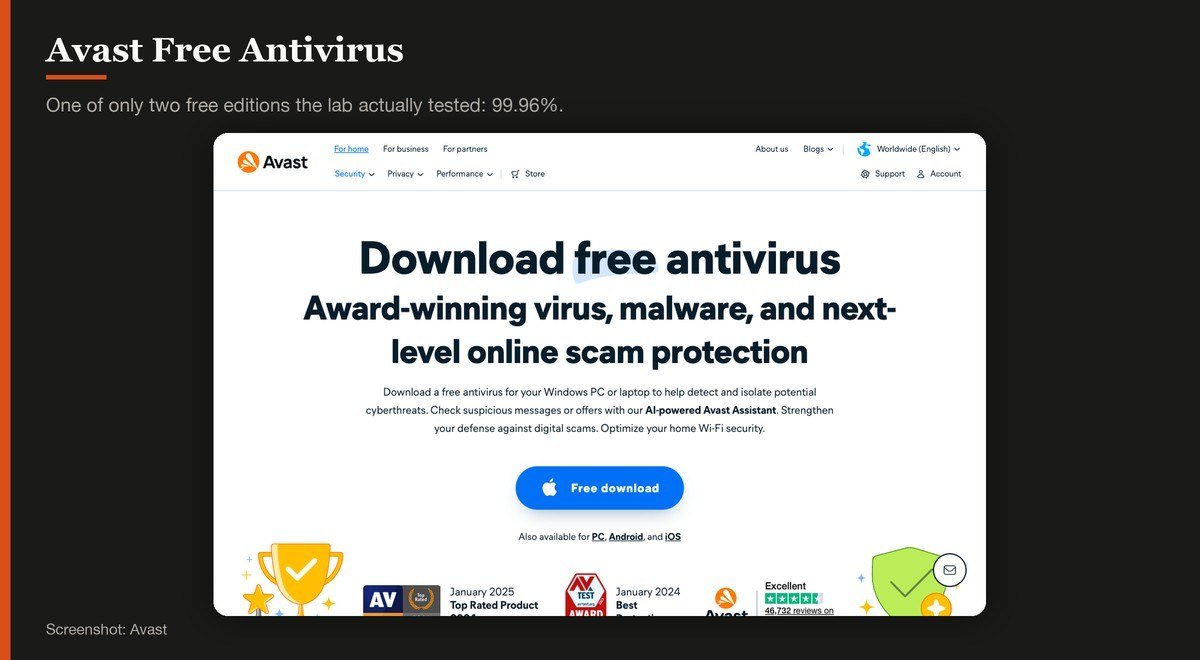
Platforms: Windows, macOS, Android, iOS · Free tier: Free tier with upsell prompts · Real-time protection: Yes · Edition the lab tested: Avast One Free Antivirus 26.8, the free edition itself · Result: 99.96% protection, 15 false alarms, 95.4% offline detection
Avast is one of only two products here whose free edition the lab put through the September 2026 test rather than its paid sibling, and it scored 99.96% with 15 false alarms. Its 95.4% offline detection was the strongest of any free option.
The cost is attention. Avast funds the free tier with regular prompts to upgrade, and the company’s history with user data is worth reading about before installing. Premium is listed at $49.08 for the first year and $77.99 a year after that.
Avast Free Antivirus product page
3. AVG AntiVirus Free: Avast protection with a calmer interface
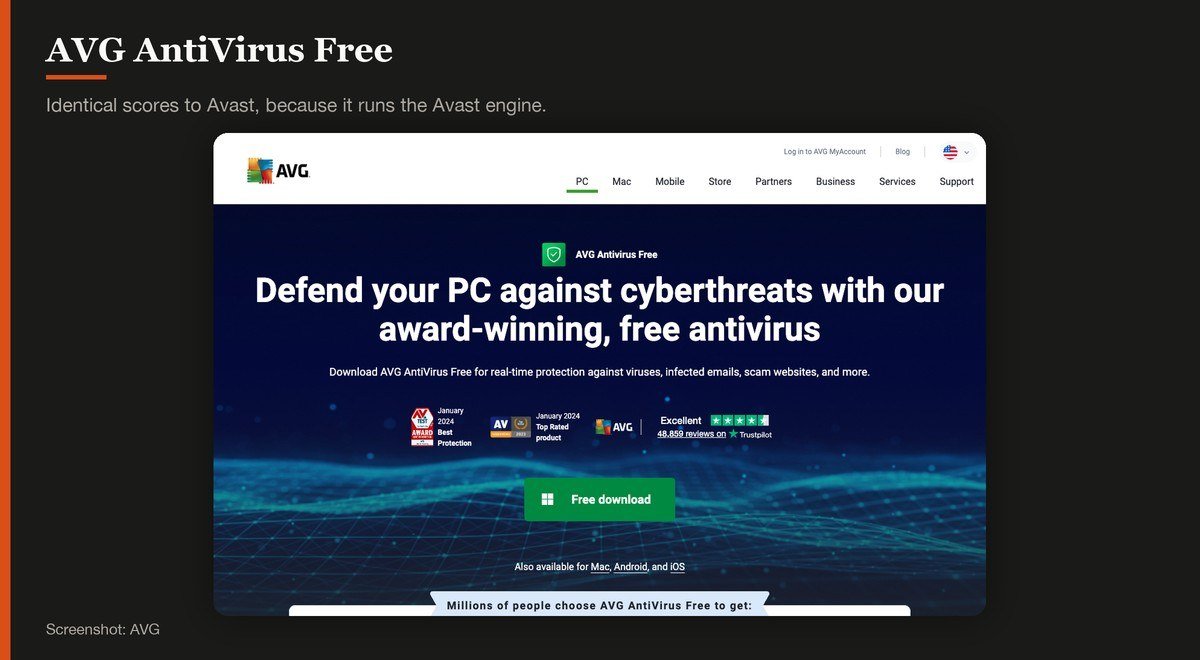
Platforms: Windows, macOS, Android · Free tier: Free tier with upsell prompts · Real-time protection: Yes · Edition the lab tested: AVG AntiVirus Free 26.8, the free edition itself · Result: 99.96% protection, 15 false alarms, 95.4% offline detection
AVG posted exactly the same figures as Avast in the September 2026 test, down to the false alarm count, and there is a plain reason for it: the lab’s own report states that AVG and Norton use the Avast engine. The three share detection logic.
So the choice between Avast and AVG is a choice of interface and nagging, not of protection. AVG’s window is the quieter of the two, which is the only real argument for picking it.
AVG AntiVirus Free product page
4. Bitdefender Antivirus Free: The cleanest detection record
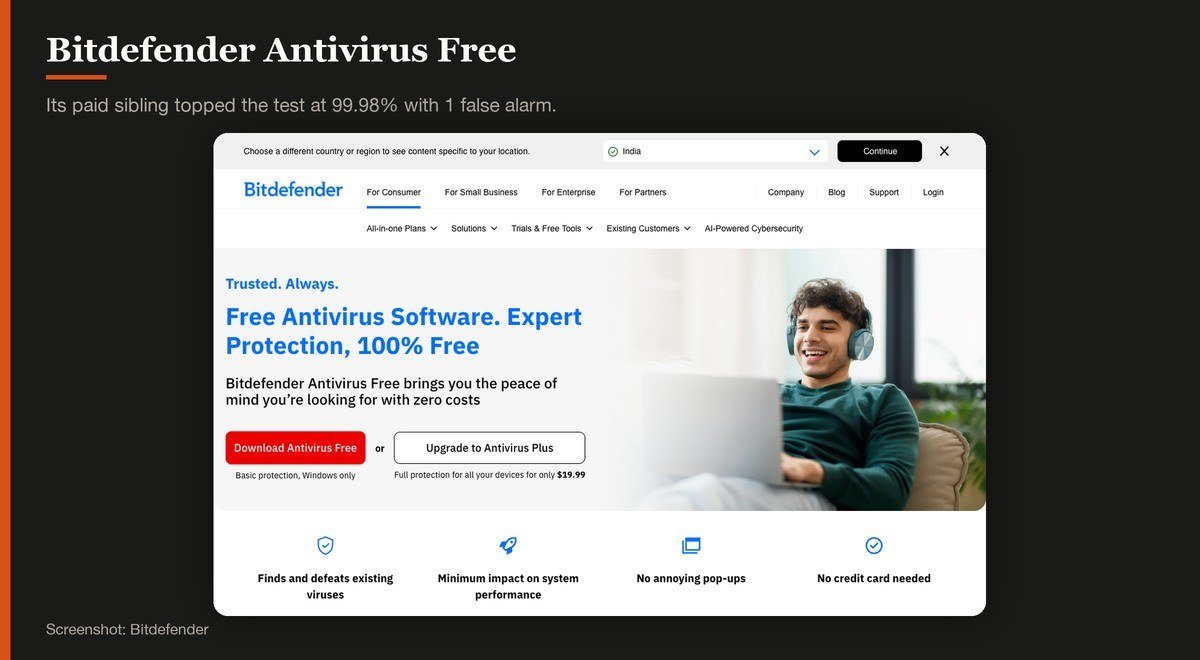
Platforms: Windows · Free tier: Free tier, essentials only · Real-time protection: Yes · Edition the lab tested: Bitdefender Total Security 27.0, the PAID suite, not the free tier · Result: 99.98% protection, 1 false alarm (paid edition)
Bitdefender’s paid suite won the September 2026 test outright with 99.98% and a single false alarm, the best combination any vendor managed. The free product shares the engine and strips the extras.
Note carefully what was measured. The lab tested Total Security, the paid suite, so the score describes the engine rather than the free package you would install. The free tier is also Windows only and deliberately bare, with no firewall, VPN or password tooling.
Bitdefender Antivirus Free product page
5. Avira Free Security: A free tier with extras attached
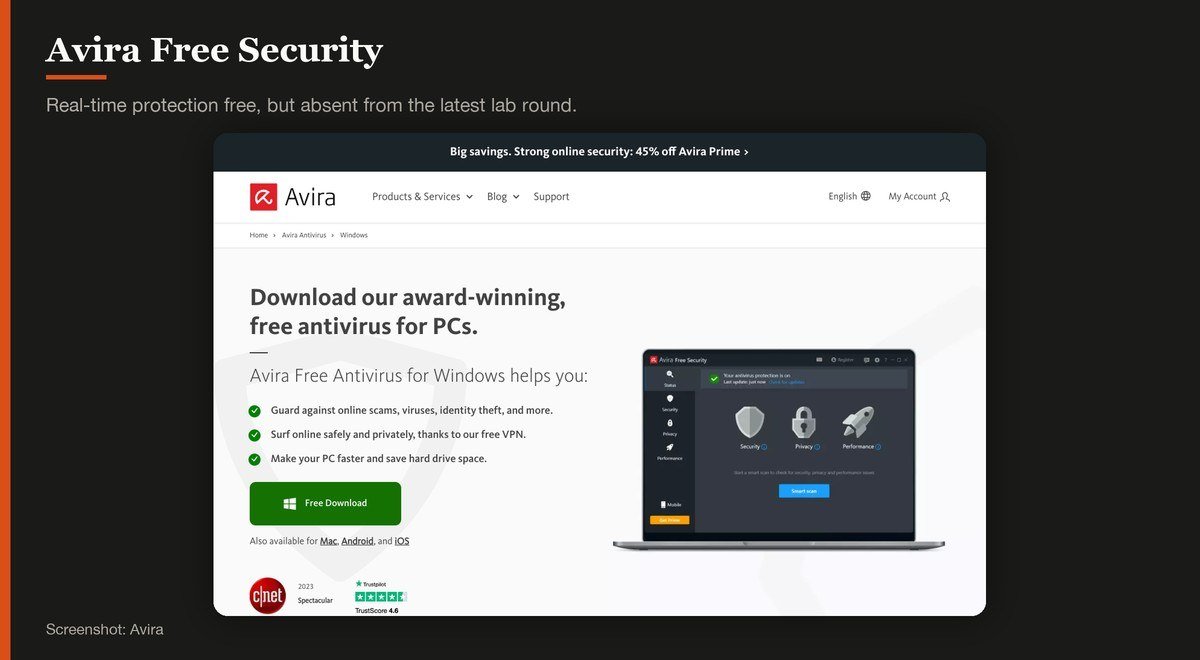
Platforms: Windows, macOS, Android, iOS · Free tier: Free tier with bundled extras · Real-time protection: Yes · Edition the lab tested: Not included in the September 2026 Malware Protection Test · Result: No score in the latest round
Avira gives away resident protection along with a software updater, a limited VPN and a password tool, which is a broader free package than Bitdefender’s. The engine has a long and respectable history, and the lab’s September 2026 report refers to products built on it.
What is missing is current evidence. Avira itself was not in that test round, so there is no recent independent figure for it, and a security product without a current score is a weaker recommendation than one with a mediocre one.
Avira Free Security product page
6. ESET Online Scanner: A second opinion on a suspect machine
Platforms: Windows · Free tier: Free one-time scan, no resident protection · Real-time protection: No · Edition the lab tested: ESET HOME Security Essential 19.2, the PAID product · Result: 99.89% protection, 3 false alarms (paid edition)
ESET’s free offering is not an antivirus, it is a scan. The Online Scanner runs once, checks the machine and leaves, which makes it the right tool for confirming a suspicion rather than for preventing anything.
Its paid sibling matched Defender’s 99.89% with only 3 false alarms, one of the most disciplined records in the test. That says something about the engine behind the scanner, and nothing about ongoing protection, which the free product does not provide.
ESET Online Scanner product page
7. Malwarebytes Free: Cleaning up an infection that already happened
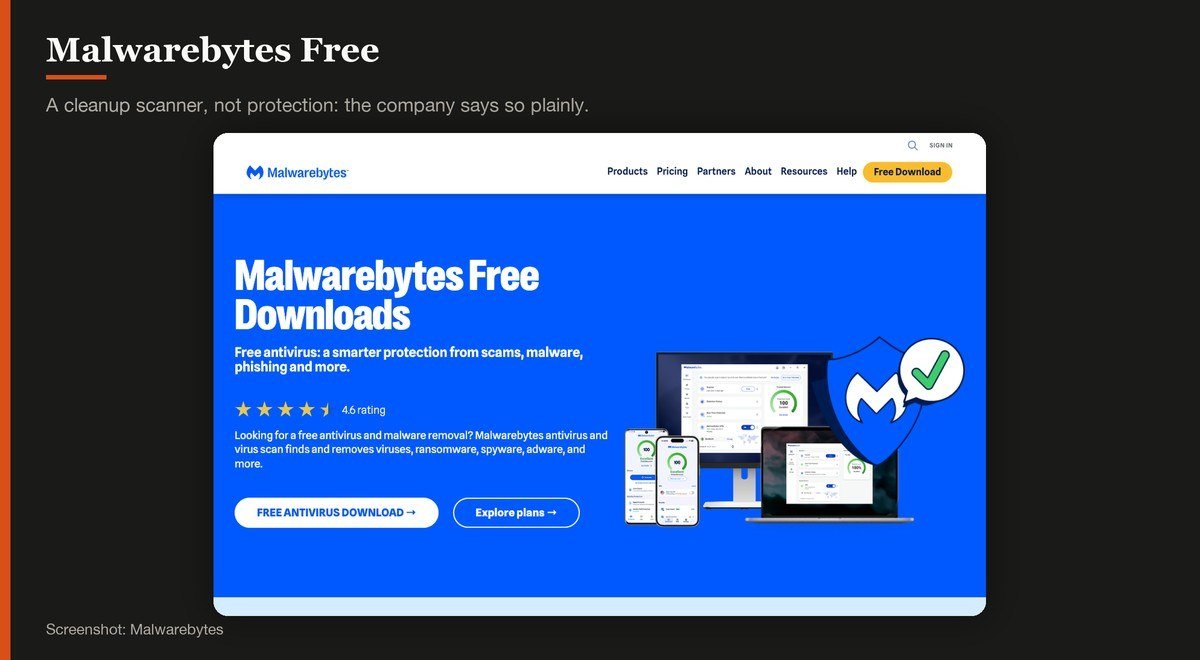
Platforms: Windows, macOS, Android, iOS · Free tier: On-demand scanning only · Real-time protection: No · Edition the lab tested: Malwarebytes Premium 5.6, the PAID product · Result: 99.65% protection, 32 false alarms, 84.2% offline detection (paid edition)
Malwarebytes states the division on its own download page: free cleans up, premium keeps threats out, and the free scanner finds and removes infections that are already on your device. There is no resident protection in the free product.
Used for what it is, it is excellent, and it is the tool to reach for when a machine is already behaving oddly. Used as your only antivirus it protects nothing, which is the single most common mistake made with it.
Malwarebytes Free product page
8. ClamAV: Scanning a mail or file server
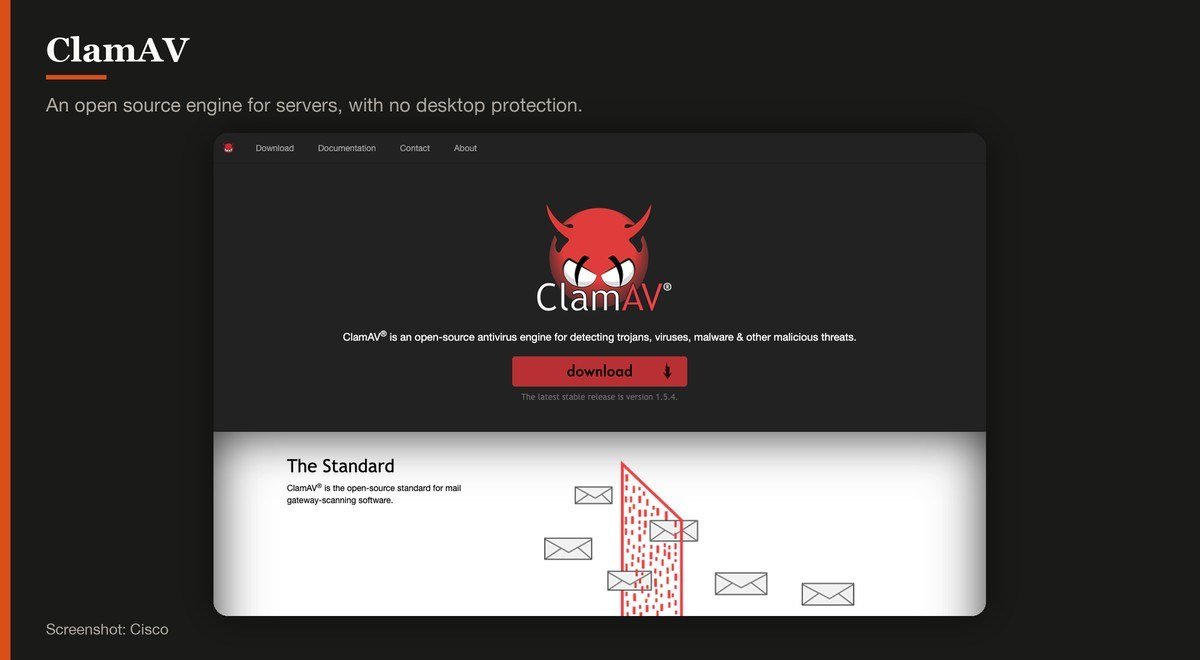
Platforms: Linux, Windows, macOS · Free tier: Free and open source · Real-time protection: Linux only · Edition the lab tested: Not submitted to consumer lab testing · Result: No consumer lab score
ClamAV is the open source engine behind a great deal of mail and file server scanning, and it is free in the way GIMP is free: no tier, no account, no company deciding your terms.
It is also not a desktop antivirus. It runs from a command line, its on-access scanning is a Linux feature, and it appears in no consumer lab test, so there is no comparable protection figure for it. Install it on a server, not on a laptop.
9. Sophos Home: Existing users only
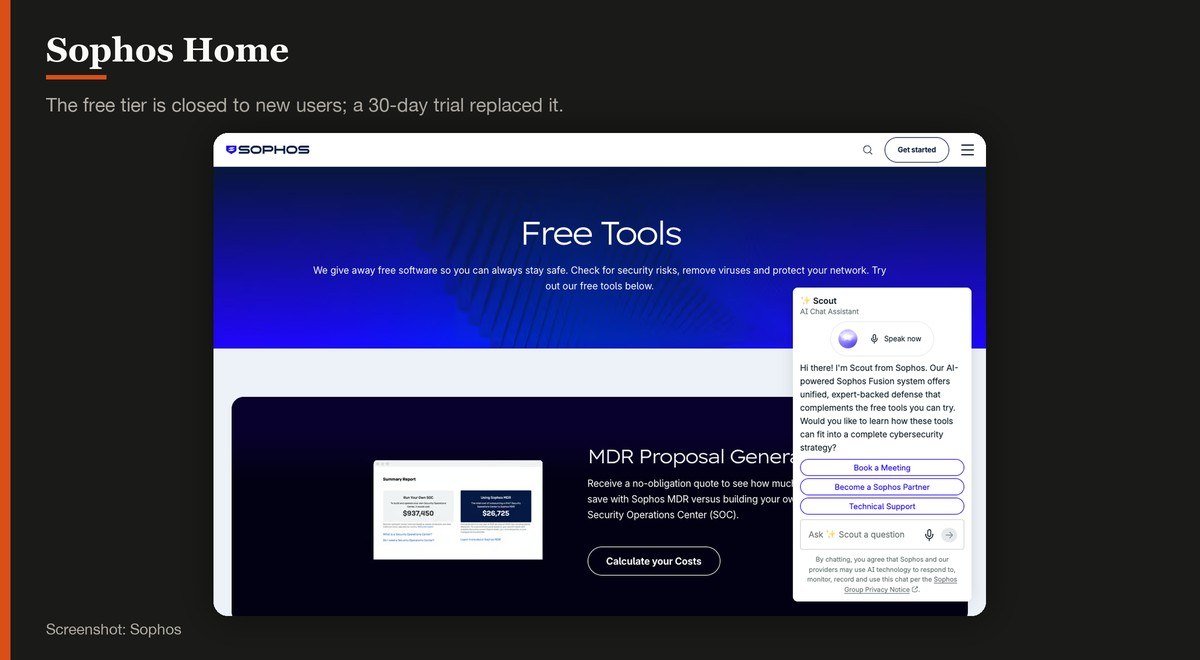
Platforms: Windows, macOS · Free tier: Free tier closed to new sign-ups · Real-time protection: Yes · Edition the lab tested: Sophos Home Premium 2025.2, the PAID product · Result: 99.83% protection, 49 false alarms (paid edition)
Sophos Home Free was a genuine recommendation for years and is no longer available to new users, having been replaced by a 30-day trial of the paid product. Accounts created before the change continue to work.
It is listed here because so many articles still recommend it. The paid edition blocked 99.83% in September 2026 but raised 49 false alarms, among the highest in the test, which is its own kind of problem on a working machine.
10. Panda Dome Free: Not much, on this evidence
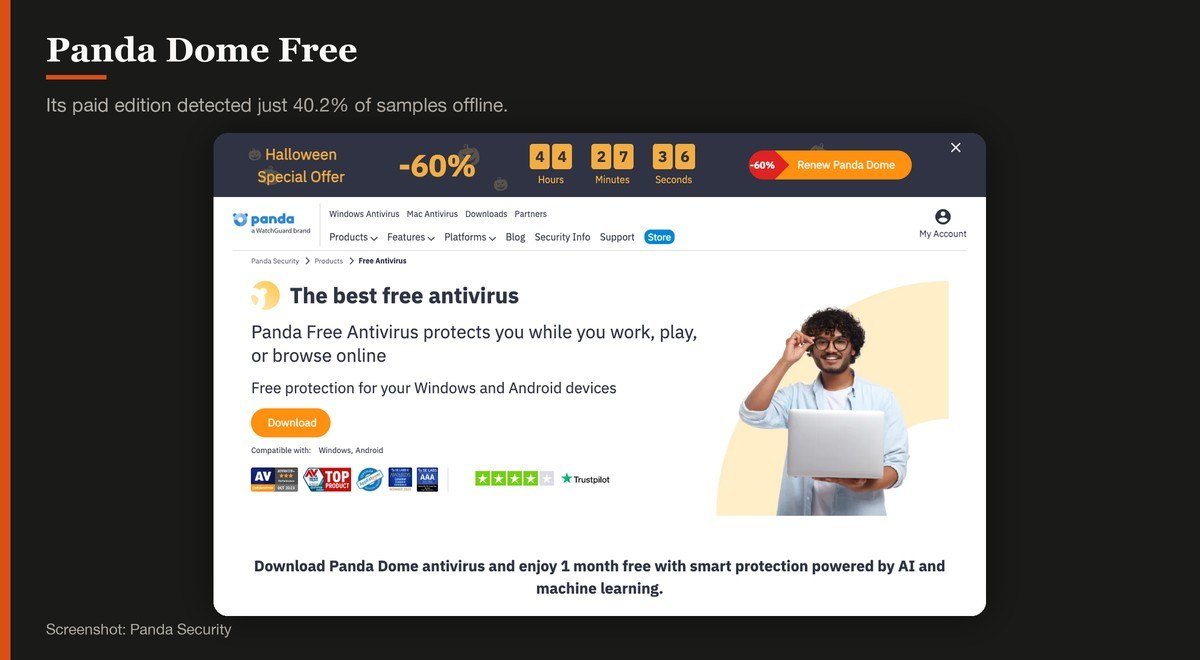
Platforms: Windows · Free tier: Free tier with real-time protection · Real-time protection: Yes · Edition the lab tested: Panda Dome Advanced 23.1, the PAID product · Result: 98.39% protection, 91 false alarms, 40.2% offline detection (paid edition)
Panda is included because it is widely listed as a free antivirus and because the numbers are worth seeing. In September 2026 its paid edition blocked 98.39%, the second lowest in the test, with 91 false alarms.
The offline figure is the striking one: 40.2%, against 95.4% for Avast. Panda leans heavily on its cloud, so a machine away from the network is substantially less protected. If you install one thing from this list, it should not be this.
Offline Detection Is the Number Nobody Quotes
Protection rates are measured with the machine online, where the engine can ask a cloud service about a file it does not recognise. Laboratories publish a separate offline figure, and the spread between vendors is far wider than the headline suggests.
- Avast and AVG: 95.4% offline, the strongest of any free option here.
- Malwarebytes: 84.2% offline for the paid edition.
- Microsoft Defender: 82.2% offline.
- Panda: 40.2% offline, meaning the majority of samples went undetected without a connection.
This matters for a laptop used on a plane, on a train or anywhere the connection drops, and for any machine where malware arrives on a USB stick. If that describes how you work, weight the offline column heavily.
Scanning Is Not Protecting
Two products here do not protect anything, and both are regularly recommended as though they did.
Malwarebytes Free is a cleanup tool. The company’s own download page draws the line: free cleans up, premium keeps threats out, and the free scanner finds and removes infections already on the device. Nothing watches for the next one.
The ESET Online Scanner is a single scan that runs and exits. Both are genuinely useful as a second opinion on a machine behaving strangely, and neither should be anyone’s only defence.
If you suspect something has already got in, a scanner is exactly right, and a malware check on a Mac follows the same logic.
What Decided the Order
Three things, in this order: whether an independent laboratory has a current figure for the product, whether the free tier includes resident protection rather than on-demand scanning, and how many false alarms the engine raised, since an antivirus that blocks your own files is its own kind of failure.
Kaspersky is absent deliberately. The US Commerce Department’s Bureau of Industry and Security prohibited Kaspersky Lab, Inc. from supplying antivirus products in the United States, and signature and codebase updates were barred after September 29, 2024. Existing users face no legal penalty but are urged to move to another vendor.
Detection rates are not something a publication can measure from a desk. Establishing one needs a controlled laboratory running thousands of live samples against every product in the same conditions, which is where every figure on this page comes from.
How to Choose Free Antivirus
On Windows, start by installing nothing. Defender is current, tested in the form you would actually run, and scored 99.89%. The 28 false alarms are its real weakness, not the detection rate.
Switch to Avast or AVG only if offline detection matters to you, since their 95.4% is meaningfully ahead of Defender’s 82.2% and theirs are the only free editions with a current score of their own. Expect upgrade prompts in return.
Add Malwarebytes Free alongside whatever you run, not instead of it. A cleanup scanner and a resident shield do different jobs, and having both costs nothing.
Treat a bundled VPN as a separate decision. A VPN service is not antivirus and buying one for its malware filter is the expensive route to a feature you can get free.
Frequently Asked Questions
Is Windows Defender good enough on its own?
For most people, yes. It blocked 99.89% of samples in the September 2026 Malware Protection Test, effectively matching paid suites. Its weak points are a high false alarm count, 28 in that round, and an offline detection rate of 82.2%.
Does free antivirus protect in real time?
Most do. Defender, Avast, AVG, Bitdefender Free, Avira and Panda all include resident protection at no cost. Malwarebytes Free and the ESET Online Scanner do not; they scan on demand and nothing more.
Why is Kaspersky not on this list?
The US Commerce Department prohibited Kaspersky Lab, Inc. from providing antivirus software and cybersecurity products or services in the United States, and barred signature and codebase updates after September 29, 2024. An antivirus that cannot update is not an antivirus.
Do I need antivirus on a Mac?
Less urgently than on Windows, since macOS ships its own protections, but not never. The free scanners here that cover macOS are useful for checking a specific suspicion rather than for running permanently.
Related Articles

Get the Fox Bulletin briefing
The stories that matter, in your inbox. No spam, unsubscribe anytime.
Newsletter signup will be available soon.
Related stories
Free Cloud Storage: How Much You Really Get
Ten free cloud storage tiers compared on allowance, encryption and the limit each provider does not advertise, from 20 GB down to 5 GB.

Best Webcams: 7 Picks for Calls and Streaming
Seven webcams compared on resolution, field of view and microphones, from the office default to a dual-camera 4K body with an 11x hybrid zoom.
Free Screen Recorders: 10 Picks and Their Limits
Ten free screen recorders ranked, with the length cap, resolution ceiling and system audio support of each one stated plainly.