

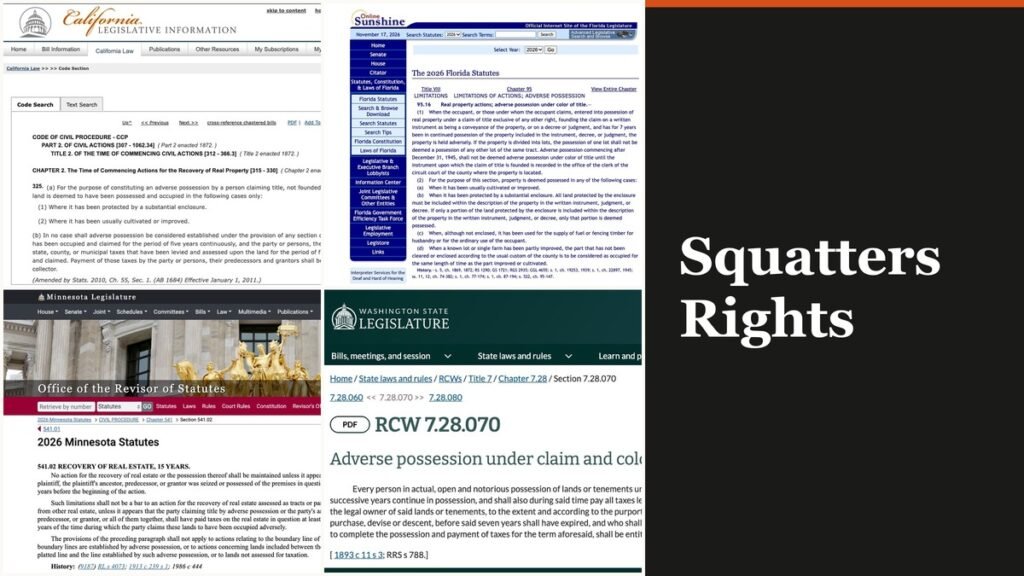
Squatters rights are the legal claims a person can build by living on someone else’s land or building for years without the owner’s permission. In 2026 they remain a slow route to ownership under adverse possession laws, and a much faster route to removal wherever a new law lets a sheriff clear a home.
Two questions come up most: can a squatter take my property, and how does an owner get a squatter out. Both depend on the state, on how long the occupant has stayed and on whether the occupant ever had a lease or permission.
What Are Squatters Rights?
Squatters rights is the everyday name for adverse possession. A person who occupies land openly and continuously, treats it as their own and is never stopped by the owner within the time set by state law can ask a court to make them the legal owner. Until that period ends, a squatter has no title and the owner can still act.
Every element has to be met for the full period, and a gap in any one of them can end the claim. State laws set that period anywhere from a few years to more than two decades, and a few add paperwork or tax requirements on top.
The Five Elements of Adverse Possession in Plain Language
New York’s statute spells out the test most clearly: occupancy must be adverse, under claim of right, open and notorious, continuous, exclusive and actual. Courts elsewhere use the same core ideas under common law. In plain terms:
- Hostile: the occupant has no permission. A tenant, a guest or a family member living there with the owner’s consent is not hostile.
- Actual: the occupant physically uses the property the way an owner would, by living on it, building on it, farming it or maintaining it.
- Open and notorious: the use is visible enough that a reasonable owner who inspected the land would notice it.
- Exclusive: the occupant keeps the property for themselves rather than sharing control with the owner or the public.
- Continuous: the occupation runs without a meaningful break for the whole statutory period.
New York also asks for a claim of right, meaning a reasonable basis for believing the property belongs to the occupant. Some statutes, such as California’s, also require the occupant to have paid the property taxes.
Squatter vs. Trespasser vs. Tenant
The three terms describe different legal positions, and the right removal route depends on which one applies:
- Squatter: someone who enters or stays on property without the owner’s permission and without any title or right to be there. New York’s 2024 definition covers exactly that situation.
- Trespasser: someone who enters without permission, usually for a short time. A trespasser who stays long enough, and meets the elements above, is also what people call a squatter.
- Tenant: someone who entered with permission under a lease or rental agreement, written or spoken. A tenant who stops paying is still a tenant for removal purposes, which means a formal court eviction.
Florida’s new removal statute excludes current and former tenants and immediate family, and New York’s amendment provides that a tenant does not include a squatter. Both draw the same line: a person who came in with permission goes through the eviction process, and a person who never had any right to enter goes through the newer routes.
How Owners Remove Squatters
Removal and adverse possession are separate tracks. Adverse possession is the squatter’s claim to title after years of occupation, while removal is the owner’s action to recover possession now. The general paths look like this:
- Tell the occupant to leave in writing. A clear demand to leave also helps show the owner never allowed the stay.
- Call local law enforcement. Under the newer squatter laws, officers can act on a sworn statement from the owner. Elsewhere they may treat the matter as a civil dispute.
- File a court action. Where no landlord-tenant relationship exists, New York uses a summary proceeding after a 10-day notice to quit. Other jurisdictions have a comparable court route.
- Avoid self-help. Changing locks or shutting off utilities can expose the owner to liability. New York, for example, bars self-help eviction of anyone who has occupied a dwelling for 30 consecutive days.
Florida: HB 621 and the Sheriff Removal Process
Florida’s HB 621 became Chapter 2024-44, was approved by the governor on March 27, 2024 and took effect July 1, 2024. It created section 82.036, which lets an owner or the owner’s agent ask the county sheriff for immediate removal of people unlawfully occupying a residential dwelling.
The owner submits a verified complaint and must show several conditions: the dwelling is residential, the entry was unauthorized, the property is not open to the public, the owner told the occupants to leave, they are not current or former tenants or immediate family, and no litigation between the owner and the occupant is pending. The text is on the Florida Legislature statute page.
New York: A Statutory Definition of Squatter
New York’s budget for fiscal 2025 was signed on April 22, 2024 and put a definition into the law: a squatter is a person who enters or intrudes on real property without permission and keeps occupying it without title, right or permission. The same amendment provides that a tenant shall not include a squatter, which separates squatters from tenants in New York law.
Georgia, Alabama and Tennessee
Other legislatures passed their own measures in 2024:
- Georgia: HB 1017, the Squatter Reform Act, was signed on April 24, 2024 and creates the offense of unlawful squatting. A person cited has three business days to provide documentation of a right to be there.
- Alabama: HB 182 took effect June 1, 2024. It creates penalties for falsifying real estate documents and lets an owner swear an affidavit to law enforcement to remove an unauthorized occupant. The governor’s announcement covers the bill.
- Tennessee: a law that took effect in July 2024 clarifies how law enforcement restores possession to an owner.
Squatters Rights by Statute: From 5 Years to 21
The period is the part of squatters rights that varies most. These statutes show how different the figures and conditions are.
California: 5 Years, With Taxes Paid
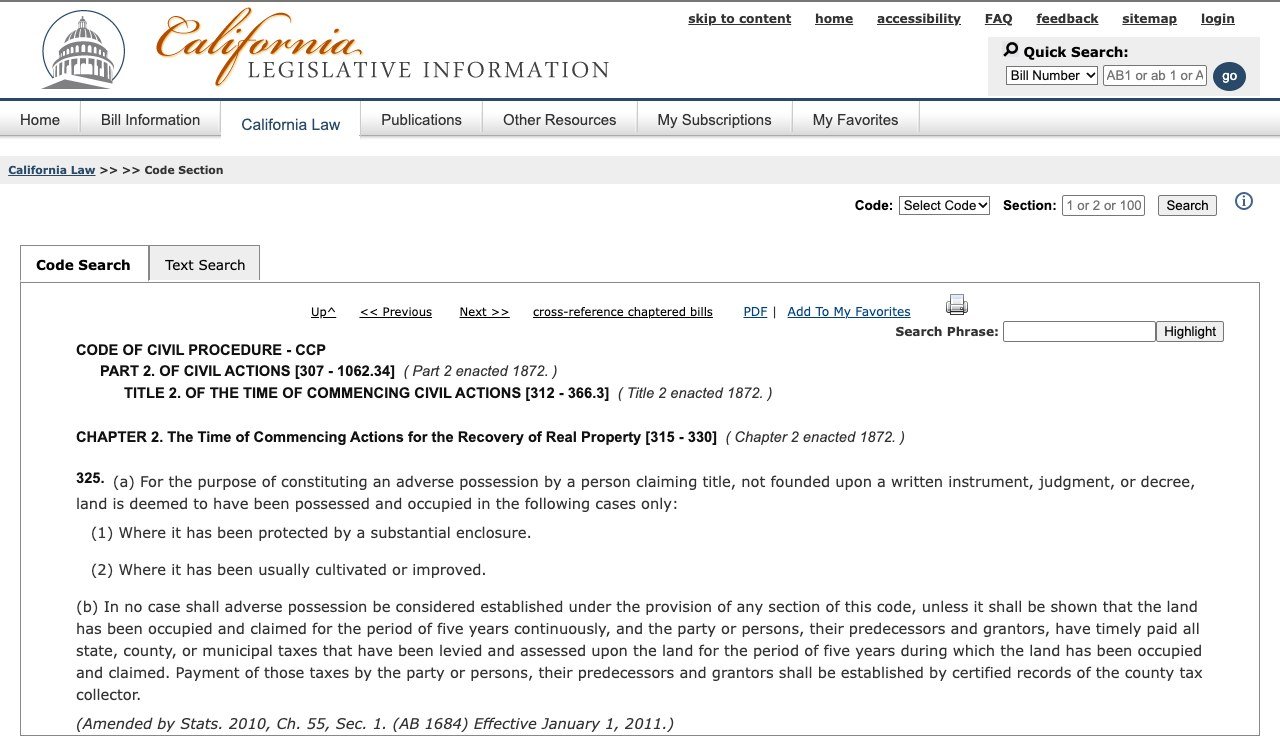
Under Code of Civil Procedure 325, the occupant must have occupied and claimed the land for 5 continuous years and paid all state, county and municipal taxes on it for those 5 years. The land must also be protected by a substantial enclosure or usually cultivated or improved.
Montana: 5 Years
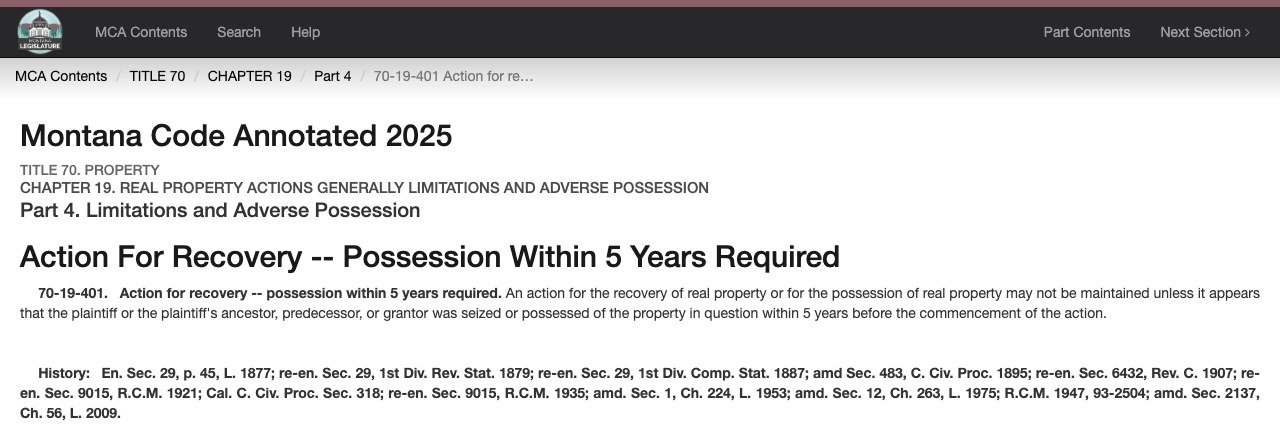
Montana’s recovery statute requires that the owner or the owner’s predecessor was in possession within 5 years before an action is brought. That is the same 5-year figure as California, though Montana’s statute does not add California’s tax rule.
Florida: 7 Years Under Two Routes
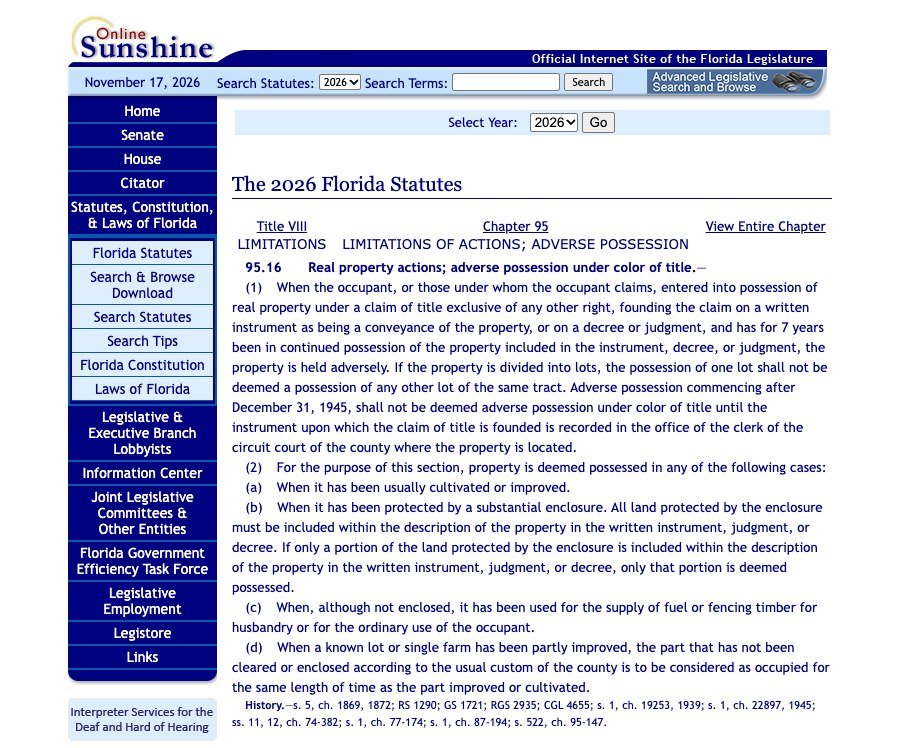
Florida section 95.16 gives a 7-year route to an occupant holding under a written instrument, decree or judgment, called color of title. Section 95.18 allows 7 years without such a document, but the occupant must pay taxes within 1 year of entering, file a return with the property appraiser within 30 days of that payment, and keep paying. Using land for fuel or fencing timber also counts as possession in Florida.
Washington: 7 Years With Color of Title and Taxes
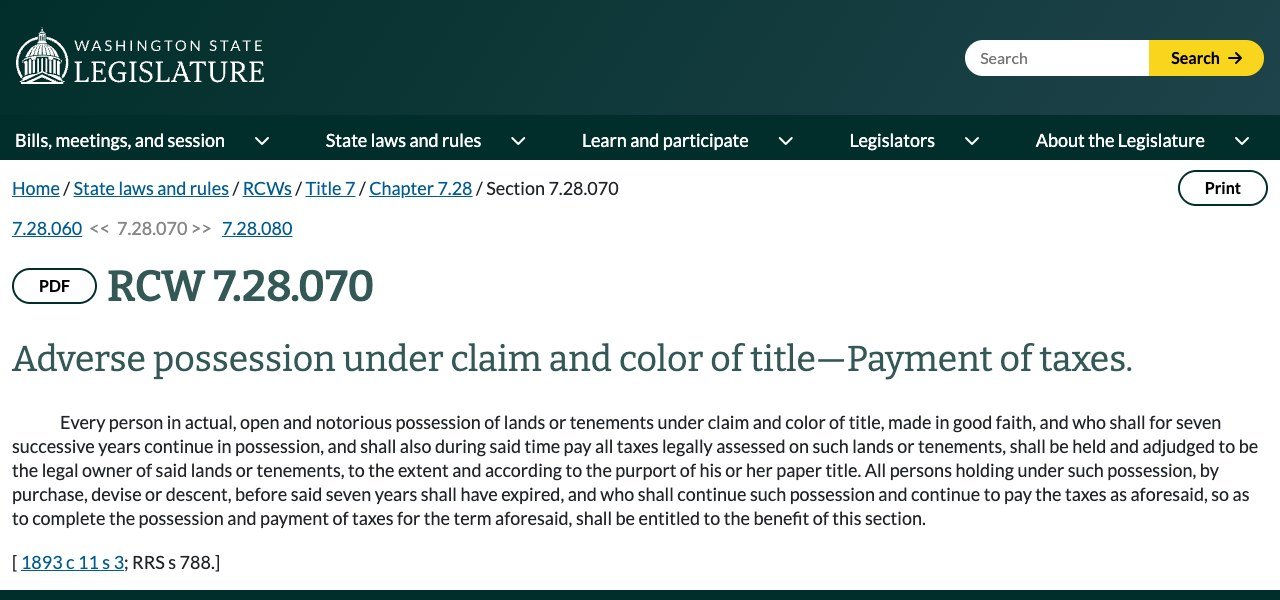
Washington’s RCW 7.28.070 requires actual, open and notorious possession under claim and color of title made in good faith, for 7 successive years, plus payment of all taxes. Without that title route, the general period under RCW 4.16.020 is 10 years.
Minnesota: 15 Years and Five Years of Taxes

Minnesota Statutes 541.02 sets 15 years. For a separately assessed parcel, the occupant must also have paid the taxes on the land for at least five consecutive years of the occupation. Boundary-line actions are an exception.
District of Columbia: 15 Years
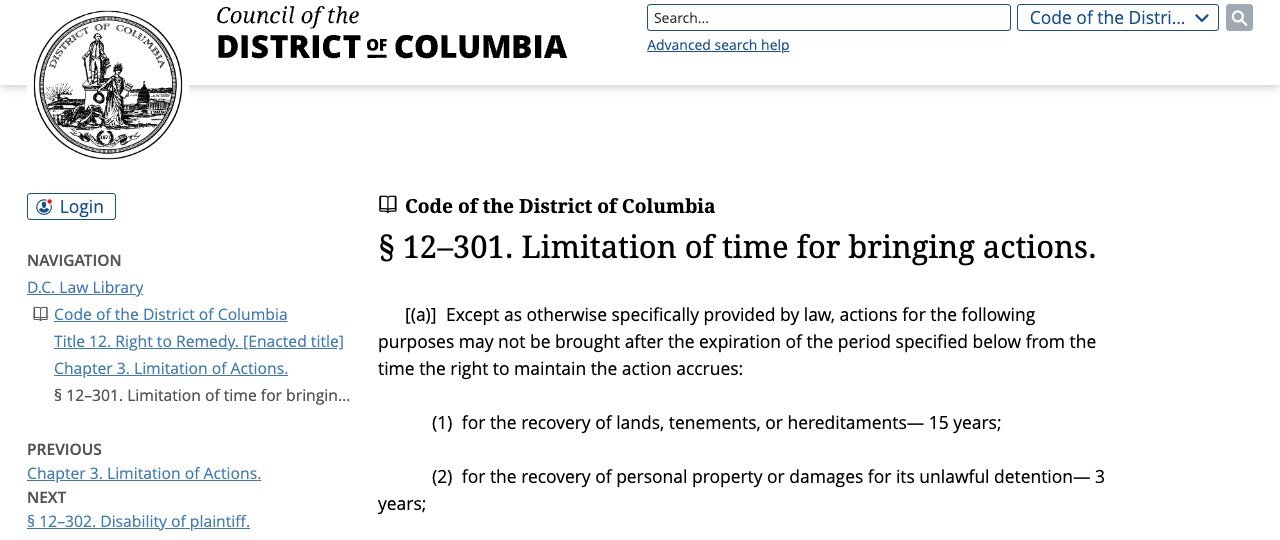
D.C. Code 12-301 sets 15 years for the recovery of lands, tenements and hereditaments. Connecticut, Kansas, Kentucky, Minnesota, Vermont and Virginia use the same 15-year figure.
Maryland: 20 Years
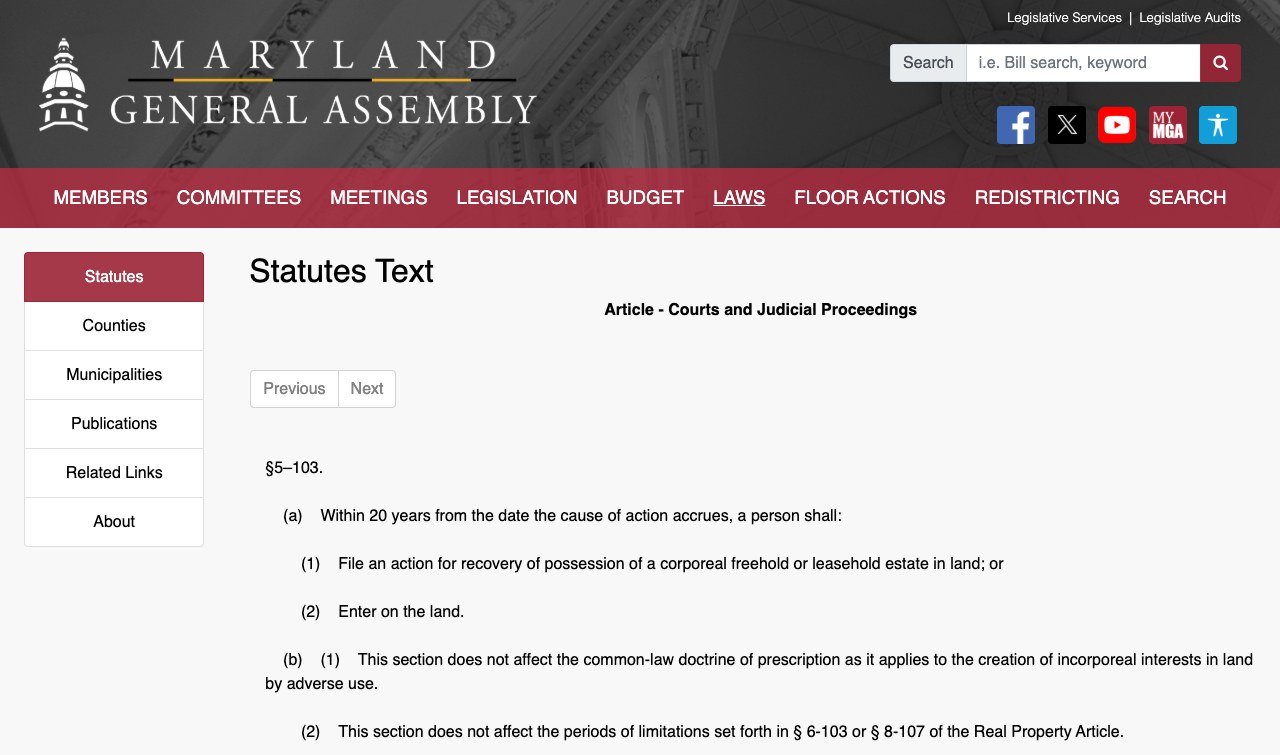
Courts and Judicial Proceedings 5-103 requires a person to file an action to recover possession of a corporeal freehold or leasehold estate in land, or enter on the land, within 20 years of the date the cause of action accrues.
Delaware: 20 Years
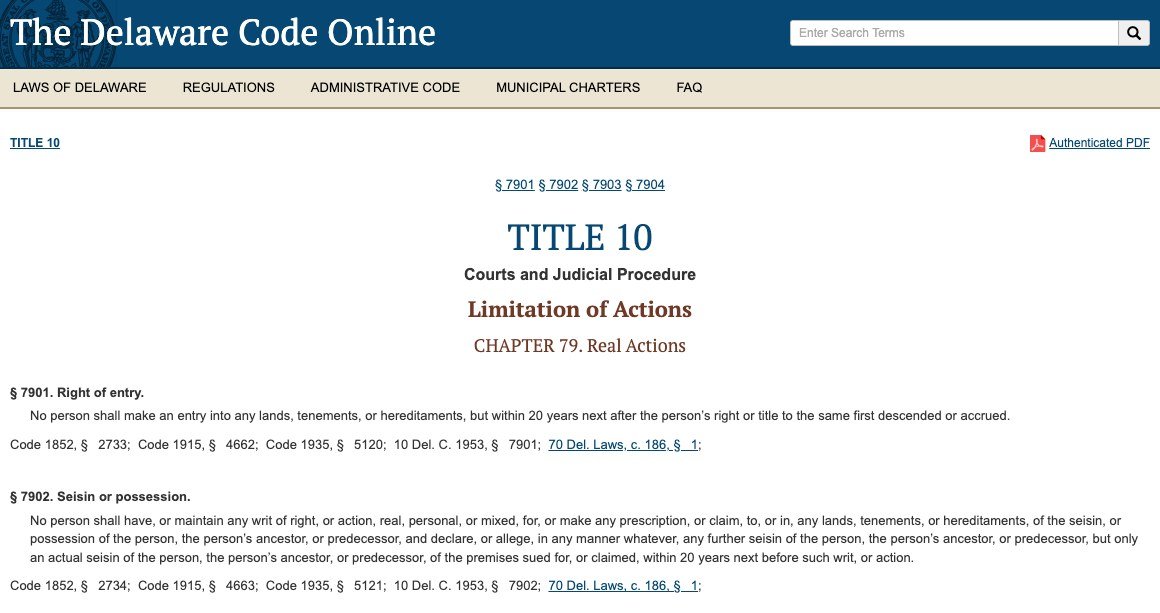
Title 10, sections 7901 and 7902 of the Delaware Code bar entry on land except within 20 years after the right accrued. Hawaii, Maine and North Dakota also use 20 years.
Squatters Rights: Adverse Possession Periods in Major States
| # | State | Standard period | Conditions and shortcuts | Statute |
|---|---|---|---|---|
| 1 | California | 5 years | Taxes must be paid for all 5 years; land enclosed or cultivated | Cal. Code Civ. Proc. 325 |
| 2 | Texas | 10 years | 3 years with title, 5 with a registered deed and taxes, 25-year outer limit | Tex. Civ. Prac. & Rem. Code 16.024-16.027 |
| 3 | Florida | 7 years | Color of title, or taxes paid and a return filed | Fla. Stat. 95.16, 95.18 |
| 4 | New York | 10 years | Claim of right plus the five-part test | CPLR 212(a); RPAPL 501 |
| 5 | Ohio | 21 years | Limit on actions to recover real property | Ohio Rev. Code 2305.04 |
| 6 | Arizona | 10 years | 3 years with title or color of title; 160-acre cap on the 10-year route | A.R.S. 12-526, 12-523 |
| 7 | Washington | 10 years | 7 years with color of title and taxes | RCW 4.16.020, 7.28.070 |
| 8 | Virginia | 15 years | Limit on entry or action to recover land | Va. Code 8.01-236 |
| 9 | Maryland | 20 years | Limit on filing an action or entering the land | Md. Code, Cts. & Jud. Proc. 5-103 |
| 10 | Minnesota | 15 years | Taxes for 5 consecutive years on separately assessed parcels | Minn. Stat. 541.02 |
| 11 | Kentucky | 15 years | Limit on actions to recover real property | KRS 413.010 |
| 12 | South Carolina | 10 years | Seizure or possession before the action | S.C. Code 15-3-340 |
State law controls squatters rights and it changes, so the current statute or a licensed attorney in the state is the authority for any specific property.
How Owners Prevent a Squatter Claim
Every element of adverse possession is an opening for prevention. The steps that matter most:
- Inspect vacant property regularly. Open and notorious use is easy to spot on a walk-through, and an early discovery keeps the clock from running.
- Secure the property. Locks, fencing and no-trespassing signs make the use less open and show the owner is actively controlling the land.
- Give permission in writing. A lease or a signed note allowing use defeats the hostile element, because the occupant is there with consent.
- Pay the taxes. California and Texas, among others, tie the claim to the occupant paying them, so keep records of every payment.
- Check boundaries. A survey shows whether a neighbor’s fence or driveway sits on your land before the period runs.
- Act early. A written demand to leave and a prompt court filing stop continuity, and the statutes bar owner actions that wait past the period.
Property taxes matter for owners and occupants alike, and the states with no property tax guide covers how they work. For disputes over a deposit or damage claim against a former tenant, small claims court is the usual route.
Frequently Asked Questions
How long does it take for a squatter to get rights to a property?
It depends on the state. California requires 5 years with taxes paid, Florida 7, New York 10, Maryland and Delaware 20, and Ohio 21. Some statutes shorten the period when the occupant holds a document that looks like a deed and pays the taxes.
Can I evict a squatter myself?
Generally no. Locking the person out or shutting off utilities can create liability, and in New York a dwelling occupant of 30 consecutive days cannot be removed by self-help. The safer routes are a sheriff complaint where a state law allows it, or a court action.
Do squatters have more rights than owners?
No. The owner holds title throughout, and a squatter has no ownership unless a court grants it after every element is met for the full period. Recent laws in Florida, New York, Georgia and Alabama also make removal quicker for owners of residential property.
Does paying property taxes help a squatter?
Where a statute requires it, yes, and without it the claim fails. California, Florida, Minnesota, Washington and Texas each tie at least one route to the occupant paying taxes.
Related Articles

Get the Fox Bulletin briefing
The stories that matter, in your inbox. No spam, unsubscribe anytime.
Newsletter signup will be available soon.
Related stories
Castle Doctrine: Where It Applies and What It Covers
Castle doctrine explained: how it differs from duty to retreat and stand your ground, with home, vehicle and workplace rules from Texas, Florida and Maine.

Death Penalty States: All 50 States, Methods and Executions
Twenty-seven states keep the death penalty, four of them under a governor's hold, and 23 have abolished it. This guide tables all 50 states with status, authorised methods and execution counts, ranks the ten states with the most recent executions and explains the Supreme Court cases behind modern capital punishment.

NFL Sunday Ticket Verdict Revived by Appeals Court
The Ninth Circuit restored the jury finding that the NFL broke antitrust law, then threw out the damages figure as guesswork.