

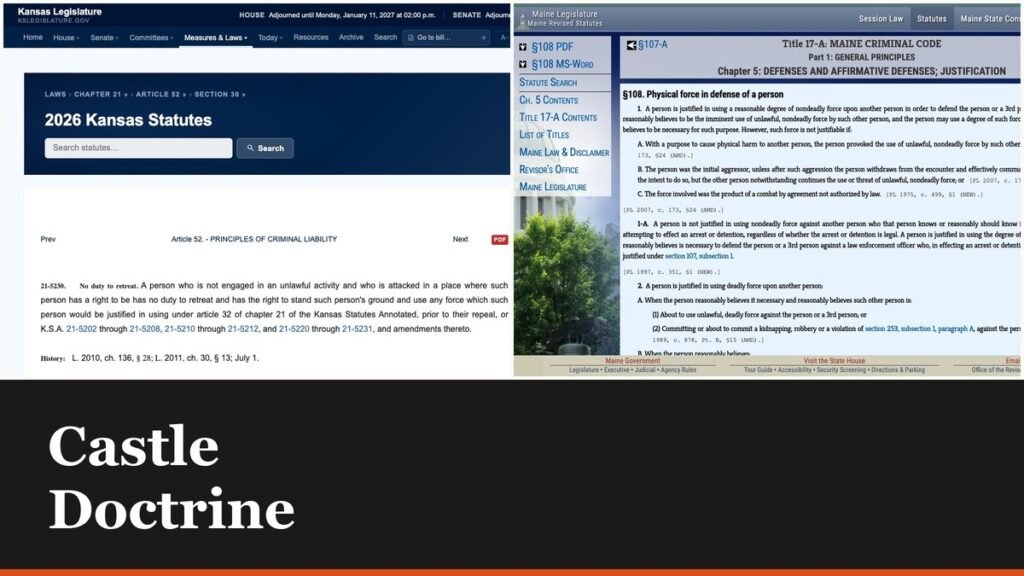
The castle doctrine is the legal rule that a person attacked inside their own home does not have to retreat before using force to defend themselves. In 2026 it sits at the center of how American courts judge home defense, and it is the narrowest of the three retreat rules that shape self-defense law.
Three questions come up most: whether it covers a car, whether it follows a person to work, and how it differs from stand your ground. The answers depend on the state.
What Is the Castle Doctrine?
The castle doctrine removes the duty to retreat when a person is in their own home. Traditional self-defense law requires someone to retreat before using force if a safe retreat is available. The castle doctrine makes an exception for the dwelling, and many state versions add a presumption that the defender feared for their life when an intruder broke in.
Stand your ground grew out of it. That later rule extends the no-retreat principle from the home to public spaces, or any place where a person has a legal right to be. South Carolina’s statute makes the link openly: its intent is to codify the castle doctrine and extend it to an occupied vehicle and the person’s place of business.
Castle Doctrine vs Duty to Retreat vs Stand Your Ground
Three rules decide whether a person must step back before using force. Each one answers the question for a different set of places:
| # | Rule | Must the person retreat? | Where it applies | Example in law |
|---|---|---|---|---|
| 1 | Duty to retreat | Yes, if the person knows a retreat is possible with complete safety | Public places and anywhere outside the exceptions | N.Y. Penal Law 35.15(2); Rhode Island case law |
| 2 | Castle doctrine | No, inside the home, and in some states at work or in an occupied vehicle | Dwelling, sometimes place of work or vehicle | 17-A Me. Rev. Stat. 108(2)(C)(3)(a); 11 Del. C. 464(e)(2) |
| 3 | Stand your ground | No, in any place where the person has a right to be and is not engaged in criminal activity | Home, vehicle, workplace and public places | Fla. Stat. 776.012(2); Tex. Penal Code 9.32(c); K.S.A. 21-5230 |
State law controls all three rules and it changes, so the current statute or a lawyer in the state can advise on a specific case.
Duty to Retreat: The Rule the Castle Doctrine Interrupts

New York’s Penal Law 35.15(2) is a plain example. A person may not use deadly physical force if they know they can avoid it with complete personal safety by retreating. The statute then carves out exceptions, and one of them is a person in their own dwelling who was not the initial aggressor.
Other states write the same structure into statute. Maine, Delaware and Hawaii all bar deadly force when it can be avoided with complete safety by retreating, then excuse retreat in specific places. In Rhode Island the rule comes from case law: a person must attempt retreat if they are consciously aware of an open, safe and available avenue of escape before using deadly force.
Where the Castle Doctrine Applies
Three places come up most often. State examples show how far each one reaches.
The Home and Dwelling

Maine’s 17-A M.R.S. 108 excuses retreat when the person is in their dwelling place and was not the initial aggressor. Colorado’s Make My Day law, section 18-1-704.5, goes further in its own way: an occupant of a dwelling is justified in using any degree of physical force, including deadly physical force, against someone who made an unlawful entry.
Definitions of the home differ. Wyoming’s statute treats a habitation as including trailers, campers and tents. Washington’s RCW 9A.16.050 uses the phrase dwelling or other place of abode. Illinois ties its castle statute to the dwelling only, and Illinois jury instructions state that a person who did not provoke the force has no duty to attempt to escape.
The Vehicle
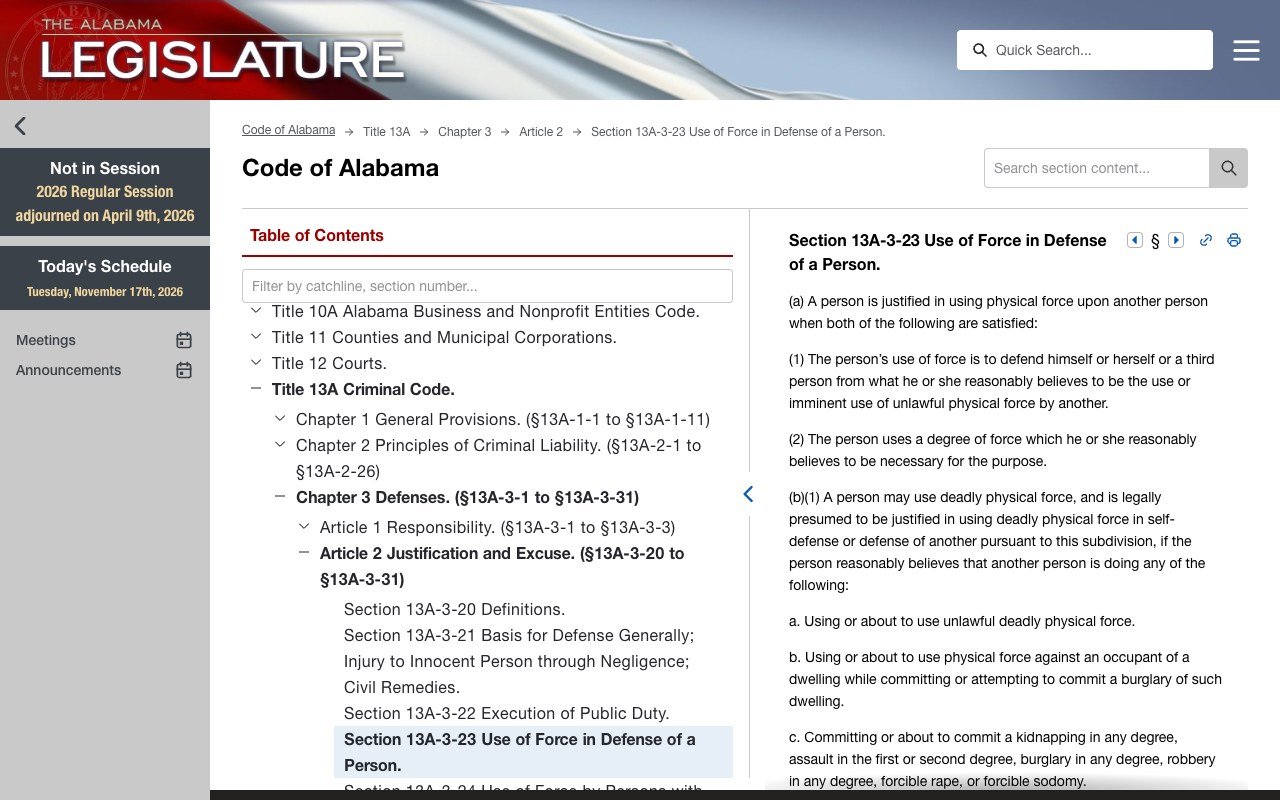
A car is not part of the home everywhere. Florida’s 776.013(2) presumption reaches a dwelling, a residence or an occupied vehicle. Texas Penal Code 9.32(b) covers an occupied habitation, vehicle or place of business or employment. Alabama’s 13A-3-23 and Pennsylvania’s 18 Pa.C.S. 505(b)(2.1) also reach an occupied vehicle, and South Carolina names it in the intent clause of 16-11-420.
Where the statute names only the dwelling, the vehicle falls outside the castle rule. New York’s retreat exception is for the dwelling, and Maine’s is for the dwelling place. In those states a person in a car is usually judged under the ordinary retreat rule.
The Workplace
Delaware and Hawaii both excuse retreat from a dwelling or place of work. Delaware sets a limit: the exception does not apply to the initial aggressor. Pennsylvania’s 505(b)(2)(ii) provides that the actor is not obliged to retreat from their dwelling or place of work unless the actor was the initial aggressor or is assailed in the place of work by another person whose place of work it is.
Texas names a place of business or employment in the same presumption that covers the home and vehicle. South Carolina’s 16-11-440(C) names a place of business among the places where a person attacked has no duty to retreat. Florida’s statute does not name the workplace, so Florida relies on the general no-retreat rule for any place where the person has a right to be.
The Presumption of Reasonable Fear and Its Exceptions
Many castle statutes add a presumption on top of the no-retreat rule. If the law presumes that the defender reasonably feared death or serious harm, the prosecution has to overcome that presumption rather than the defender proving the fear was reasonable.
The statutes attach conditions to the presumption. These are the ones the texts spell out:
- Florida 776.013(2): the presumption arises when the other person was unlawfully and forcefully entering, or had entered, a dwelling, residence or occupied vehicle, or was removing someone against their will. Exceptions follow in subsection (3).
- Texas 9.32(b): the belief is presumed reasonable if the actor knew or had reason to believe the other person unlawfully and with force entered or tried to enter an occupied habitation, vehicle or place of business or employment, did not provoke that person, and was not engaged in criminal activity other than a Class C traffic misdemeanor.
- Pennsylvania 505(b)(2.1): the presumption covers a dwelling, residence or occupied vehicle.
- Initial aggressors: Delaware, Maine, New York and Pennsylvania each withhold the home exception from the person who started the encounter.
Civil Immunity Under the Castle Doctrine
Some laws protect a defender from being sued as well as prosecuted. Florida’s 776.032 grants immunity from criminal prosecution and civil action for justifiable use of force. Once a prima facie claim of immunity is raised at a pretrial hearing, the burden shifts to the party seeking to overcome it, who must do so by clear and convincing evidence.
That is Florida’s rule, and it should not be read as a national one. Each state decides for itself whether to attach immunity to its self-defense statutes, and on what terms.
What the Castle Doctrine Does Not Cover
The doctrine is narrower than its reputation. Statutes and courts place several limits on it:
- Force must still be necessary. Florida’s 776.012(2) justifies deadly force only when the person reasonably believes it is necessary to prevent imminent death or great bodily harm, or to prevent the imminent commission of a forcible felony.
- The aggressor loses it. Wyoming’s 6-2-602(e) applies only if the person is not the initial aggressor and is not engaged in illegal activity.
- Unlawful activity ends the protection. Florida, Iowa, Kansas and Oklahoma each condition the no-retreat rule on the person not being engaged in criminal or unlawful activity.
- Public places can fall outside it. In New York and Rhode Island, a person outside the home is still held to the retreat rule.
- The home may be the only place. Illinois and Colorado limit their home-defense rules to the dwelling, and Maine and New York do not extend the exception to vehicles.
Carrying a firearm is a separate legal question. The castle doctrine does not decide whether a person may carry one, and the open carry states guide covers that side.
Stand Your Ground: The Castle Doctrine Beyond the Home

Florida’s 776.012(2) reads that a person using deadly force has no duty to retreat and the right to stand their ground if they are not engaged in criminal activity and are in a place where they have a right to be. Kansas, Iowa, Montana and South Dakota use similar wording in their own statutes.

Kansas’s 21-5230 is headed No duty to retreat. Montana’s 45-3-110 provides that a person lawfully in a place who is threatened with bodily injury or loss of life has no duty to retreat or to summon law enforcement before using force. Iowa’s 704.1(3) applies the rule to any place where the person is lawfully present. For the state-by-state classification, read the full list of stand your ground states.
Frequently Asked Questions
What is the castle doctrine in simple terms?
It is the rule that a person does not have to retreat from their own home before defending themselves. Outside the home, traditional law asks a person to retreat if they can do so safely, unless the state has adopted stand your ground.
Does the castle doctrine apply to a car?
In some states it does. Florida, Texas, Alabama, Pennsylvania and South Carolina name an occupied vehicle in their statutes. New York and Maine limit the exception to the dwelling, so a vehicle is not covered the same way.
Does the castle doctrine apply at work?
Where the statute names a place of work, yes. Delaware, Hawaii, Pennsylvania, Texas and South Carolina do, each with conditions such as the initial aggressor rule. Florida does not name the workplace.
Is the castle doctrine the same as stand your ground?
No. The castle doctrine removes the retreat duty in the home, and sometimes the workplace or vehicle. Stand your ground removes it in public places too, as long as the person has a right to be there and is not engaged in criminal activity.
Related Articles

Get the Fox Bulletin briefing
The stories that matter, in your inbox. No spam, unsubscribe anytime.
Newsletter signup will be available soon.
Related stories
Squatters Rights: What They Are and How Owners Respond
Squatters rights explained: the five elements of adverse possession, periods from 5 to 21 years in major states and the Florida and New York changes.

Death Penalty States: All 50 States, Methods and Executions
Twenty-seven states keep the death penalty, four of them under a governor's hold, and 23 have abolished it. This guide tables all 50 states with status, authorised methods and execution counts, ranks the ten states with the most recent executions and explains the Supreme Court cases behind modern capital punishment.

NFL Sunday Ticket Verdict Revived by Appeals Court
The Ninth Circuit restored the jury finding that the NFL broke antitrust law, then threw out the damages figure as guesswork.