

Dropshipping marketing gets discussed as a creative problem and it is really an arithmetic one. You have a fixed amount of money per order, decided by your product and supplier, and marketing either acquires customers for less than that or it does not. Every channel decision, every advert, every email is a way of moving one of two numbers.
On a $40 product costing $15 delivered, with $1.46 going to card processing, you have $23.54 to acquire a customer and keep as profit. That figure is your entire marketing budget per sale, and it is the number every tactic below should be measured against.
The Only Two Numbers That Matter
- Cost per purchase. Total spend on a channel divided by the orders it produced. Not clicks, not impressions, not reach.
- Gross margin per order. Retail price minus supplier cost minus payment processing.
If cost per purchase sits below gross margin you have a business that scales by spending more. If it sits above, spending more makes the loss bigger, which is why stores can grow revenue impressively while going broke. Every other metric is diagnostic, useful for working out why those two numbers are where they are, but never a substitute for them.
One consequence is worth stating plainly: raising the average order value is usually easier than lowering the cost per purchase. Competitors set your ad costs. You set your bundles.
Paid Social: Where Most Stores Start
Paid social is the default because it puts a product in front of people who were not looking for it, which is exactly what an unknown store needs. It is also the most expensive way to learn, and the place most first budgets disappear.
What decides results is less the targeting than the creative. A product that demonstrates visibly in a few seconds can work. One that needs explaining usually cannot, at least not at a cost per purchase your margin can absorb. Before spending, make sure the product passes that test, which our guide to the best products to dropship covers in detail.
- Test one product at a time. A budget split across six teaches you nothing about any of them.
- Give the test enough budget and time to produce conversions. A few dollars a day generates neither sales nor a conclusion.
- Judge on cost per purchase against your margin, and stop there. Cheap clicks that do not convert are not a good result.
- Change one variable at a time so you can tell what moved the number.
Search Traffic: Slower, and Yours
Someone searching for a product has already decided they want it, so search traffic converts better than interruption traffic almost everywhere. The catch is timing: paid search is an auction you can enter today, while organic search takes months and pays back indefinitely.
For a dropshipping store the realistic organic play is not competing for broad product terms against retailers with a decade of authority. It is the long tail: specific questions, comparisons and problems in your niche that nobody has answered well. Those pages take time, they cost nothing per visitor once ranked, and they keep working after you stop paying, which is the opposite of everything else on this list.
Email: The Only Channel You Own
Every other channel is rented. An algorithm change, a rising auction price or a suspended account can remove your traffic overnight. An email list cannot be taken away, and sending to it costs almost nothing per message.
This is where the margin arithmetic finally works in your favour. A first purchase costs $14 to acquire and leaves $9.54. A second purchase from the same customer, prompted by an email, costs cents and leaves nearly the full $23.54. One repeat buyer can be worth more than three new ones.
The tooling is cheap enough that there is no reason to delay. Klaviyo starts free with 250 profiles and 500 email sends a month, which covers a store’s first few hundred customers. Three automated sequences do most of the work.
- Abandoned cart. Built into Shopify already, and the highest-return email in ecommerce, recovering orders from people who already wanted the product.
- Post-purchase. Sets delivery expectations, which reduces the “where is my order” messages that slow dropshipping stores generate.
- Replenishment or accessory. Timed to when the customer would plausibly need the next thing.
Organic Social and Creators
Short-form video can produce sales at no media cost, and it is the closest thing to a free acquisition channel available to a new store. It is also unpredictable, which makes it a poor primary plan and an excellent secondary one.
Working with creators splits the difference. Paying someone with an established audience to demonstrate the product buys both the content and the distribution, and the content usually outperforms studio-made advertising because it does not look like advertising. Price it the same way as any other channel: total cost divided by orders produced, measured against your margin.
Choosing the Right Channel for Your Store
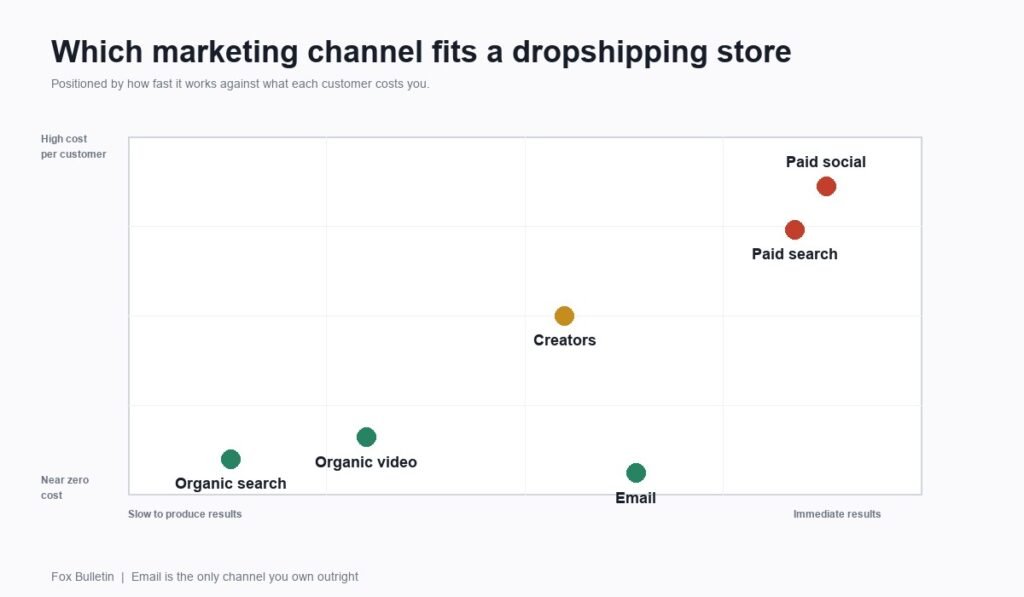
| Channel | Speed | Cost | Best for | Main risk |
|---|---|---|---|---|
| Paid social | Immediate | High per customer | Visual, demonstrable products | Costs rise as you scale |
| Paid search | Immediate | High, high intent | Products people search for by name | Competing with retailers |
| Organic search | Months | Time only | Niches with real questions | Slow, no early feedback |
| Needs a list first | Near zero | Repeat purchases | Useless until you have buyers | |
| Organic video | Unpredictable | Time only | Products that look good in motion | Cannot be relied on |
| Creators | Weeks | Moderate | Niches with visible audiences | Hard to attribute accurately |
The practical sequence for most stores is paid social to find out whether the product converts at all, email from the first order onward because it costs nothing to start, and organic search built in the background once you know which product is worth writing about.
Marketing Mistakes That Waste the Budget
- Spreading a small budget across channels. Three underfunded tests produce three inconclusive results.
- Stopping a test after two days. You pay for the data and then decline to collect it.
- Optimising for clicks. Cheap traffic that does not buy is more expensive than expensive traffic that does.
- Sending traffic to a homepage. Paid visitors should land on the product page they were promised.
- Not collecting emails from day one. Every customer you cannot contact again has to be bought a second time.
- Hiding delivery times to lift conversion. It raises refunds and disputes, and creates the shipping-rule exposure our guide to dropshipping legality sets out.
- Blaming marketing for a margin problem. If the product leaves $8 an order, no campaign fixes it.
How the Numbers Change as You Scale
A campaign that works at $20 a day frequently stops working at $200, and the reason is structural rather than a mistake in the account.
Advertising platforms show your product to the most likely buyers first. As you raise the budget, you reach progressively less responsive people, so the cost per purchase drifts upward while everything else stays the same. A store with $23.54 of margin might acquire customers at $12 in week one and $19 by the time it is spending five times more, which is still profitable but far less so.
That drift is why average order value matters so much. A store that lifts its average order from $40 to $60 through a bundle has raised its ceiling on acquisition cost by roughly $20, which buys a great deal more headroom than any targeting adjustment. Scaling is usually an order-value problem disguised as an advertising problem.
Getting the First Sales
The first sales are the hardest because you have no data, no reviews and no list. Three things shorten it.
- Pick one product and one audience and put the whole budget behind that combination.
- Make the product page answer the obvious objections before the visitor has to ask: what it is, when it arrives, what happens if it is wrong.
- Treat the first ten orders as research. Ask those customers what nearly stopped them buying, and fix that.
If the cost per purchase after a fair test sits far above your margin, the answer is usually a different product rather than a different advert, which is where our guide to dropshipping profitability picks the decision up.
Frequently Asked Questions
How do you market a dropshipping store with no budget?
Organic short-form video and long-tail content in your niche, plus email from the first order. Both cost time rather than money and neither produces fast results. The honest position is that a store with no budget can start but will grow slowly, because paid traffic is what buys speed.
How much should you spend testing a dropshipping product?
Enough to produce a meaningful number of conversions, which in practice means a few hundred dollars per product rather than a few dozen. Below that the advertising platform cannot optimise and you cannot distinguish a bad product from a small sample. Budget for several tests, since most products fail.
Which channel is best for dropshipping?
Paid social to discover whether a product converts, email to make each customer worth more than one order, and organic search to build traffic you do not rent. Most successful stores use all three in that sequence rather than choosing between them.
Why do dropshipping ads stop working after a while?
Usually audience saturation and rising competition rather than a broken campaign. The people most likely to buy see the advert first, so cost per purchase climbs as you scale into less responsive audiences. The fixes are new creative, a wider or different audience, or raising order value so a higher acquisition cost is still affordable.
Related Articles

Get the Fox Bulletin briefing
The stories that matter, in your inbox. No spam, unsubscribe anytime.
Newsletter signup will be available soon.
Related stories
Dropshipping Apps: What Each One Does and What It Costs
Dropshipping apps do four different jobs and most stores need one, not four. Five apps compared on current pricing, what each is actually for, and how many you really need.
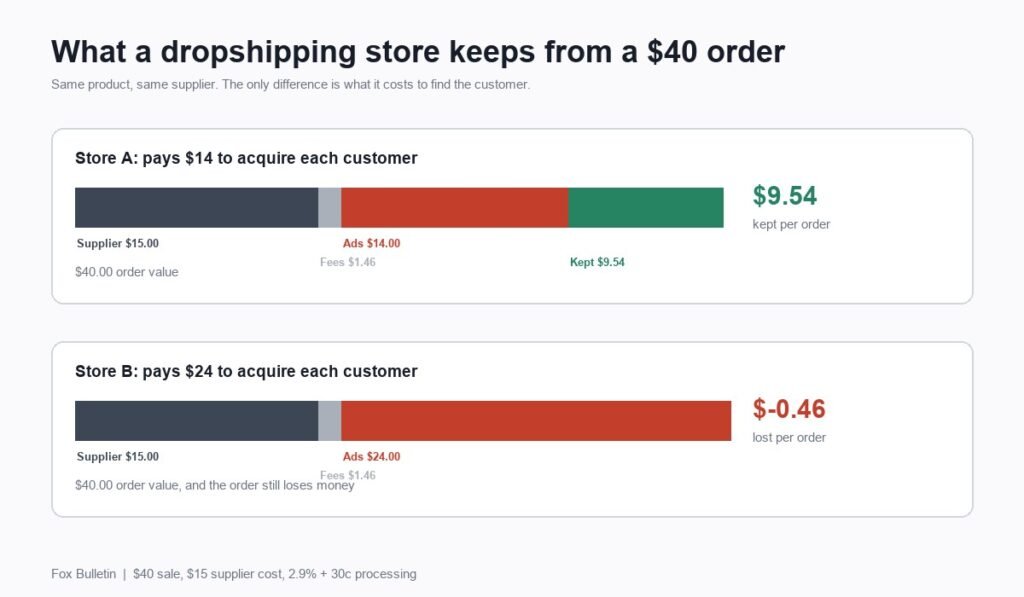
Is Dropshipping Profitable? The Numbers Behind the Answer
Dropshipping is profitable and most dropshipping stores are not. The margin arithmetic that decides which, what stores really earn, the costs that eat it, and the four levers that fix it.
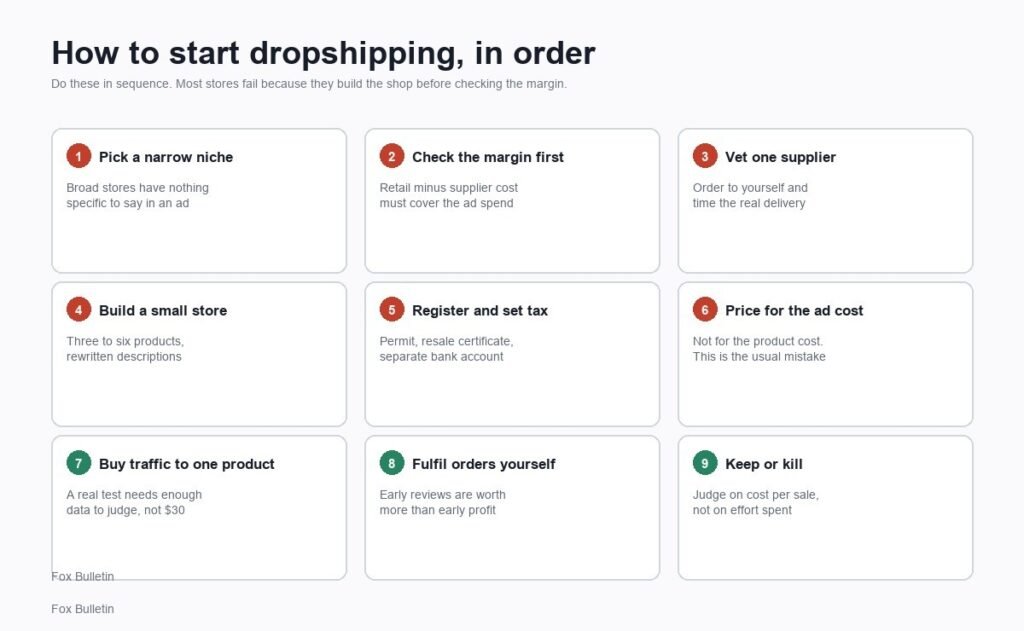
How to Start Dropshipping: The Nine Steps in the Right Order
Most guides put the steps in the wrong order and reach the margin arithmetic last. Nine steps in the sequence that catches problems while they are still cheap, with current vendor prices.