

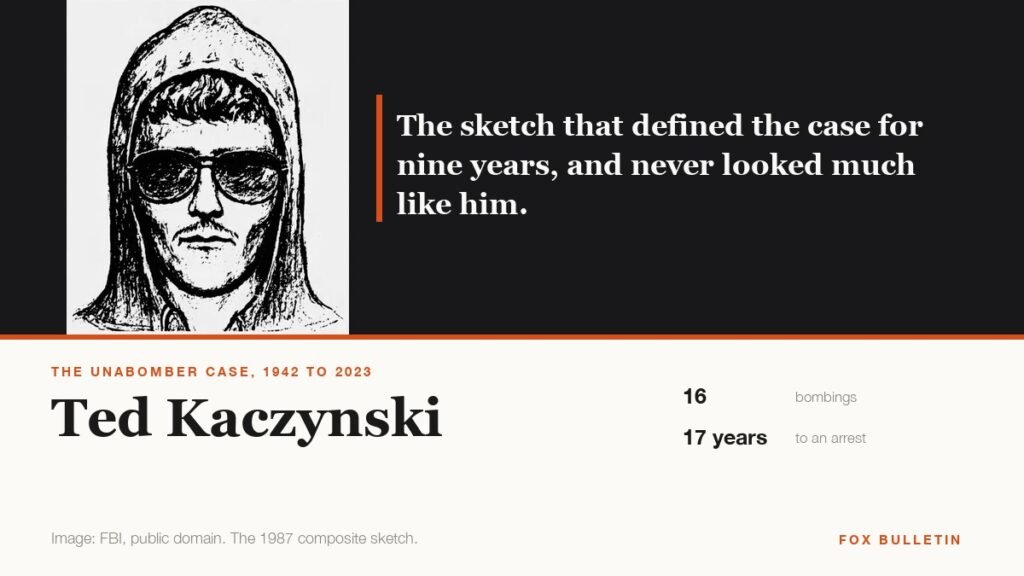
Ted Kaczynski was a Harvard-educated mathematician who became the Unabomber, carrying out 16 bombings between 1978 and 1995 that killed three people and injured close to two dozen. He was caught not by forensic evidence but because his own brother recognised his writing, and he died in federal custody in 2023.
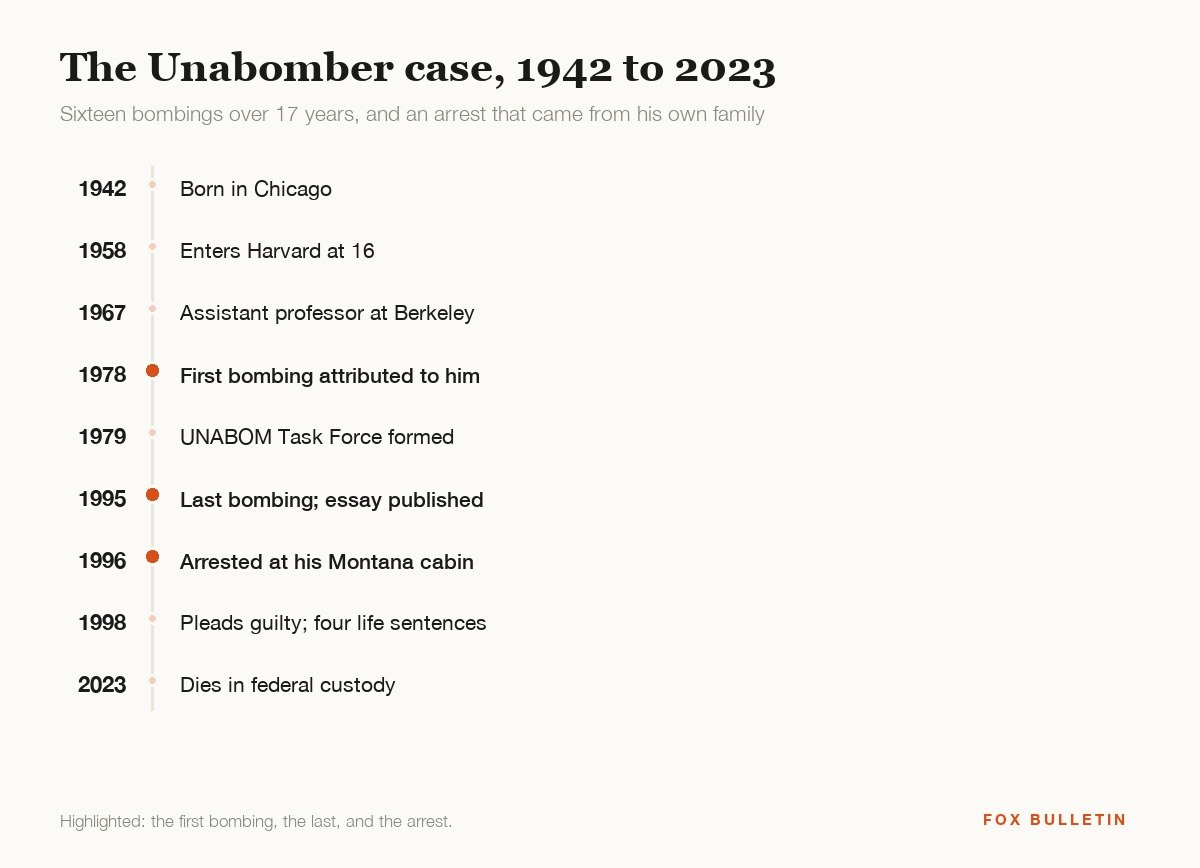
The case took 17 years and one of the largest investigations in FBI history, and it turned on a decision Kaczynski made himself. Here is the sequence:
| When | What happened |
|---|---|
| 1942 | Born in Chicago |
| 1958 to 1962 | Enters Harvard at 16 and graduates at 20 |
| 1962 to 1967 | Takes a master’s degree and a doctorate in mathematics at the University of Michigan |
| 1967 to 1969 | Assistant professor of mathematics at Berkeley, then resigns |
| 1978 | The first of the bombings attributed to him |
| 1979 | The UNABOM Task Force is formed |
| 1995 | The last bombing, and publication of his essay in national newspapers |
| April 3, 1996 | Arrested at his cabin near Lincoln, Montana |
| January 22, 1998 | Pleads guilty |
| May 4, 1998 | Sentenced to four consecutive life sentences plus 30 years |
| June 10, 2023 | Dies in federal custody in North Carolina |
Who Ted Kaczynski Was Before 1978
The biography is the part people find hardest to square with the rest. He was born in Chicago in 1942, entered Harvard in 1958 at the age of sixteen and graduated in 1962, then took a master’s degree and a doctorate in mathematics at the University of Michigan between 1962 and 1967.
He then taught at Berkeley. The university confirmed he was hired as an assistant professor of mathematics for the 1967-68 school year and that he resigned from university employment on June 30, 1969. He was 27, and he left academic mathematics permanently. Colleagues interviewed afterwards remembered almost nothing about him, and a 1996 campus account described how little trace he had left in the department he had worked in.
He moved to a small cabin near Lincoln, Montana, which he built with his brother David, and lived there without electricity or running water. The bombings began nine years after he left Berkeley.
The Bombing Campaign, 1978 to 1995
The FBI case file ran under the codename UNABOM, which the National Archives records as standing for University and Airline Bomber, after the early target pattern. Five facts define the campaign:
- The attacks ran from 1978 to 1995, a span of 17 years, which is longer than most serial investigations stay open.
- There were 16 bombings in total. Three people were killed and close to two dozen were injured.
- Targets clustered around universities and airlines, which is where the case name came from.
- The devices were posted or delivered rather than planted, which meant the evidence trail ran through the mail system rather than through a crime scene.
- He worked alone and left almost no forensic trace, which is why a task force with enormous resources spent nearly two decades without a name.
This article does not describe the devices, and the detail of how they were built is not the interesting part of the case anyway. What made it unsolvable for so long was the absence of a relationship between the attacker and the victims. Conventional investigation works outward from a victim toward the people around them. Here there was nothing to work outward from.
Why the Investigation Took 17 Years
The UNABOM Task Force was one of the longest and most expensive manhunts the FBI has run, and for most of its life it had no suspect at all:
- The UNABOM Task Force was formed in 1979, a year after the first attack, and eventually drew in the FBI, the ATF and the US Postal Inspection Service.
- A public tip line took 50,000 calls in a three month period, a volume that creates its own problem: every call has to be read and ranked by people who do not yet know what they are looking for.
- There was no useful physical description for most of the investigation, and no forensic link to any named person.
- The break came from language rather than forensics, which is why the case is taught as a landmark in forensic linguistics.
The scale is worth sitting with. Records from the lead prosecutor files, now at the National Archives, show a task force formed in 1979 and a tip line that took 50,000 calls in three months. None of it produced him.
The Essay That Ended the Case
In 1995 Kaczynski offered to stop the bombings if a national newspaper published a long essay he had written. The Washington Post and The New York Times agreed to publish it, a decision taken in consultation with the Attorney General and the FBI Director, and one that was heavily criticised at the time as negotiating with a bomber.
It worked, and not in the way either newspaper expected. David Kaczynski’s wife, Linda Patrik, read the published text and recognised the ideas and phrasing as his brother’s. She persuaded David to compare it with letters and documents Ted had written, and he took them to the FBI. The identification was made on language alone, which is why the case became a foundational example of forensic linguistics: the author was identified by how he wrote rather than by anything he left at a scene.
That is the moral centre of the case. A man was caught because he insisted on being read, and because a family member chose to act on what she recognised, knowing what it would mean.
The Arrest and What Was in the Cabin
FBI agents arrested him at the Montana cabin on April 3, 1996. The search of that one-room building produced the evidence the task force had lacked for 17 years: bomb components, around 40,000 handwritten journal pages that documented experiments and described the crimes, and one completed device ready to be posted.
The cabin itself was removed intact and has since been held as evidence and exhibited. It is an unusual artefact for a federal case, and it exists because the building was effectively the entire crime scene for a campaign conducted by mail.
The Plea, the Sentence and the End
The case never reached a jury:
- He pleaded guilty on January 22, 1998, which removed the need for a trial and for a jury to weigh an insanity defense his lawyers had wanted to run and he had refused.
- He was sentenced on May 4, 1998 to four consecutive life sentences plus 30 years, with no possibility of parole.
- He filed a motion to vacate his conviction on April 23, 1999, and the appeal was decided on February 21, 2001.
- He served most of the sentence at the federal supermax prison in Florence, Colorado.
- He was later moved to a federal medical facility in Butner, North Carolina, where he died on June 10, 2023.
The refusal to allow an insanity defense is the detail that still divides people who study the case. His legal team believed it was his strongest argument and he rejected it, because accepting it meant accepting that the ideas in the essay were symptoms rather than arguments. He preferred four life sentences.
Why the Case Still Gets Made Into Films
Dramatists return to it because it has a structure fiction usually has to invent: a brilliant man who removes himself from society, an investigation that fails for a generation, and a resolution that arrives through a brother rather than through police work. The ethical question at the centre, what you owe a family member you believe is killing people, belongs to David Kaczynski rather than to his brother, and it is the part that adaptations tend to be most interested in.
It also sits at the start of an argument that did not end with the case, about technology, autonomy and what industrial society does to people, which is why the name keeps reappearing in contexts that have nothing to do with the crimes. If you are working through the genre on screen, our list of the best Halloween movies covers the fictional end of it, and the most watched Netflix shows of all time shows how reliably true crime performs once it reaches a large platform. For an older American case that never produced a conviction at all, see our account of the Lizzie Borden murders and trial.
Frequently Asked Questions
How was Ted Kaczynski finally caught?
Through his own writing. After his essay was published in 1995, his brother David’s wife recognised the ideas and phrasing, David compared it with letters Ted had written and took them to the FBI, and agents arrested him at his Montana cabin on April 3, 1996.
How many people did the Unabomber kill?
Three people were killed and close to two dozen injured across 16 bombings between 1978 and 1995.
What does UNABOM stand for?
University and Airline Bomber, the FBI codename for the case, after the early pattern of targets. The task force that ran under that name was formed in 1979.
Where did Ted Kaczynski die?
At a federal medical facility in Butner, North Carolina, on June 10, 2023. He had served most of his sentence at the federal supermax prison in Florence, Colorado.
Related Articles

Get the Fox Bulletin briefing
The stories that matter, in your inbox. No spam, unsubscribe anytime.
Newsletter signup will be available soon.
Related stories

Amazon Prime Video Subscription: What It Costs and What You Get
An Amazon Prime Video subscription costs $8.99 standalone or $14.99 with full Prime, plus $4.99 for ad-free Ultra and 4K. Every plan, the discounted tiers and what the trial covers.

How Much Is Kindle Unlimited? Price, Trial and What You Get
Kindle Unlimited costs $11.99 a month plus tax with a 30 day free trial. What the fee covers, how it differs from Prime Reading, and how to tell whether it pays for itself.

Best Audiobook Apps: 7 Compared on Price and Catalog
Audible, Libro.fm, Spotify, Kobo Plus, Libby, hoopla and LibriVox compared on monthly price, catalog size and whether the audiobook stays yours after you cancel.