

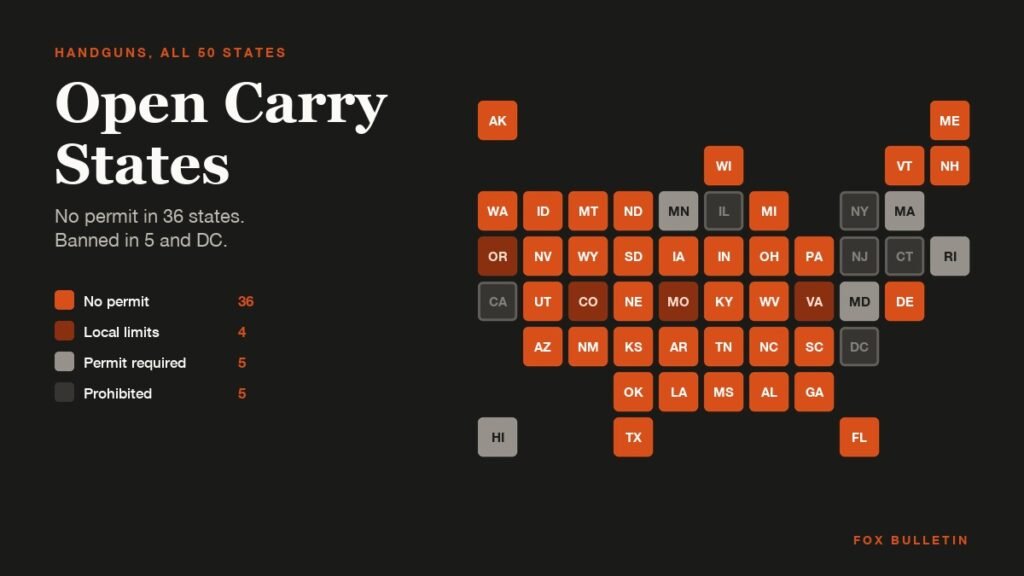
Open carry of a handgun requires no permit in 36 states, requires a permit in 5, and is banned outright in 5 states plus the District of Columbia. Four more states allow it but let cities and counties impose their own restrictions. The open carry states therefore split four ways rather than two, and the category a state falls into decides whether carrying a visible handgun is routine or a criminal offence.
Florida moved from the banned column to the permitless column in 2025 after a state appeals court struck down its prohibition. The table below lists every state, its current status, and the single condition most likely to catch someone out.
| State | Open carry status | Key condition |
|---|---|---|
| Alabama | No permit | Handgun must be in a holster |
| Alaska | No permit | No permit to carry openly or concealed |
| Arizona | No permit | Tribal land may ban it or require a tribal permit |
| Arkansas | No permit | Status settled by state police guidance in 2017 |
| California | Prohibited | Narrow exceptions in some rural counties |
| Colorado | Local limits | Banned in Denver; other localities vary |
| Connecticut | Prohibited | Banned since October 1, 2023 |
| Delaware | No permit | Dover repealed its local restriction in 2015 |
| Florida | No permit | Ban struck down in 2025; full state preemption |
| Georgia | No permit | Local restrictions preempted |
| Hawaii | Permit required | Permits issued by county and rare in practice |
| Idaho | No permit | Local restrictions preempted |
| Illinois | Prohibited | Banned statewide |
| Indiana | No permit | Permits remain available and are shall-issue |
| Iowa | No permit | Local restrictions preempted |
| Kansas | No permit | Local restrictions preempted |
| Kentucky | No permit | Local restrictions preempted |
| Louisiana | No permit | Local restrictions preempted |
| Maine | No permit | Local restrictions preempted |
| Maryland | Permit required | Wear and Carry Permit required; holders directed to carry concealed |
| Massachusetts | Permit required | Requires an unrestricted License to Carry |
| Michigan | No permit | Permit required to carry in a vehicle |
| Minnesota | Permit required | Shall-issue permit to carry |
| Mississippi | No permit | Permits remain available and are shall-issue |
| Missouri | Local limits | Some cities and counties restrict it; a permit overrides |
| Montana | No permit | Local restrictions preempted |
| Nebraska | No permit | Local restrictions preempted |
| Nevada | No permit | Loaded long guns banned in vehicles |
| New Hampshire | No permit | Local restrictions preempted |
| New Jersey | Prohibited | Banned even for carry permit holders |
| New Mexico | No permit | Tribal land rules apply |
| New York | Prohibited | Handguns and loaded long guns banned |
| North Carolina | No permit | Local restrictions preempted |
| North Dakota | No permit | Valid ID must be carried |
| Ohio | No permit | Local restrictions preempted |
| Oklahoma | No permit | Visitors from permitless states may carry with ID |
| Oregon | Local limits | Several cities and one county restrict loaded firearms |
| Pennsylvania | No permit | Permit required for a loaded firearm in a vehicle |
| Rhode Island | Permit required | Handgun permit is may-issue |
| South Carolina | No permit | Local restrictions preempted |
| South Dakota | No permit | Local restrictions preempted |
| Tennessee | No permit | Long guns may not be carried openly except when hunting |
| Texas | No permit | Handgun must be in a holster; minimum age 21 |
| Utah | No permit | Loaded long guns banned in vehicles |
| Vermont | No permit | State constitution bars a carry permit requirement |
| Virginia | Local limits | Localities may restrict certain firearms |
| Washington | No permit | Permit needed for a loaded handgun in a vehicle |
| West Virginia | No permit | Local restrictions preempted |
| Wisconsin | No permit | License needed for a loaded handgun within reach in a vehicle |
| Wyoming | No permit | Local restrictions preempted |
What Open Carry Means in Law
Open carry is carrying a firearm visibly, rather than concealed under clothing or in a bag. The legal line between the two is narrower than it sounds, and several states define it by whether the firearm is in a holster rather than by whether it can be seen.
Texas is the clearest example. Under Penal Code section 46.02(a-5) it is an offence to display a handgun in plain view in a public place, with an explicit exception when the handgun is carried in a holster. The same section sets a minimum age of 21 for carrying without a licence. A visible handgun is lawful; the same handgun tucked into a waistband without a holster is not.
Three terms are worth separating before reading any state rule:
- Open carry is carrying a visible firearm, which is what this list covers
- Concealed carry is carrying a hidden firearm, governed by a separate set of state rules
- Permitless or constitutional carry means no licence is required, and it usually covers concealed carry rather than open carry
- Preemption means state law overrides city and county ordinances, which is why some states are uniform and others are not
A state can be permitless for one and restrictive for the other. Our guide to the constitutional carry states covers the concealed side of the same question.
The 36 States That Require No Permit
In 36 states anyone who may lawfully possess a firearm under federal and state law may carry it openly without applying for anything. This is the largest group by a wide margin and includes Texas, Florida, Georgia, Ohio, Pennsylvania and most of the South and Mountain West.
No permit does not mean no conditions. Alabama and Texas both require the handgun to be in a holster. North Dakota requires valid identification to be carried. Vermont is the outlier at the permissive end: its state constitution has been read to bar any permit requirement for carrying at all.
Vehicles are where this group diverges most sharply. Michigan requires a permit to carry in a car, Pennsylvania requires one for a loaded firearm in a vehicle, Washington requires one for a loaded handgun, and Wisconsin courts have held that a licence is needed to keep a loaded handgun within reach while driving. A lawful carry on foot can become an offence on crossing into the driver’s seat.
The 5 States That Require a Permit to Open Carry
Hawaii, Maryland, Massachusetts, Minnesota and Rhode Island all require a licence before a handgun may be carried in public, openly or otherwise. The practical difficulty of obtaining one varies enormously between them.
Minnesota and Massachusetts issue on a shall-issue basis, meaning an applicant who meets the published criteria must be granted a permit. Massachusetts requires an unrestricted Licence to Carry specifically. Rhode Island’s handgun permit remains may-issue, leaving discretion with the issuing authority.
Hawaii issues permits by county, and they are valid only in the county that granted them. Maryland requires a Wear and Carry Permit, and permit holders there are directed to keep the handgun concealed, so a Maryland permit should not be read as authorising visible carry.
The 5 States and DC Where Open Carry Is Banned
California, Connecticut, Illinois, New Jersey and New York prohibit open carry of handguns, as does the District of Columbia. In New Jersey the ban applies even to people who hold a valid concealed carry permit, which is the strictest formulation in the country.
Connecticut is the most recent addition, with its ban taking effect on October 1, 2023, and carrying exceptions for private property, shooting ranges and hunting. New York bans handguns and loaded long guns in public but permits unloaded long guns outside New York City. California allows narrow exceptions in some rural counties that issue their own licences.
These six jurisdictions are not uniformly restrictive on concealed carry. Each issues carry permits, and the Supreme Court’s decision in New York State Rifle & Pistol Association v. Bruen required them to do so on objective criteria rather than at official discretion. The ruling addressed the right to carry, not the manner of carrying, which is why open carry bans have survived it in these states while Florida’s did not.
Four States Where Your City Matters More Than Your State
Colorado, Missouri, Oregon and Virginia permit open carry at state level but have not preempted local regulation, so the answer changes with the city limits sign.
- Colorado allows it statewide but Denver bans it, and other municipalities set their own rules
- Missouri lets cities and counties restrict it, though holding a carry permit overrides most local limits
- Oregon has several cities and one county restricting loaded firearms, with concealed handgun licence holders exempt
- Virginia allows localities to restrict certain firearms in public spaces
In three of these four, a carry permit functions as an exemption from the local rule. That is the reverse of the usual logic: the permit is not what makes carrying lawful, it is what makes the city ordinance inapplicable.
How Florida Became an Open Carry State
Florida banned open carry under section 790.053 for decades. On September 10, 2025, the First District Court of Appeal held in McDaniels v. State that the ban violated the Second Amendment, vacated the conviction and reversed the sentence. The court reasoned that the historical record treated open carry as the default way of bearing arms.
Five days later the Florida Attorney General issued a guidance memorandum to police and prosecutors stating that the decision binds all state trial courts and directing them not to arrest or prosecute law-abiding people carrying a visible firearm. The state did not appeal.
Two limits survive. Section 790.06(12)(a) still bars carrying in designated sensitive locations, and section 790.10 still prohibits carrying a firearm in a rude, careless, angry or threatening manner. The underlying statute also remains on the books, so Florida’s status rests on an appellate decision and executive guidance rather than on a repeal.
Long Guns Follow a Different Set of Rules
Rifles and shotguns are regulated separately from handguns in most states, and a state’s handgun category does not predict its long gun category.
Maryland prohibits open carry of handguns for permit holders but allows long guns to be carried openly with no permit at all. Tennessee is the mirror image: handguns may be carried openly without a permit, while long guns may not be except while hunting. New Jersey bans handgun open carry outright but allows unloaded long guns with a firearms identification card.
California, Connecticut, Illinois and the District of Columbia prohibit open carry of long guns as well as handguns. Massachusetts and Minnesota require a permit for both.
Where Open Carry Is Banned Whatever Your State Says
Every state that allows open carry also designates locations where it is prohibited, and federal law adds its own. These override permissive state rules and account for most inadvertent offences.
- Schools and school grounds, under the federal Gun-Free School Zones Act and parallel state statutes
- Federal buildings, courthouses, post offices and military installations
- Airport secure areas past the screening checkpoint
- Polling places in a large number of states
- Bars and licensed premises in many states, often keyed to the share of revenue from alcohol
- Private property where the owner has posted notice, which is enforceable in nearly every state
Carrying across state lines adds another layer, because open carry reciprocity is not the same as concealed carry reciprocity and in most states does not exist at all. The Second Amendment is the constitutional text these rules are litigated against.
Employers form a separate category again. A private employer may generally bar firearms from the workplace whatever the state allows in public, a power that sits alongside the rules covered in our guide to employment at will by state.
A Note on Legal Advice
This is general information, not legal advice. Firearm law changes through legislation, court decisions and executive guidance, sometimes within a single year, as Florida demonstrates. Verify the current rule with the state attorney general or state police before carrying, and consult a lawyer licensed in that state for anything turning on your own circumstances.
Carrying law and the law on using a firearm are separate questions decided by separate statutes. Our guide to the stand your ground states covers when force may lawfully be used, which is governed independently of whether carrying was permitted.
Frequently Asked Questions
How many states allow open carry without a permit?
36 states allow open carry of a handgun with no permit. Four more allow it statewide but let cities and counties restrict it, five require a permit, and five plus the District of Columbia prohibit it.
Which states ban open carry completely?
California, Connecticut, Illinois, New Jersey and New York ban open carry of handguns, along with the District of Columbia. New Jersey’s ban applies even to holders of a valid concealed carry permit.
Is open carry the same as constitutional carry?
No. Constitutional carry means no permit is needed to carry, and it usually refers to concealed carry. A state can be a constitutional carry state and still restrict open carry, and several do.
Does a concealed carry permit let me open carry?
Not automatically. In Maryland permit holders are directed to carry concealed, and in New Jersey open carry is prohibited even with a permit. In Missouri, Oregon and Virginia a permit works the other way, exempting the holder from local restrictions.
Related Articles

Get the Fox Bulletin briefing
The stories that matter, in your inbox. No spam, unsubscribe anytime.
Newsletter signup will be available soon.
Related stories
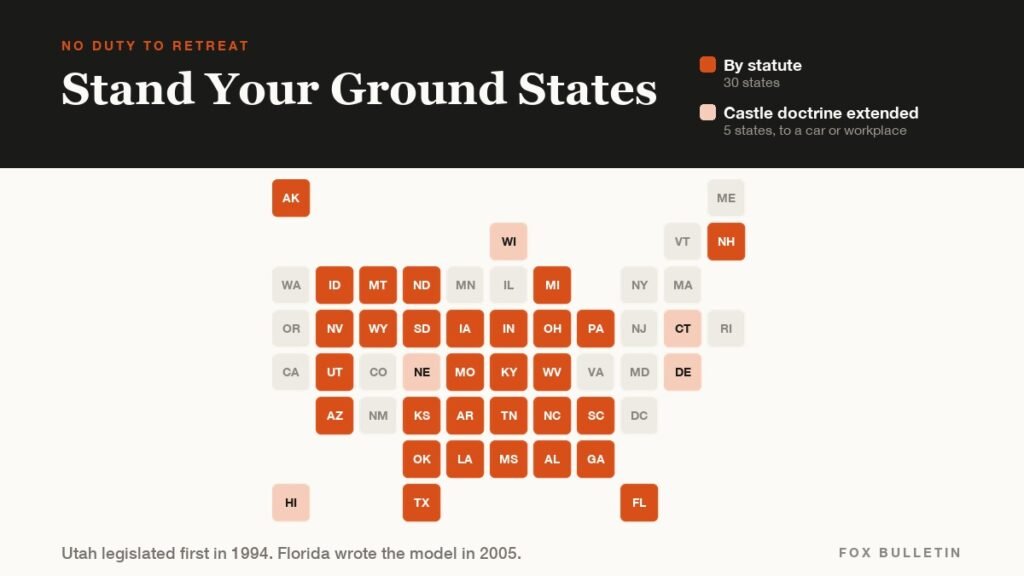
Stand Your Ground States: All 30 and the 5 In Between
Thirty states have removed the duty to retreat by statute. Here is each one with its code section, the five that went partway, and how the doctrine differs from castle doctrine.
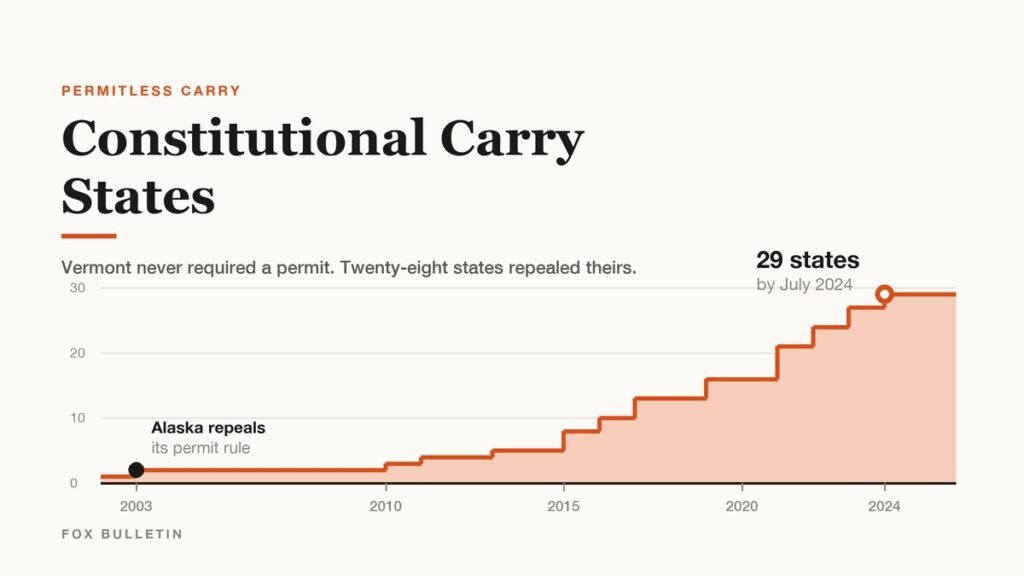
Constitutional Carry States: All 29 and the Limits
Twenty-nine states let a qualifying adult carry a concealed handgun without a permit. Here is when each law took effect, what it does not change, and why permits still matter.
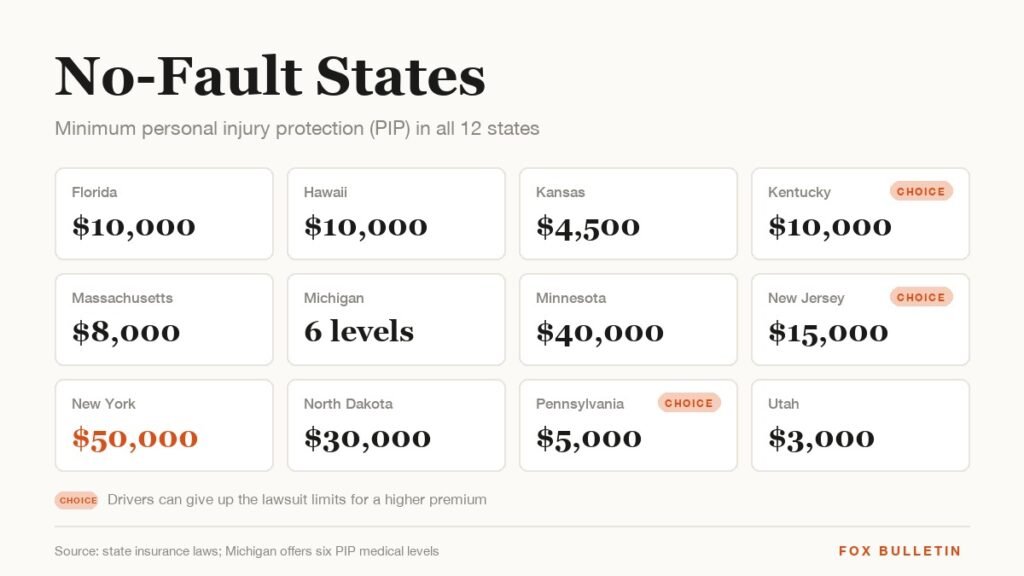
No-Fault States: All 12, With PIP Minimums and Lawsuit Rules
Florida, Hawaii, Kansas, Kentucky, Massachusetts, Michigan, Minnesota, New Jersey, New York, North Dakota, Pennsylvania and Utah use no-fault car insurance. What each requires and when you can still sue.