

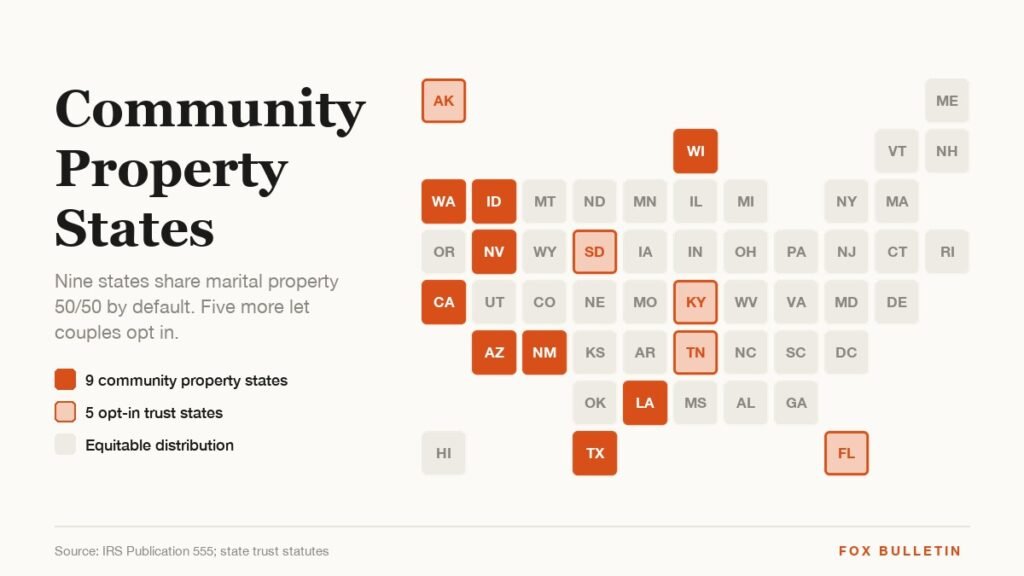
Community property states are the nine US states where most property and income acquired during a marriage belongs to both spouses equally: Arizona, California, Idaho, Louisiana, Nevada, New Mexico, Texas, Washington and Wisconsin. In the other 41 states, ownership generally follows whose name is on the asset, and a divorce court divides marital property under a different system called equitable distribution.
Five of those 41 states, Alaska, Tennessee, South Dakota, Kentucky and Florida, let married couples opt into community property for assets they place in a qualifying agreement or trust. The table lists the nine full community property states, the rule each applies when a marriage ends in divorce, and how federal tax law treats income earned from one spouse’s separate property there.
| # | State | Divorce division rule | Statute | Income from separate property |
|---|---|---|---|---|
| 1 | Arizona | Equitable, not necessarily in kind | A.R.S. 25-318 | Separate |
| 2 | California | Equal | Family Code 2550 | Separate |
| 3 | Idaho | Substantially equal unless compelling reasons | Idaho Code 32-712 | Community |
| 4 | Louisiana | Equal net value | La. R.S. 9:2801 | Community |
| 5 | Nevada | Equal unless a compelling reason is put in writing | NRS 125.150 | Separate |
| 6 | New Mexico | Equal | Case law under NMSA 40-4-7 | Separate |
| 7 | Texas | Just and right | Family Code 7.001 | Community |
| 8 | Washington | Just and equitable, separate property included | RCW 26.09.080 | Separate |
| 9 | Wisconsin | Presumed equal | Wis. Stat. 767.61 | Community |
What Counts as Community Property and What Stays Separate
The IRS describes community property in IRS Publication 555 as property either spouse acquires during the marriage while the couple is domiciled in a community property state, property the spouses agree to convert into community property, and anything that cannot be identified as separate property. That last part works as a presumption: an asset bought during the marriage is treated as shared unless one spouse can trace it to a separate source.
Separate property generally includes:
- Property owned before the marriage by either spouse
- Gifts and inheritances received by one spouse alone during the marriage
- Money earned while living in a non-community property state
- Property bought with separate funds or acquired in exchange for separate property
- Property converted from community to separate through a valid agreement between the spouses
Mixing is where most disputes start. When separate money and community money pay for the same asset, such as a house bought before the wedding and paid down from wages afterwards, only the part bought with separate funds stays separate. Inherited money kept in an account in one spouse’s name is far easier to prove separate than inherited money deposited into a joint account alongside paychecks.
How Each of the 9 Community Property States Divides Property in Divorce
Owning property equally during the marriage does not always mean a 50/50 split when it ends. California, Louisiana and New Mexico require an equal division. Idaho, Nevada and Wisconsin start from equal but let a judge depart from it for stated reasons. Arizona, Texas and Washington give the court open discretion to reach a fair result.
1. Arizona: Equitable Division Under A.R.S. 25-318
Divorce rule: equitable, not necessarily in kind · Statute: A.R.S. 25-318 · Income from separate property: separate
Arizona courts divide community property “equitably, though not necessarily in kind.” A judge can give one spouse the house and the other the retirement account, provided the overall result is fair, and the statute fixes no percentage.
The same section reaches property acquired in other states. For divorce purposes, anything either spouse acquired outside Arizona is treated as community property if it would have been community property had it been acquired in Arizona, so moving to Phoenix from a common-law state does not shield what the couple earned during the marriage before the move.
2. California: A Strict Equal Split
Divorce rule: equal · Statute: Family Code 2550 · Income from separate property: separate
California is the strictest of the nine. Family Code section 2550 directs the court to divide the community estate equally unless the spouses agree otherwise in writing or in open court, so the judge’s job is valuation and allocation rather than deciding what share is fair.
California applies the same treatment to quasi-community property, defined in Family Code section 125 as property acquired while living elsewhere that would have been community property had the couple been domiciled in California. Registered domestic partners are covered too, and the IRS requires California partners to report half of their combined community income.
3. Idaho: Substantially Equal Unless There Are Compelling Reasons
Divorce rule: substantially equal · Statute: Idaho Code 32-712 · Income from separate property: community
Idaho Code 32-712 calls for a substantially equal division in value, taking debts into account, unless there are compelling reasons to divide differently. The factors a court may weigh include how long the marriage lasted, any premarital agreement, and each spouse’s age and health.
Idaho is one of four states where income produced by separate property counts as community income. A rental house one spouse owned before the wedding stays that spouse’s property, but the rent it earns during the marriage belongs to both.
4. Louisiana: Equal Net Value, Enforced With Cash
Divorce rule: equal net value · Statute: La. R.S. 9:2801 · Income from separate property: community
Louisiana requires each spouse to leave with property of equal net value. Under Revised Statutes 9:2801 the court values the assets as of the trial, subtracts the debts allocated to each spouse, and orders an equalizing payment in cash if the assets themselves cannot be split evenly.
Louisiana law calls the system a matrimonial regime. As in Idaho, Texas and Wisconsin, income earned from one spouse’s separate property during the marriage is treated as community income for federal tax purposes.
5. Nevada: Equal Unless a Judge Explains Otherwise
Divorce rule: equal unless a compelling reason is written · Statute: NRS 125.150 · Income from separate property: separate
NRS 125.150 tells the court to make an equal disposition of community property to the extent practicable. A judge may divide it unequally only after finding a compelling reason and setting that reason out in writing, such as one spouse wasting or hiding marital assets.
Nevada adopted this equal standard in 1993 after previously dividing property equitably. It is also one of three states, with California and Washington, whose registered domestic partners must follow community property rules on their federal returns.
6. New Mexico: Equal Division as a Duty
Divorce rule: equal · Statute: case law under NMSA 40-4-7 · Income from separate property: separate
New Mexico courts treat an equal division of community property as a duty rather than a starting point. All property either spouse holds during the marriage is presumed to be community property until shown otherwise.
The burden falls on the spouse claiming an asset is separate. Property owned before the marriage, and gifts or inheritances, stay with the spouse who received them only if they can still be traced, which matters most for money that has passed through joint accounts.
7. Texas: A “Just and Right” Division
Divorce rule: just and right · Statute: Family Code 7.001 · Income from separate property: community
Texas Family Code section 7.001 lets the court divide the estate in the manner it deems “just and right,” having due regard for the rights of each party and any children of the marriage. The statute sets no default percentage, which gives Texas judges more room than the equal-division states to award one spouse more than half.
Texas is also one of the four states where income from separate property is community income, so dividends paid during the marriage on stock a spouse owned beforehand are shared. Texas shares another trait with two other community property states, Nevada and Washington: all three appear on our list of states with no income tax.
8. Washington: Separate Property Is on the Table
Divorce rule: just and equitable · Statute: RCW 26.09.080 · Income from separate property: separate
RCW 26.09.080 tells a Washington court to make a disposition that is “just and equitable” after weighing the nature and extent of the community property, the separate property, the length of the marriage and each spouse’s economic circumstances. Because separate property is on that list, a Washington court can divide assets one spouse owned before the marriage, a reach California’s equal-division statute does not have.
Registered domestic partners in Washington follow the same community property rules. For federal taxes each partner reports half of the combined community income, even though registered partners are not treated as married for federal tax purposes.
9. Wisconsin: Marital Property Since 1986
Divorce rule: presumed equal · Statute: Wis. Stat. 767.61 · Income from separate property: community
Wisconsin calls it marital property rather than community property. Its Marital Property Act took effect on January 1, 1986, when Wisconsin joined the other eight states, and the IRS treats Wisconsin marital property as a form of community property.
In a divorce, Wisconsin Statute 767.61 presumes that all property is divided equally except property one spouse received as a gift or inheritance, so assets owned before the marriage can end up in the split. A court can depart from equal after weighing listed factors such as the length of the marriage and the property each spouse brought into it.
The 5 States Where Couples Can Opt Into Community Property
Five common-law states let couples choose community property, mainly for the tax treatment at death described below. Each requires a written agreement or a trust that declares the assets to be community property:
- Alaska (1998): the first opt-in state; couples can sign a community property agreement or use a community property trust
- Tennessee (2010): the Tennessee Community Property Trust Act, open to residents and non-residents
- South Dakota (2016): community property trusts allowed from July 1, 2016
- Kentucky (2020): the Kentucky Community Property Trust Act took effect on July 15, 2020
- Florida (2021): the Florida Community Property Trust Act took effect on July 1, 2021
The election covers only the assets placed in the agreement or trust, and everything else stays under the state’s ordinary rules. Publication 555 states that it does not address the federal tax treatment of property under the Alaska, Tennessee and South Dakota elections.
Community Property Rules on Your Federal Tax Return
Spouses who file a joint return see little difference. The rules bite when a couple in a community property state files separately: each spouse must report half of all community income plus all of their own separate income, and IRS Form 8958 is used to allocate wages, withholding and other amounts between them.
Which income counts as community depends partly on the state. Income produced by separate property is:
- Separate income in Arizona, California, Nevada, New Mexico and Washington
- Community income in Idaho, Louisiana, Texas and Wisconsin
There is an exception for spouses who live apart. If they lived apart all year, did not file a joint return, had earned income that is community income, and transferred none of it between themselves, the community property rules do not apply to that earned income.
The largest tax difference arrives at death. Under section 1014(b)(6) of the Internal Revenue Code, when one spouse dies, both halves of community property receive a new cost basis equal to market value on the date of death, not just the deceased spouse’s half. A couple in a common-law state who own a stock portfolio jointly get the step-up on only half, so the survivor can owe capital gains tax on decades of growth in the other half when it is sold.
Ownership also changes what passes through probate. Because the surviving spouse already owns half of the community property outright, only the deceased spouse’s half is distributed under a will or, if there is none, under the state rules in our guide to dying without a will.
Moving To or From a Community Property State
Domicile decides which rules apply, not where an asset sits. Spouses domiciled in different states have to check the law of each, because one state may treat their earnings as community income and the other may not.
Moving in can reach property acquired before the move. California’s quasi-community property rule and Arizona’s divorce statute both treat property acquired elsewhere during the marriage as if it had been acquired in-state when the marriage ends in divorce. A couple relocating from Illinois to California with a brokerage account built from Illinois wages should expect that account to be split equally in a California divorce.
Property rules are state law and change through statutes and court decisions, so use this as a guide to the questions to ask a family or estate lawyer licensed in your state, not as legal advice.
Frequently Asked Questions
How many community property states are there?
Nine: Arizona, California, Idaho, Louisiana, Nevada, New Mexico, Texas, Washington and Wisconsin. Alaska, Tennessee, South Dakota, Kentucky and Florida let couples opt in through an agreement or trust, and Puerto Rico also uses community property.
Is Texas a community property state?
Yes. Property either spouse acquires during the marriage is presumed to be community property, and income from separate property is community income. A divorce court divides the estate in whatever way it finds “just and right,” which is not always 50/50. Texas also recognizes informal marriage, so the rules can apply to couples without a ceremony, as our guide to common law marriage states explains.
Is Florida a community property state?
No. Florida divides marital property in a divorce through equitable distribution. Since July 1, 2021, however, Florida couples can create a community property trust and have the assets inside it treated as community property.
Is an inheritance community property?
No. Gifts and inheritances received by one spouse are separate property in all nine states. The income they produce is another matter: in Idaho, Louisiana, Texas and Wisconsin, interest or rent earned on an inheritance during the marriage is community income.
Related Articles

Get the Fox Bulletin briefing
The stories that matter, in your inbox. No spam, unsubscribe anytime.
Newsletter signup will be available soon.
Related stories

Lemon Law: How a Car Qualifies and What You Get Back
A lemon law makes the manufacturer buy back or replace a new car it cannot fix. Here are the real tests in nine states, the refund formulas, and the steps to file a claim.

Statute of Limitations: What It Means and How Long You Have
A statute of limitations is the legal deadline to sue or bring charges. Here are the real time limits in four big states, the crimes with no limit, and how old debts work.
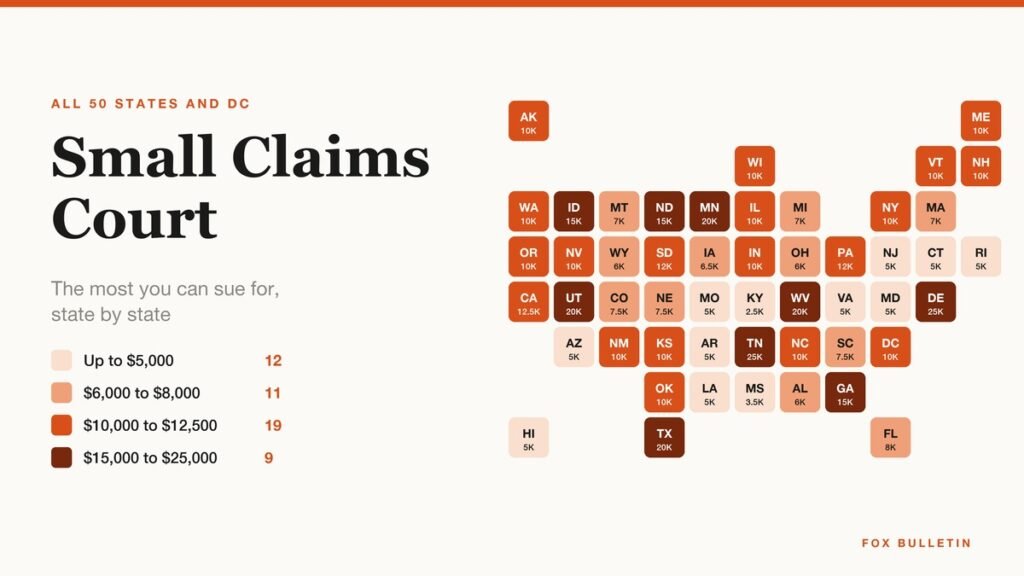
Small Claims Court: Limits in Every State and How It Works
Small claims court settles money disputes quickly and cheaply. Here is the dollar limit in every state, what it costs to file, who can bring a lawyer, and how collection works.