

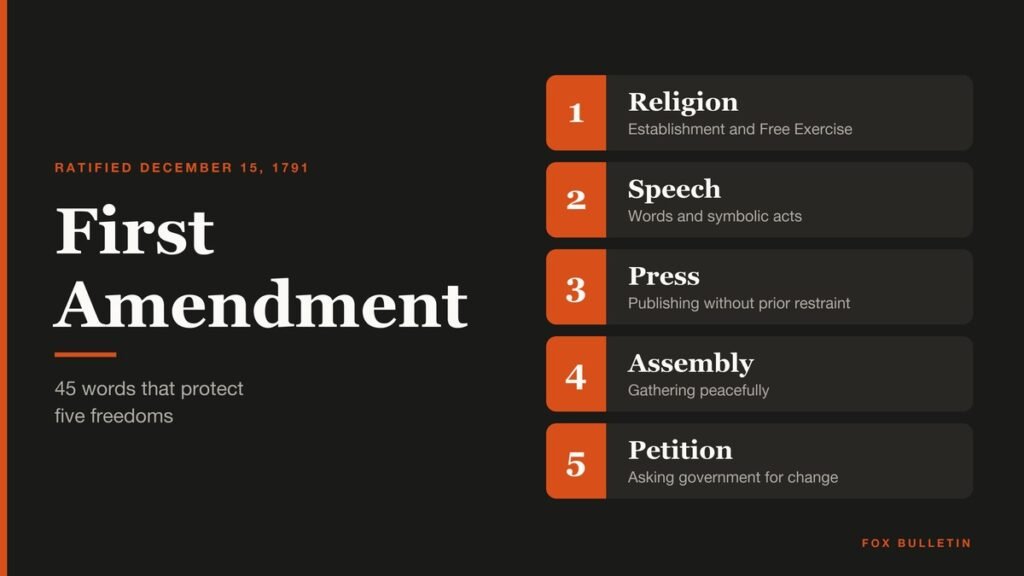
The First Amendment bars the federal government, and through later rulings every state, from setting up a religion or blocking its practice, and from abridging speech, the press, peaceable assembly or the right to petition. In 2026 it is still the same 45 words ratified in 1791, but its meaning comes from more than a century of Supreme Court cases.
What Is the First Amendment?
The First Amendment is the first of the 10 amendments in the Bill of Rights. It forbids the government from establishing a religion, interfering with religious exercise, or abridging freedom of speech, freedom of the press, the right to assemble peacefully, and the right to petition the government for a redress of grievances.
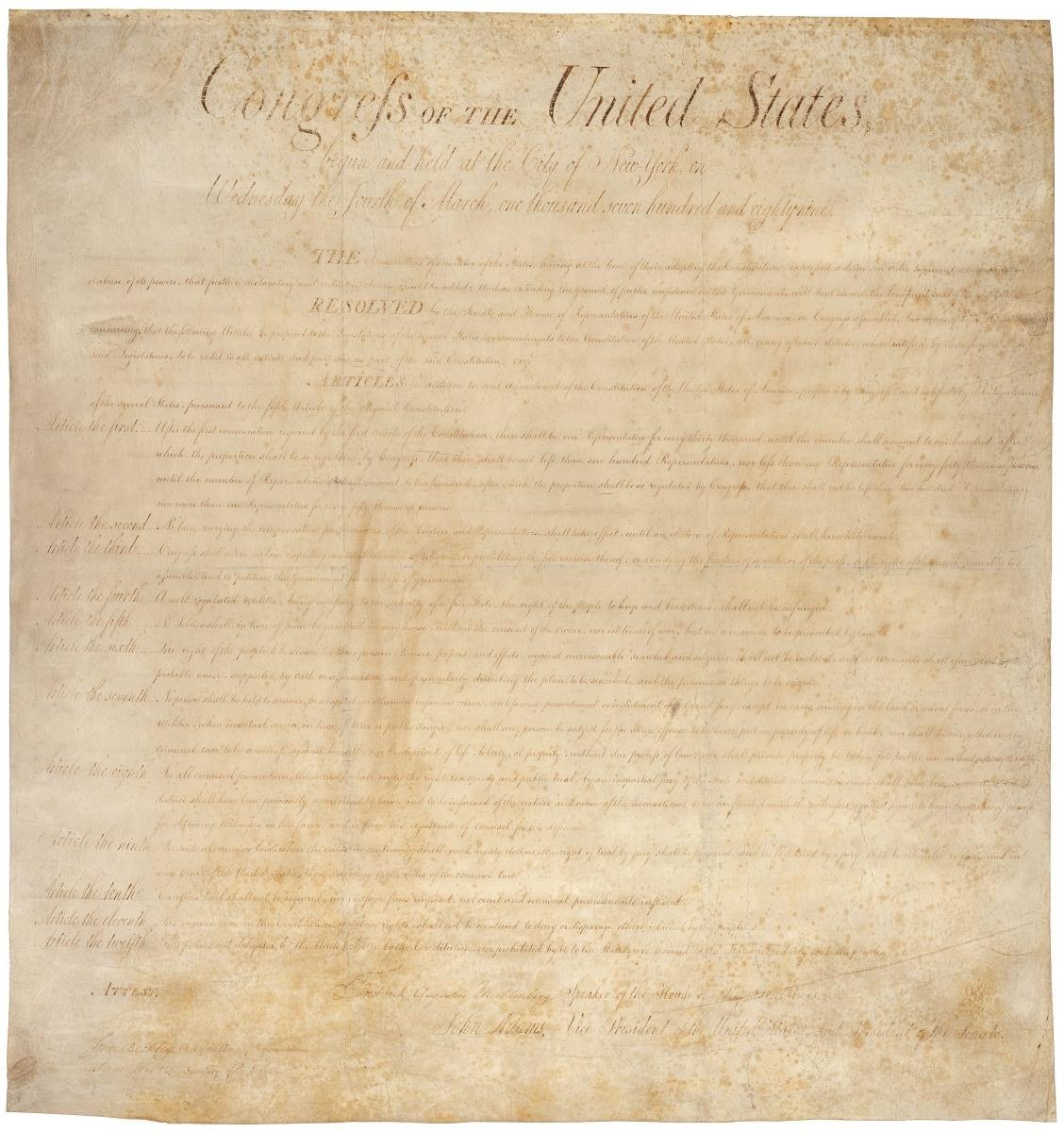
Here is the full text, word for word as ratified:
“Congress shall make no law respecting an establishment of religion, or prohibiting the free exercise thereof; or abridging the freedom of speech, or of the press; or the right of the people peaceably to assemble, and to petition the Government for a redress of grievances.”
The amendment names only Congress, but the Supreme Court applies it to the entire federal government. It does not bind private businesses or people, a point that matters for anyone fired over a post, as our guide to at-will employment by state explains.
When the First Amendment Was Proposed and Ratified
Several state conventions asked for amendments when they ratified the Constitution. James Madison introduced his proposed amendments in the House of Representatives on June 8, 1789. On September 25, 1789, the First Congress sent 12 amendments to the states, and what became the First Amendment was listed as “Article the third.”
Three-fourths of the state legislatures ratified 10 of the 12 on December 15, 1791. The National Archives transcript of the 1789 joint resolution shows all 12 articles. Article the first, on House apportionment, was never ratified. Article the second, on congressional pay, finally passed on May 7, 1992, as the 27th Amendment, 203 years after it was proposed.
The Second Amendment sits right after it in the same document, and its modern reach is mapped in our list of constitutional carry states.
First Amendment Freedoms and the Cases That Defined Each One
Each freedom, the words that create it, and its two defining rulings:
| # | Freedom | Words in the text | Landmark case | Second case |
|---|---|---|---|---|
| 1 | Religion | establishment of religion; free exercise | Engel v. Vitale (1962) | Kennedy v. Bremerton (2022) |
| 2 | Speech | abridging the freedom of speech | Tinker v. Des Moines (1969) | Texas v. Johnson (1989) |
| 3 | Press | or of the press | NYT v. Sullivan (1964) | NYT v. United States (1971) |
| 4 | Assembly | peaceably to assemble | Edwards v. South Carolina (1963) | Snyder v. Phelps (2011) |
| 5 | Petition | petition the Government for a redress of grievances | McDonald v. Smith (1985) | Borough of Duryea v. Guarnieri (2011) |
The 5 Freedoms of the First Amendment, One by One
For each freedom: the year, the vote and what the Court held in its two defining cases.
1. Freedom of Religion: Two Clauses Pulling in Two Directions
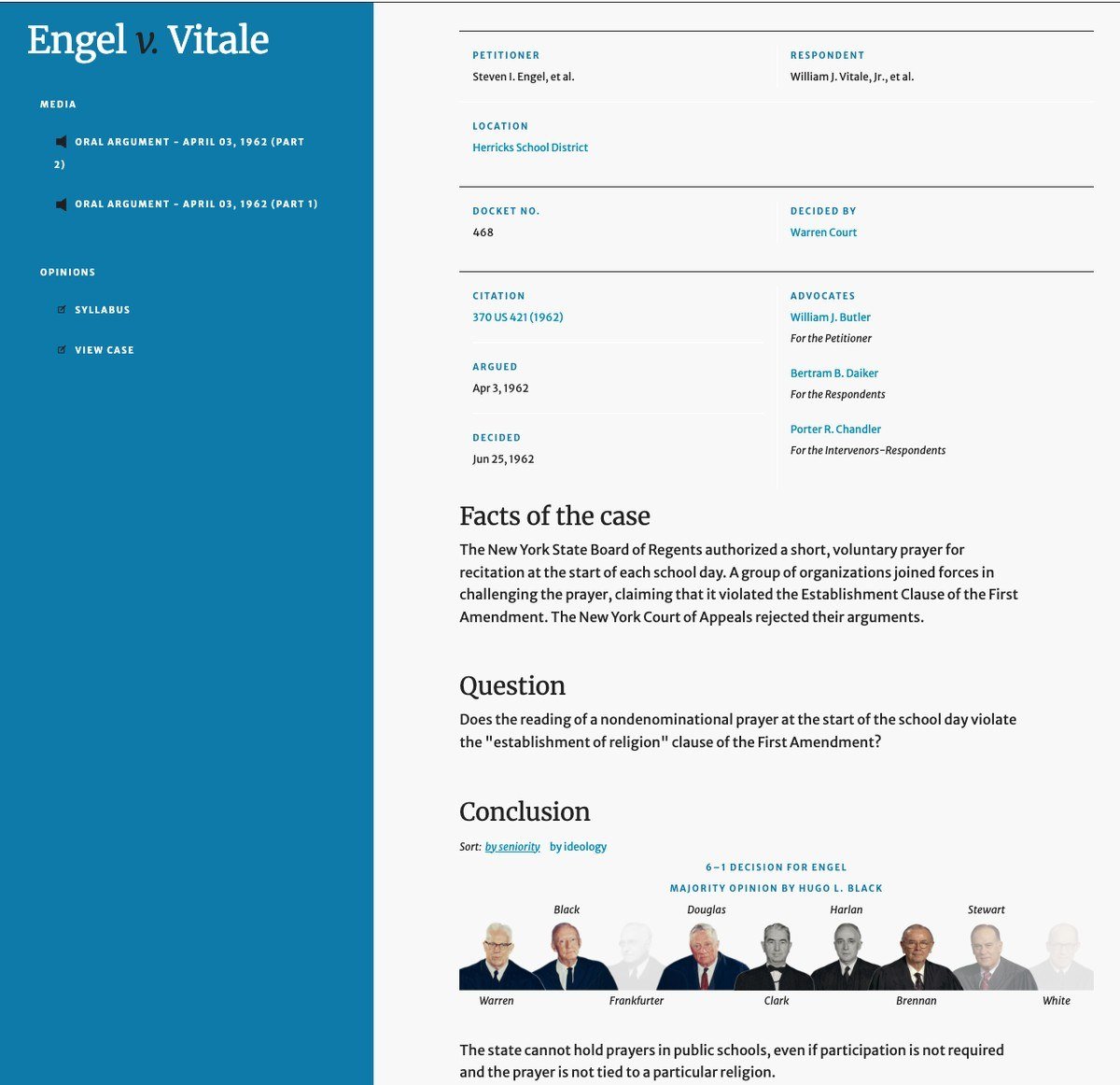
Clauses: Establishment and Free Exercise | Engel v. Vitale (1962, 6-1) | Kennedy v. Bremerton (2022, 6-3)
The religion guarantee has two parts. The Establishment Clause stops government from setting up or sponsoring religion, and the Free Exercise Clause stops it from punishing religious practice. In Engel v. Vitale, decided June 25, 1962, the Court struck down a short, voluntary prayer written by the New York State Board of Regents for public school mornings. Justice Hugo Black wrote for a 6-1 majority that government has no business composing official prayers, even nondenominational ones.
Sixty years later the Court leaned the other way on a different set of facts. Joseph Kennedy, a public high school football coach in Bremerton, knelt at the 50-yard line after games and prayed quietly for about 30 seconds. In Kennedy v. Bremerton School District, decided June 27, 2022, a 6-3 majority held that the Free Exercise and Free Speech Clauses protected that personal prayer. The opinion said the Court had “long ago abandoned” the Lemon test from 1971 and now reads the Establishment Clause by historical practices and understandings.
2. Freedom of Speech: Protection for Ideas, Even Offensive Ones
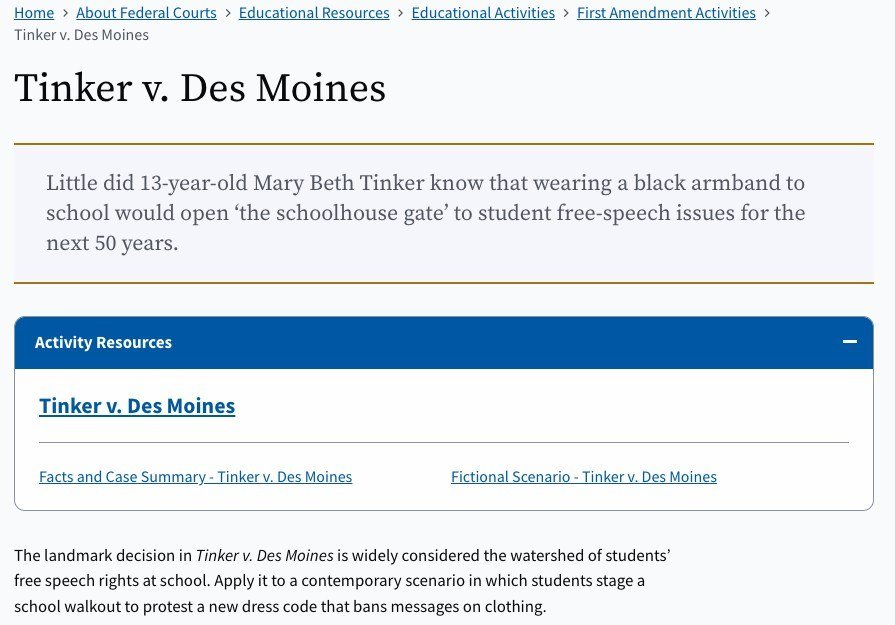
Covers: words and symbolic acts | Tinker v. Des Moines (1969, 7-2) | Texas v. Johnson (1989, 5-4)
Speech means more than talking. In December 1965, Des Moines students wore black armbands to protest the Vietnam War, and the school sent them home. In Tinker v. Des Moines, decided February 24, 1969, Justice Abe Fortas wrote for a 7-2 Court that students do not “shed their constitutional rights to freedom of speech or expression at the schoolhouse gate.” A school can punish speech only if it would materially and substantially disrupt classes, not out of fear that it might.
Twenty years later the Court extended that logic to the flag. Gregory Lee Johnson burned an American flag outside Dallas City Hall in 1984 and received a year in jail and a $2,000 fine. In Texas v. Johnson, decided June 21, 1989, a 5-4 majority called the burning protected expressive conduct. Its “bedrock principle” is that government may not ban an idea simply because society finds it offensive or disagreeable.
3. Freedom of the Press: No Prior Restraint, Room for Honest Error
Core rule: no censorship before publication | NYT v. Sullivan (1964, 9-0) | NYT v. United States (1971, 6-3)
A full-page civil rights advertisement in The New York Times on March 29, 1960 contained minor factual errors. L.B. Sullivan, an elected Montgomery, Alabama commissioner who was not named in it, won $500,000 from an Alabama jury. The Supreme Court reversed unanimously on March 9, 1964. In New York Times Co. v. Sullivan, Justice William Brennan set the “actual malice” rule: a public official must prove a statement was made knowing it was false or with reckless disregard for whether it was false.
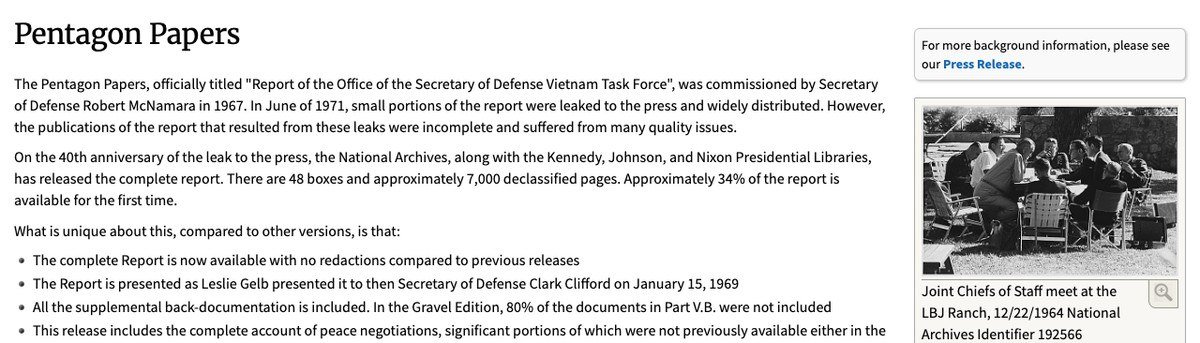
The second case tested censorship before publication. In June 1971 the Nixon administration went to court to stop the Times and The Washington Post from printing the Pentagon Papers, a classified Defense Department study of the Vietnam War commissioned in 1967. On June 30, 1971, a 6-3 Court ruled in New York Times Co. v. United States that the government had not overcome the “heavy presumption against” prior restraint. The National Archives released the full report, about 7,000 pages, on the leak’s 40th anniversary.
4. Freedom of Assembly: The Right to Gather and Protest
Covers: peaceful protest and association | Edwards v. South Carolina (1963, 8-1) | Snyder v. Phelps (2011, 8-1)
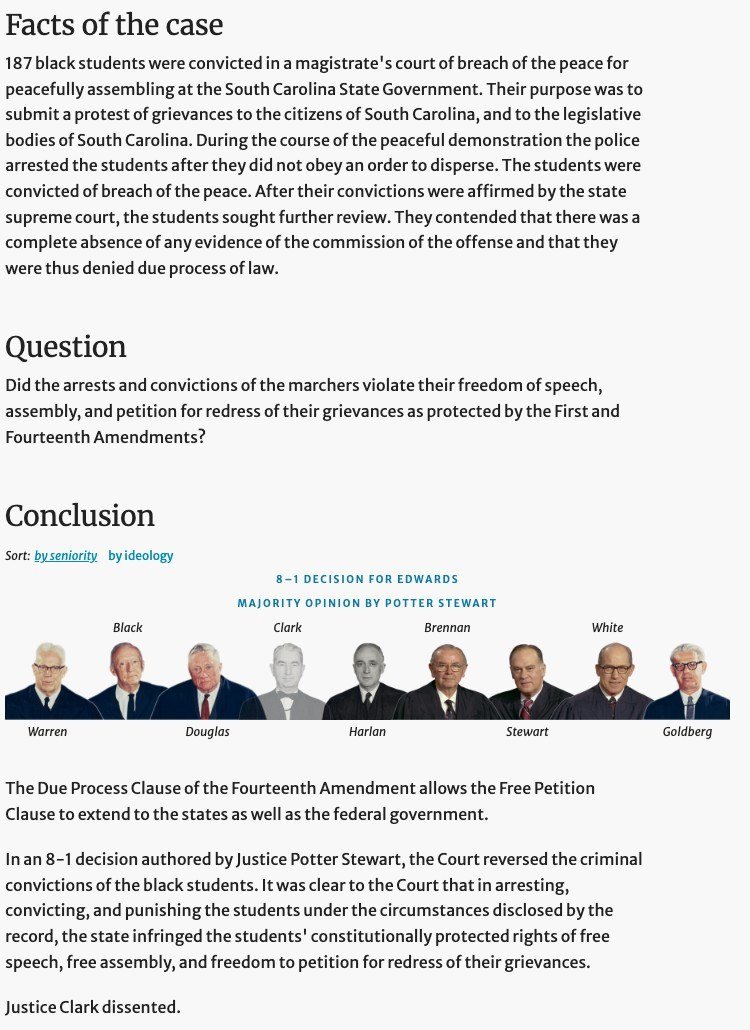
A group of 187 Black students gathered peacefully at the South Carolina State House to protest their grievances to the legislature. Police arrested them when they did not obey an order to disperse, and they were convicted of breach of the peace. In Edwards v. South Carolina, decided February 25, 1963, Justice Potter Stewart wrote for an 8-1 Court that the arrests and convictions infringed their rights of free speech, free assembly and petition. The ruling reversed every conviction.
Snyder v. Phelps showed how far that protection reaches. Members of the Westboro Baptist Church picketed at the funeral of Marine Lance Cpl. Matthew Snyder with signs reading “Thank God for dead soldiers,” and a jury awarded his family $5 million. On March 2, 2011, Chief Justice John Roberts wrote for an 8-1 Court that the First Amendment shielded the protesters from liability. Justice Samuel Alito was the lone dissenter.
5. Freedom to Petition: Asking Government to Fix a Wrong
Covers: letters, lawsuits and grievances | McDonald v. Smith (1985, 8-0) | Borough of Duryea v. Guarnieri (2011, 9-0)
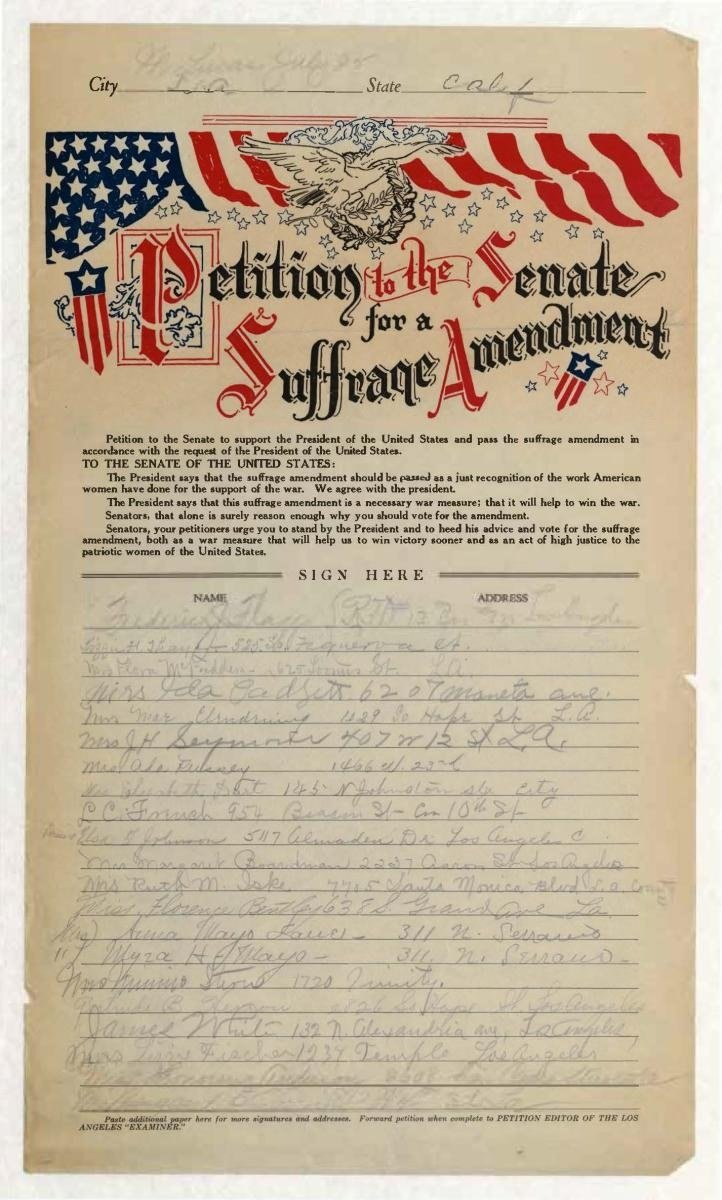
Americans have petitioned Congress since its first sessions. Petitions held by the Center for Legislative Archives cover the abolition of slavery, women’s suffrage, an 8-hour workday and prohibition, some rolled into oversized bundles of signatures. Women signed suffrage appeals to Congress before they could vote. Today the right also covers lawsuits and letters asking officials for relief.
It has limits. In McDonald v. Smith, decided June 19, 1985, an 8-0 Court held that letters to President Ronald Reagan containing knowingly false accusations against a U.S. attorney candidate were not immune from a libel suit, because the Petition Clause gives no more protection than free speech does. In Borough of Duryea v. Guarnieri, decided June 20, 2011, a unanimous Court ruled that a public employee’s petition is protected from workplace retaliation only when it concerns a matter of public concern.
How the First Amendment Came to Bind the States
In 1791 the amendment restrained only the federal government, and in Barron v. City of Baltimore (1833) the Court confirmed the Bill of Rights did not apply to the states. That changed after the Fourteenth Amendment, whose Due Process Clause the Court used to apply each freedom to states one case at a time:
- Speech and press: Gitlow v. New York, June 8, 1925, assumed both were liberties the Fourteenth Amendment protects from the states.
- Press, firmly: Near v. Minnesota, June 1, 1931, held a state law used to shut down a newspaper infringed press liberty.
- Assembly: De Jonge v. Oregon, January 4, 1937, overturned a seven-year sentence for helping run a peaceful meeting.
- Free exercise: Cantwell v. Connecticut, May 20, 1940, sided with three Jehovah’s Witnesses arrested in New Haven.
- Establishment: Everson v. Board of Education, February 10, 1947, quoted Thomas Jefferson’s “wall of separation” between church and state.
- Petition: Edwards v. South Carolina, February 25, 1963, extended the Petition Clause to the states.
Where Each Freedom Stops
None of the five freedoms is absolute:
- Incitement: Brandenburg v. Ohio (1969) allows punishment only for speech directed to inciting imminent lawless action and likely to produce it.
- True threats: Counterman v. Colorado (2023) requires proof the speaker at least recklessly ignored the threatening nature of the words.
- Obscenity: Miller v. California (1973) set a three-part test, including whether a work lacks serious literary, artistic, political or scientific value.
- Defamation: false statements of fact that harm a reputation can be sued over, though officials must meet the actual malice standard.
- Time, place and manner: content-neutral rules on noise, permits and crowd size are allowed, as Ward v. Rock Against Racism (1989) held for Central Park concerts.
Defamation suits also run on short clocks: the statute of limitations for libel or slander is often just one year.
First Amendment Rulings From 2024 to 2026
Four recent decisions show where the fights are now:
- Moody v. NetChoice (July 1, 2024): the Court sent challenges to Florida and Texas social media laws back to lower courts, while recognizing that curating others’ posts is expressive activity.
- Free Speech Coalition v. Paxton (June 27, 2025): a 6-3 Court upheld Texas’s age verification law for sites where over one-third of content is sexual material harmful to minors.
- Chiles v. Salazar (March 31, 2026): an 8-1 Court held that Colorado’s conversion therapy ban, applied to a counselor’s talk therapy, regulates speech by viewpoint and needs stricter review.
- First Choice Women’s Resource Centers v. Platkin (April 29, 2026): a unanimous Court held that a state demand for a nonprofit’s donor records injures association rights and can be challenged in federal court.
This article is general information about constitutional law, not legal advice for a specific situation.
Frequently Asked Questions
What are the 5 freedoms of the First Amendment?
Religion, speech, press, assembly and petition. Religion has two parts: the Establishment Clause, which bars an official religion, and the Free Exercise Clause, which protects religious practice.
When was the First Amendment ratified?
Congress proposed it on September 25, 1789, as one of 12 amendments. It was ratified with the rest of the Bill of Rights on December 15, 1791.
Does the First Amendment apply to private companies?
No. It limits government, from Congress to public schools, not private employers, stores or websites. A private company can generally set its own rules for speech on its property or platform.
Is hate speech protected by the First Amendment?
Offensive and hateful opinions are generally protected, as Snyder v. Phelps showed in 2011. Hateful speech loses protection when it becomes a true threat or incitement, and Virginia v. Black (2003) allows a ban on cross burning done with intent to intimidate.
Related Articles

Get the Fox Bulletin briefing
The stories that matter, in your inbox. No spam, unsubscribe anytime.
Newsletter signup will be available soon.
Related stories
Lemon Law: How a Car Qualifies and What You Get Back
A lemon law makes the manufacturer buy back or replace a new car it cannot fix. Here are the real tests in nine states, the refund formulas, and the steps to file a claim.
Statute of Limitations: What It Means and How Long You Have
A statute of limitations is the legal deadline to sue or bring charges. Here are the real time limits in four big states, the crimes with no limit, and how old debts work.
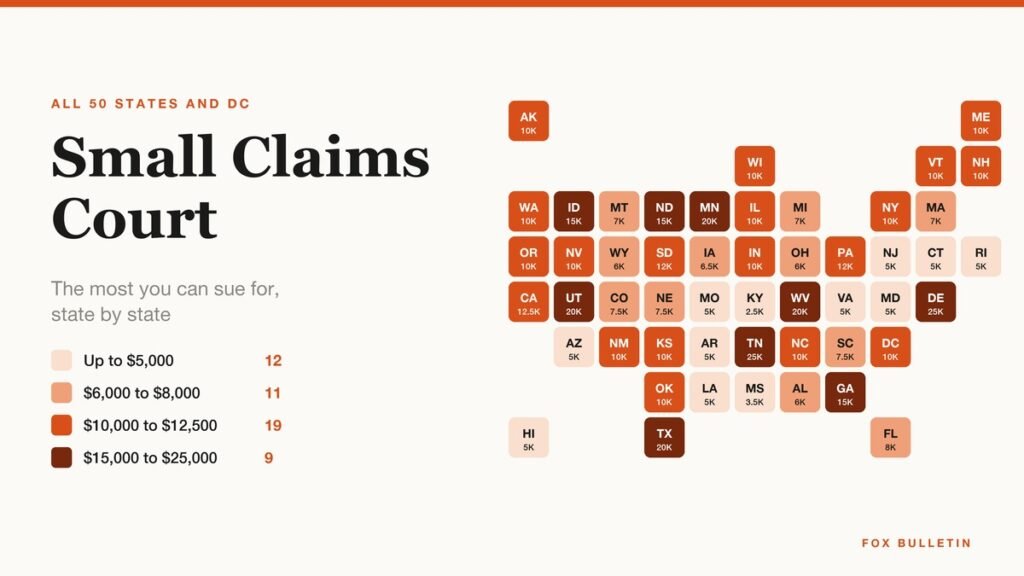
Small Claims Court: Limits in Every State and How It Works
Small claims court settles money disputes quickly and cheaply. Here is the dollar limit in every state, what it costs to file, who can bring a lawyer, and how collection works.