

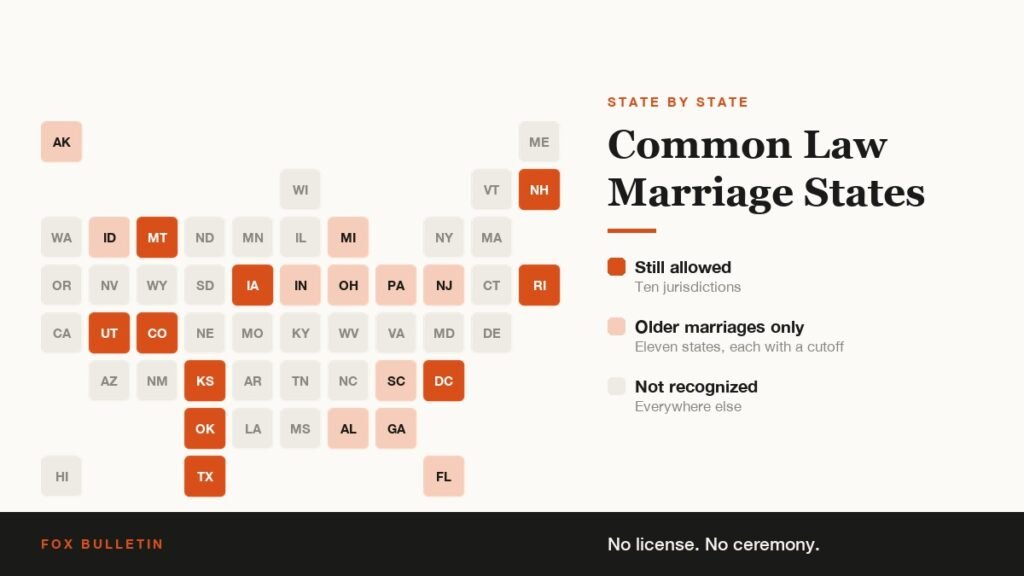
Ten jurisdictions still allow a couple to become legally married without a license or a ceremony: Colorado, the District of Columbia, Iowa, Kansas, Montana, New Hampshire, Oklahoma, Rhode Island, Texas and Utah. The common law marriage states are not uniform, and two of those ten work in a way that surprises people who assume the rules match Texas.
Eleven more states abolished it but still honor marriages formed before a cutoff date, which is why the question keeps surfacing in probate and benefits cases decades later. Here is what each of the ten requires:
| Jurisdiction | What creates a marriage | The detail that catches people out |
|---|---|---|
| Colorado | Agreement to be married, followed by mutual and open assumption of a marital relationship | For marriages entered on or after September 1, 2006, both parties must be 18 or older |
| District of Columbia | Express mutual agreement to be married now, followed by living together | The words exchanged must make the present consent clear |
| Iowa | A present agreement to be married, with cohabitation and holding out | Evidence of cohabitation after the agreement is not separately required |
| Kansas | A present agreement, which may be implied from living together and reputation | Implied agreement applies in the absence of proof to the contrary |
| Montana | Competence to marry, mutual consent, and confirmation by cohabitation and public repute | Proved by a preponderance of the evidence; short cohabitation is not enough |
| New Hampshire | Cohabitation, acknowledging each other as spouses and general reputation as such for three years | It operates at death: the couple is deemed married when one of them dies |
| Oklahoma | Actual mutual agreement, a permanent and exclusive relationship, cohabitation and public holding out | A temporary stay by nonresidents does not create one |
| Rhode Island | Agreement plus cohabitation and reputation as a married couple | Proved by clear and convincing evidence |
| Texas | Agreement to be married, living together in the state as spouses, and representing to others that you are married | A temporary stay in Texas by nonresidents does not create one |
| Utah | Legal age and capacity, cohabitation, mutual assumption of marital rights and duties, and a uniform reputation as married | A court or administrative order must be sought during the relationship or within one year of its end |
The Common Law Marriage States That Still Allow New Ones
Texas is the one most people have heard of, and its rule is the clearest: a couple agrees to be married, lives together in the state as spouses and represents to other people that they are married. All three have to be true, and a temporary stay by nonresidents does not create one. Once formed, it does not lapse. Time apart and the end of cohabitation do not undo a common law marriage that already exists.
Colorado added an age rule rather than abandoning the doctrine: a common law marriage entered on or after September 1, 2006 is not valid unless both parties were 18 or older and the marriage was not otherwise prohibited. Iowa, Kansas, Montana, Oklahoma, Rhode Island and the District of Columbia all turn on a present agreement backed by living together and reputation, with differences mainly in the standard of proof. Montana asks for a preponderance of the evidence; Rhode Island wants clear and convincing evidence.
Utah is the outlier among the ten that otherwise look alike. The relationship has to meet the statutory elements, but it is not recognized until a court or administrative order says so, and that proceeding has to be started during the relationship or within one year after it ends. Miss the year and the marriage cannot be established at all, whatever the facts were.
New Hampshire is the second outlier and the most misunderstood. A couple who lived together, acknowledged each other as spouses and were generally reputed as married for three years are deemed legally married, but the rule operates when one of them dies. In practice it is an inheritance provision rather than a way to be married while both partners are alive, which matters a great deal when there is no will. Our guide to who inherits when there is no will covers what happens next.
Eleven States Honor Older Marriages Only
These states ended common law marriage prospectively. Anything formed before the cutoff remains a valid marriage, and the couple stays married until death, annulment or divorce:
| State | Still valid if |
|---|---|
| Alabama | Entered before January 1, 2017 |
| Alaska | Entered between March 7, 1939 and December 31, 1963 |
| Florida | Entered before January 2, 1968 |
| Georgia | Entered before January 1, 1997 |
| Idaho | Entered before January 1, 1996 |
| Indiana | Entered before January 1, 1958 |
| Michigan | Entered before January 1, 1957 |
| New Jersey | Entered before December 1, 1939 |
| Ohio | Entered before October 10, 1991 |
| Pennsylvania | Entered on or before January 1, 2005 |
| South Carolina | Entered before July 24, 2019 |
South Carolina is the most recent change, and it shows how the cutoff works in practice. New common law marriages could not be formed there from July 24, 2019, but a couple can still prove today that theirs began before that date, and if they do, they are married. Pennsylvania works the same way for anything on or before January 1, 2005, which is why these marriages keep appearing in estate cases long after the legislature moved on.
What Actually Creates One, and Why Seven Years Is a Myth
No state has ever had a rule that living together for seven years creates a marriage. Length of time is evidence of the real elements, not a substitute for them. Four things do the work:
- Capacity to marry: both parties are old enough, of sound mind, and not already married to someone else. An existing marriage voids the attempt, though several states will treat a valid marriage as forming once that impediment is removed and the couple keeps living as spouses.
- A present agreement: the couple agrees that they are married now, not that they will marry later. An engagement is the opposite of this element.
- Cohabitation: they live together as a married couple. Most states treat this as evidence of the agreement rather than as the agreement itself.
- Holding out: they present themselves to other people as married. Shared surnames, joint tax returns, insurance and lease applications, and how they introduce each other all carry weight.
The agreement is the element couples get wrong. Two people can share a home, a mortgage and children for twenty years and never be married, because they never agreed that they were married. The reverse also happens: a couple who told everyone they were married and filed joint returns can find a court agreeing with them years later, when one of them wanted out. Cohabitation alone is not enough to establish a common law marriage, though it is generally required as one element.
How It Gets Proved
A common law marriage usually gets litigated at the worst possible time: at a death, a separation or a benefits claim. Because no license exists, the evidence is circumstantial, and courts look for the paper trail a married couple leaves:
- Joint federal or state tax returns filed as married.
- Deeds, leases, loans and insurance policies naming the other person as a spouse.
- Employer benefit enrollments and beneficiary designations.
- Affidavits from family, neighbors and coworkers who knew the couple as married.
- Correspondence, social media and anything else showing a shared surname or the word spouse over a period of years.
The Social Security Administration maintains a state-by-state digest of common law marriage rules precisely because entitlement to survivor benefits can turn on which state a couple lived in and when. Where the facts are close, the agency refers the question to its own counsel for a legal opinion rather than deciding it at the counter.
Moving States Does Not Undo It
A common law marriage validly formed in one state is recognized in the others. That follows from the full faith and credit clause, and it is the single most useful thing to know about the doctrine: a couple married informally in Texas who move to California are still married, even though California has not allowed new common law marriages for over a century.
The reverse does not work. Living in a state that does not recognize common law marriage and taking a short trip to one that does will not create a marriage, and several states say so explicitly. Oklahoma, Ohio and Texas all state that a temporary stay by nonresidents is insufficient.
How a Common Law Marriage Ends
This is where the informality stops. A marriage formed without paperwork can only be dissolved with it:
- There is no common law divorce. A valid common law marriage ends only by death, annulment or a court divorce, in exactly the same way as a licensed one.
- Property follows state law. In a divorce, assets are divided under the same rules that would apply to any other married couple in that state.
- Federal benefits turn on the state test. The Social Security Administration applies the law of the state where the couple lived, which is why it keeps a state-by-state digest at all.
- Inheritance rights attach. A surviving common law spouse inherits as a spouse under intestacy rules, which is a frequent reason the question reaches a court years later.
- A later ceremonial marriage to someone else, while the common law marriage stands, is bigamous rather than a clean start.
The practical consequences reach further than divorce. Property division follows the rules of the state the couple lives in, which is a different exercise depending on whether that state splits marital assets equally; our list of community property states sets out which ones do. Whether fault matters in the divorce itself is a separate question covered in our guide to no-fault divorce states.
Frequently Asked Questions
Does living together for seven years make you married?
No. No state creates a marriage from a number of years of cohabitation. The states that still recognize common law marriage require a present agreement to be married, living together and holding yourselves out to others as a married couple. Time is evidence of those elements, never a substitute.
Which states still allow common law marriage?
Colorado, the District of Columbia, Iowa, Kansas, Montana, New Hampshire, Oklahoma, Rhode Island, Texas and Utah. New Hampshire applies its rule when one spouse dies, and Utah requires a court or administrative order sought during the relationship or within a year of its end.
Do you need a divorce to end a common law marriage?
Yes. A valid common law marriage ends only by death, annulment or a court divorce, exactly as a licensed marriage does. There is no informal way to undo it, and remarrying without a divorce is bigamy.
Is a common law marriage recognized in other states?
Yes. A marriage validly formed in a state that allows common law marriage is recognized across the country. Moving to a state that has abolished the doctrine does not dissolve a marriage that already exists.
A Note on Legal Advice
This article is general information rather than legal advice. Common law marriage is governed entirely at state level, the elements differ between the ten jurisdictions listed here, and Utah and New Hampshire depart from the pattern in ways that change the outcome.
Whether a particular relationship qualifies is a fact-heavy question that courts decide case by case. Anyone whose inheritance, survivor benefits or property rights may depend on the answer should speak to an attorney licensed in their state.
Related Articles

Get the Fox Bulletin briefing
The stories that matter, in your inbox. No spam, unsubscribe anytime.
Newsletter signup will be available soon.
Related stories
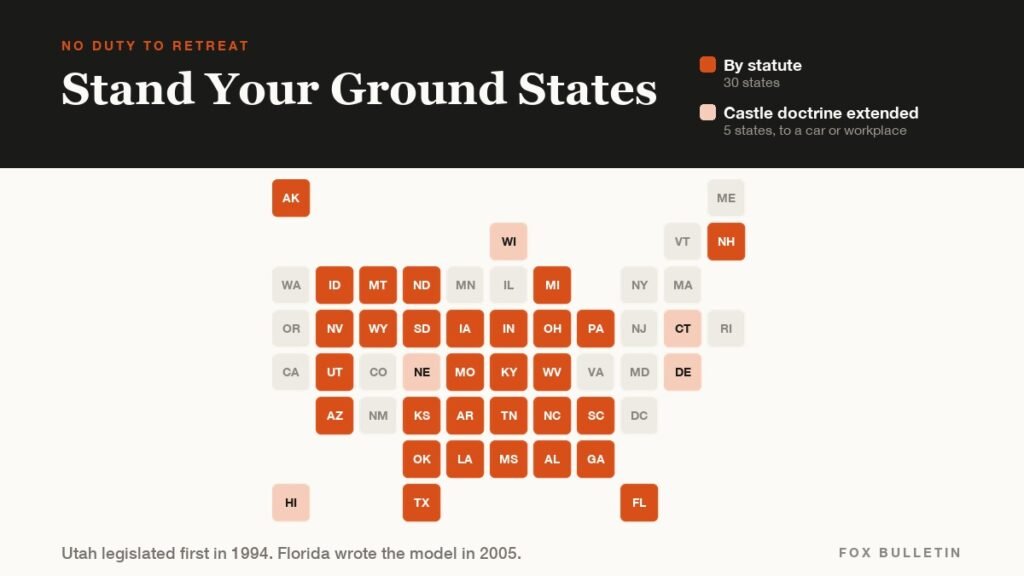
Stand Your Ground States: All 30 and the 5 In Between
Thirty states have removed the duty to retreat by statute. Here is each one with its code section, the five that went partway, and how the doctrine differs from castle doctrine.
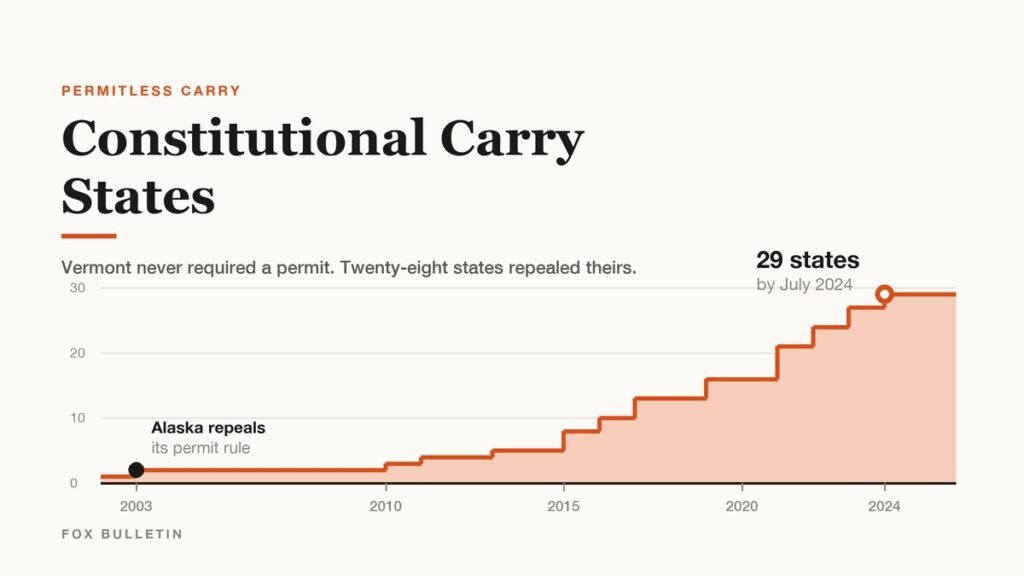
Constitutional Carry States: All 29 and the Limits
Twenty-nine states let a qualifying adult carry a concealed handgun without a permit. Here is when each law took effect, what it does not change, and why permits still matter.
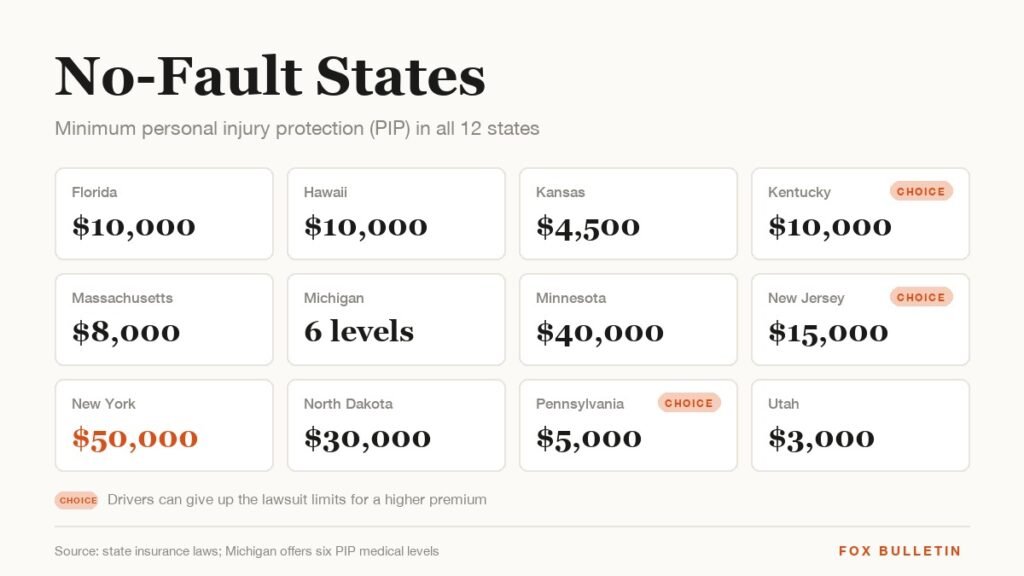
No-Fault States: All 12, With PIP Minimums and Lawsuit Rules
Florida, Hawaii, Kansas, Kentucky, Massachusetts, Michigan, Minnesota, New Jersey, New York, North Dakota, Pennsylvania and Utah use no-fault car insurance. What each requires and when you can still sue.