

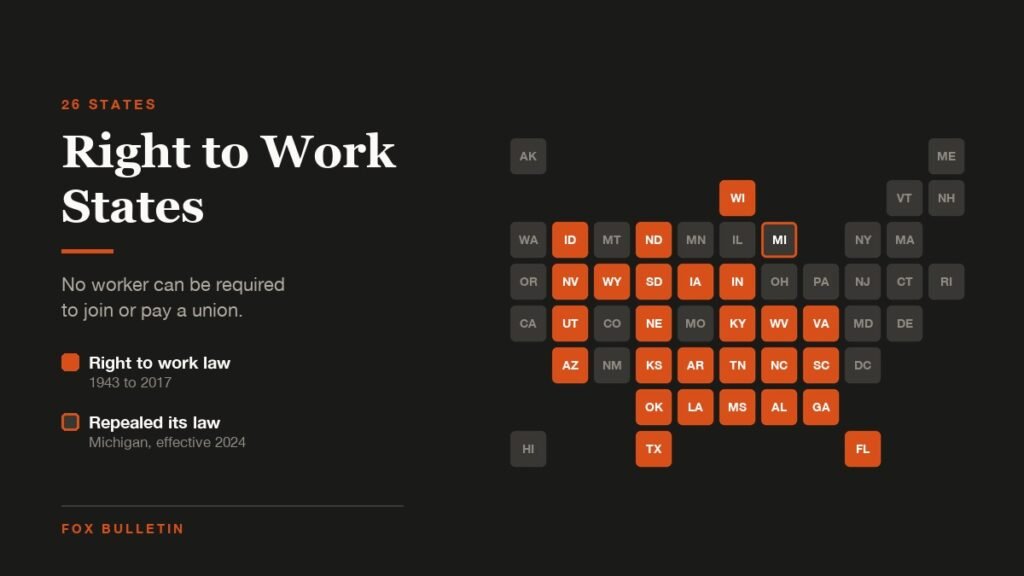
Twenty-six states have a right to work law, which makes it illegal to require an employee to join a union or pay union dues or fees as a condition of employment. The right to work states run from Florida, which acted in 1943, to Kentucky, which acted in 2017, and the count is 26 rather than 27 because Michigan repealed its law.
The laws do not ban unions or collective bargaining. They ban one clause in a union contract, the union security agreement, which would otherwise require everyone covered by the contract to help pay for it. Here is every state with such a law and when it arrived:
| State | Year adopted | Note |
|---|---|---|
| Florida | 1943 | The earliest, adopted before the federal law that authorized the others |
| Arizona | 1947 | |
| Arkansas | 1947 | |
| Georgia | 1947 | |
| Iowa | 1947 | |
| Nebraska | 1947 | |
| North Carolina | 1947 | |
| North Dakota | 1947 | |
| South Dakota | 1947 | |
| Tennessee | 1947 | |
| Texas | 1947 | Rewritten into its current form in 1993 |
| Virginia | 1947 | |
| Nevada | 1951 | |
| Alabama | 1953 | |
| Mississippi | 1954 | |
| South Carolina | 1954 | |
| Utah | 1955 | |
| Kansas | 1958 | |
| Wyoming | 1963 | |
| Louisiana | 1976 | |
| Idaho | 1985 | |
| Oklahoma | 2001 | |
| Indiana | 2012 | First of the modern wave |
| Wisconsin | 2015 | Signed March 9, 2015, effective two days later |
| West Virginia | 2016 | Enacted over a governor veto, effective July 1, 2016 |
| Kentucky | 2017 | Passed in the first week of the session with an emergency clause |
What the 26 Right to Work States Have in Common
Every one of these laws does the same narrow thing. It voids any agreement that conditions a job on union membership or on payment to a union. What it does not do is remove the union from the workplace. If a majority of workers vote for a union, that union still bargains for everyone in the unit, and the contract it negotiates still covers employees who pay it nothing.
That asymmetry is the whole argument. Unions call the non-paying employee a free rider, because federal law obliges the union to represent that person in bargaining and in grievances at the union expense. Supporters answer that nobody should have to fund an organization to hold a job, and that a union which has to persuade members to pay is a more accountable one. Both sides are describing the same rule.
Section 14(b) of Taft-Hartley Is What Makes Them Possible
Federal labor law, not state law, decides whether states get to legislate here at all. The National Labor Relations Act allowed union security agreements, and the 1947 Taft-Hartley amendments carved out an exception: section 14(b), codified at 29 U.S.C. 164(b), says nothing in the act shall be construed as authorizing agreements requiring membership in a labor organization as a condition of employment in any state where such agreements are prohibited by state or territorial law.
That single sentence is why twelve states passed laws in 1947 and why the subject keeps returning to Congress. Repealing section 14(b) would wipe out all 26 state laws at once without any state changing its own statute, which is why national bills to repeal it appear in almost every session and why state level campaigns continue regardless.
Four Waves and a Reversal
The map did not arrive all at once. It was built in bursts, each with its own politics:
| Period | What happened |
|---|---|
| 1943 to 1947 | Florida acts first, then twelve states adopt laws in 1947, the year Congress passes the Taft-Hartley amendments that explicitly permit them. |
| 1951 to 1963 | Nevada, Alabama, Mississippi, South Carolina, Utah, Kansas and Wyoming follow, concentrated in the South and the Mountain West. |
| 1976 to 2001 | Three isolated additions: Louisiana, Idaho and Oklahoma, the last by ballot measure. |
| 2012 to 2017 | A fast wave through the industrial Midwest and Appalachia: Indiana and Michigan in 2012, Wisconsin in 2015, West Virginia in 2016, Kentucky in 2017. |
| 2018 to 2024 | The direction reverses. Missouri voters repeal theirs before it takes effect, and Michigan repeals its own, the first state to do so in decades. |
The modern wave is what makes the subject live again. Indiana and Michigan in 2012 broke the pattern that right to work was a Southern and Mountain West arrangement, and Wisconsin, West Virginia and Kentucky followed within five years. Kentucky passed its law as House Bill 1 in the first week of the 2017 session, with an emergency clause so that it took effect immediately.
Michigan Repealed Its Law
Michigan adopted right to work in 2012 and undid it eleven years later. Governor Gretchen Whitmer signed Senate Bill 34 on March 24, 2023, restoring the ability of private sector employers and unions to agree to union security clauses, and House Bill 4004 did the same for public employment. Neither was given immediate effect, so both took effect on the 91st day after the 2023 legislature adjourned.
The public sector half is limited by a federal ceiling. Parts of the public employment law cannot operate unless the Supreme Court reverses or narrows Janus, which held that public employees cannot be compelled to pay fees to a union. In practice Michigan restored union security in the private sector and left public employment where federal constitutional law puts it.
Missouri Voters Rejected Theirs Before It Took Effect
Missouri shows the other way a law can fail. The legislature passed Senate Bill 19 in 2017, opponents gathered signatures to force a referendum before it could take effect, and the question went on the August 7, 2018 primary ballot as Proposition A.
It lost badly. The official returns record 453,283 votes for and 939,973 against, 32.5 percent to 67.5 percent, across all 3,228 precincts. The law never took effect, and Missouri remains a state without one. No other right to work law has been overturned at the ballot box by that margin.
What It Changes for Workers, Unions and Employers
The practical effects are narrower than the rhetoric on either side suggests:
- For a worker: you cannot be required to join a union or pay it anything as a condition of getting or keeping the job, even where a union represents your workplace.
- For a union: it still has to represent everyone in the bargaining unit, including people who pay nothing, because the duty of fair representation does not depend on membership.
- For an employer: union security clauses cannot be agreed to, so a contract that requires dues payment is unenforceable in that state.
- For public employees anywhere: the question is already settled nationally, because the Supreme Court held in Janus that public sector workers cannot be required to pay fees to a union.
- For everyone: the law governs payment, not representation. It does not ban unions, strikes, collective bargaining or union contracts.
For most employees nothing visible changes, because union representation is uncommon in large parts of the private economy either way. The rule matters most in sectors that are organized, where the question of who pays for the contract is a live one. Terms of employment that are not covered by a contract are governed by the default rules instead, which our guide to employment at will by state sets out, and pay floors come from the separate state minimum wage rules.
The 24 States Without a Right to Work Law
These states permit union security agreements in the private sector, which means a contract may require employees covered by it to pay toward the cost of representation:
- Alaska, California, Colorado, Connecticut, Delaware, Hawaii, Illinois, Maine.
- Maryland, Massachusetts, Michigan, Minnesota, Missouri, Montana, New Hampshire, New Jersey.
- New Mexico, New York, Ohio, Oregon, Pennsylvania, Rhode Island, Vermont, Washington.
Michigan and Missouri sit in this group for different reasons: one repealed a law it had, the other never let one take effect. Several of the remaining states have seen bills introduced repeatedly without passage, and New Hampshire has come closest, having considered and rejected right to work legislation more than once.
Frequently Asked Questions
How many right to work states are there?
Twenty-six. Florida was first in 1943 and Kentucky the most recent in 2017. The total was 27 until Michigan repealed its law, which took effect in 2024.
Does right to work mean you can be fired for any reason?
No. That is employment at will, a separate doctrine that applies in nearly every state. Right to work concerns only whether union membership or payment can be required as a condition of employment.
Can a union still represent you in a right to work state?
Yes. A union that wins an election represents everyone in the bargaining unit and owes all of them a duty of fair representation, including employees who pay nothing toward its costs.
Which states have repealed a right to work law?
Michigan is the only state in recent decades to repeal one, through bills signed in March 2023. Missouri passed a law in 2017 that voters rejected by referendum in August 2018 before it ever took effect.
A Note on Legal Advice
This article is general information rather than legal advice. Labor law is split between federal statute and state law, and the interaction between the two decides most individual questions.
Anyone facing a dispute about dues, membership or representation at work should speak to an attorney licensed in their state or contact the National Labor Relations Board, which administers the federal side of these rules.
Related Articles

Get the Fox Bulletin briefing
The stories that matter, in your inbox. No spam, unsubscribe anytime.
Newsletter signup will be available soon.
Related stories
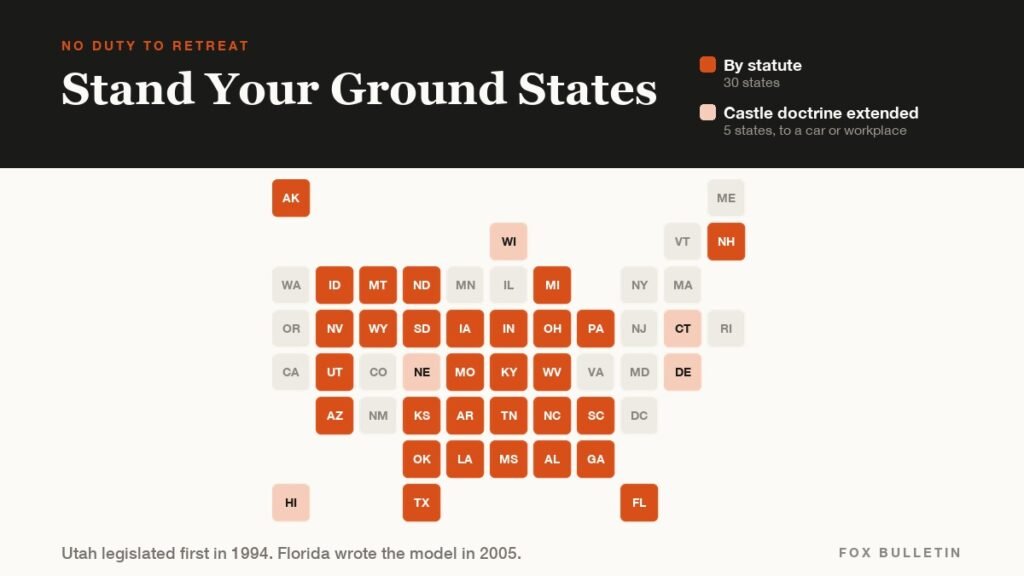
Stand Your Ground States: All 30 and the 5 In Between
Thirty states have removed the duty to retreat by statute. Here is each one with its code section, the five that went partway, and how the doctrine differs from castle doctrine.
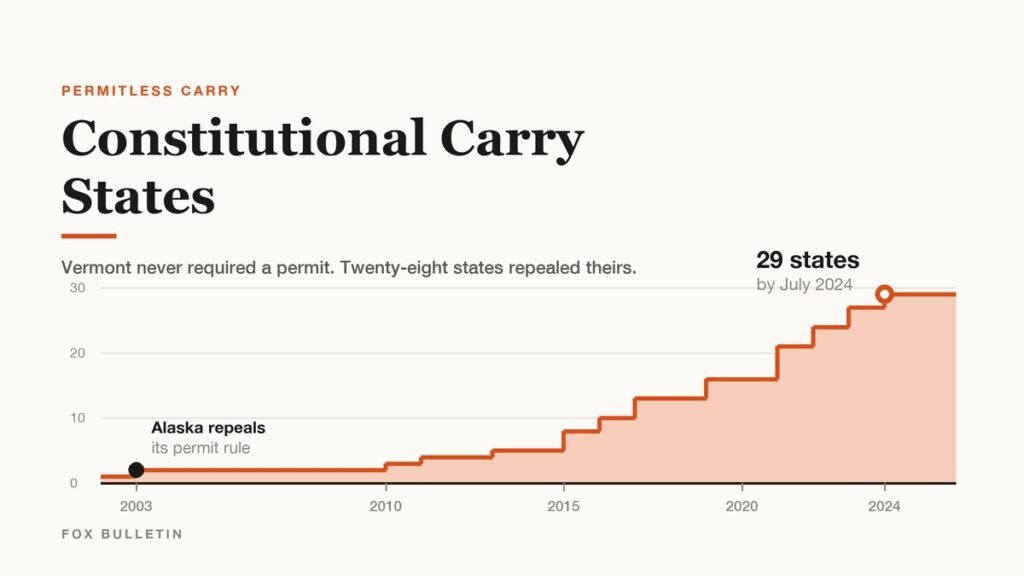
Constitutional Carry States: All 29 and the Limits
Twenty-nine states let a qualifying adult carry a concealed handgun without a permit. Here is when each law took effect, what it does not change, and why permits still matter.
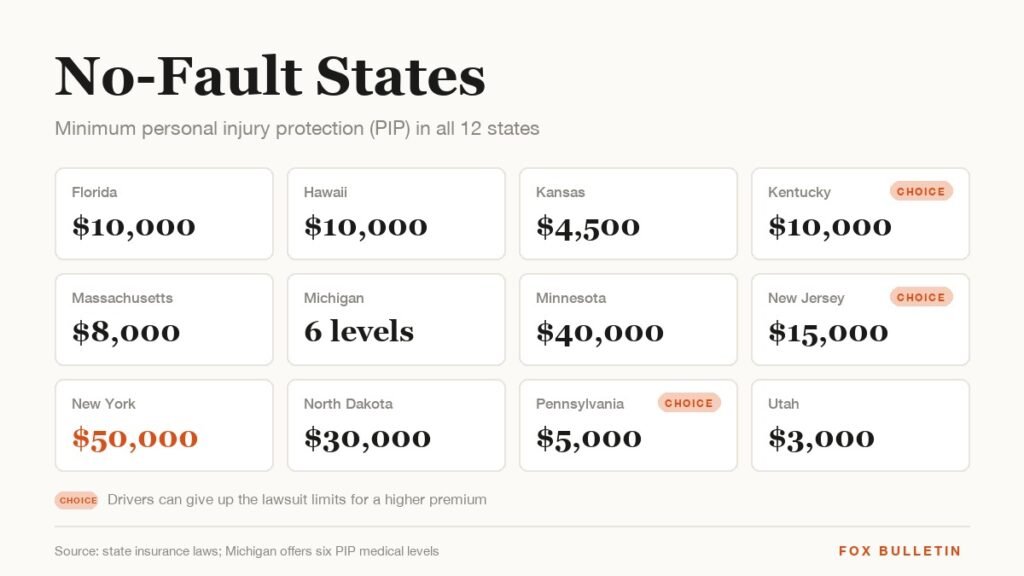
No-Fault States: All 12, With PIP Minimums and Lawsuit Rules
Florida, Hawaii, Kansas, Kentucky, Massachusetts, Michigan, Minnesota, New Jersey, New York, North Dakota, Pennsylvania and Utah use no-fault car insurance. What each requires and when you can still sue.