

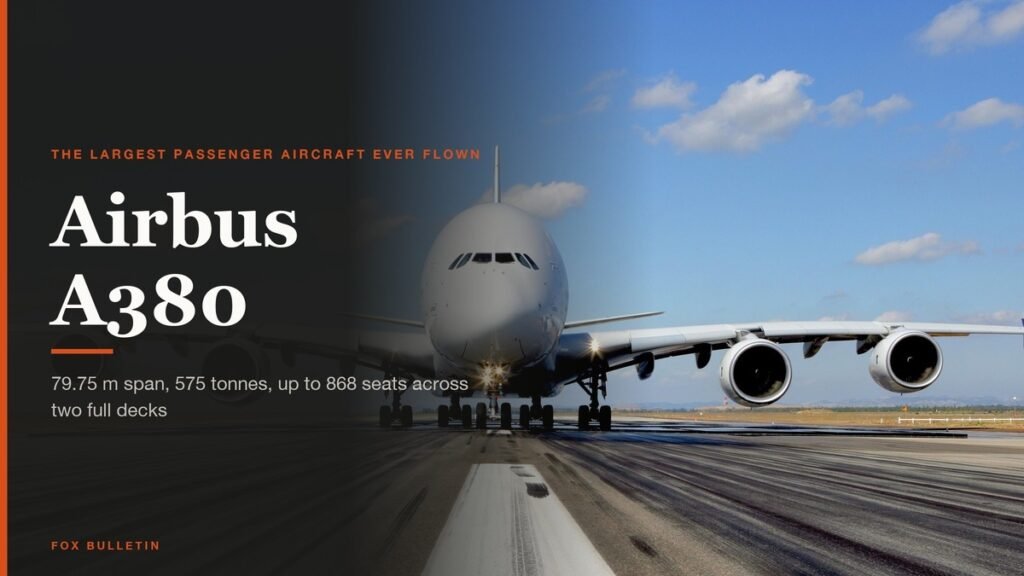
The Airbus A380 is the largest passenger aircraft ever flown: 72.72 metres long, 79.75 metres across the wings, and the only airliner ever built with a passenger deck running the full length of the fuselage on two levels. Airbus stopped making it in 2021 after 251 aircraft, yet roughly 190 of them are still in airline fleets in 2026 and more are flying now than at any point since the pandemic.
That combination is what makes the aircraft unusual. It is out of production and commercially unrepeatable, and at the same time it is back on marquee long-haul routes because no other jet moves 500 passengers through a slot-constrained airport in one movement. Here is what the aircraft actually measures, what is inside it, why Airbus walked away, and which airlines you can still book one with.
Airbus A380 Specifications, Weights and Performance
Every figure below is for the A380-800, the only version ever built. A planned freighter, the A380F, was cancelled before any airframe was completed.
| Measure | A380-800 |
|---|---|
| Overall length | 72.72 m (238 ft 7 in) |
| Wingspan | 79.75 m (261 ft 8 in) |
| Tail height | 24.09 m (79 ft 1 in) |
| Wing area | 845 sq m (9,100 sq ft) |
| Maximum take-off weight | 575 tonnes (1,268,000 lb) |
| Operating empty weight | 285 tonnes (628,000 lb) |
| Fuel capacity | 253,983 kg |
| Typical three-class seating | 525 passengers |
| Maximum certified occupancy | 868 passengers |
| Range | 14,800 km (7,991 nmi) |
| Cruise speed | Mach 0.85 (903 km/h) |
| Maximum speed | Mach 0.89 (955 km/h) |
| Service ceiling | 43,100 ft |
| Engines | 4 x Rolls-Royce Trent 900 or Engine Alliance GP7200 |
| Wheels | 22 |
| Minimum flight crew | Two |
Two numbers in that list surprise people. The A380 is actually shorter than a Boeing 747-8 Intercontinental, which measures 76.25 metres. It is the 11-metre wider span, the second full-length deck and the 575-tonne take-off weight that put it in a class of its own.
Two Full Decks and 550 Square Metres of Floor

The A380 carries 550 square metres of cabin across its main and upper decks. The 747 has an upper deck too, but it is a hump that stops a short way behind the flight deck. On the A380 the upper deck runs essentially the whole cabin length, which is why Airbus describes it as the only full-length double-deck airliner.
Certification sets the ceiling on how many people can sit in that space. The European type certificate for the A380 approves 868 passengers for emergency evacuation, split 538 on the main deck and 330 on the upper deck. No airline has ever come close.
Real layouts run far lighter, because floor area is worth more as premium cabin than as extra rows:
- Emirates: typically 484 to 519 seats in three or four classes, with first class suites and a bar on the upper deck.
- Singapore Airlines: 471 seats, including six enclosed suites on the main deck.
- British Airways: 469 seats across four classes.
- Qantas: 485 seats after a refit that enlarged the upper-deck lounge.
The staircases matter more than the seat count. Two of them, fore and aft, mean boarding can run through two jet bridges at once, which is how a 500-seat aircraft turns around in a slot that would otherwise need two departures.
Four Engines, 22 Wheels and a Two-Pilot Flight Deck
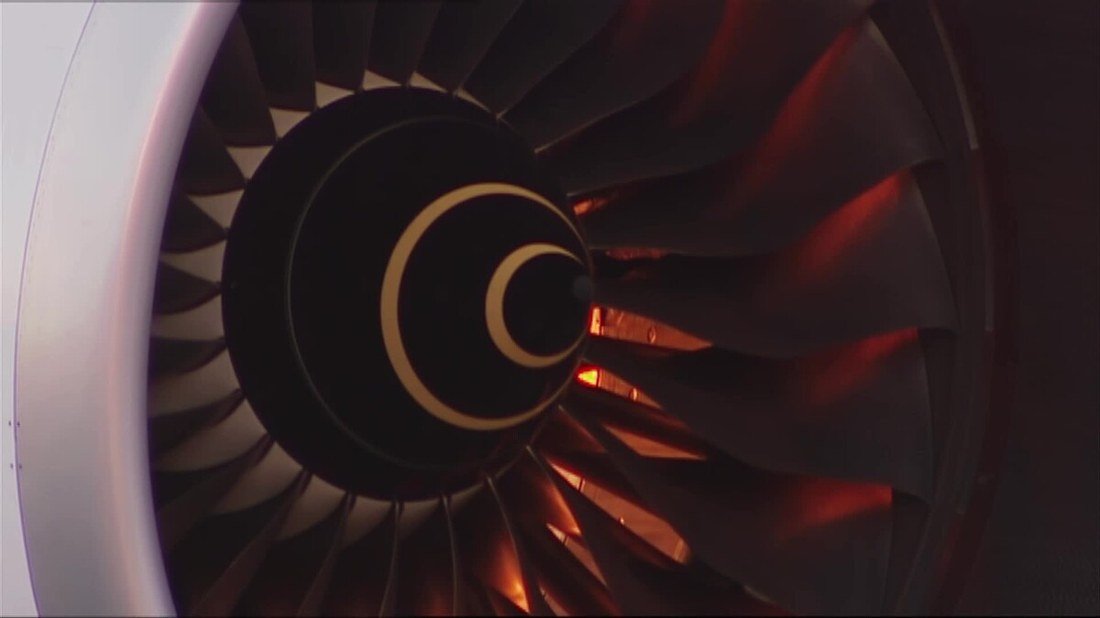
Airlines chose between two engines. The Rolls-Royce Trent 900 is rated at 334.29 kN of take-off thrust in its Trent 970-84 form, rising to 341.41 kN on the Trent 972 variants. Singapore Airlines, Lufthansa, Qantas, British Airways, All Nippon Airways and Asiana all took it.
The alternative came from Engine Alliance, the General Electric and Pratt & Whitney joint venture, whose GP7200 family is rated between 70,000 and 81,500 lb of thrust and turns a 116-inch fan. Emirates, Etihad, Qatar Airways, Air France and Korean Air went that way.
Underneath, 22 wheels spread 575 tonnes across the pavement: a nose leg, two four-wheel wing legs and two six-wheel body legs. The body gear steers, which is the only reason an aircraft this size can make a 90-degree turn onto a standard taxiway. Over 400 airports worldwide can handle the type.
For all that size, the flight deck is certified for two pilots and the aircraft is cleared for Category 3 precision approaches and autoland. A pilot moving up from an A320 sees the same sidestick, the same thrust levers and much the same display layout.
From First Flight in 2005 to the Last Delivery in 2021

Airbus had been sketching a double-deck aircraft since the early 1990s, aiming squarely at the one segment Boeing owned outright with the 747. The programme that resulted was the first new aircraft of the 21st century and the most expensive civil project Europe had attempted, with Airbus putting development cost at around 15 billion euros.
- 27 April 2005: first flight from Toulouse, with a six-person test crew aboard.
- 15 October 2007: first aircraft handed to Singapore Airlines.
- 25 October 2007: first revenue flight, SQ380 from Singapore to Sydney.
- February 2019: Airbus announces production will end.
- 16 December 2021: the final aircraft, serial 272, is delivered to Emirates.
In between, the type logged more than 800,000 flights. The engineering outlived the programme: over 380 patents were filed against the A380, covering everything from noise-reducing acoustic panelling to weight-saving hydraulic design, and the Trent XWB that now powers the A350 first flew bolted to an A380 test airframe.
Why Airbus Stopped Building the Superjumbo
The A380 was designed for a world of congested mega-hubs, where airlines would funnel passengers through a handful of giant airports and need one very large aircraft per slot. That world arrived in parts of Asia and the Gulf. It did not arrive anywhere else.
Three things went against it at once:
- Twin-engine economics. The Boeing 787 and Airbus A350 carry 300-odd passengers on two engines, burning materially less fuel per flight than four. An airline can fly three of them a day where it would fly one A380.
- Point-to-point routing. Long, thin routes that once required a hub transfer became directly viable, which removed the connecting traffic the A380 was sized to absorb.
- A single dominant customer. Emirates took 123 of the 251 aircraft. When it cut its remaining order in early 2019, the backlog no longer supported a production line.
Airbus announced the end that February. Deliveries had already fallen from 30 aircraft in 2012 to eight in 2019, and the last five went out in 2021.
Which Airlines Still Fly the Airbus A380

Eleven carriers hold A380s in 2026. The pandemic parked almost the entire world fleet in 2020 and several airlines said the type would never return; most of them reversed that decision once traffic recovered and new aircraft deliveries ran late.
| Airline | Fleet | Note |
|---|---|---|
| Emirates | 116 | By far the largest operator, and the launch customer for the final delivery |
| British Airways | 12 | Flies from Heathrow to the US West Coast and the Gulf |
| Singapore Airlines | 12 | The launch operator in 2007 |
| Qantas | 10 | Phase-out begins in 2028 |
| Etihad Airways | 9 | Returned the type to service after a full grounding |
| Lufthansa | 8 | Eight of its original 14 brought back from storage |
| Qatar Airways | 8 | Used mainly on peak European and Asian routes |
| Asiana Airlines | 6 | Merging into Korean Air |
| Korean Air | 5 | Scheduled to retire the type before 2031 |
| All Nippon Airways | 3 | Turtle-liveried aircraft dedicated to Tokyo-Honolulu |
| Global Airlines | 1 | A UK start-up flying charters under a Maltese certificate |
Fleet figures are current as of June 2026 and include stored airframes; Emirates alone had around 21 of its 116 parked at any one time. Air France, Thai Airways, China Southern, Malaysia Airlines and Hi Fly have all retired the type for good.
Qantas has set the next milestone. Its ten aircraft start leaving the fleet in 2028, four years earlier than previously planned, as Project Sunrise A350-1000ULRs and additional 787s arrive.
How to Book a Seat on an A380
No airline sells an “A380 ticket”, so the aircraft type has to be checked on the route. Three practical rules get you onto one.
- Pick a hub pair, not a thin route. Dubai, London Heathrow, Singapore, Doha, Sydney, Los Angeles, New York JFK, Frankfurt, Munich, Seoul Incheon and Paris Charles de Gaulle carry most A380 movements.
- Check the equipment code before paying. Airline booking engines show it as 388 or A380. Schedules swap at short notice, so confirm again in the week before departure.
- Book the upper deck if you want the quiet. It sits ahead of the wing root on most layouts, is narrower, and holds roughly a third of the seats, which makes boarding and disembarking noticeably faster.
Emirates operates the widest choice by a distance, with the type reaching more destinations than the rest of the world fleet combined. Route an itinerary through Dubai and the odds of an A380 on at least one leg are high.
Cabin baggage rules do not change because the aircraft is larger. The same carry on bag size limits and the same limits on liquids apply on an A380 as on a narrowbody.
What Happens to the A380 Next
Airbus has committed to supporting the in-service fleet for decades, and several operators are spending heavily to make that worthwhile. Singapore Airlines, Qantas and Emirates have all put aircraft through full cabin refits rather than retire them, which only makes sense against a long remaining life.
The airframe also has a second career at Airbus itself. The manufacturer has selected the A380 as its flight demonstrator for future propulsion systems, the same role an A380 test aircraft played for the Trent XWB. A fifth pylon on the inboard wing lets engineers hang an experimental engine on an airframe with power and payload to spare.
For passengers the practical horizon is the 2030s. Korean Air is out before 2031 and Qantas from 2028, while Emirates has said it expects to fly the type into the middle of the next decade. Nothing replaces it: no manufacturer has a four-engine, double-deck successor in development, and none is planned.
Frequently Asked Questions
How many passengers can an Airbus A380 carry?
Certification allows up to 868 people in an all-economy layout, 538 on the main deck and 330 on the upper deck. Airlines fit far fewer. Typical three-class configurations run around 525 seats, and most operators sit between 469 and 519 because premium cabins take more floor area per passenger.
Is the Airbus A380 still being made?
No. Airbus announced the end of production in February 2019 and delivered the last aircraft, serial number 272, to Emirates on 16 December 2021. In total 251 aircraft went to 14 customers. The type certificate remains active, so the existing fleet stays supported.
Is the A380 bigger than a Boeing 747?
By every measure except length. The A380 spans 79.75 metres against 68.40 metres for a 747-8, takes off at 575 tonnes against roughly 448, and seats 525 in three classes against 467. The 747-8 is the longer aircraft at 76.25 metres.
Why do airlines keep flying the A380 if it is out of production?
Slot scarcity. At an airport where an airline cannot add another departure, the only way to carry more passengers is a bigger aircraft, and nothing else carries 500 of them. Delayed deliveries of new widebodies have extended that logic by several years.
Related Articles

Get the Fox Bulletin briefing
The stories that matter, in your inbox. No spam, unsubscribe anytime.
Newsletter signup will be available soon.
Related stories

Apple Creator Studio: Price and the New AI Tools
Generate Fill in Pixelmator Pro, an AI assistant in Logic Pro and MotionVFX in Final Cut. A free update for subscribers.

Apple Home Collection: Every Accessory and Price
Cameras, a smart lock and two thermostats, built by LG and Schneider Electric and sold by Apple.
HomePod mini 2: Price, Specs and Sound Glow
The S10 chip, a light-up top and five colours. HomePod mini 2 is $149 and the first of the new Apple lineup to ship.