

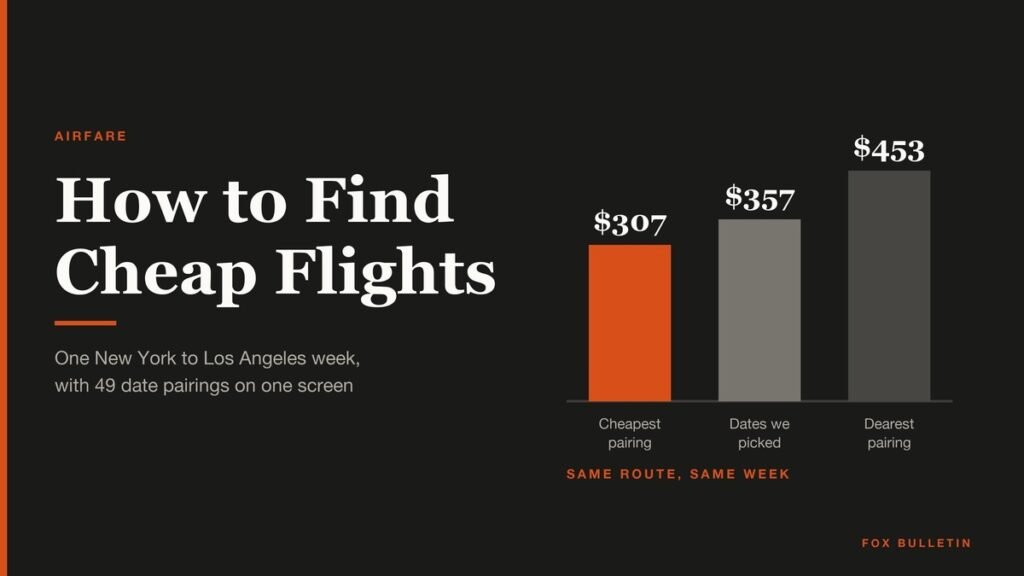
The quickest way to find cheap flights is to price the same trip on more than one search engine, then move the dates around before you commit to anything. On 29 October 2026 a New York to Los Angeles round trip in the second week of December came back at $357 on Google Flights. The same seven nights, shifted two days, cost $307. The worst pairing in that one grid was $453.
That $146 spread is the whole game, and nothing about it requires a secret website or a cleared browser. It requires knowing which tool answers which question, when fares on your kind of route usually bottom out, and what the checkout page is going to add after you click through. Here are 15 tactics that do that work, with the numbers behind each one.
What Actually Moves the Price of a Ticket
Airlines sell the same cabin in buckets. A route opens with a small number of seats at the lowest fare, and as those sell the system moves to the next bucket up. Demand, the day of the week you fly, how close you are to departure and whether a connection is involved all decide which bucket you land in.
Google published an analysis on 5 October 2026 drawn from five years of Google Flights data, and two of its findings are worth memorising. Flying out on a Monday and back on a Tuesday or Wednesday costs about 14 percent less than the equivalent weekend trip, rising to roughly 20 percent against a Sunday out and Sunday back on domestic routes. A nonstop ticket averages about 20 percent more than one with a connection.
Which booking day you buy on barely registers. Buying on a Wednesday instead of a Sunday, the dearest day to purchase, saved about 1.4 percent. The day you fly matters far more than the day you pay.
Flight Search Tools Compared: What Each One Is Best At
Comparison engines do not sell you the seat. They index fares and hand you off to an airline or an online travel agency to pay. Booking platforms sell the ticket themselves, which changes who you deal with when something goes wrong.
| Tool | What it is best at | Who takes your payment |
|---|---|---|
| Google Flights | Date grid, price graph and price history on one screen | Redirects to the airline or an agency |
| Skyscanner | Explore everywhere search and a nearby-airports toggle | Redirects to the airline or an agency |
| KAYAK | Smart Filters on stops, times and journey length | Redirects to the airline or an agency |
| Momondo | A second index for pricing a fare you have already found | Redirects to the airline or an agency |
| MakeMyTrip | Bank-card offers and promotional codes on Indian routes | Sells the ticket itself |
| ixigo | Student, senior, armed forces and medical special fares | Sells the ticket itself |
| EaseMyTrip | The same four special-fare categories, plus festive codes | Sells the ticket itself |
| Cleartrip | Date changes priced from a flat fee at booking | Sells the ticket itself |
No single one of these is cheapest on every route, which is why the first tactic below is to use two of them rather than trusting one.
1. Compare the Same Route on More Than One Site
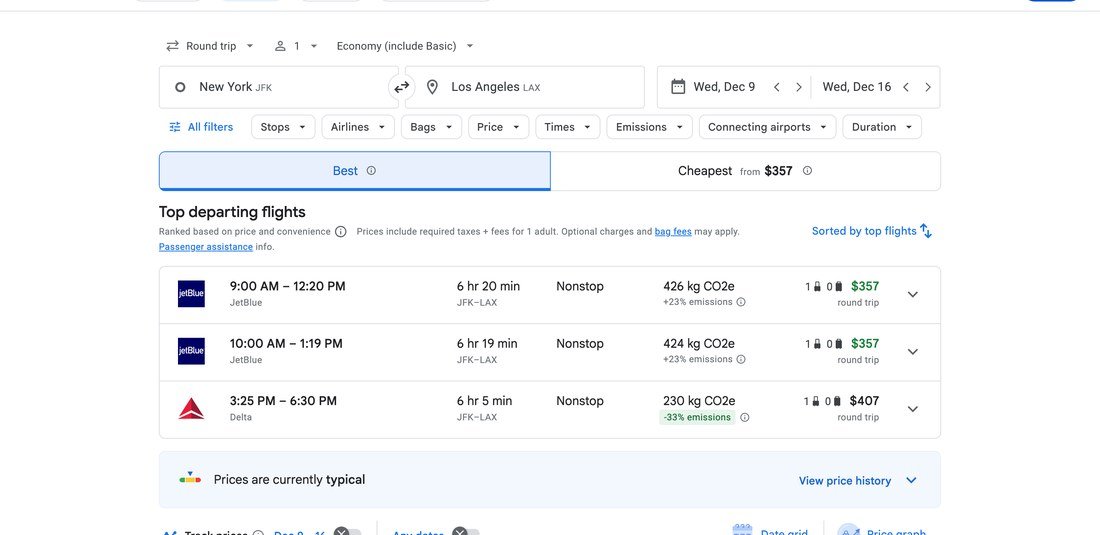
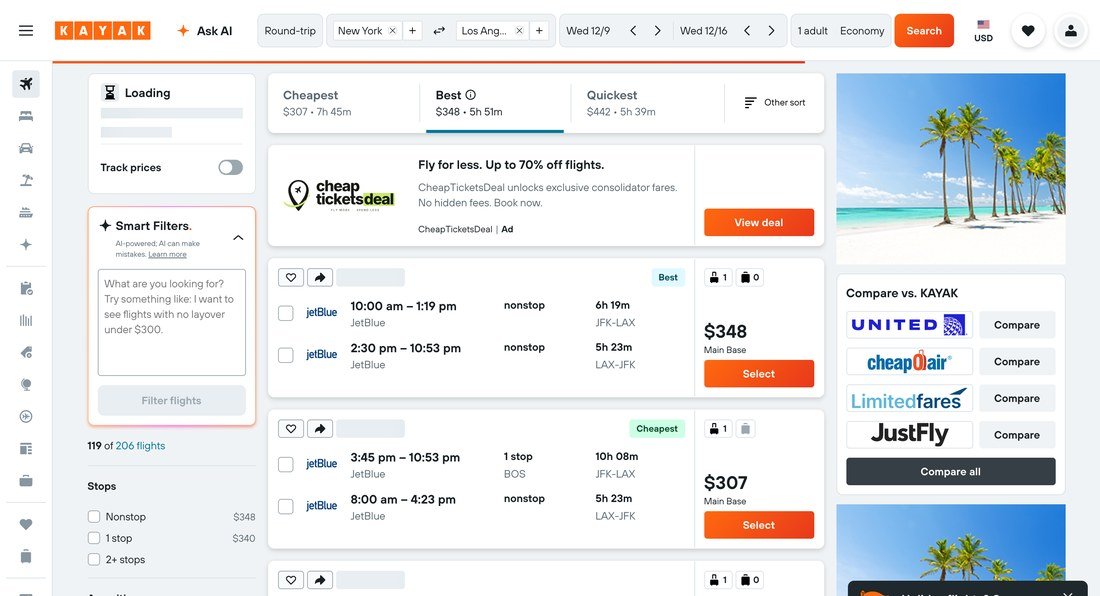
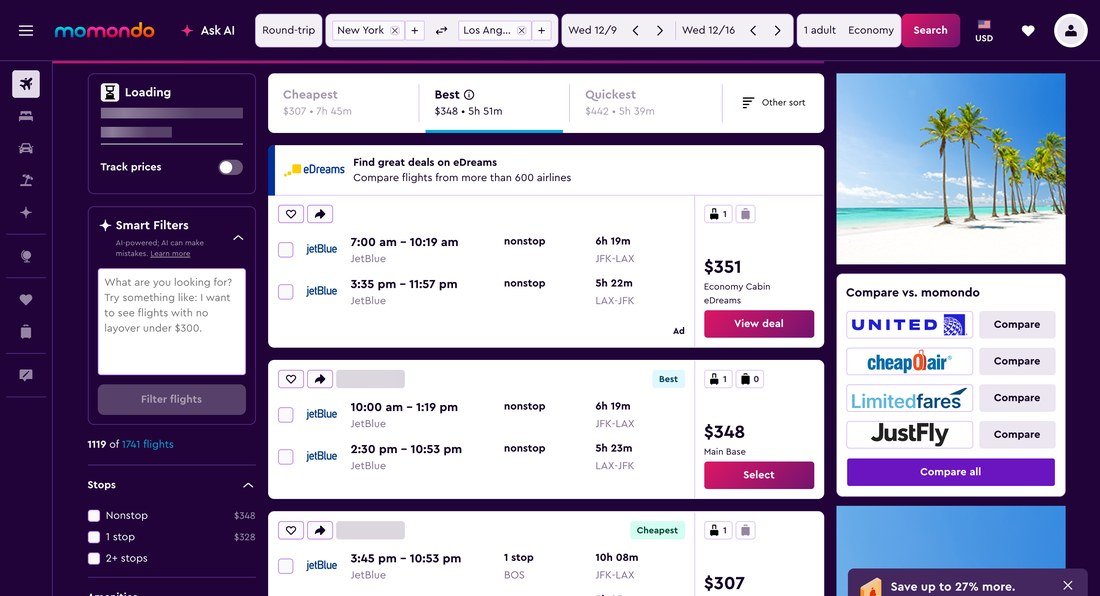
Run your route and dates on Google Flights first, because its calendar tools are the fastest way to get a baseline number. Then put the identical search into KAYAK or Momondo. Each index carries a slightly different set of airlines and agencies, so the lowest number is rarely the same twice.
Compare the total you would actually pay, not the headline fare. A $40 gap between two sites usually disappears once one of them adds a seat or a bag at checkout. Two is enough; a fifth rarely tells you anything the first two did not.
2. Book Inside the Window Where Fares Bottom Out
There is no single cheapest day to buy a ticket, but there is a window. Google’s five-year analysis puts the low point for US domestic flights at 39 days before departure, with a broad low range running from 22 to 57 days out. International trips bottom out later, around 89 days, inside a range of 50 to 133 days.
Holidays and seasons shift that mark, and the differences are large enough to plan around:
- Thanksgiving: cheapest around 34 days out, low range 21 to 57 days
- Christmas: cheapest around 56 days out, low range 33 to 67 days
- Summer, July or August: cheapest around 21 days out, low range 20 to 47 days
- Spring break, March or April: cheapest around 50 days out, low range 29 to 64 days
- Europe: cheapest around 90 days out, with the low range starting 49 days before departure
- Mexico and the Caribbean: cheapest around 43 days out, low range 24 to 69 days
For long-haul in particular, the average price drop inside that low range is small. Getting roughly into the window matters; hitting the exact day does not.
3. Shift Your Dates by a Day or Two
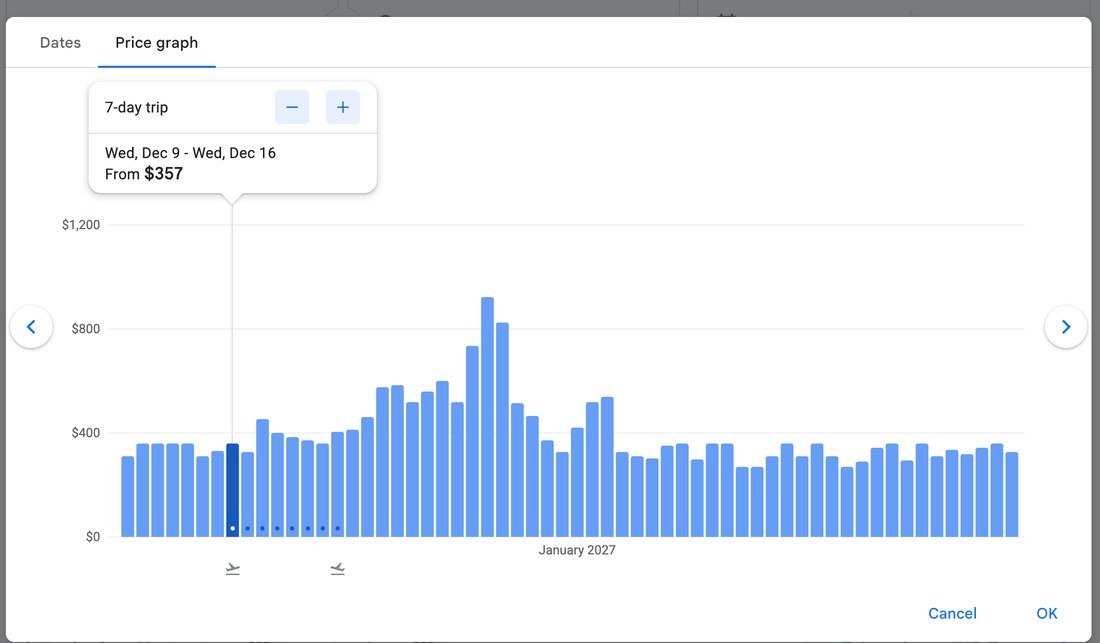
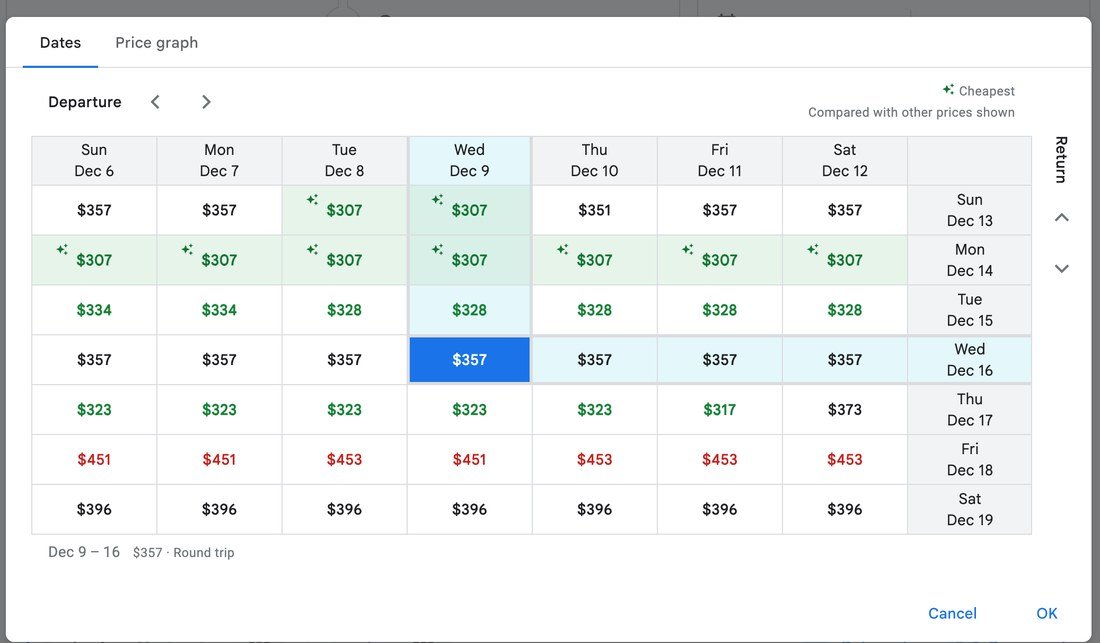
Flexibility is worth more than any booking trick. Open the date grid on a route you are watching and you see every departure and return pairing priced side by side, which turns a guess into a decision you can make in ten seconds.
The New York to Los Angeles grid below is a live example. The dates we picked came to $357. Leaving a day earlier and returning two days earlier dropped the same trip to $307. Returning on the Friday instead pushed it to $453. One week of calendar, one route, a 48 percent range between the best and worst combination.
Price any saving against what the change costs you. Fifty dollars is a good trade for leaving a day early and a poor one if it means an extra hotel night.
4. Let the Fare Choose the Destination
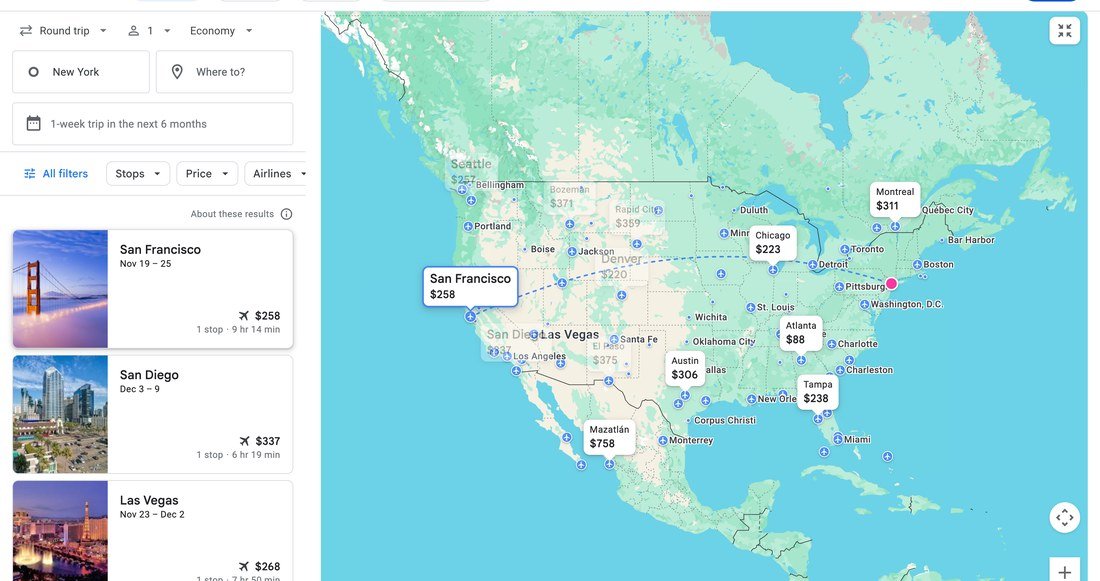
When the trip matters more than the place, search without a destination. Google Flights has an explore map and Skyscanner has an everywhere search; both take an origin and a rough trip length and return cities sorted by price.
From New York in the next six months, that map returned San Francisco at $258, Las Vegas at $268 and San Diego at $337. Before you book the cheapest pin, add what it costs to get from that airport to where you actually want to be. A fare that is $60 lower into a city two hours away is not a saving.
5. Set a Price Alert Instead of Searching Daily
Once you know the route, let the fare come to you. Google Flights, Skyscanner, KAYAK and Momondo all let you follow a specific route and set of dates and email you when the number moves.
Set the alert as soon as the trip is decided, not two weeks before you fly. That gives you a sense of what normal looks like on your route, so you can tell a genuine drop from a number that merely sounds low. When an alert fires, price the flight again before paying. Indexed fares go stale.
6. Check the Airports You Did Not Think Of
Most large cities have more than one airport, and the secondary one is often where the low-cost carriers sit. Both Skyscanner and KAYAK have a nearby airports setting that widens a search without you typing in each code.
Run the arithmetic before you switch. Parking, a train fare, a longer taxi ride and two extra hours of travel can swallow a $70 saving. The same caution applies to connections that change airports in the same city, which are a missed-flight risk as well as a cost. If you are curious how the biggest hubs compare, we ranked the busiest airports in the world by passenger numbers.
7. Price Two One-Way Tickets Against the Round Trip
Nothing requires you to fly home on the airline that took you out. On routes where one carrier is cheap in one direction and another is cheap coming back, two one-way tickets can beat the round trip outright.
There is a real cost to this. Separate tickets are separate contracts, so if the first flight runs late the second airline owes you nothing. Leave several hours between them, never book a same-day connection across two tickets, and check the baggage allowance on each one, because two tickets can mean paying for the same suitcase twice.
8. Judge a Budget Airline on the Final Total
A low-cost carrier unbundles everything a legacy airline includes. The fare buys the seat and often nothing else, so the comparison that matters is the checkout total with the things you will actually use added in.
Price the cabin bag, the checked bag, seat selection and any change fee on both carriers, and look at which airport each one uses. A fare that is $55 cheaper out of an airport 50 miles from the city is not cheaper. Use the filters on KAYAK to strip out the itineraries that fail on stops or journey length before you start comparing prices at all.
9. Confirm the Fare on the Airline’s Own Site
Found a price you like? Open the airline’s website and search the same flight. US carriers are required under 14 CFR 259.5 to disclose when their lowest fare is available elsewhere, so the two numbers often match, and booking direct gives you one party to deal with when a schedule changes.
Compare four things before deciding where to pay: the final total, the baggage allowance, the change and cancellation terms, and who answers the phone. A third-party fare that is $20 lower but non-refundable through an agency is not obviously the better buy.
10. Claim the Discount You Already Qualify For
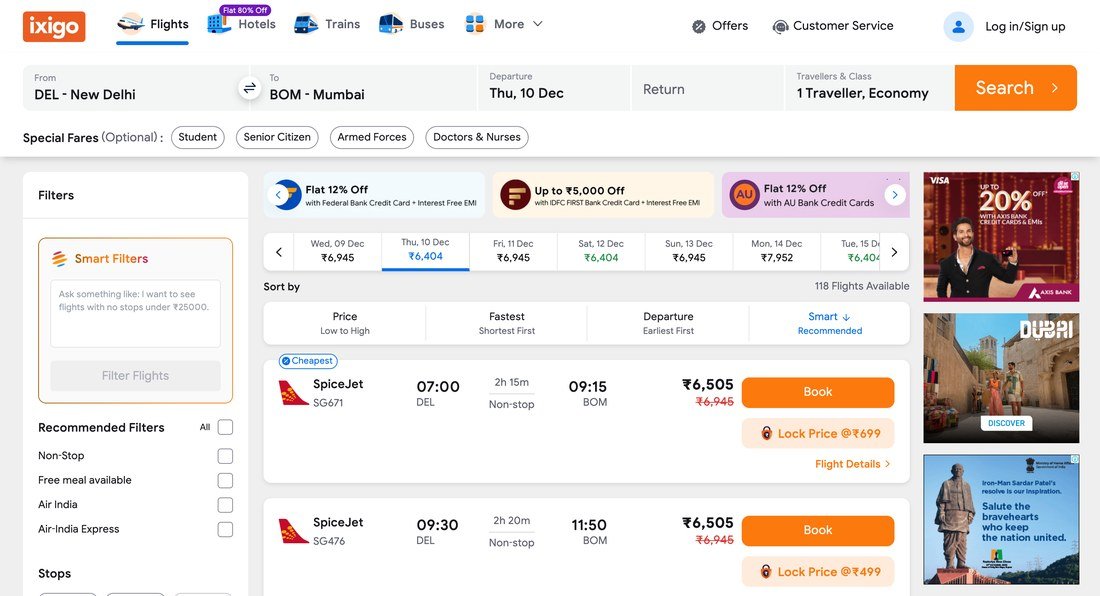
Several categories of traveller get fares that are not shown by default. On Indian booking platforms this is an explicit toggle on the search form: ixigo, EaseMyTrip and Cleartrip all carry special fares for students, senior citizens, armed forces personnel and, on two of them, doctors and nurses, typically worth up to 600 rupees off or extra baggage.
Elsewhere the same discounts exist under different names: student and youth fares, senior fares, airline loyalty programmes, co-branded card benefits and promotional codes. Check the eligibility rules and the documents you will be asked for at the airport, then compare the discounted total against the ordinary fare, because a special fare is not automatically the lowest one.
11. Compare India’s Booking Platforms Against the Airlines
For domestic Indian routes, the four large platforms are MakeMyTrip, ixigo, EaseMyTrip and Cleartrip. They sell the ticket themselves rather than passing you to the airline, and most of their advantage comes from bank-card offers and promotional codes rather than a lower base fare.
A Delhi to Mumbai search for 10 December showed how narrow the gap between carriers can be: SpiceJet from 6,945 rupees, Air India Express from 7,681, Air India from 7,852 and Akasa Air from 8,008. Non-stop started at 6,945 rupees while the cheapest one-stop itinerary was 7,732, so the connection cost more and took longer. Always check the airline’s own site as a fifth price.
12. Spend Miles and Card Points Where They Beat Cash
Frequent-flyer miles and transferable card points reduce the cash cost of a seat, but only on the right redemption. Work out what each point is returning: divide the cash fare by the number of points the airline wants, and compare that against what the same points are worth elsewhere.
Check the taxes and carrier charges on the award booking before you commit. On some long-haul routes those alone run into the hundreds, which can leave a reward seat costing more cash than a cheap paid fare on the same day.
13. Pack So You Never Pay for a Bag
Checked-bag fees are where a cheap fare stops being cheap. Delta charges $45 for the first standard checked bag on a domestic flight and $55 for the second, each way. American, under allowances updated on 18 May 2026, charges $50 for the first bag or $45 if you pay online, and $60 for the second or $55 online, with an extra $5 on each for Basic Economy tickets.
On a round trip for two people, that is $180 of bags on top of the fare. Measure your cabin bag against what each US airline allows as a carry-on before you travel, prepay online if you must check something, and keep your toiletries inside the TSA liquid limits so nothing gets pulled at the checkpoint.
14. The Mistakes That Quietly Add to the Fare
Most money lost on airfare is lost after the search, not during it. These are the ones that cost real money:
- Trusting incognito mode. Fares move with demand, seat availability and fare updates. Clearing cookies does not hold a price, and a number that rises between two searches is usually a bucket selling out.
- Booking with a seller you have not checked. An unfamiliar agency with a $25 edge is a poor trade when a schedule change leaves you arguing with a call centre. Read its cancellation terms first.
- Ignoring the fee page. Seat selection, bags, payment surcharges and service fees are added after the fare you compared.
- Leaving a tight connection on separate tickets. If the first leg is late, the second airline is not obliged to rebook you.
- Forgetting visas and transit rules. A cheap routing through a third country can require a transit visa you do not hold.
- Skipping the 24-hour window. US carriers must hold a reservation at the quoted fare, or let you cancel it without penalty, for at least 24 hours after booking, provided you booked a week or more before departure. That is a free day to keep checking.
15. How to Find Cheap Flights in Eight Steps
Run the whole thing in this order and a search takes about fifteen minutes:
- Fix the destination and a rough set of dates.
- Search Google Flights to get a baseline number for the route.
- Open the date grid and the price graph, and note the cheapest pairing.
- Re-run the same search on KAYAK or Momondo.
- Widen it to nearby airports and check whether the saving survives the ground transport.
- If you are not ready to buy, set a price alert and wait.
- Add bags, seats and fees to both candidates so you are comparing final totals.
- Check the airline’s own site last, then read the change and refund terms before you pay.
The one habit that matters more than the rest: never buy the first number you see. Even a single comparison and one shift of the calendar is usually worth more than every other trick combined.
Frequently Asked Questions
What is the best website to find cheap flights?
Google Flights is the best place to start, because its date grid and price graph answer the two questions that move a fare most. Run the same search on KAYAK or Momondo, then confirm on the airline’s site. The cheapest site changes by route, so no single one wins every time.
What is the cheapest day to book a flight?
No day guarantees a lower fare. Google’s five-year data found that buying on a Wednesday rather than a Sunday saved about 1.4 percent, which is noise next to the roughly 14 percent you save by flying midweek instead of at the weekend. Choose your travel days carefully and buy whenever the price is right.
How far in advance should I book a flight?
For US domestic trips, fares average their lowest around 39 days before departure, inside a low range of 22 to 57 days. International fares bottom out nearer 89 days. Holiday travel is earlier: roughly 56 days for Christmas and 34 for Thanksgiving. Start watching early and buy inside the window.
Do flight prices go up if you search the same route twice?
Not because you searched. Prices change when a fare bucket sells out, when demand shifts or when the airline republishes fares, and search engines show cached numbers that go stale between refreshes. Incognito mode does not protect a price, so re-check the fare on the seller’s page before paying.
Related Articles

Get the Fox Bulletin briefing
The stories that matter, in your inbox. No spam, unsubscribe anytime.
Newsletter signup will be available soon.
Related stories

Most Expensive House in the World: Top 10, Sold or Valued
Ten of the most expensive houses in the world, split into those with a recorded or reported sale price and those valued only by estimate, with the deed, auction or accounts behind each figure.

Best Stocking Stuffers for Adults 2026: 12 Small, Useful Gadgets
The best stocking stuffers for adults are small gadgets that fix an everyday annoyance, like lost keys or a dying phone. Our top pick is the Chipolo POP, a bright Bluetooth tracker…

Self Care Gifts for Women 2026: 10 Relaxing Gift Ideas for Her
The best self care gift for a woman is one that makes an ordinary part of her day calmer, like the Himalayan Glow Salt Lamp for a soft amber glow at bedtime…