

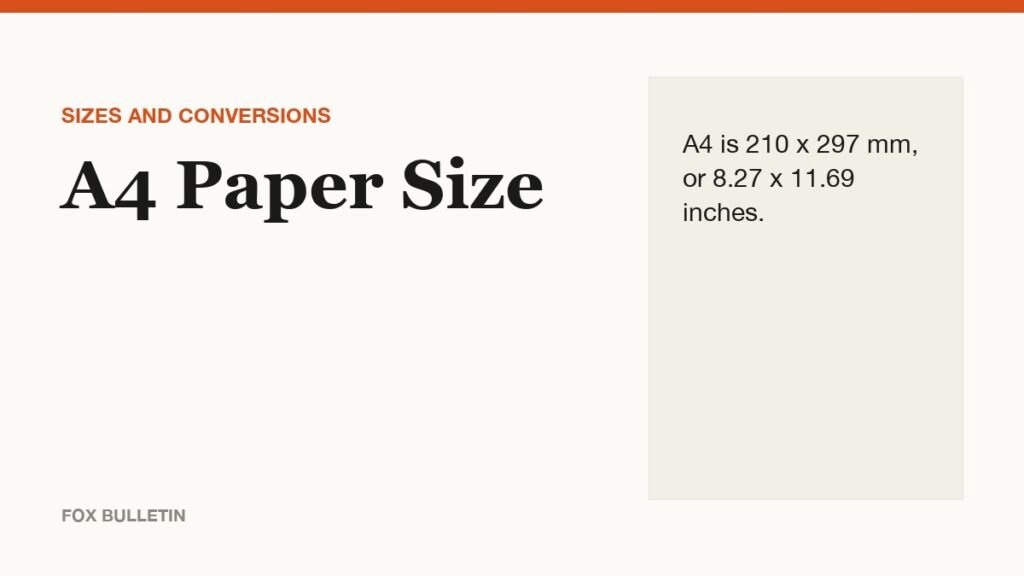
A4 is 210 x 297 millimetres, or 8.27 x 11.69 inches, which makes the A4 paper size the everyday sheet for letters, forms, reports and laser printer output in most of the world. In centimetres that is 21.0 x 29.7, and the sheet has an area of exactly one sixteenth of a square metre. The page is 297 mm tall because every sheet in the family keeps the same proportions, a ratio of 1 to 1.4142.
The figures here follow ISO 216:2007, the international standard for trimmed paper sizes, with each dimension rounded to the whole millimetre and inches shown to two decimal places. Below you will find the full conversion chart, a direct comparison with US Letter, the sizes either side of A4 in the A series, and the practical points that matter when a file built for one sheet is printed on the other.
A4 Dimensions in mm, cm, Inches and Pixels at 72, 150 and 300 DPI
| Unit | Width | Height |
|---|---|---|
| Millimetres | 210 mm | 297 mm |
| Centimetres | 21.0 cm | 29.7 cm |
| Inches | 8.27 in | 11.69 in |
| Pixels at 72 DPI | 595 px | 842 px |
| Pixels at 150 DPI | 1240 px | 1754 px |
| Pixels at 300 DPI | 2480 px | 3508 px |
The pixel rows are the standard conversions: millimetres divided by 25.4 gives inches, and inches multiplied by the DPI gives pixels. The 72 DPI row matches the point grid used by PDF and PostScript, so a blank A4 page is 595 x 842 points in those formats. At 300 DPI, the usual density for print-quality scans and exports, a full A4 page comes to 2480 x 3508 pixels.
If you capture or design a screen image for printing, pick the DPI first and the pixel size follows. The same arithmetic applies to a Mac screenshot, which is stored in pixels with no paper size attached until you print it.
A4 Against US Letter: Every Measurement Side by Side
| Measure | A4 | US Letter |
|---|---|---|
| Width and height (mm) | 210 x 297 | 215.9 x 279.4 |
| Width and height (in) | 8.27 x 11.69 | 8.50 x 11.00 |
| Area | 623.7 cm2 | 603.2 cm2 |
| Pixels at 72 DPI | 595 x 842 | 612 x 792 |
| Pixels at 150 DPI | 1240 x 1754 | 1275 x 1650 |
| Pixels at 300 DPI | 2480 x 3508 | 2550 x 3300 |
Letter is 5.9 mm wider than A4 and 17.6 mm shorter. A4 is therefore the taller, narrower page, and its total area is about 3 percent larger. Paper makers label Letter reams 8.5 x 11 in and 216 x 279 mm, the rounded metric figure.
Letter is also the same size as ANSI A in the American engineering sheet ladder, so a drawing office that works to ANSI sizes uses the same 8.5 x 11 in page as an ordinary office. A4 has no such twin in inches, which is why conversions between the two always involve a small trim or a small reduction.
The A4 Paper Size in the A Series, A0 to A6
A0 is defined as one square metre. Cut it in half across its longer side and you have two sheets of A1; cut an A1 in half and you have A2, and so on down the line. A4 is the fourth cut, and each sheet in the series is exactly half the area of the one before. The walk below runs from A0 to A6, the sizes that bracket A4.
A0: The One Square Metre Master Sheet
Size: 841 x 1189 mm · Inches: 33.11 x 46.81 · Area: 1 m2 · Closest US: ANSI E, 34 x 44 in
A0 anchors the system. At 841 x 1189 mm it covers one square metre, and every other A size is a power-of-two fraction of that area. Posters and large technical drawings are its usual work.
The nearest American sheet is ANSI E at 34 x 44 inches (863.6 x 1117.6 mm), which is wider and shorter. They are close, but not interchangeable.
A1: Half of A0 for Posters and Drawings
Size: 594 x 841 mm · Inches: 23.39 x 33.11 · Area: 1/2 m2 · Closest US: ANSI D, 22 x 34 in
A1 is A0 cut into two equal pieces, and its longer side of 841 mm is the shorter side of A0. Like A0, it is a common size for drawings and posters.
ANSI D, at 22 x 34 inches (558.8 x 863.6 mm), is the closest US sheet. It is narrower than A1 by about 35 mm and slightly taller.
A2: A Quarter Square Metre
Size: 420 x 594 mm · Inches: 16.54 x 23.39 · Area: 1/4 m2 · Closest US: ANSI C, 17 x 22 in
A2 is 420 x 594 mm and takes up a quarter of a square metre. Its width of 420 mm is also the longer side of A3, so the chain of halving is visible in the numbers themselves.
ANSI C, 17 x 22 inches (431.8 x 558.8 mm), sits nearest. The match is rough: A2 is 594 mm tall, ANSI C is 558.8 mm.
A3: Two A4 Pages Side by Side
Size: 297 x 420 mm · Inches: 11.69 x 16.54 · Area: 1/8 m2 · Closest US: Tabloid, 11 x 17 in
A3 is the size you get by placing two A4 pages next to each other along their long edges. Its short side of 297 mm is exactly A4’s long side. Diagrams and wall charts are typical A3 jobs, and a copier moves between A3 and A4 with a ratio of 71 percent going down and 141 percent going up.
The closest US sheet is Tabloid, also called Ledger or ANSI B, at 11 x 17 inches (279.4 x 431.8 mm). Both are described as the nearest match rather than an equivalent, because Tabloid is 17.6 mm narrower and 11.8 mm taller.
A4: The Everyday Letter, Form and Print Sheet
Size: 210 x 297 mm · Inches: 8.27 x 11.69 · Area: 1/16 m2 · Closest US: Letter, 8.5 x 11 in
A4 is the working centre of the series. A common office ream is 80 g/m2 and 500 sheets, and because A4 is one sixteenth of a square metre, one sheet at that weight comes to 5 g. A full ream of 500 sheets then weighs 2.5 kg before packaging.
Letters, forms and laser printer output are its home ground. Fold an A4 sheet once across the middle and you have A5; place two together and you have A3.
A5: Half of A4 for Notepads
Size: 148 x 210 mm · Inches: 5.83 x 8.27 · Area: 1/32 m2 · Closest US: Statement, 5.5 x 8.5 in
A5 is A4 folded once. Its long side of 210 mm is A4’s short side, which is why a folded A4 sheet makes a tidy A5 booklet page. Note pads are the typical use.
The nearest American size is Statement, 5.5 x 8.5 inches (about 140 x 216 mm). It is 8 mm narrower than A5 and 6 mm taller.
A6: A Quarter of A4 for Postcards
Size: 105 x 148 mm · Inches: 4.13 x 5.83 · Area: 1/64 m2 · Closest US: Postcard, 4 x 6 in
A6 is A5 cut in half, so four A6 cards fit on one A4 sheet. At 105 x 148 mm it is the standard postcard size in the series.
The usual American postcard is 4 x 6 inches (about 102 x 152 mm), a close match to A6 though a little narrower and taller. Smaller sizes continue down to A10 at 26 x 37 mm, each again half the area of the one above.
Why A4 Is 297 mm Tall: The Square Root of Two
Every sheet in the A, B and C series has a height to width ratio of the square root of two, about 1.4142. That is the only ratio at which cutting a rectangle across its long side produces two halves with the same shape as the original. Take A4 at 210 x 297: half of it is 148.5 x 210, and that is A5 rounded down to 148 x 210 mm, still 1.4142 to 1.
The starting point is the area, not a length. A0 is fixed at one square metre, and the ratio then forces 841 x 1189 mm. Every smaller size follows by halving and rounding down to the whole millimetre.
The B series sits between the A sizes: each B dimension is the geometric mean of the matching A size and the next larger one. B0 is 1000 x 1414 mm, one metre wide. The C series, used for envelopes, is the geometric mean of the A and B sizes with the same number.
Which Countries Use A4 and Which Use US Letter
A4 is the default paper size for the world in the Unicode CLDR locale data, and the exceptions are listed by territory. Fourteen territories default to Letter: Belize, Canada, Chile, Colombia, Costa Rica, Guatemala, Mexico, Nicaragua, Panama, the Philippines, Puerto Rico, El Salvador, the United States and Venezuela. Every other territory defaults to A4.
That locale default is a software setting rather than a law, and practice inside a country can be mixed. Mexico is the best-known example, where ISO sizes are used only in part. The United States and Canada are the largest Letter markets, and they are the main reason a document sent abroad needs a size check.
Japan’s JIS B series differs from the ISO one. Japanese B5 is 182 x 257 mm, against 176 x 250 mm for ISO B5, so a B size should never be assumed to match across the two systems. The A series is the same everywhere.
Printing Between A4 and Letter: What Changes at the Edge of the Page
A document built for A4 and printed on Letter loses height first. Letter is 17.6 mm shorter, so a page fitted to the full 297 mm must shrink to about 94 percent to fit, and the sheet will show side margins of roughly 9 mm that were not there on A4. A printer set to print at 100 percent will cut off the bottom of the page.
A Letter document on A4 fails the other way. A4 is 5.9 mm narrower, so content that runs within about 3 mm of the sides can clip, and a Letter page scaled to fit shrinks only to about 97 percent. At full size, the extra 17.6 mm of height sits as blank space at the foot of the sheet.
Envelopes follow the A series folding rule. A C4 envelope takes an unfolded A4 sheet, C5 takes A4 folded once, and C6 takes A4 folded twice. C4 measures 229 x 324 mm, C5 is 162 x 229 mm and C6 is 114 x 162 mm. For PDFs and exports, a PDF editor and a file converter let you check or change the page size before a file goes out.
ISO 216 and What the A4 Measurements Rest On
ISO 216:2007 is the standard that fixes the A and B series for writing paper and printed matter such as forms and catalogues. It is Edition 2, published in September 2007, and was last confirmed in 2021. Its scope does not necessarily cover newspapers, published books or posters. The standard’s own page is on the ISO committee site.
The millimetre values are rounded to whole numbers, with tolerances of 1.5 mm up to 150 mm, 2 mm above 150 and up to 600 mm, and 3 mm above 600 mm. The envelope sizes were published as ISO 269, which was withdrawn in 2009, so the C series is described here as part of the wider ISO paper family and not as a current standard of its own.
Inches are rounded to two decimals, and printer makers sometimes round to one: 8.3 x 11.7 inches for A4. US Letter is exactly 215.9 x 279.4 mm, while paper wrappers often round that to 216 x 279. The pixel counts are straight arithmetic from the millimetre sizes, and the CLDR country list is a software default, not a statement of national policy.
How to Check That a File Will Print Cleanly on A4 or Letter
Open the print dialog and read the paper size before the page count. A4 and Letter often sit next to each other in the list, and picking the wrong one is the usual cause of clipped footers and shifted margins.
Keep important content at least 10 mm from every edge. That clears the 3 mm side loss on a Letter page printed on A4 and leaves room for the 17.6 mm height difference in the other direction. Use fit to page only when you accept the 94 to 97 percent reduction in type size.
For files that will be sent abroad, export a PDF with the page size set to the recipient’s paper. A PDF sized 595 x 842 points is A4, and 612 x 792 points is Letter, so a quick look at the document properties confirms the size.
Frequently Asked Questions
Is A4 bigger than Letter?
A4 is taller and narrower. It is 297 mm tall against 279.4 mm, and 210 mm wide against 215.9 mm, so Letter is 5.9 mm wider and A4 is 17.6 mm taller. The areas are 623.7 cm2 for A4 and 603.2 cm2 for Letter.
How many pixels is an A4 page at 300 DPI?
An A4 page at 300 DPI is 2480 x 3508 pixels. At 150 DPI it is 1240 x 1754 pixels, and at 72 DPI it is 595 x 842.
Which envelope fits A4 paper?
C4 fits an A4 sheet flat, at 229 x 324 mm. C5 (162 x 229 mm) takes A4 folded once, and C6 (114 x 162 mm) takes it folded twice.
What size is half of A4?
Half of A4 is A5, at 148 x 210 mm (5.83 x 8.27 inches). A5 is half the area of A4, at 1/32 of a square metre against 1/16, and A6 at 105 x 148 mm is half again.
Related Articles

Get the Fox Bulletin briefing
The stories that matter, in your inbox. No spam, unsubscribe anytime.
Newsletter signup will be available soon.
Related stories
Cheese Types: 7 Classes and How to Spot Each One
Every cheese at the counter belongs to one of seven classes: fresh, soft-ripened, semi-soft, semi-hard, hard, blue or processed. This guide shows how to recognise each by feel, rind and age, with milk, moisture limits and ageing times for 16 familiar cheeses.
How Many Bones in the Human Body: 206, Region by Region
The adult human skeleton has 206 bones, and this page counts every one by region in a single chart. It then walks through the skull, spine, ribs, arms and legs, explains why babies have roughly 270 to 300 bones, and covers the longest and smallest bones and the extra bones some adults carry.
Periodic Table Groups: All 18 With Names and Members
The periodic table has 18 numbered groups, and six of them carry family names approved by IUPAC. This page lists every group with its members and valence pattern, then walks through the families one at a time. It also explains groups against periods, the lanthanoid and actinoid rows, hydrogen and the older roman numeral labels.