

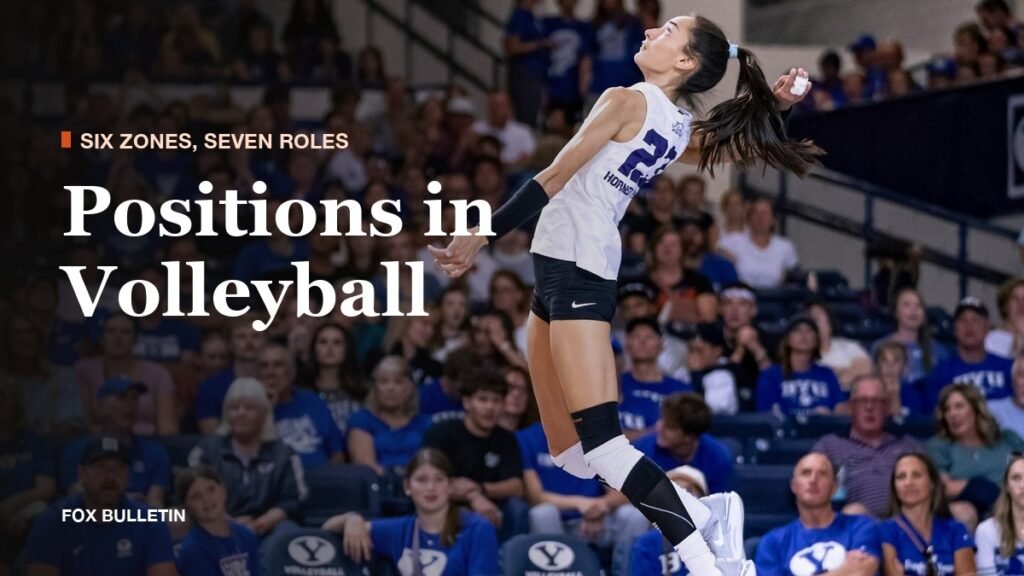
There are seven positions in volleyball, and they share six court zones: the setter, outside hitter, opposite hitter, middle blocker, libero, defensive specialist and serving specialist. Only six players stand on court at once, three at the net in zones 4, 3 and 2 and three behind them in zones 5, 6 and 1, so the roles are shared out across a fixed grid that every team rotates through.
This page follows the FIVB Official Volleyball Rules 2025-2028 and states plainly where US college volleyball (NCAA) works differently. The grid, the rotation and the libero are written into the rules. The other six roles are coaching conventions, described here as NCAA.com and Volleyball World describe them.
Court Zone, Job and Key Rule for All 7 Positions in Volleyball
| Role | Zone(s) | Primary job | Key rule |
|---|---|---|---|
| Outside hitter | Front left (4); passes from the back row | Left-side attack and serve receive | A back-row attack must take off behind the 3 m line |
| Middle blocker | Middle front (3) and middle back (6) at the start | Block the centre, quick attack beside the setter | Often swapped for the libero in the back row |
| Opposite hitter | Front right (2) | Right-side attack, block the opposing outside hitter, backup setter | Same back-row attack rule as every back-row player |
| Setter | No fixed zone; NCAA starts the setter in left back (5), and a front-row setter in a 4-2 takes centre front (3) | Run the offense with the second touch | Rotation order at the serve; a back-row setter may not attack from in front of the 3 m line above net height |
| Libero | Back row only (5, 6 or 1) | Serve receive and digging | Contrasting jersey; no block; no attack above net height; unlimited replacements that are not substitutions |
| Defensive specialist | Back row | Passing and defense | Team jersey; normal substitutions; about 3 of 6 rotations |
| Serving specialist | Position 1 | A consistent, hard-to-receive serve | Normal substitution; not defined in any rulebook |
Two entries in the chart are starting points, not rules. The setter’s start in zone 5 is the NCAA example, and no rule fixes any role to any zone. The libero is the only role that either rulebook defines.
The Positions in Volleyball, Front Row First and Back Row After
The order follows the court: the net from left to right, then the setter, then the back-row and substitution roles. It is a lookup order, not a ranking.
Outside hitter: the zone 4 attacker who never leaves the floor

The outside hitter attacks from the left side of the net and usually receives the most sets. Hitting from the front and back rows and passing serve keep this player on court for all six rotations.
In zone 4 the outside hitter may attack at any height. From the back row, the take-off must happen behind the 3 m line. The NCAA rotation example starts the two outsides at left front and right back, so when one goes back to serve, the other rotates from the back row to the front.
Middle blocker: the zone 3 wall and the quick attack

The middle blocker is usually the tallest player on the team. The job is to block the centre of the net against quick attacks, slide left and right to help the outside blockers, and take fast sets from near the setter.
Two middles start three positions apart, at middle front (3) and middle back (6). In NCAA play the libero most often replaces a middle in the back row, so when one middle rotates to the back, the other middle comes in for the libero and takes the net.
Opposite hitter: the zone 2 attacker across from the setter

The opposite hitter, or right-side hitter, starts in right front and gets the name from standing opposite the outside hitter. Beyond hitting from the front and back rows, the opposite blocks the other team’s outside hitter and at times acts as a backup setter.
A front row should always hold an outside hitter, a middle blocker and either a setter or an opposite, which is why the opposite sits across the rotation from the setter.
Setter: the one role with no fixed zone

The setter runs the offense and aims to take the second touch, placing the ball in front of the hitter for the third and final contact. A setter can work from either row, so the role also needs digging, blocking and serve receive, plus an eye for the opponent’s weakest blockers.
No rule gives the setter a zone. The NCAA example starts the setter in left back with the opposite in right front, and in a 4-2 a front-row setter moves to centre front after the serve. In the back row a setter is bound by the same 3 m line as every other back-row player. The setter must be in rotation order before sprinting to the net.
Libero: the only role the rulebook defines

The libero is a specialist defender in a jersey whose dominant colour clearly contrasts with the rest of the team, numbered like everyone else. The job is serve receive, digging, reading attacks and talking to teammates, and the libero usually leads the team in digs.
Back-row positions 5, 6 and 1 are the libero’s only territory. The libero may not block or attempt to block, and may not complete an attack hit when the ball is entirely higher than the top of the net. Replacements are unlimited and are not substitutions.
Defensive specialist: a back-row passer in the team jersey
A defensive specialist (DS) does much the same work as the libero, with serve receive and defense in the back row. The difference is the paperwork: a DS wears the team jersey and follows the normal substitution rules, which both NCAA.com and Volleyball World describe as playing three of six rotations.
The FIVB text defines the libero as its only designated specialist, so the DS is a coaching convention. In NCAA Division I a team has 15 substitutions per set (Divisions II and III have 18), and each DS entry spends one. The libero and DS are normally the best two passers on the floor.
Serving specialist: the substitute who exists for one skill
A serving specialist is put in the game just to serve. The player has a very consistent serve that is tough to receive and comes in for a teammate who is not as strong behind the service line, serving from position 1 and leaving afterwards.
Like the DS, this is a convention built on ordinary substitutions, and each entry counts toward the per-set limit.
How One Rally Moves Through the Positions
A rally touches the roles in a fixed order. The server stands in zone 1, and the back-row passers (the libero or DS, and any outside hitter in the back row) receive. The pass goes to the setter, who takes the second touch and chooses a hitter among the outside, middle and opposite.
On the other side of the net, the middle blocker lines up in the centre of the block while the outside and opposite hitters close in beside it. The remaining back-row players cover the floor behind the block and dig what gets through. A dug ball restarts the cycle: pass, set, attack.
The rules shape that chain. A back-row player may attack at any height only if the take-off stays behind the 3 m line, and may land in the front zone. Once the serve is struck, players may run anywhere.
Why the Zones Rotate: Positions 4-3-2 and 5-6-1 Under Rule 7
FIVB Rule 7 puts three front-row players along the net in positions 4 (front left), 3 (front centre) and 2 (front right). The back row holds 5 (back left), 6 (back centre) and 1 (back right). The NCAA rule book numbers the court the same way, starting with right back as No. 1 and counting counterclockwise.
When the receiving team wins the right to serve, its players rotate one position clockwise. The player in zone 2 moves to 1 to serve, then the chain runs 1 to 6, 6 to 5, 5 to 4, 4 to 3 and 3 to 2. The order is set by the starting lineup and stays fixed for the entire set.
Zone names describe a place and role names describe a job. A setter passes through all six zones during a set, which is why the roles in the chart are not tied to one zone. The same split between a field and the jobs on it shows up in football positions, where 22 players cover fixed areas.
Where NCAA Volleyball Departs From the FIVB Code
The grid, the rotation and the 3 m line read the same in both codes. The differences sit mostly around the libero and the substitution allowance.
- Libero serving: FIVB Rule 19.3.1.3 forbids it. NCAA Rule 12.1.2.3 lets either libero replace the position 1 player and serve, but in one rotation only.
- Libero count: FIVB allows up to two, with only one on court, and makes two mandatory in FIVB, World and Official senior competitions when more than 12 players are on the score sheet. NCAA allows a maximum of two per set.
- Libero entry: FIVB uses the Libero Replacement Zone beside the bench. NCAA uses the sideline between the attack line and the end line.
- Substitutions: NCAA Division I gives 15 per set and Divisions II and III give 18. Libero replacements never count against that limit.
Formations: How a Coach Fits the Positions Into 4-2, 6-2 and 5-1
Formation names list hitters first and setters second, so a 5-1 is five hitters and one setter. The choice changes how many front-row attackers a team has in each rotation.
| Formation | Hitters | Setters | Front-row attackers |
|---|---|---|---|
| 4-2 | 4 | 2 | Two, because one setter is always in the front row |
| 6-2 | 4 (all six can hit) | 2, setting only from the back row | Three in every rotation |
| 5-1 | 5 | 1 | Two in three rotations, three in the other three |
The 4-2 is the simplest and most beginner-friendly shape: the two setters sit opposite each other, so one is always at the net. The 6-2 keeps three attackers at the net all the time, since the setter is always the back-row player who comes forward.
The 5-1 is the most common lineup in high-level volleyball. It looks like a 4-2 while the lone setter is at the net and like a 6-2 when the setter is behind. The defensive specialist and serving specialist sit outside all three counts because they come in beyond the six starters.
Picking a Position as a Beginner: Matching the Role to the Skill
Each role rewards a different strength. A player who loves the big swing and passes well fits the outside spot, and a tall, quick player who enjoys timing fits in the middle.
Quick thinkers who want to control the game fit the setter role, and a strong right arm suits the opposite. Fast, fearless defenders look to the libero or DS roles, while a player with one reliable weapon, a serve, can start as a serving specialist. Compare how soccer positions fix players to areas of a pitch.
What the Zones and Role Definitions Rest On, and Where They Stop
The rule-defined facts here are the zone numbering, the rotation order, the overlap rules, the back-row attack rule and the libero chapter. They come from the FIVB Official Volleyball Rules (2025-2028 edition) and the NCAA 2026 and 2027 women’s rule book.
The descriptions of the setter, hitters, middle blocker, defensive specialist and serving specialist are conventions published by NCAA.com and Volleyball World, so a team may field a role differently from the description. The starting zones are examples as well. The NCAA article starts the setter in left back, while many coaches start a 5-1 setter in right back, and no rule decides it.
How to Read a Lineup and a Rotation From the Stands
- Spot the libero by the contrasting jersey. It is the one player who cannot block or attack above the net.
- Find the setter, then count three rotation steps to find the opposite hitter, who usually stands across from the setter.
- Count setters on the lineup. One setter means a 5-1, and two means a 4-2 or 6-2.
- Watch the middles. When one rotates to the back row, expect the libero to enter and the other middle to take the net.
- Ignore the scattered look in serve receive. Overlap rules only require the right relationships between neighbours, and everyone moves freely once the ball is served.
Frequently Asked Questions
How many positions are there in volleyball?
Seven roles are named: setter, outside hitter, opposite hitter, middle blocker, libero, defensive specialist and serving specialist. Only six players are on court, in zones 4, 3 and 2 at the net and 5, 6 and 1 behind.
Which direction do volleyball players rotate?
Clockwise, after the team wins the serve back. The path is 2 to 1 to 6 to 5 to 4 to 3, so the player in zone 2 becomes the next server.
Can a volleyball libero spike?
Not above the net. A libero may not complete an attack hit when the ball is entirely higher than the top of the net, from anywhere on the court or free zone, and may not block. FIVB bars the libero from serving, while NCAA lets a libero serve in one rotation.
Do libero replacements count as substitutions?
No. They are unlimited, with one completed rally needed between replacements, and they do not count toward the 15-per-set limit in NCAA Division I.
Related Articles

Get the Fox Bulletin briefing
The stories that matter, in your inbox. No spam, unsubscribe anytime.
Newsletter signup will be available soon.
Related stories

Richest Athletes in the World: All 8 Billionaires Ranked
Michael Jordan is the richest athlete alive, with a net worth of $4.663 billion, about three times the next name on the list. Only eight athletes have reached a billion dollars, and this ranking covers every one with the stake, deal or business that got them there.
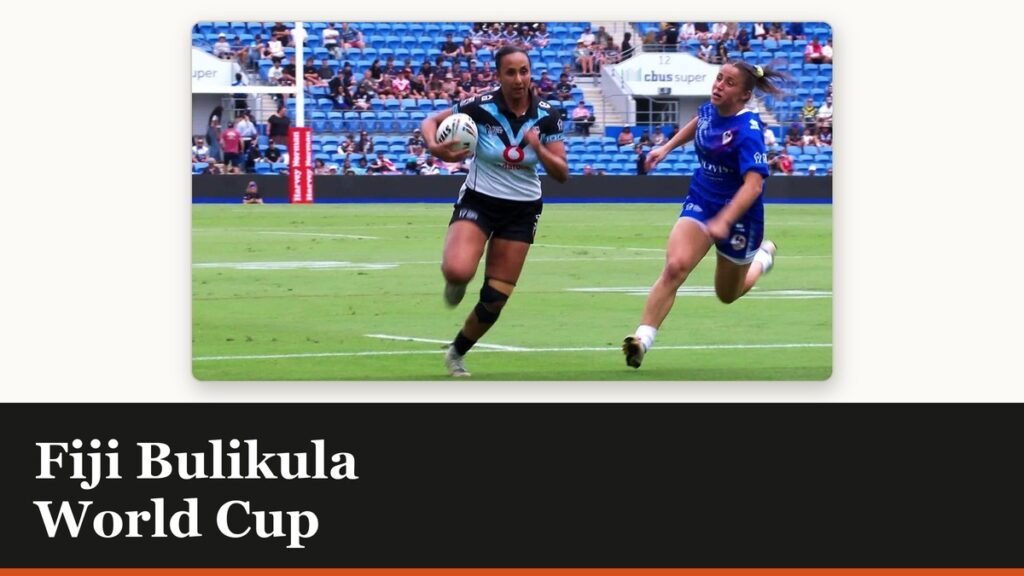
Fiji Bulikula Reach a First World Cup Semi-Final
Eleven tries, a 22-0 half-time lead and a first semi-final in the nation's history. Fiji Bulikula now face the world champions.

Best Soccer Players of All Time: Top 10 Ranked
Pele won three World Cups, a feat no other player has matched. Lionel Messi holds eight Ballon d'Or awards. This ranking of the ten greatest players is built on countable honours rather than highlight reels.