

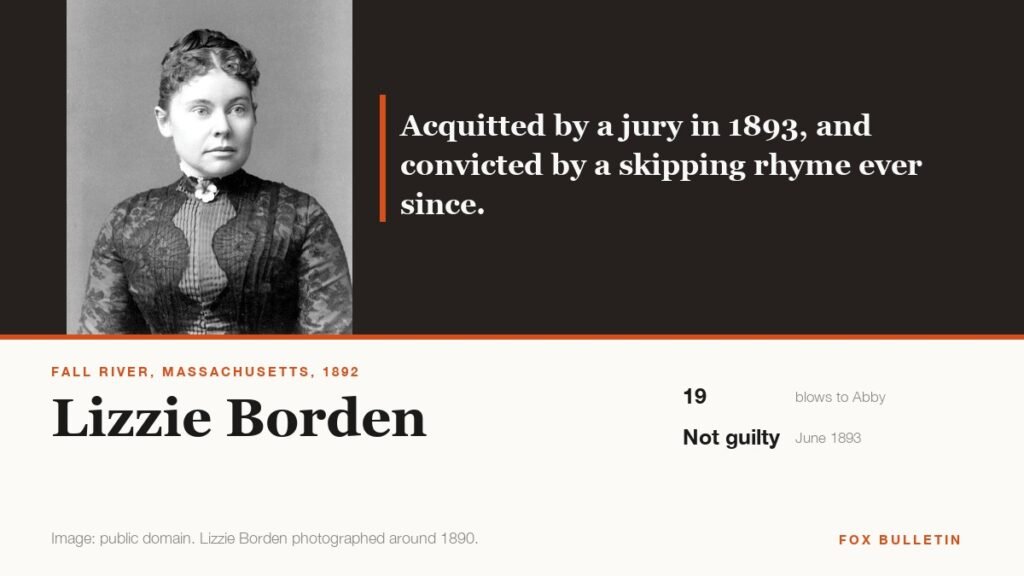
Lizzie Borden was tried for killing her father and stepmother with a hatchet in 1892, and a jury found her not guilty after deliberating for about an hour and a half. No one else was ever charged, which is why the case is still argued over more than a century later: the acquittal closed the trial without closing the question.
Most of what people think they know comes from a children rhyme that gets the central fact wrong. Here is the documented sequence of events:
| Date | What happened |
|---|---|
| August 4, 1892 | Andrew Borden and his wife Abby are killed at the family home on Second Street in Fall River, Massachusetts |
| August 11, 1892 | Lizzie Borden is arrested in Fall River and charged with the murders |
| Late 1892 | A grand jury hears the case and returns indictments against her |
| June 5, 1893 | The trial opens in New Bedford, Massachusetts |
| June 20, 1893 | The jury returns a verdict of not guilty and she is acquitted |
| July 1893 | Lizzie and her sister Emma buy a house on French Street in Fall River, later called Maplecroft |
| 1927 | Lizzie Andrew Borden dies in Fall River, aged 66 |
What Happened on August 4, 1892
The Library of Congress dates the killings to the morning of August 4, 1892, at the Borden home in Fall River, Massachusetts, where Andrew Borden and his wife Abby were both killed. Lizzie was arrested a week later, on August 11. The basic facts of the household that morning are not in dispute:
- The household was small. Andrew Borden, a wealthy and famously frugal businessman, lived with his second wife Abby, his daughters Lizzie and Emma, and a live-in maid, Bridget Sullivan.
- Emma was away from Fall River that week, which left Lizzie, Bridget and a visiting uncle, John Morse, as the people in and around the house that morning.
- Bridget was washing windows when the killings happened and became one of the most important witnesses at every stage of the case.
- Abby was killed first, in an upstairs guest room. The medical examiner, Dr William Dolan, concluded she died at least an hour before Andrew.
- Andrew came home late that morning, lay down on a sofa in the sitting room and was killed there.
Lizzie told police she had been in the barn loft looking for sinkers when her father was killed, and that she came back to find him on the sofa. The prosecution argued the barn was too hot and too undisturbed for anyone to have spent twenty minutes in it. That disagreement, about where one person stood for twenty minutes on a August morning, is most of the case.
The Rhyme Gets the Numbers Wrong
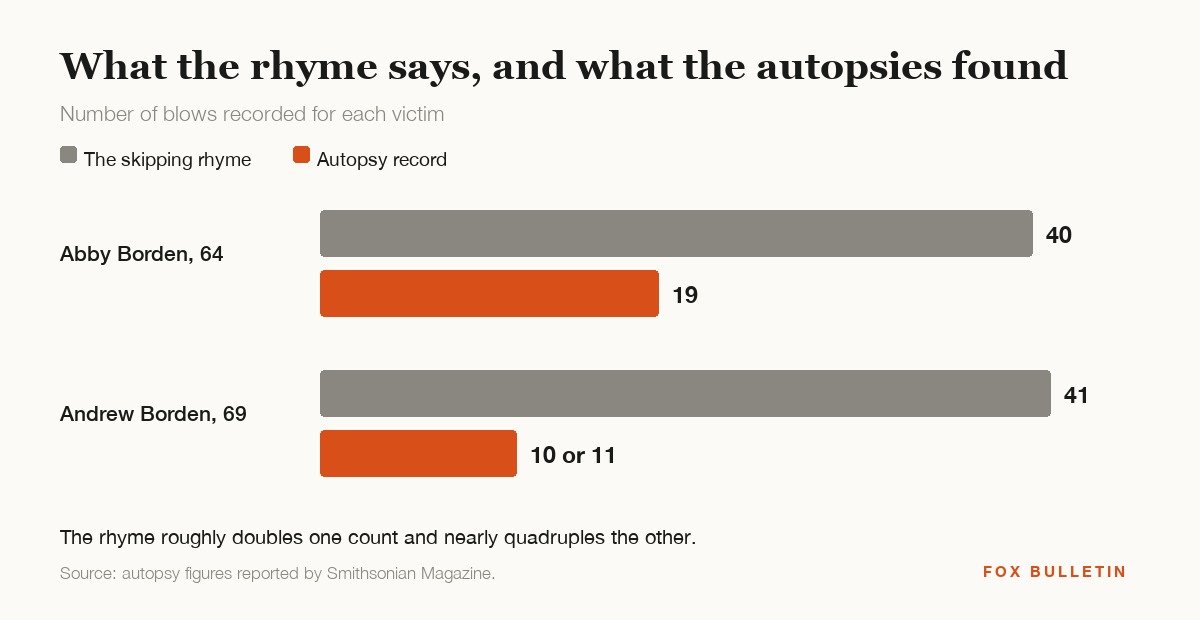
The skipping rhyme that outlived the trial gives Lizzie forty whacks for her stepmother and forty-one for her father. The autopsies did not. Smithsonian Magazine puts the count at 19 blows to Abby Borden, who was 64, and 10 or 11 to Andrew Borden, who was 69 and whose face was left unrecognizable.
The rhyme is also wrong about the relationship. Abby Borden was Lizzie stepmother, not her mother: Lizzie own mother, Sarah, died when she was a small child. Lizzie called Abby by her first name rather than mother, a detail the prosecution used to argue there was tension in the house over property. The Library of Congress notes the case inspired popular rhymes and cheap novels, and that Lizzie was acquitted by a jury but condemned by the rhyme, which is a fair summary of the last 130 years.
Why the Jury Acquitted Her
The trial opened in New Bedford on June 5, 1893 and ended on June 20. The prosecution case was circumstantial, and three things weakened it badly:
- No murder weapon was ever conclusively tied to the killings, though a hatchet head found in the cellar became the focus of the prosecution case.
- There was no blood on Lizzie or her clothing when police arrived, which the defense pressed hard given the nature of the wounds.
- Lizzie burned a dress in the kitchen stove days after the murders, which the prosecution treated as destruction of evidence and the defense explained as a paint-stained garment.
- Her inquest testimony was inconsistent on where she had been, but the trial judges ruled it inadmissible because she had effectively been in custody without counsel when she gave it.
- An attempt to buy prussic acid from a local druggist the day before the murders was also excluded from the jury.
The judges excluded the inquest testimony and the prussic acid evidence, which removed the two strands most likely to persuade a jury. What was left was opportunity without a weapon, a motive the defense called speculation, and a defendant whose respectable standing in Fall River worked in her favour. Her lead counsel, former Massachusetts governor George Robinson, had appointed one of the trial judges to the bench.
The jury took around ninety minutes. In the America of 1893 the idea that a Sunday school teacher from a prominent family had done this was, for many of the men in that room, simply harder to believe than the alternative that someone else had and had got away.
What Lizzie Borden Did Afterwards
The acquittal did not end the matter socially. She was free, wealthy and widely assumed to be guilty, and she spent the next 34 years in the town where it happened:
- She never left Fall River, which surprised people who expected an acquitted defendant to disappear.
- She and Emma bought a larger house in a better part of town within weeks of the verdict and named it Maplecroft.
- Emma moved out permanently in 1905 after a falling out, and the sisters did not reconcile.
- Lizzie began using the name Lizbeth, kept a small circle, and was reported to be a generous but socially isolated figure in the town.
- She died in 1927, nine days before Emma, and left much of her estate to an animal welfare charity.
That decision to stay is the detail that still puzzles people. Fall River did not forgive her, and she made no attempt to be forgiven anywhere else.
Where the Evidence Is Now
The case has an unusually complete archive for a 19th century crime. The Fall River Historical Society holds the central collection, which includes original trial exhibits, crime scene photographs, forensic material and the alleged murder weapon, alongside letters and manuscripts documented for provenance.
Two holdings matter most to anyone reading about the case. The Knowlton Papers come from the personal files of Hosea Morrill Knowlton, the district attorney who prosecuted her, and are the largest body of primary material on the case to surface. The Hip-Bath Collection was assembled by Andrew Jennings, who defended her, and contains physical and forensic evidence and trial exhibits from the other side of the courtroom. Having both sets of working papers survive is rare, and it is why the case can still be re-argued from documents rather than legend.
Why the Case Keeps Coming Back to Screen
Few American crimes have been dramatised as often. The case has carried operas, plays, films and television series, and each adaptation has to choose a theory, because the record does not supply one. That is the appeal for writers: the facts are fixed, documented and public, and the ending is a blank the audience fills in.
It is also why the story resurfaces every few years at the top of the streaming charts, in the same slot that other true crime occupies on the services compared in our guide to the best streaming services. If you are working through the genre, our list of the best Halloween movies covers the fictional end of it, and the most watched Netflix shows of all time shows how reliably true crime performs once it reaches a large platform.
The Theories That Persist
Four explanations have circulated for more than a century, and none has ever been proved. The first is that Lizzie did it, acting over money, over Abby, or over something inside the house that never reached the record. The second is that Bridget Sullivan did it, which the evidence does not support but which recurs because she was there. The third is that an intruder did it, which requires that person to have waited in the house for an hour between the two killings. The fourth, floated periodically, involves an illegitimate or estranged relative.
What keeps the case alive is not that one of these is obviously right. It is that the strongest evidence against the most obvious suspect was ruled inadmissible, so the jury decided a different case from the one history has been arguing about ever since. If you want to read the contemporary coverage rather than the folklore, the Library of Congress guide points to digitised newspapers from 1892 and 1893, when the trial was front-page news across the country.
Frequently Asked Questions
Did Lizzie Borden actually kill her parents?
A jury found her not guilty in June 1893, and no one else was ever charged. The evidence against her was circumstantial, and the two strongest items, her inquest testimony and an alleged attempt to buy poison, were both excluded from the trial. Historians remain divided.
How many times were the Bordens actually struck?
Far fewer than the rhyme claims. Smithsonian Magazine reports 19 blows to Abby Borden and 10 or 11 to Andrew Borden, against the forty and forty-one in the verse.
Was Abby Borden really Lizzie mother?
No. Abby was her stepmother. Lizzie biological mother, Sarah, died when Lizzie was very young, and Andrew Borden remarried a few years later. Lizzie addressed Abby by her first name.
What happened to Lizzie Borden after the trial?
She stayed in Fall River, bought a house she named Maplecroft with her sister Emma, began going by Lizbeth, and lived there until her death in 1927. Emma moved out in 1905 and the sisters never reconciled.
Related Articles

Get the Fox Bulletin briefing
The stories that matter, in your inbox. No spam, unsubscribe anytime.
Newsletter signup will be available soon.
Related stories

Amazon Prime Video Subscription: What It Costs and What You Get
An Amazon Prime Video subscription costs $8.99 standalone or $14.99 with full Prime, plus $4.99 for ad-free Ultra and 4K. Every plan, the discounted tiers and what the trial covers.

How Much Is Kindle Unlimited? Price, Trial and What You Get
Kindle Unlimited costs $11.99 a month plus tax with a 30 day free trial. What the fee covers, how it differs from Prime Reading, and how to tell whether it pays for itself.

Best Audiobook Apps: 7 Compared on Price and Catalog
Audible, Libro.fm, Spotify, Kobo Plus, Libby, hoopla and LibriVox compared on monthly price, catalog size and whether the audiobook stays yours after you cancel.