

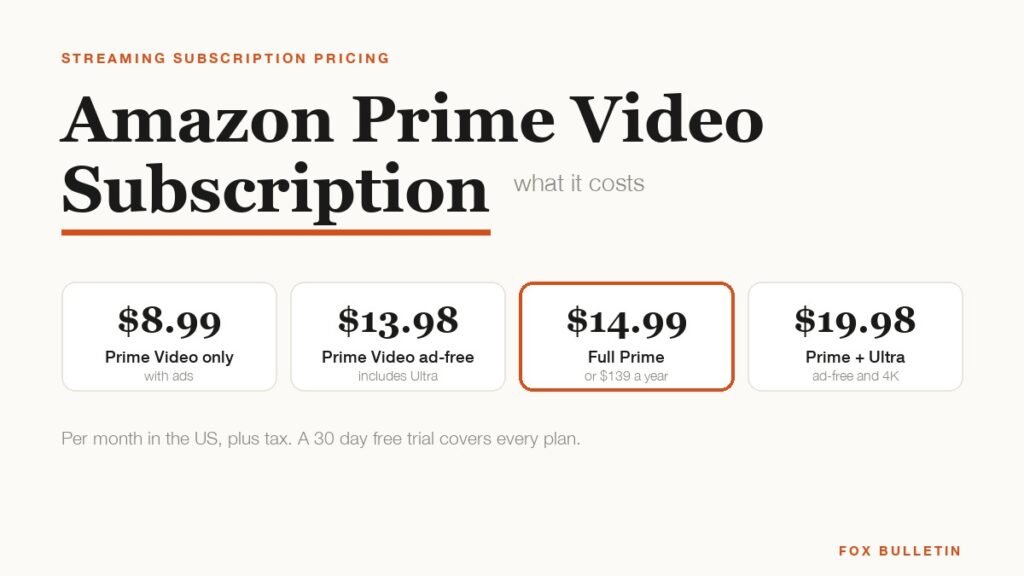
An Amazon Prime Video subscription can cost $8.99, $13.98, $14.99 or $19.98 a month depending on how you buy it, and the four prices buy noticeably different things. Two of them are not really Prime Video subscriptions at all, they are Prime memberships that happen to include video.
The structure changed in April 2026, when Amazon replaced the old ad-free upcharge with a tier called Prime Video Ultra and moved 4K streaming behind it. That reshuffle is the main reason the pricing confuses people now. Here is what each plan costs, what the ads tier actually withholds, and which of the four discounted Prime rates you might already qualify for. Every plan below opens with the same 30 day free trial, so the cheapest way to settle which one suits you is to test the catalog before paying for anything.
What an Amazon Prime Video Subscription Costs
Every figure below is a monthly US rate before tax, and every plan opens with a 30 day free trial.
| Plan | Monthly Cost | Ads | What Else You Get |
|---|---|---|---|
| Prime Video standalone | $8.99 | Yes | Video only, no Prime shipping |
| Prime Video plus Ultra | $13.98 | No | 4K, better audio, more streams |
| Full Prime membership | $14.99 | Yes | Shipping, Music, Reading, Photos |
| Prime plus Ultra | $19.98 | No | Everything, ad-free and in 4K |
Prime also sells annually at $139, which works out at about $11.58 a month and is the cheapest route to a full membership for anyone planning to keep it past four months. Whichever row you land on, the trial covers it, and signing up for Prime Video bills nothing for the first 30 days.
Standalone Prime Video or the Full Prime Membership
The gap between video-only at $8.99 and the whole membership at $14.99 is six dollars, which is the single most consequential decision in this pricing table. For six dollars the membership adds free shipping, Prime Music, Prime Reading, unlimited photo storage, Grubhub+ and the grocery delivery benefits.
- Take the standalone only if you genuinely never order from Amazon. It is a narrow case, and the service is otherwise identical.
- Take the full membership if you order even twice a month, because the shipping alone usually covers the difference.
- Take the annual plan if you are confident about keeping it, since $139 beats twelve monthly payments by about $41.
Worth knowing before you pick: the standalone plan is harder to find than the membership. Amazon does not advertise it prominently and the signup flow steers firmly toward full Prime, which is a reasonable thing to be aware of rather than a reason to avoid it.
Ads, Prime Video Ultra and Who Actually Gets 4K
Prime Video has carried advertising on its base tiers since 2024. In April 2026 the ad-free option was rebranded as Prime Video Ultra and raised from $2.99 to $4.99 a month, a 67 percent increase that also changed what the upgrade includes.
Ultra now bundles several things that used to come as standard, which is the part that catches people out. It is not purely an ad switch.
- Ad-free playback across the catalog, the original purpose of the upgrade.
- 4K and UHD streaming, now exclusive to Ultra rather than included at the base rate.
- Enhanced audio and video, covering the higher-bitrate and surround formats.
- Five concurrent streams and 100 downloads, up from the base allowances.
If you bought Prime Video for 4K on a large screen, this is the change that matters most, because the base tier no longer delivers it at any resolution above HD. On a phone or a laptop the difference is close to invisible and the $4.99 is hard to justify. On a large modern panel it is the whole reason to pay, and our TV buying guide covers which sets actually resolve the difference.
The Discounted Prime Tiers Most People Never Check
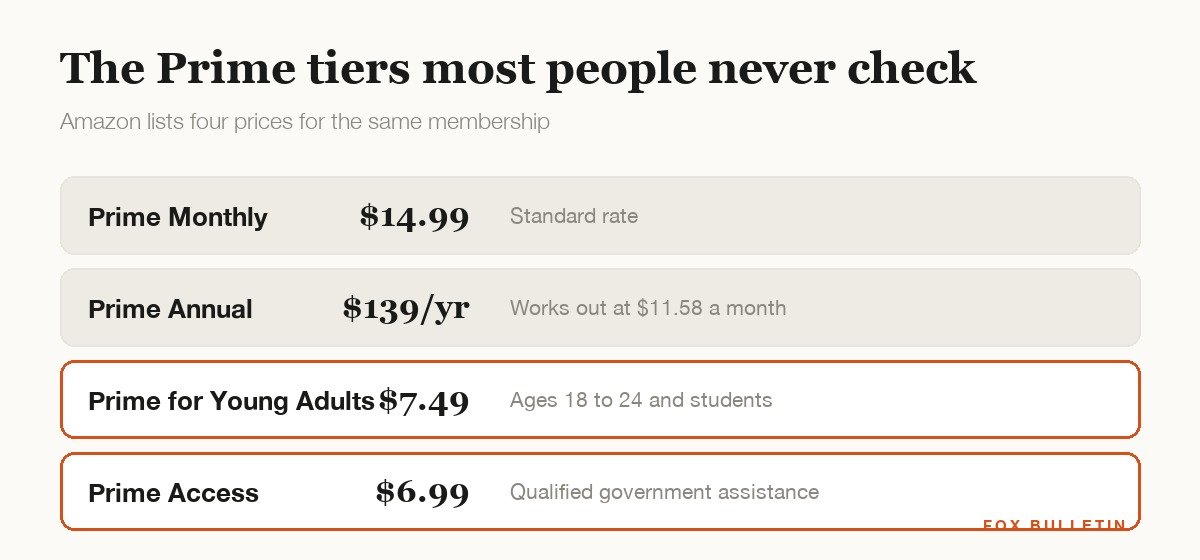
Amazon publishes four rates for an identical membership, and two of them cut the price by roughly half. They are listed plainly on the signup page and are still missed constantly.
- Prime Monthly, $14.99. The standard rate, and the one most subscribers pay by default.
- Prime Annual, $139. About $11.58 a month, the best rate available to anyone without a qualifying discount.
- Prime for Young Adults, $7.49. For ages 18 to 24 and for students, at half the monthly rate.
- Prime Access, $6.99. For holders of qualifying government assistance, the cheapest route of all.
Anyone aged 18 to 24, enrolled in study, or receiving qualifying assistance is paying double what they need to if they are on the standard plan. Both discounted tiers include the same Prime Video catalog as the full-price membership, with no reduction in what you can watch.
What the Subscription Covers Beyond Films and Series
Amazon describes the app as Prime Originals, live sports, rentals, add-on subscriptions and free Live TV, and that list is wider than most subscribers use. Three parts of it are easy to miss.
- Live sports are now a substantial part of the offering rather than a novelty, and they are included at no extra cost on the standard tiers.
- Free Live TV runs a set of ad-supported linear channels that need no subscription at all, which is worth knowing if you are deciding whether to keep paying.
- Rentals and purchases sit in the same interface and always cost extra. A title appearing in search is not necessarily a title your subscription covers.
That last point causes more complaints than any other part of the service. Prime Video deliberately blends included, rented and Channel-exclusive titles in one catalog, so the word to look for on a title page is Included rather than a price. Checking it before you commit to a plan is the difference between a catalog that serves you and one that quietly charges per film.
Prime Video Channels Are Separate Subscriptions
Channels is the part of the service most often mistaken for something included. It lets you add other services such as premium film networks and sports packages inside the Prime Video app, billed by Amazon on your existing account, and every one of them costs extra on top of whatever you already pay.
What the arrangement genuinely buys you is administrative rather than financial. Everything appears in one app with one search and one bill, and each Channel cancels independently with a couple of clicks rather than through its own provider. Most Channels open with their own free trial, which is worth using deliberately rather than stacking several at once and forgetting them.
The failure mode is predictable. Three Channels at roughly ten dollars each turn a $14.99 membership into a $45 monthly bill that looks like one Amazon charge on a statement. If you add them, write down the renewal dates, and see the FTC’s guidance on stopping automatic payments if one proves awkward to stop.
Getting Something Out of the 30 Day Trial
Every plan here opens with a 30 day free trial, which is unusually generous next to the seven day trials common elsewhere. It is long enough to answer the only question that matters, which is whether the catalog holds things you will actually watch.
- Search for five specific titles you intend to watch in the first week, not in general. A catalog that does not hold them is not worth any price.
- Check whether those titles are included or rented. Prime Video mixes both, and a title showing in search may still cost extra.
- Set a reminder for day 28. The trial converts silently to a paid month otherwise.
- Decide on Ultra separately and late. Watch the base tier with ads first, because plenty of people find the ad load tolerable and save $4.99 a month.
If you are weighing it against the competition rather than in isolation, our comparison of the major streaming services puts the catalogs side by side, and the highest grossing films of all time is a reasonable shortlist to test any service against.
Frequently Asked Questions
How much is an Amazon Prime Video subscription per month?
Prime Video on its own costs $8.99 a month with ads. A full Amazon Prime membership, which includes Prime Video along with shipping and the other benefits, costs $14.99 a month or $139 a year. Removing ads adds $4.99 either way.
Can you get Prime Video without an Amazon Prime membership?
Yes. The standalone Prime Video plan is $8.99 a month and carries the same catalog without Prime shipping or the other membership benefits. It is a real option, just one Amazon promotes far less visibly than full Prime.
Does Prime Video include 4K?
Not any more on the base tiers. Since April 2026, 4K and UHD streaming sit behind the Prime Video Ultra upgrade at $4.99 a month, alongside ad-free playback and the higher audio formats. The standard $8.99 and $14.99 plans top out below 4K.
Is the Prime Video free trial really 30 days?
Yes, and it applies to the full Prime membership as well as to Prime Video alone. It converts to a paid month automatically when it ends, so set a reminder a couple of days before if you are only testing the catalog.
Related Articles
- Best Horror Movies: The 24 Preserved by the Library of Congress
- Best Halloween Movies: 15 Family Picks
- Best VPN Services for Streaming: Top 10 Ranked
- Best Movies on Netflix by Weeks Survived
- What Is Amazon Haul? Prices, Shipping and the Catch
- How to Cancel Amazon Prime and When You Get a Refund
- Amazon Prime Benefits: Everything Included for $14.99 a Month

Get the Fox Bulletin briefing
The stories that matter, in your inbox. No spam, unsubscribe anytime.
Newsletter signup will be available soon.
Related stories
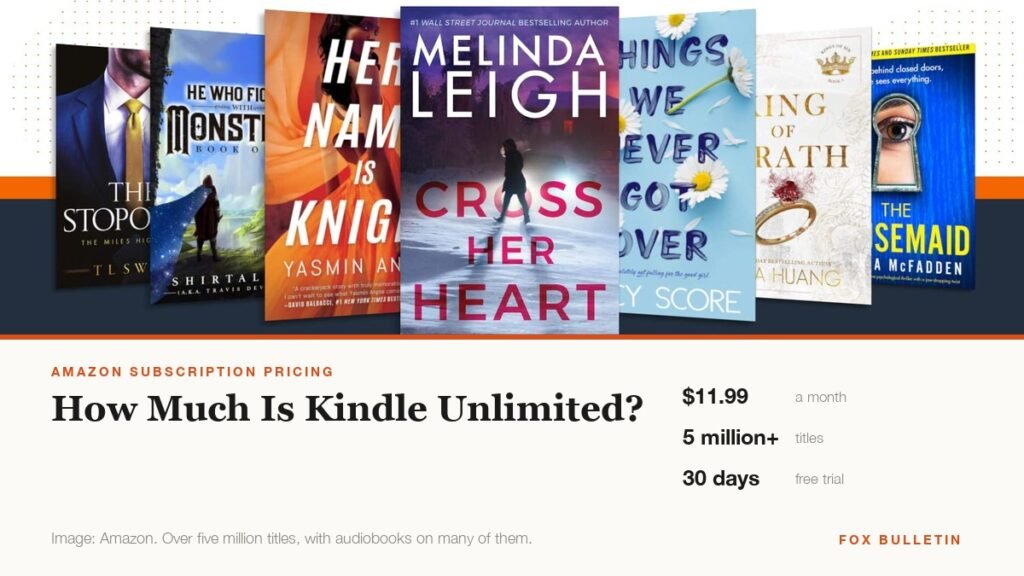
How Much Is Kindle Unlimited? Price, Trial and What You Get
Kindle Unlimited costs $11.99 a month plus tax with a 30 day free trial. What the fee covers, how it differs from Prime Reading, and how to tell whether it pays for itself.
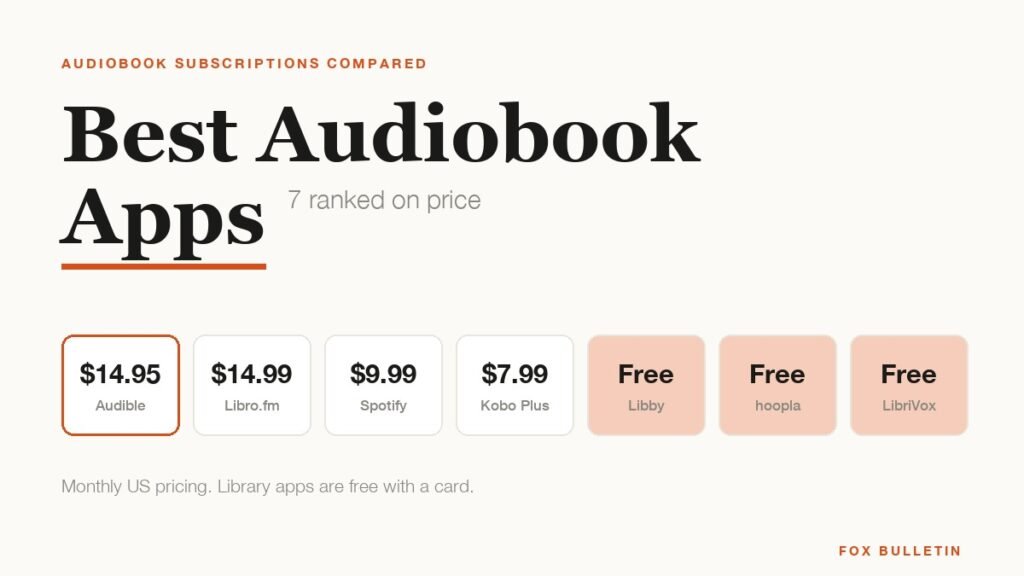
Best Audiobook Apps: 7 Compared on Price and Catalog
Audible, Libro.fm, Spotify, Kobo Plus, Libby, hoopla and LibriVox compared on monthly price, catalog size and whether the audiobook stays yours after you cancel.
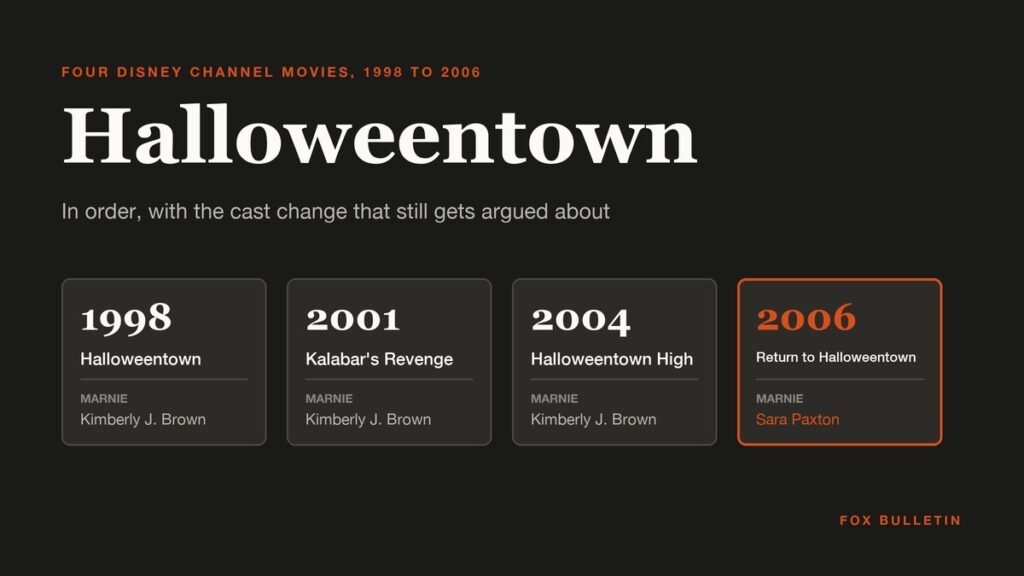
Halloweentown: All Four Movies, the Cast and the Recast
Four Disney Channel movies between 1998 and 2006, one family of witches, and a lead actress swapped out for the finale. Here is the order, the cast and what each film actually did in the ratings.