

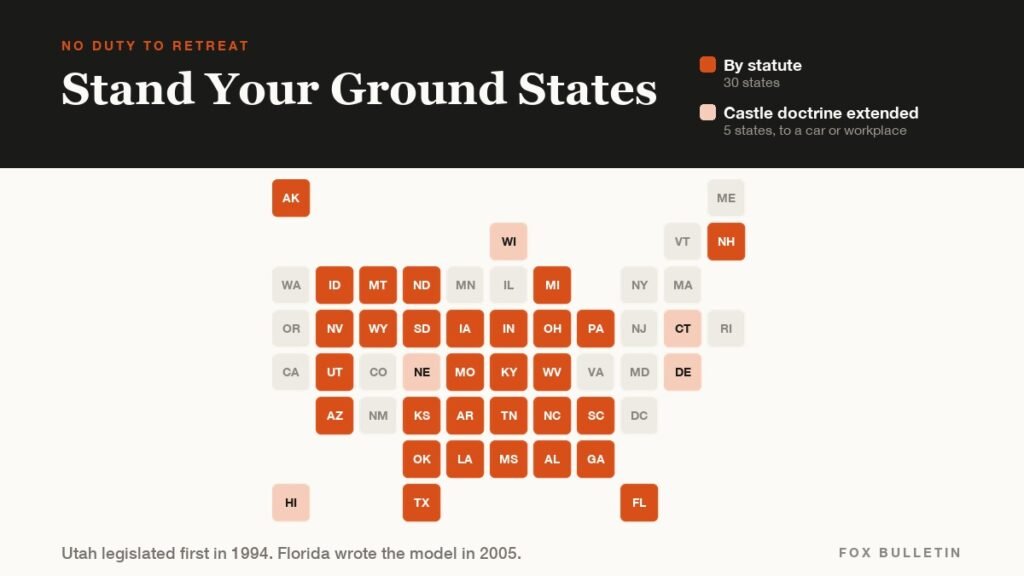
Thirty states have a stand your ground statute, which removes the duty to retreat before using force in self-defense anywhere a person is lawfully present. Five more extend castle doctrine beyond the home to a vehicle or a workplace without going the whole way, which is why counts of stand your ground states vary between about 28 and 38 depending on who is counting and what they include.
Utah passed the first such law in 1994, and Florida made it a national movement in 2005. Here is every state with a stand your ground statute and the code section that contains it:
| State | Statute |
|---|---|
| Alabama | Ala. Code 13A-3-23(b) |
| Alaska | Alaska Stat. 11.81.335 |
| Arizona | Ariz. Rev. Stat. 13-411 |
| Arkansas | Ark. Code 5-2-607 |
| Florida | Fla. Stat. 776.013 |
| Georgia | Ga. Code 16-3-23.1 |
| Idaho | Idaho Code 19-202A(3) |
| Indiana | Ind. Code 35-41-3-2(c)(2) |
| Iowa | Iowa Code 704.1 |
| Kansas | Kan. Stat. 21-5222 |
| Kentucky | Ky. Rev. Stat. 503.050(4), 503.055(3) |
| Louisiana | La. Stat. 14:20(C) |
| Michigan | Mich. Comp. Laws 780.972(2) |
| Mississippi | Miss. Code 97-3-15(4) |
| Missouri | Mo. Stat. 563.031 |
| Montana | Mont. Code 45-3-110 |
| Nevada | Nev. Rev. Stat. 200.120(2) |
| New Hampshire | N.H. Rev. Stat. 627:4(III) |
| North Carolina | N.C. Gen. Stat. 14-51.3 |
| North Dakota | N.D. Cent. Code 12.1-05-07(2)(b)(2) |
| Ohio | Ohio Rev. Code 2901.05 |
| Oklahoma | Okla. Stat. tit. 21, 1289.25(D) |
| Pennsylvania | 18 Pa. Cons. Stat. 505(b)(2.3) |
| South Carolina | S.C. Code 16-11-440(C) |
| South Dakota | S.D. Laws 22-18-4 |
| Tennessee | Tenn. Code 39-11-611(b) |
| Texas | Tex. Penal Code 9.32(c) |
| Utah | Utah Code 76-2-402(3) |
| West Virginia | W. Va. Code 55-7-22 |
| Wyoming | Wyo. Stat. 6-2-602(e) |
What the Stand Your Ground States Changed
Self-defense has always been a defense to a criminal charge. What differs between states is whether you had to try to get away first. Four positions exist, and the labels are often used loosely:
| Rule | What it means |
|---|---|
| Duty to retreat | The traditional rule. Before using force in self-defense, you must retreat if you can do so safely. It still governs in the states that have not legislated otherwise. |
| Castle doctrine | An exception for the home. Inside your own dwelling you have no duty to retreat before using reasonable force, including deadly force where the other requirements of the state self-defense law are met. |
| Castle doctrine extended | The same exception stretched to a vehicle or a workplace, without going further. |
| Stand your ground | The exception applied anywhere you are lawfully present. There is no duty to retreat before using force in self-defense outside the home. |
Cornell Law School describes castle doctrine as an exception to the duty to retreat that applies in a person dwelling, so long as the other requirements of that jurisdiction self-defense statute are met. A stand your ground law takes the same exception and detaches it from the building.
Florida Wrote the Model Other States Copied
Utah legislated first, in 1994, but Florida produced the text that spread. Section 776.013 of the Florida Statutes provides that a person who is in a dwelling or residence where they have a right to be has no duty to retreat and has the right to stand their ground, using non-deadly force where they reasonably believe it necessary to defend against imminent unlawful force, or deadly force where they reasonably believe it necessary to prevent imminent death or great bodily harm or the imminent commission of a forcible felony.
The 2005 Florida law became the basis for a model bill adopted by the American Legislative Exchange Council, and in the following two decades another 28 states enacted similar statutes. That is why the wording is so consistent from state to state: most of these laws descend from the same draft, with local variation in the aggressor exception, the presumptions that apply inside a home or vehicle, and whether there is a pretrial immunity hearing.
Five States Extend the Castle to a Car or a Workplace
Connecticut, Delaware, Hawaii, Nebraska and Wisconsin sit between the two positions. Each removes the duty to retreat in places beyond the home, typically a vehicle or a place of work, without extending it to anywhere a person may lawfully be:
| State | Statute |
|---|---|
| Connecticut | Conn. Gen. Stat. 53a-20 |
| Delaware | 11 Del. Code 464 and 465 |
| Hawaii | Haw. Rev. Stat. 703-304(5)(b)(i) |
| Nebraska | Neb. Rev. Stat. 28-1409(4)(b) |
| Wisconsin | Wis. Stat. 939.48 |
Counting these five alongside the thirty is what produces the figure of 35 states, which is how the RAND Corporation tallies it as of January 1, 2025. Advocacy groups on both sides use narrower or broader definitions and arrive at different totals, which is the main reason published counts disagree.
Eight More States Have It Through Case Law
Statutes are not the only route. Courts in several states reached the same position long before legislatures took up the question, and those rulings still govern. RAND cites the Giffords Law Center for the count of eight states without a stand your ground statute whose case law effectively establishes the same policy, a group that includes California.
That matters for anyone reading a map of this subject. A state shaded as having no stand your ground law may still impose no duty to retreat in practice, because its appellate courts decided the point decades ago. It also complicates the research: studies that sort states by statute alone can end up with practically similar states on both sides of the comparison.
What the Research Finds
RAND systematically reviewed the published evidence on these laws and rated the strength of findings by outcome. Its summary, at the level of the underlying studies:
- Homicides: fifteen studies examined the relationship. The six higher-quality studies found effects consistent with stand your ground laws increasing homicides, two of them statistically significant.
- Firearm homicides: of sixteen studies, seven of the eight higher-quality ones found the laws associated with higher firearm homicide rates, with two significant overall and one significant in urban areas.
- Other violent crime: eight studies on nonfatal violence generally pointed toward increases, though only one without serious methodological weaknesses found significant results.
- Defensive gun use, suicide, mass shootings and police shootings: the evidence was rated inconclusive in each case, partly because the data on defensive gun use is weak.
RAND classifies the evidence that stand your ground laws increase total and firearm homicides as supportive, its second highest rating, and the evidence on every other outcome it examined as inconclusive. The full review sets out the inclusion criteria and the individual studies. The policy argument on the other side is about deterrence and about the position of a person who has to judge, in seconds, whether a safe retreat exists.
What a Stand Your Ground Law Does Not Do
These statutes are narrower than the public debate implies. Five limits apply in nearly all of them:
- It is not a licence to start a fight. The statutes exclude the initial aggressor, and several exclude someone who entered combat by agreement unless they have clearly withdrawn.
- It does not remove the other elements of self-defense. A reasonable belief that force was necessary to prevent death, serious bodily harm or a forcible felony still has to be established.
- It does not apply where you are not lawfully present. Being somewhere unlawfully takes the protection away in most of these statutes.
- It is not the same as immunity from arrest. Some states, including Florida, provide a pretrial immunity hearing; others treat it purely as a defense at trial. The procedure differs more than the substance does.
- It does not change federal law or location bans, which is a separate question from how carry itself is regulated.
Whether a person may be armed in the first place is a different question, governed by a separate body of state law. Our guide to constitutional carry states covers where a permit is required to carry at all, and the same state-by-state pattern shows up across unrelated areas of law, from recording consent to no-fault car insurance.
Frequently Asked Questions
How many stand your ground states are there?
Thirty states have a stand your ground statute. Counting the five that extend castle doctrine to a vehicle or workplace brings the total to 35, which is how RAND counts it as of January 1, 2025, and a further eight states reach a similar position through case law rather than legislation.
What is the difference between castle doctrine and stand your ground?
Castle doctrine removes the duty to retreat inside your own home. A stand your ground law removes it anywhere you are lawfully present. Every stand your ground state has castle doctrine; the reverse is not true.
Which state passed the first stand your ground law?
Utah, in 1994. Florida followed in 2005 with a law that became the basis for a model bill, and 28 more states enacted similar statutes over the next two decades.
Does stand your ground protect someone who started the fight?
No. The statutes exclude the initial aggressor, and several also exclude a person who entered into combat by agreement unless they have withdrawn or clearly communicated an intention to withdraw.
A Note on Legal Advice
This article is general information rather than legal advice. Self-defense law turns on the facts of an individual encounter, on the exact wording of a state statute and on how that state courts have read it, including who carries the burden of proof and whether a pretrial immunity hearing is available.
Anyone facing a question about the lawful use of force should consult an attorney licensed in the state where the events occurred.
Related Articles

Get the Fox Bulletin briefing
The stories that matter, in your inbox. No spam, unsubscribe anytime.
Newsletter signup will be available soon.
Related stories
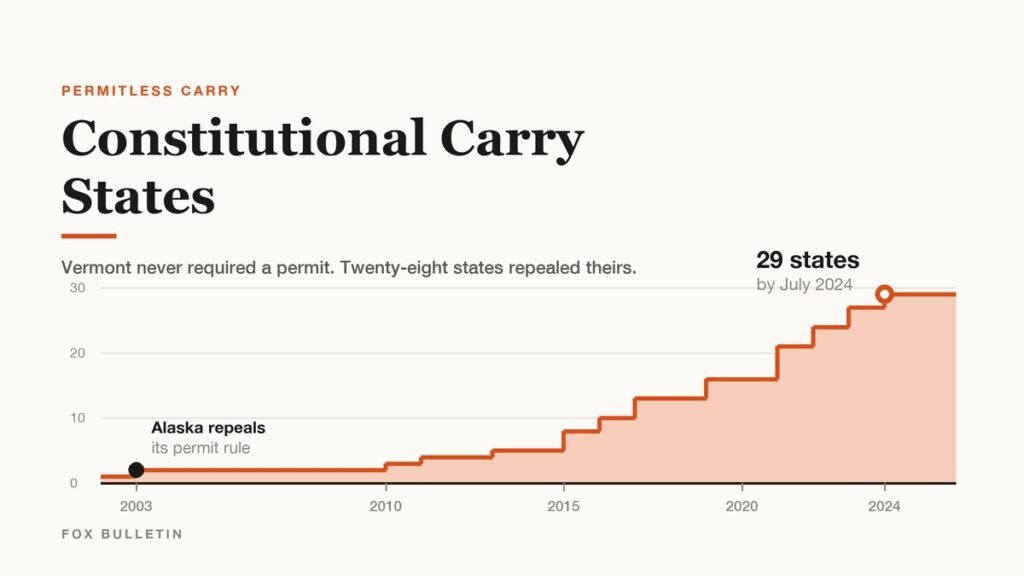
Constitutional Carry States: All 29 and the Limits
Twenty-nine states let a qualifying adult carry a concealed handgun without a permit. Here is when each law took effect, what it does not change, and why permits still matter.
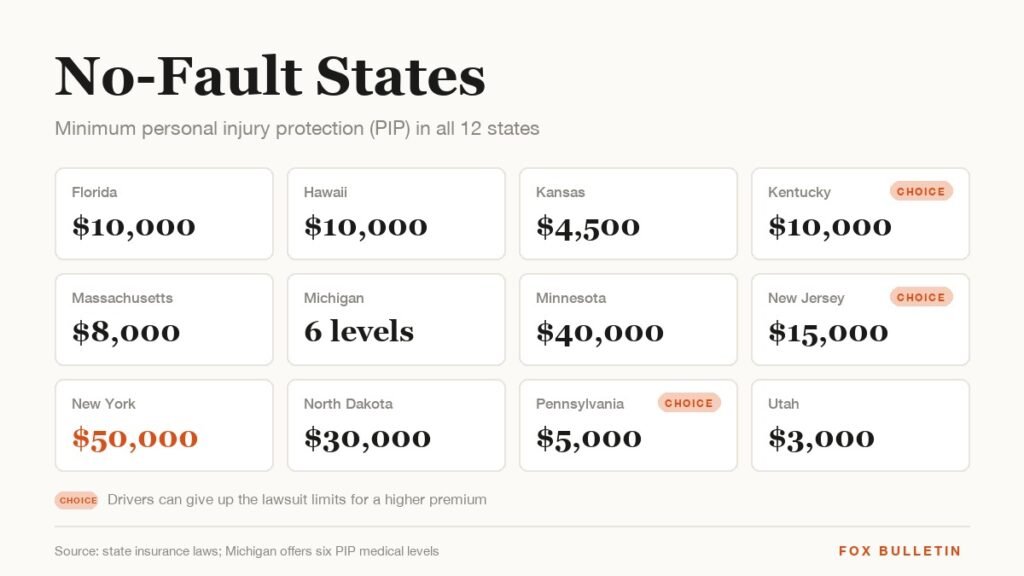
No-Fault States: All 12, With PIP Minimums and Lawsuit Rules
Florida, Hawaii, Kansas, Kentucky, Massachusetts, Michigan, Minnesota, New Jersey, New York, North Dakota, Pennsylvania and Utah use no-fault car insurance. What each requires and when you can still sue.
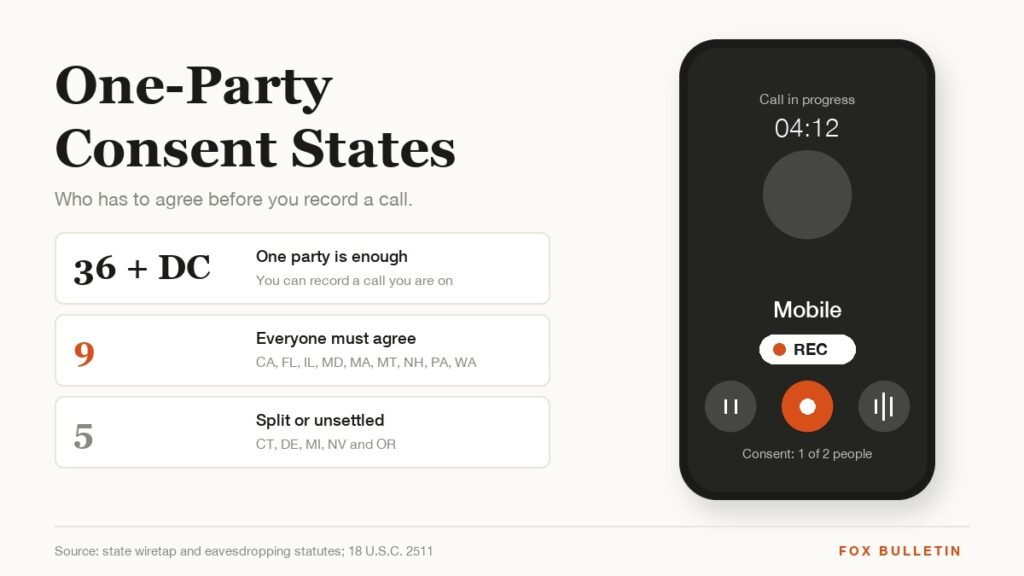
One-Party Consent States: Recording Laws in All 50 States
Thirty-six states and DC let you record a conversation you are part of. Nine require everyone's consent, three split the rule between calls and in-person talks, and two are unsettled.