

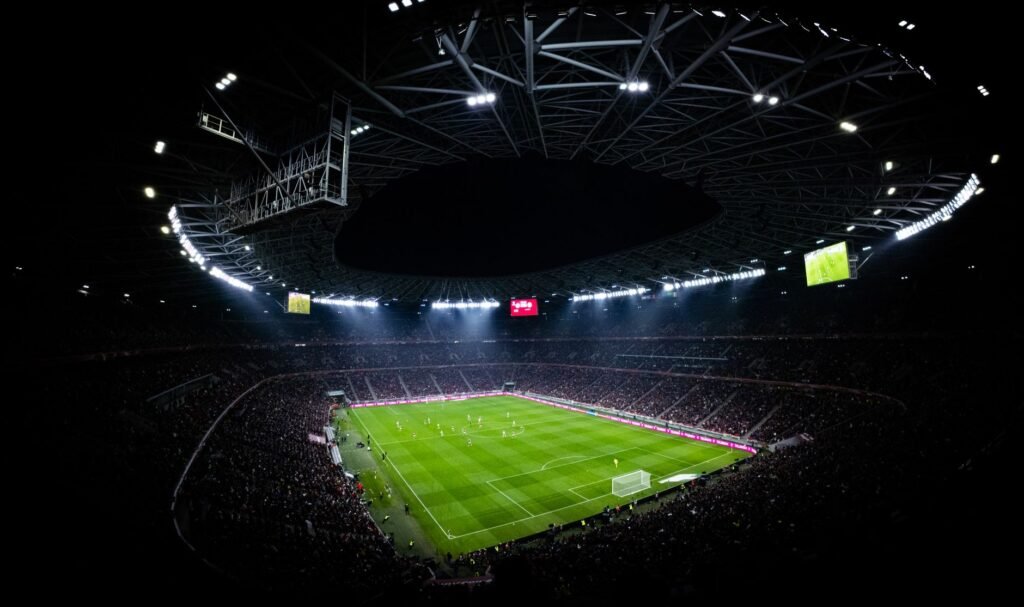
The largest stadiums on earth are not where most people would guess. Neither the NFL nor European soccer owns this list, and only two of the ten biggest venues sit outside the United States.
Instead, American college football dominates, filling eight of the top ten with campus stadiums that hold more than 100,000 people. Below we rank the ten largest stadiums in the world by seating capacity, with each venue’s location, primary sport, and what makes it remarkable.
| Rank | Stadium | Capacity | Location | Primary Sport |
|---|---|---|---|---|
| 1 | Narendra Modi Stadium | 132,000 | Ahmedabad, India | Cricket |
| 2 | Rungrado 1st of May Stadium | 113,281 | Pyongyang, North Korea | Football and athletics |
| 3 | Michigan Stadium | 107,601 | Ann Arbor, USA | College football |
| 4 | Beaver Stadium | 106,572 | University Park, USA | College football |
| 5 | Ohio Stadium | 102,780 | Columbus, USA | College football |
| 6 | Kyle Field | 102,733 | College Station, USA | College football |
| 7 | Tiger Stadium | 102,321 | Baton Rouge, USA | College football |
| 8 | Neyland Stadium | 101,915 | Knoxville, USA | College football |
| 9 | Darrell K Royal-Texas Memorial Stadium | 100,119 | Austin, USA | College football |
| 10 | Bryant-Denny Stadium | 100,077 | Tuscaloosa, USA | College football |
The 10 Largest Stadiums in the World, Ranked
1. Narendra Modi Stadium: The World’s Biggest
Capacity: 132,000 | Location: Ahmedabad, India | Sport: Cricket
Narendra Modi Stadium in Ahmedabad is the largest stadium on the planet, seating 132,000 people, roughly 18,000 more than the next venue on this list. Rebuilt and reopened in 2020 on the site of the former Motera Stadium, it was purpose-built for cricket at enormous scale.
Its size makes sense given cricket’s popularity in India, where a single international match can command a national television audience in the hundreds of millions. The venue has hosted World Cup finals and remains the clearest symbol of the sport’s commercial power.
2. Rungrado 1st of May Stadium: The State Spectacle
Capacity: 113,281 | Location: Pyongyang, North Korea | Sport: Football and athletics
The Rungrado 1st of May Stadium in Pyongyang holds 113,281 and is the largest stadium outside of cricket and American football. Opened in 1989, its distinctive roof is designed to resemble a magnolia blossom.
It was built less for regular sporting competition than for mass gymnastics displays and state ceremonies involving tens of thousands of participants. That unusual purpose explains why a country of North Korea’s size maintains a venue this large.
3. Michigan Stadium: The Big House
Capacity: 107,601 | Location: Ann Arbor, USA | Sport: College football
Michigan Stadium, universally known as The Big House, is the largest stadium in the United States and the Western Hemisphere at 107,601 seats. It has recorded attendance figures above 115,000 for marquee games, exceeding its official capacity.
Opened in 1927, it was deliberately designed with foundations that allowed future expansion, which is why it has grown steadily for nearly a century. On seven or eight Saturdays each autumn it becomes one of the most populous places in Michigan.
4. Beaver Stadium: College Football’s Loudest Night
Capacity: 106,572 | Location: University Park, USA | Sport: College football
Beaver Stadium at Penn State seats 106,572, making it the second-largest venue in the United States. Its reputation rests on atmosphere as much as size, particularly the White Out games when the entire crowd wears white.
The stadium has been expanded repeatedly since 1960, including a relocation and reconstruction of the original structure. It is routinely ranked among the most intimidating environments in American sport.
5. Ohio Stadium: The Horseshoe
Capacity: 102,780 | Location: Columbus, USA | Sport: College football
Ohio Stadium, nicknamed The Horseshoe for its distinctive shape, holds 102,780 spectators at Ohio State University. Opened in 1922, it is a registered National Historic Landmark, a rare designation for a working sports venue.
Beyond football it is famous for Script Ohio, the marching band formation performed before games. Its combination of architectural significance and scale makes it one of the most recognizable stadiums in the country.
6. Kyle Field: The Home of the 12th Man
Capacity: 102,733 | Location: College Station, USA | Sport: College football
Kyle Field at Texas A&M seats 102,733 following a major reconstruction completed in 2015. The tradition of the 12th Man, in which the student body stands for the entire game, defines the experience here.
That standing tradition means the noise generated is disproportionate even for a venue this large. It is the largest stadium in the Southeastern Conference and among the loudest anywhere.
7. Tiger Stadium: Death Valley
Capacity: 102,321 | Location: Baton Rouge, USA | Sport: College football
LSU’s Tiger Stadium holds 102,321 and carries the nickname Death Valley for the difficulty visiting teams face there. Its night games are considered among the most hostile environments in American sport.
Local legend holds that crowd noise once registered on a campus seismograph during a dramatic 1988 finish. Whether or not the reading was truly caused by the crowd, the story captures the venue’s reputation.
8. Neyland Stadium: Football on the River
Capacity: 101,915 | Location: Knoxville, USA | Sport: College football
Neyland Stadium at the University of Tennessee seats 101,915 and sits directly on the Tennessee River. Its most distinctive tradition is the Vol Navy, a fleet of boats that ties up along the riverbank so fans can tailgate on the water.
Opened in 1921, it is one of the oldest venues on this list and a defining feature of its city. Knoxville’s mix of affordability and outdoor character also earns it a place in our guide to the best places to live in Tennessee.
9. Darrell K Royal-Texas Memorial Stadium: The Austin Giant
Capacity: 100,119 | Location: Austin, USA | Sport: College football
The University of Texas plays in Darrell K Royal-Texas Memorial Stadium, which holds 100,119 people in the middle of Austin. Continual expansion has pushed it past the six-figure mark, reflecting the program’s enormous revenue.
Its position inside a fast-growing state capital makes game days a significant civic event rather than just a campus one. Austin’s broader appeal is covered in our guide to the best places to live in Texas.
10. Bryant-Denny Stadium: Alabama’s Fortress
Capacity: 100,077 | Location: Tuscaloosa, USA | Sport: College football
Bryant-Denny Stadium in Tuscaloosa completes the top ten at 100,077 seats, named partly for legendary coach Paul Bear Bryant. It is the home of the most decorated program in modern college football history.
Sustained success has driven repeated expansions, since demand consistently outstrips supply. For a city of roughly 100,000 residents, the stadium effectively doubles the local population on game days.
Why American College Football Dominates This List
Eight of the ten largest stadiums host college football, which surprises almost everyone outside the United States. The explanation is structural: American universities built enormous venues to serve alumni bases, student bodies, and entire state populations, and they had the land and public support to keep expanding.
Unlike professional teams, universities are not competing for a metro market with rival franchises, so a single campus can absorb demand from a whole state. Several of these programs also generate revenue comparable to professional clubs, which funds continual expansion, a dynamic we explore in our guide to the most valuable sports teams.
Why Modern Professional Stadiums Are Smaller
New professional venues are deliberately built smaller, typically seating 60,000 to 80,000. The reason is economics: premium seating, suites, and hospitality generate far more revenue per person than filling the upper deck with cheap tickets.
Television revenue also reduced the incentive to maximize physical attendance, since broadcast audiences dwarf any crowd. The result is that the age of the 100,000-seat professional stadium has largely passed, leaving college programs and cricket to hold the records.
How We Ranked the Largest Stadiums
This ranking uses official listed seating capacity, the standard basis for comparison. Actual attendance can exceed capacity where standing room is permitted, which is why Michigan Stadium has recorded crowds above 115,000 despite its 107,601 listing.
Capacities change as venues are renovated or expanded, so treat these as current figures rather than permanent ones. Facilities under construction and racing venues with vast uncovered spectator areas are excluded, since their capacities are not directly comparable.
What These Stadiums Say About Their Sports
Stadium size is a rough map of where a sport commands mass devotion. Cricket tops the list because of India’s population and passion, while college football occupies most of the remaining spots because of a uniquely American tradition of campus-centered sport.
Association football, the world’s most popular game by participation, holds no top-ten spot, since its biggest clubs prioritize revenue-dense stadiums over sheer volume. Capacity measures cultural intensity in one place, not global popularity.
Frequently Asked Questions
What is the largest stadium in the world?
Narendra Modi Stadium in Ahmedabad, India, is the largest at 132,000 seats. Built for cricket and reopened in 2020, it holds roughly 18,000 more people than the next-biggest venue.
What is the largest stadium in the United States?
Michigan Stadium in Ann Arbor, known as The Big House, is the largest in the US and the Western Hemisphere at 107,601 seats, with recorded attendance above 115,000 for major games.
Why are college football stadiums so big?
American universities built large venues to serve alumni, students, and statewide fan bases, with land and public backing to expand. Without competing local franchises, one campus can absorb an entire state’s demand.
Why do NFL stadiums hold fewer people?
Modern professional venues typically seat 60,000 to 80,000 because premium seating and hospitality generate more revenue per seat than large cheap sections, and television income reduces the value of maximizing attendance.
Are any soccer stadiums in the top ten?
No. The largest soccer-first venues, such as Camp Nou in Barcelona at roughly 99,354, fall just outside the top ten, as leading clubs prioritize revenue-dense designs over maximum capacity.
Related Articles
- Most Valuable Sports Teams in the World: Top 10 for 2026
- Highest-Paid Athletes in the World in 2026: Top 10
- Best Places to Live in Tennessee: Top 8 Cities for 2026
- Most Super Bowl Wins: Top 10 NFL Teams Ranked
- Most Olympic Medals by Country: Top 10 Ranked
- Most FIFA World Cup Wins by Country: All 8 Winners Ranked
- Tallest Buildings in the World: Top 10 Ranked by Height
- Most NBA Championships: All 12 Multiple Winners Ranked

Get the Fox Bulletin briefing
The stories that matter, in your inbox. No spam, unsubscribe anytime.
Newsletter signup will be available soon.
Related stories
Most Goals in Football History: Top 10 Ranked
Most Goals in Football History: Top 10 Ranked showcases Cristiano Ronaldo’s 973‑goal lead, Lionel Messi’s 913‑goal tally and the full list, using data compiled up to 2026. Key Takeaways Ronaldo sits a
Most Premier League Titles by Club: Top 10 Ranked
For background, see our guide to most Ballon d’Or Wins: All 10 Multiple Winners Ranked. Most Premier League Titles by Club: Top 10 Ranked – Manchester United leads with 13 titles, the most in th
Most Ballon d’Or Wins: All 10 Multiple Winners Ranked
Lionel Messi has won the Ballon d’Or eight times, three more than Cristiano Ronaldo and five more than anyone else in the award’s history. No other player has won it more than…