

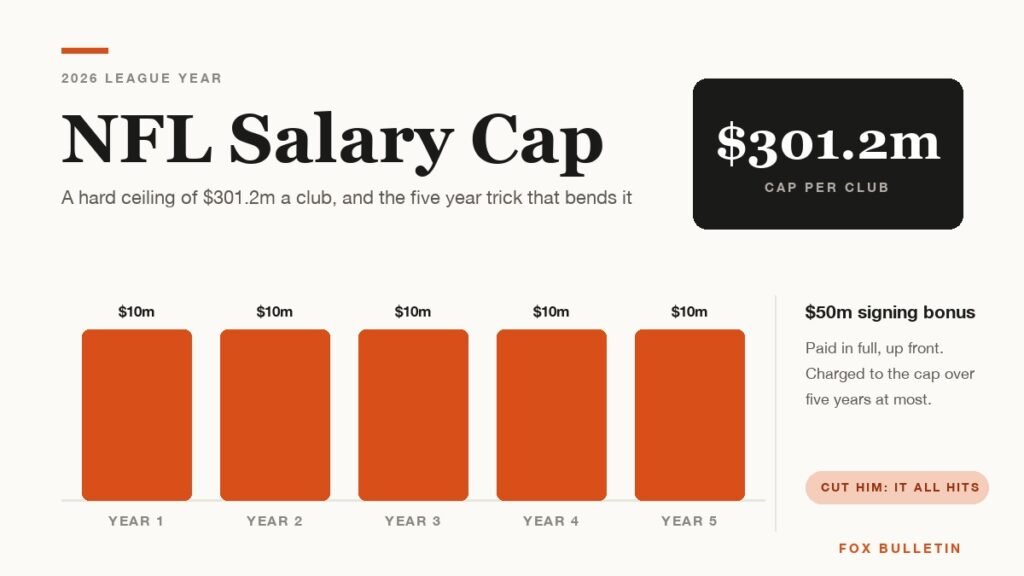
The NFL salary cap is a hard ceiling, which makes it unusual in American sport: there is no luxury tax to pay and no way to buy an exemption. For 2026 the figure is $301.2 million per club, the first time it has cleared $300 million.
What trips people up is that the cap does not count money paid, it counts money charged. A team can hand a player $60 million in cash in March and absorb only $12 million of it this year. That single piece of accounting explains signing bonuses, dead money, void years and most of the moves that look financially impossible in free agency.
| 2026 league figures | Per club |
|---|---|
| Salary cap | $301.2 million |
| Increase on 2025 | $22 million, up from $279.2 million |
| Player benefits | $77.6 million |
| Total player cost | $378.8 million |
| Maximum signing bonus proration | 5 years |
| Minimum cash spend | 89 percent of the cap over four years |
How the NFL Salary Cap Number Is Set Each Year
The cap is not a figure the league picks. It is a share of revenue, fixed by the collective bargaining agreement and then divided 32 ways. The players association sets out the arithmetic plainly: estimate all revenue for the coming season, take roughly 48 percent of it, subtract estimated player benefits, and divide by 32 teams.
Revenue here means close to everything the business earns. National television deals, ticket sales, concessions, league sponsorships, local media and gambling money all feed the pool, and the players are guaranteed a minimum of 48 percent of it every year.
Benefits come off the top before the division, which is why the cap and the actual cost of a roster are different numbers. The league told clubs their 2026 figure alongside $77.6 million in benefits, putting real player spending at $378.8 million per team. Benefits are not optional and do not count against the cap, so a team genuinely has $301.2 million to allocate and a much larger bill to pay.
Signing Bonus Proration: Spreading Cash Over Five Years
A signing bonus is paid up front in cash and charged to the cap evenly across the life of the contract, to a maximum of five years. That cap limit, not the contract length, is the number that matters:
- A $50 million bonus on a four year deal charges $12.5 million a year for four years.
- The same bonus on a seven year deal still only spreads across five, so the charge is $10 million a year and years six and seven carry none of it.
- Base salary is charged in the year it is earned, which is why teams convert base salary into bonus when they need room: the cash to the player is identical, the current year charge is not.
This is the mechanism behind every “restructure” headline. Converting $20 million of salary into a bonus on a deal with four years left moves $15 million off this season and pushes it onto the next three. Nothing is saved. The bill is deferred, and the team is betting the cap keeps rising fast enough to absorb it. Given the $22 million jump into 2026, that bet has been paying.
Dead Money: Paying for Players Who Already Left
Release or trade a player and the proration that has not yet been charged does not disappear. It accelerates onto the current year all at once. That charge is dead money: cap space spent on somebody who is no longer on the roster, and occasionally on somebody now playing for a rival.
A player cut two years into a four year deal with $40 million of bonus still carries two years of unused proration, and both land immediately. It is the main reason teams keep players who are clearly finished: cutting them costs more against the cap than keeping them.
Void Years and the June 1 Designation
Two devices exist to move that pain around, and both are widely used:
- Void years. Fake seasons added to the end of a contract purely to create more years to prorate a bonus across. When the deal voids, the remaining proration becomes dead money in the following season unless the player signs a new contract first.
- The June 1 release. A player released after June 1 has his dead money split across two seasons rather than crashing into one. Teams may also designate up to two players before June 1 for that same treatment, which lets those players reach free agency early while the team still gets the split.
Void years are the more aggressive tool because they create a charge for a season in which the player is guaranteed not to be on the roster. A team using them heavily is trading future flexibility for a window now, which is a defensible plan for a roster that is one piece away and a dangerous one for a roster that is not.
Franchise Tags, Transition Tags and What They Cost
A tag keeps one expiring contract from reaching the market. The league sets out three versions, and the differences are about money and compensation rather than intent:
- Non-exclusive franchise tag. Worth the greater of the cap percentage average for the position or 120 percent of the player’s prior year salary. He may negotiate elsewhere; his team has five days to match an offer sheet and receives two first round picks if it declines.
- Exclusive franchise tag. Worth the greater of the average of the five largest prior year salaries at the position at the close of the restricted free agent signing period, or the non-exclusive number. The player cannot negotiate with anyone else.
- Transition tag. Worth the greater of the cap percentage average of the top 10 prior year salaries at the position or 120 percent of his own. It carries no draft pick compensation at all, which is why it is rarely used.
Tagging the same player again raises the price by 120 percent of the previous tag salary, and the window to apply one is short. For 2026 it ran from February 17 to 4 p.m. Eastern on March 3. The escalation is deliberate: the tag is designed as a one year delay, not a way to keep a player indefinitely without a contract, and the players at the top of lists of the highest paid athletes are usually the ones who refused the second one.
The Spending Floor Teams Cannot Ignore
The cap is a ceiling, and there is a floor underneath it. Each club must spend at least 89 percent of the cap in actual cash across a rolling four year period. A team that falls short pays the difference directly to its players, so hoarding space is not a viable long term strategy.
There is also a roster accounting quirk worth knowing. Between the start of the league year in March and the first regular season game, only a club’s top 51 cap numbers count against the cap, along with all bonus proration and roster bonuses. Base salaries outside that top 51 do not count at all, which is how teams carry 90 players through training camp without breaching anything.
Put together, these rules make the cap a timing problem rather than a budget. Every team has the same $301.2 million, so the advantage goes to clubs that avoid dead money and get production from rookie contracts. That is also why the richest franchises on the list of the most valuable sports teams cannot simply outspend the rest of the league the way clubs in other sports can.
Rookie Contracts Are the Only Real Discount Left
Before 2011, top draft picks negotiated like free agents and the first overall selection could sign for more than established stars at the same position. The collective bargaining agreement signed that year replaced the negotiation with a scale. Every drafted rookie now signs a four year contract at a slotted figure, and clubs hold an option for a fifth year on first round picks.
The effect on roster building is larger than the saving itself. A quarterback taken in the first round costs a fraction of a veteran at the same position for four seasons, and the difference is the money that pays for the rest of the roster. Teams that win while their quarterback is still on a rookie deal are not better at the cap than everyone else; they are operating with a discount the rules hand out once.
Three consequences follow from that, and they drive most of the league calendar:
- The extension clock starts early. Teams negotiate with first round picks after three seasons because waiting means paying the market rate rather than the slotted one.
- The fifth year option buys time. Exercising it adds a season and delays the moment a player can test free agency, which is why the option and the franchise tag are often used back to back.
- Positions with short careers lost ground. A four year scale followed by a franchise tag can take a player past his peak years before he ever negotiates freely.
Frequently Asked Questions
What is the NFL salary cap for 2026?
$301.2 million per club, up $22 million from $279.2 million in 2025 and the first cap above $300 million. Adding $77.6 million in benefits takes total player spending to $378.8 million per team.
How is the salary cap calculated?
The league projects all revenue for the coming season, takes roughly 48 percent of it as the players’ share, subtracts estimated player benefits, and divides the remainder by 32. The 48 percent minimum is written into the collective bargaining agreement.
What is dead money in the NFL?
Cap space charged for a player who is no longer on the roster. It happens because signing bonus money is paid immediately but charged over as many as five years, so cutting or trading a player accelerates every remaining year of that charge onto the current cap.
Can NFL teams go over the salary cap?
No. Unlike leagues with a luxury tax, the NFL cap is hard and there is no payment that buys an exemption. Teams create room by restructuring contracts, releasing players or using void years, all of which shift charges to later seasons rather than removing them.
Related Articles

Get the Fox Bulletin briefing
The stories that matter, in your inbox. No spam, unsubscribe anytime.
Newsletter signup will be available soon.
Related stories

Best Soccer Players of All Time: Top 10 Ranked
Pele won three World Cups, a feat no other player has matched. Lionel Messi holds eight Ballon d'Or awards. This ranking of the ten greatest players is built on countable honours rather than highlight reels.
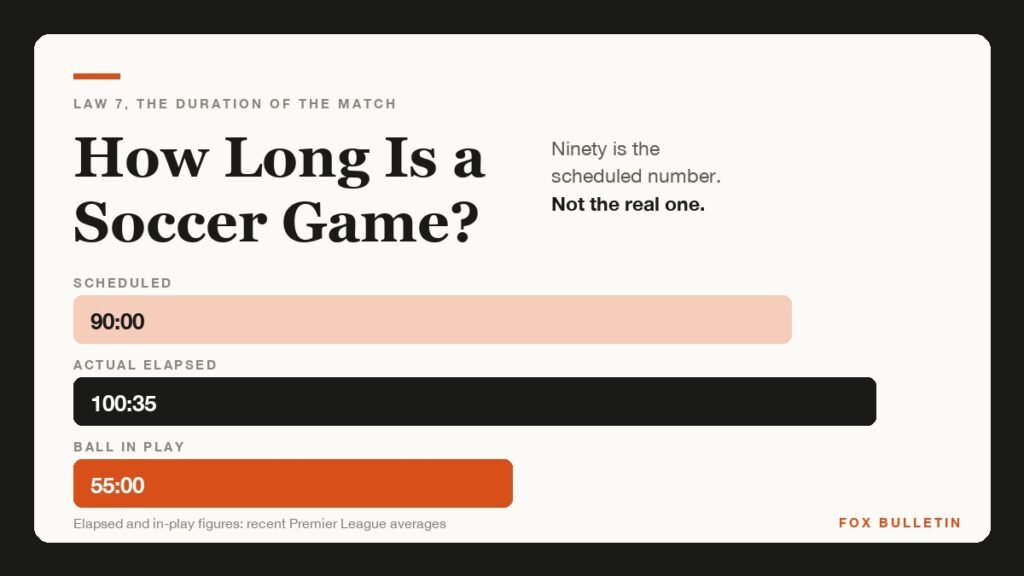
How Long Is a Soccer Game? Halves, Stoppage and Extra Time
Ninety minutes is the scheduled figure, not the real one. What the referee adds, when extra time applies, and how much of a match is actually live football.
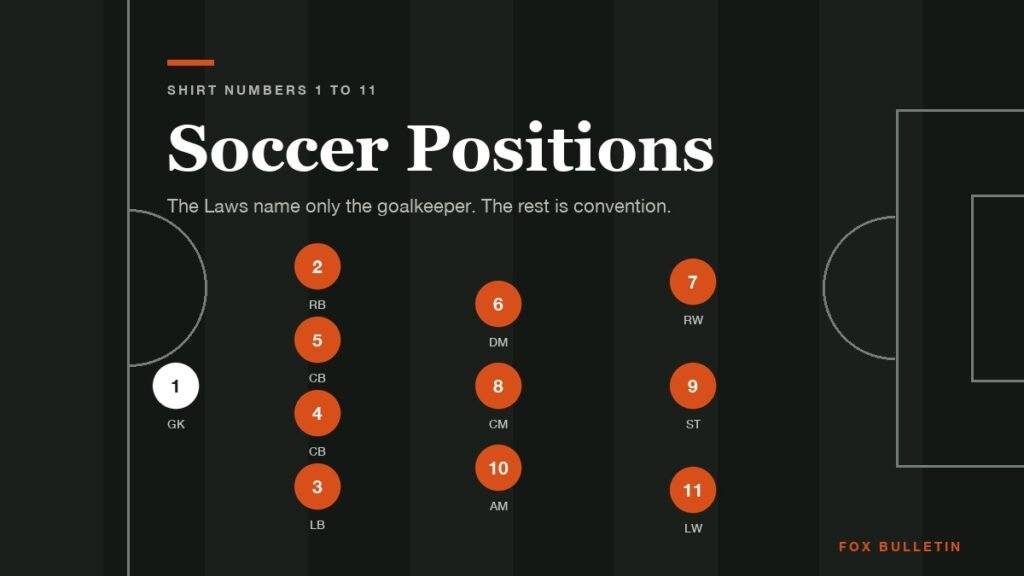
Soccer Positions: Every Role on the Pitch and What It Does
The Laws of the Game name only one position. Everything else, from the number 6 to the false nine, is a convention coaches built on top of it.