
Dropshipping is legal in the United States. There is no statute against it, no licence specific to it, and no regulator that treats it as inherently suspect. It is a fulfilment arrangement, in the same family as consignment or third-party logistics, and retailers have used versions of it for decades.
What trips people up is that “legal” and “compliant” are different questions. A dropshipping store is a retail business, and three separate bodies of law apply to it the moment it takes its first order: federal consumer protection rules about shipping, state sales tax obligations, and the ordinary income tax and business-registration requirements that apply to any trade. Most guides cover the second and third. The first is the one that quietly catches dropshippers more than anyone else, because the model’s defining weakness is slow delivery. The following is general information rather than legal advice, and a lawyer or accountant in your state is worth the hour if real money is involved.
The FTC Shipping Rule Dropshippers Break Most Often
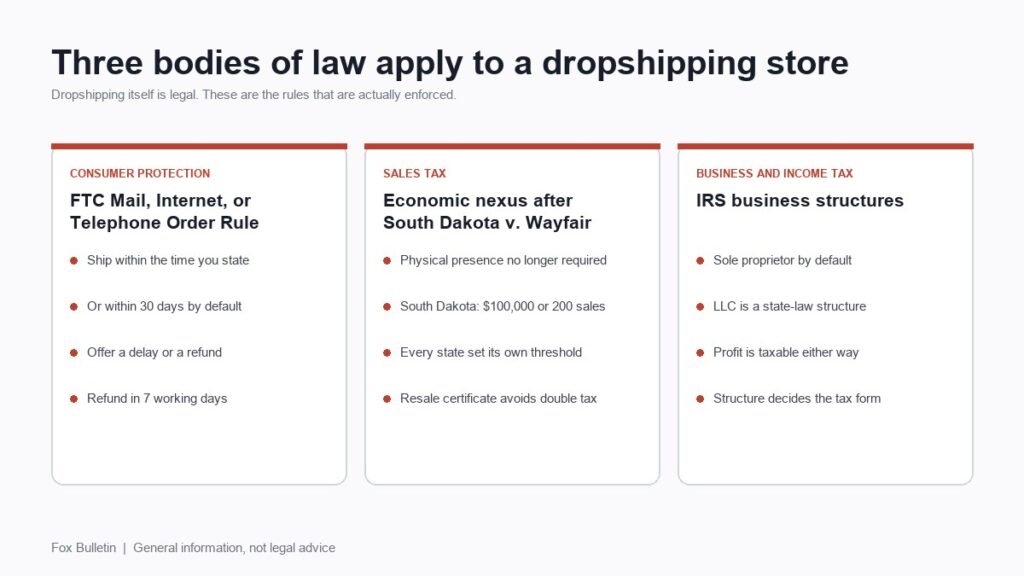
This is the rule that deserves top billing in any honest article about dropshipping legality, and it is the one almost never mentioned. The Federal Trade Commission’s Mail, Internet, or Telephone Order Merchandise Rule governs how quickly you have to ship what someone buys online, and it applies to you whether or not you have ever heard of it.
The requirements are specific. You must have a reasonable basis, at the time you advertise, to expect you can ship within whatever timeframe you clearly and conspicuously state. If you state no timeframe at all, the default is 30 days from receipt of a properly completed order. If you then cannot ship in time, you must offer the buyer a choice between consenting to a delay, with a definite revised date or a statement that you cannot estimate one, or cancelling for a prompt refund. Refunds are due within seven working days for cash, cheque or money order payments, and within one billing cycle for credit accounts where you are the creditor, and they must include the shipping and handling the customer paid.
Now place that next to how the model actually works. A store sourcing from an overseas supplier with three-week delivery, advertising nothing about shipping time, is in breach the moment day 31 arrives without a compliant delay notice. The fix is not complicated and costs nothing.
- State your shipping window plainly on the product page and at checkout, not buried in a policy page.
- Base it on what your supplier actually does, not the best case they advertise. Order a sample and time it.
- Build a delay notice into your process, so that a late order automatically triggers the choice between waiting and a refund.
- Refund promptly when asked, including the shipping charge, rather than arguing about it.
Sales Tax After the Wayfair Decision
Until 2018, a state could only require you to collect its sales tax if you had a physical presence there. That ended with South Dakota v. Wayfair. According to the Congressional Research Service’s summary of the decision, the Supreme Court upheld South Dakota’s law requiring out-of-state sellers to collect and remit sales tax, and overruled the earlier physical presence rule as an unsound and incorrect reading of the Commerce Clause.
The South Dakota thresholds the Court approved were $100,000 in sales into the state or 200 separate transactions. Every state then wrote its own version, and the numbers are not uniform: thresholds commonly sit between $100,000 and $500,000, some states use sales value alone, and several have been dropping the 200-transaction trigger because it caught small sellers of cheap items.
For a dropshipper the practical consequences are three.
- You almost certainly owe tax in your home state from the first sale, because you have physical presence there.
- You owe tax elsewhere only once you cross that state’s threshold, which most new stores never do.
- Selling through a marketplace usually shifts the burden, because marketplace facilitator laws make Amazon, eBay or Etsy responsible for collecting on sales made through them. Sales through your own store remain yours.
Resale Certificates and Not Paying Tax Twice
Here is the wrinkle specific to this model. You buy from a supplier and a customer buys from you, so without intervention the same item can be taxed twice: once when you buy it and once when your customer does. A resale certificate is the mechanism that prevents that.
You register for a sales tax permit in your state, which issues you a number, and you give a resale certificate to your supplier. The supplier then sells to you without charging sales tax, because they can document that you are buying for resale rather than consumption. The tax is collected once, from the end customer, by you.
Two things to know. First, the certificate is not optional paperwork if you want the exemption: suppliers who accept it are relying on it to justify not charging you, and many will not accept one from a seller who is not registered. Second, misusing a resale certificate to buy things for yourself tax free is a genuine offence rather than a grey area.
Choosing a Business Structure for a Dropshipping Store
You do not have to form a company to sell legally. Start selling without registering anything and you are a sole proprietor by default, which is entirely lawful and how a large share of stores begin.
The IRS sets out the available structures and notes that your form of business determines which income tax return you file, and that an LLC is a structure allowed by state statute rather than a federal tax classification. That last point matters: an LLC is formed with a state, and by default a single-member LLC is still taxed as a sole proprietorship.
What the LLC buys you is separation. If a customer or supplier has a claim against the business, a properly maintained LLC limits that to business assets rather than your house. For a dropshipping store, which sells physical goods it has never inspected to strangers, that is not a theoretical concern. Our comparison of business structures covers how the options differ on tax, cost and paperwork.
- Sole proprietor: nothing to file, no fee, no liability protection, profits on your personal return.
- Single-member LLC: state filing and an annual fee, liability separation, taxed the same as a sole proprietorship unless you elect otherwise.
- S corporation election: potential self-employment tax savings once profits are substantial, with real payroll and accounting overhead attached.
Income Tax on What the Store Makes
Profit from a dropshipping store is taxable income, and the fact that it arrived through a Shopify payout rather than a payslip changes nothing. Sole proprietors and single-member LLCs report it on Schedule C with their personal return, and self-employment tax applies on top of income tax.
The deduction side is where good records pay for themselves, because almost every cost in this business is deductible: the product cost, your store subscription, supplier app fees, advertising, domain and email, product samples, and payment processing fees. Advertising alone is usually the largest line item, and a store that does not track it properly will overstate its profit and its tax bill at the same time. Keeping the business money in its own account and running it through accounting software from the start is far cheaper than reconstructing a year of it in April.
What Actually Gets Dropshipping Stores Shut Down
Nobody is closed down for dropshipping. Stores are closed, sued or banned from platforms for four things, and all four are choices the seller made.
- Selling counterfeits. Listing a branded item you source from a marketplace where the authenticity is unverifiable is the fastest route to a legal problem, and ignorance is not much of a defence.
- Using other people’s intellectual property. Supplier product photos are usually fine to use, but brand names, logos and characters on the product itself are not. Our guide to copyright, trademarks and patents sets out which protection covers what.
- Making claims you cannot support. Health, safety or performance claims about a product you have never tested are FTC territory, and the rules on substantiation are strict.
- Hiding where the goods come from. Telling customers an item ships from within the country when it ships from overseas is a deceptive practice, separate from any shipping-time breach.
A Compliance Checklist Before the First Sale
None of this is expensive, and all of it is easier before you have customers than after.
- Decide your structure and register it if you are forming an LLC.
- Get an EIN from the IRS, which is free and takes minutes.
- Register for a sales tax permit in your home state and obtain your resale certificate.
- Open a separate business bank account so the money never mixes.
- Write shipping, returns and refund policies that match what your supplier actually does.
- State delivery times on the product page, not only in the policy.
- Order samples of everything you list, so your product claims are yours to defend.
- Keep records of supplier invoices, ad spend and payouts from day one.
If you are still working out whether the model suits you at all, our explainer on how dropshipping works covers the mechanics and the margin arithmetic that sit underneath all of this.
Frequently Asked Questions
Is dropshipping legal in the United States?
Yes. No federal or state law prohibits selling goods a third party ships on your behalf. What is regulated is how you behave as a retailer: shipping within the time you promised or 30 days by default, collecting sales tax where you have nexus, reporting your profit, and not selling counterfeits or making unsupported claims.
Do you need an LLC to start dropshipping?
No. Without registering anything you are a sole proprietor, which is lawful. An LLC is worth forming for liability separation rather than legality, and that matters more than usual here because you are selling physical products you have never inspected. Many sellers start as sole proprietors and form an LLC once revenue justifies the filing fee.
Do you have to collect sales tax on dropshipped orders?
In your home state, almost certainly yes, from the first sale. In other states, only once you cross their economic nexus threshold, which since Wayfair is commonly $100,000 in sales or a set number of transactions. Sales made through a marketplace such as Amazon or Etsy are generally collected by the marketplace under facilitator laws, not by you.
What is a resale certificate and do dropshippers need one?
It is a document you give your supplier showing you are buying goods to resell rather than to use, so they do not charge you sales tax on the purchase. Without it the same item can be taxed twice. You get one by registering for a sales tax permit in your state, and using it for anything other than genuine resale purchases is a real offence.
Related Articles

Get the Fox Bulletin briefing
The stories that matter, in your inbox. No spam, unsubscribe anytime.
Newsletter signup will be available soon.
Related stories
Dropshipping Marketing: The Numbers That Decide Every Channel
Dropshipping marketing is arithmetic, not creativity. The two numbers that decide everything, what each channel costs and delivers, and why scaling is usually an order-value problem.
Dropshipping Apps: What Each One Does and What It Costs
Dropshipping apps do four different jobs and most stores need one, not four. Five apps compared on current pricing, what each is actually for, and how many you really need.
Is Dropshipping Profitable? The Numbers Behind the Answer
Dropshipping is profitable and most dropshipping stores are not. The margin arithmetic that decides which, what stores really earn, the costs that eat it, and the four levers that fix it.