

A lemon law is a state consumer protection law that forces a carmaker to buy back or replace a new vehicle it cannot fix. If the same serious defect keeps coming back under warranty, or the car spends weeks in the shop, the law shifts the loss from you to the manufacturer.
Every state writes its own version, so the number of repair attempts, the time window and the refund formula all change at the state line. Below are the real tests in nine states, the math behind a buyback, the federal law that sits on top, and the steps to file a claim before a deadline runs out.
What Is the Lemon Law?
Connecticut passed an early one in 1982, a law its consumer protection department calls pioneering and says was then copied in states across the country, and Massachusetts followed in 1983. These laws cover new vehicles with a defect that substantially impairs their use, value or safety, as long as the problem is reported while the warranty or the law's own time window is still running.
Three conditions show up in almost every state law:
- A covered defect: a problem with the car itself, not damage from an accident, abuse, neglect or aftermarket modifications.
- A fair chance to fix it: the manufacturer or its dealer has had a reasonable number of repair attempts.
- A time limit: the defect first shows up within a set period, usually one to two years or a mileage cap.
How a Car Qualifies as a Lemon
States measure a "reasonable number of attempts" with one of three tests, and passing any one is usually enough. Texas is a clear example, with all three spelled out by its Department of Motor Vehicles:
- Four-times test: four repairs for the same defect within the first 24 months or 24,000 miles.
- Serious safety hazard test: two repairs for a life-threatening problem that impairs control of the car or creates a real risk of fire or explosion.
- 30-day test: 30 or more days out of service in that window. Days when you had a comparable loaner do not count.
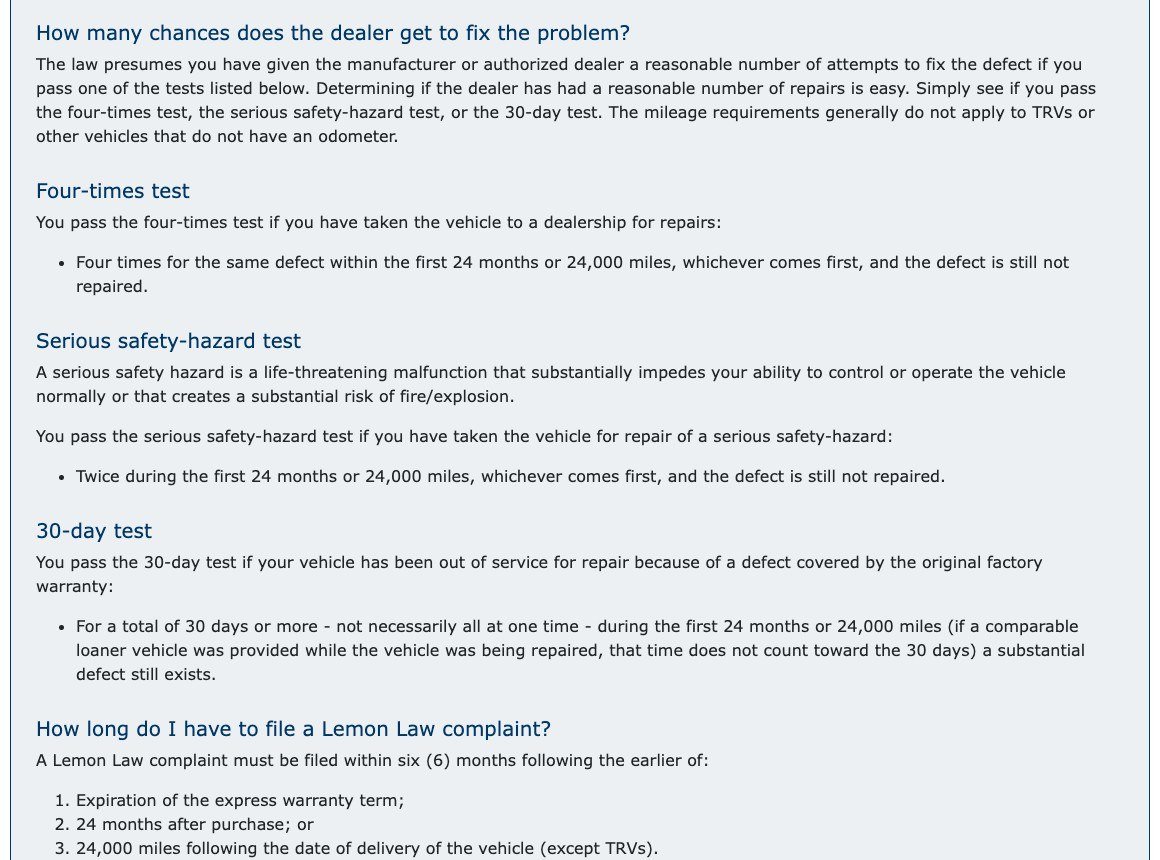
Texas also requires written notice to the manufacturer and a final chance to repair. The complaint must be filed within six months after the earliest of three dates: the end of the warranty, 24 months from purchase, or 24,000 miles. The filing fee is $35.
Some states add their own tests. Massachusetts covers defects that impair use, safety or market value, and if you rely on market value you must show the car is worth at least 10% less than it would be without the defect.
Lemon Law by State: Nine States Compared
The table compares the window, the repair tests and the dispute program in nine states, using each state's statute, attorney general or consumer agency.
| State | Presumption window | Same-defect repairs | Safety-defect repairs | Days out of service | Dispute program |
|---|---|---|---|---|---|
| California | 18 months or 18,000 miles | 4 | 2 | More than 30 | State-certified manufacturer programs, free |
| New York | 2 years or 18,000 miles | 4 | Not set separately | 30 | State arbitration program |
| Texas | 24 months or 24,000 miles | 4 | 2 | 30 (loaner days excluded) | TxDMV, $35 filing fee |
| Florida | First 24 months | 3, then a final notice | Not set separately | 15 triggers notice; 30 for a buyback | State arbitration board |
| New Jersey | 2 years or 24,000 miles | 3 (final letter after 2) | 1 | 20 | Lemon Law Unit, $50 refunded if you win |
| Pennsylvania | 1 year, 12,000 miles or the warranty | 3 | Not set separately | 30 | Manufacturer program or court |
| Massachusetts | 1 year or 15,000 miles | 3 | Not set separately | 15 business days | State arbitration |
| Connecticut | 2 years or 24,000 miles | 4 | Not listed | Not listed | State arbitration |
| Washington | 2 years or 24,000 miles | 4 | 2 | 30 (15 under warranty) | Attorney General program, free |
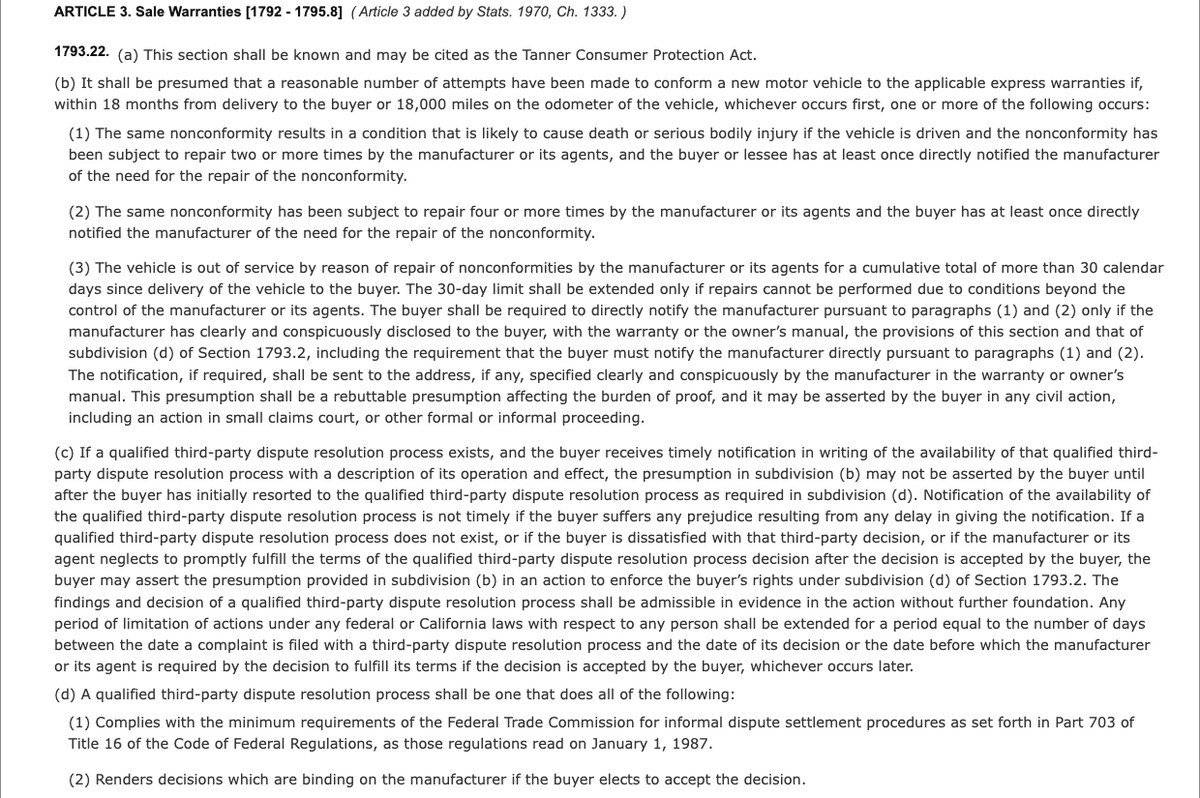
California's rule, known as the Tanner Consumer Protection Act, presumes a car is a lemon within 18 months or 18,000 miles if one of three things happened: a defect likely to cause death or serious injury was repaired twice, the same defect was repaired four times, or the car was out of service for more than 30 days. For the first two, you must also have notified the manufacturer directly at least once, if the warranty or owner's manual tells you to. The law itself applies for the whole original warranty period; the 18-month window only sets when the car is presumed to be a lemon.
Arbitration is the usual first stop. California's state-certified programs are free to consumers, and the state arbitration FAQ says arbitrators usually decide within 40 days, with the manufacturer given 30 days to carry out an award you accept. Manufacturers are not required to take part, though.
What You Get Back: How Lemon Law Refunds Are Calculated
A buyback is not a full refund. Most states subtract a fee for the miles you drove, though they count those miles differently:
- California: purchase price times the miles before the first repair visit, divided by 120,000.
- Florida: miles driven up to the settlement or arbitration hearing, times the base selling price, divided by 120,000, or 60,000 for RVs.
- New Jersey: price times miles at the first repair attempt, divided by 100,000. On a $19,500 car with 9,500 miles, the state works out a $1,853 deduction and a $17,647 refund.
- New York: only miles over 12,000 count. On a $20,000 car with 15,000 miles, the deduction is $600.
The refund usually includes more than the sticker price. In California, restitution covers the price paid, sales tax, license and registration fees, plus costs such as towing, repairs and rental cars. A manufacturer that willfully breaks California's warranty law can owe a civil penalty of up to twice your actual damages. In Florida, you can always choose a refund instead of a replacement, and the manufacturer has 40 days to pay.
The Federal Lemon Law: Magnuson-Moss Warranty Act
Above the state laws sits the Magnuson-Moss Warranty Act, signed in January 1975 and codified at 15 U.S.C. 2301 and the sections after it. It covers written warranties on all consumer products, not just cars, and BBB National Programs, which runs a car arbitration service, calls it a federal lemon law.
The Act draws a line between two warranty types:
- Full warranty: if the product still has a defect after a reasonable number of repair attempts, you can choose a refund or a free replacement.
- Limited warranty: anything that does not meet the federal minimum. Most car warranties fall here, which is why state lemon laws matter so much.
The most useful part is the fee rule. A court can award a winning consumer court costs and attorney fees based on actual time spent. Federal court is only available if the total amount in dispute is at least $50,000, so most cases are filed in state court.
Used Cars and the FTC Buyers Guide
Most lemon laws cover only new cars, but a few states protect used-car buyers too. New York requires dealers to give a written warranty on used cars that cost at least $1,500 and have more than 18,000 but fewer than 100,000 miles. New Jersey and Massachusetts have used-car laws of their own.
Everywhere else, the federal Used Car Rule is the main protection. Dealers who sell more than five used cars in a 12-month period must display a Buyers Guide on the car, in every state except Maine and Wisconsin.
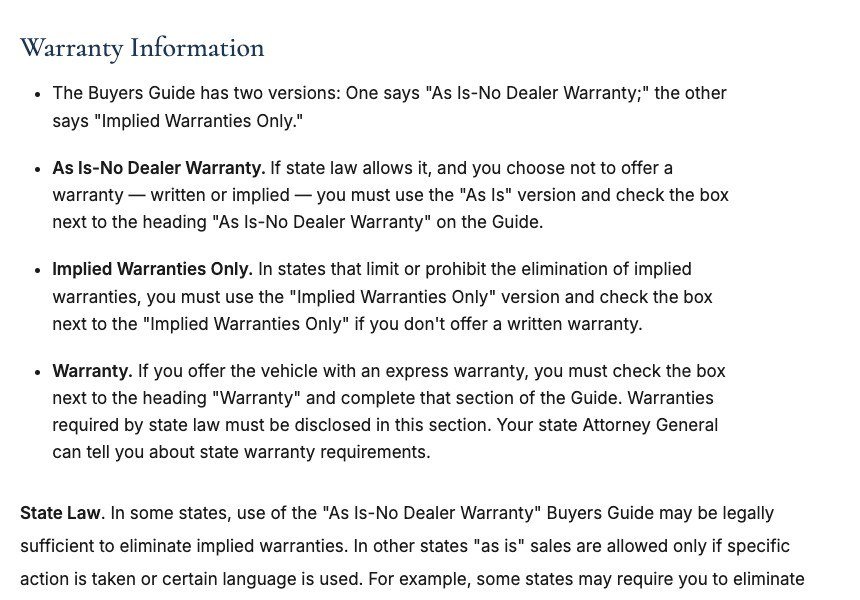
The Buyers Guide comes in two versions, "As Is, No Dealer Warranty" and "Implied Warranties Only." It also overrides the sales contract: if the guide promises a warranty and the contract says "as is," the dealer must honor the warranty.
How to File a Lemon Law Claim
The details vary by state, but the sequence is close to the same everywhere:
- Get a repair order every time. It should describe the problem, the dates in and out, and the odometer reading.
- Notify the manufacturer in writing. Send it to the carmaker, not the dealer. After three attempts, Florida's statute requires the notice by registered or express mail.
- Allow the final repair attempt. Florida gives the manufacturer 10 days to direct the car to a shop and up to 10 more to fix it; New Jersey allows 10 days after its final letter.
- File for arbitration before the deadline. Florida requires it within 60 days after the 24-month rights period ends, Texas within six months, Washington within 30 months of delivery.
- Keep paying the loan or lease. Washington's attorney general says the law does not let you stop payments, and New York's warns the car can be repossessed if you fall behind.
If arbitration fails, you can still sue. California even lets you raise its lemon law presumption in small claims court. Lawsuits have their own deadlines, separate from arbitration, and our guide to the statute of limitations explains how those clocks run.
This guide explains how lemon laws generally work and is not legal advice. Your state attorney general or consumer protection office can confirm the rules that apply to your car.
Frequently Asked Questions
Do lemon laws apply to used cars?
Only in some states. New York, New Jersey and Massachusetts have used-car lemon laws, and California covers a used car sold with the manufacturer's new-car warranty. Elsewhere, the FTC Buyers Guide and any dealer warranty are your main protection.
How many repair attempts make a car a lemon?
Usually three or four attempts for the same defect, or one or two for a serious safety defect. Most of the states in the table above also count a car that spends 30 days in the shop, though Florida, New Jersey and Massachusetts use shorter periods to trigger the final notice.
Who pays the lawyer in a lemon law case?
Usually the manufacturer, if you win. California, Florida and New Jersey provide for attorney fees when the consumer wins, and federal law lets a court award them.
Does the lemon law cover leased cars?
In many states, yes. New York, New Jersey, Florida, Pennsylvania and Massachusetts all cover leased vehicles as well as purchased ones.
Related Articles

Get the Fox Bulletin briefing
The stories that matter, in your inbox. No spam, unsubscribe anytime.
Newsletter signup will be available soon.
Related stories

Statute of Limitations: What It Means and How Long You Have
A statute of limitations is the legal deadline to sue or bring charges. Here are the real time limits in four big states, the crimes with no limit, and how old debts work.
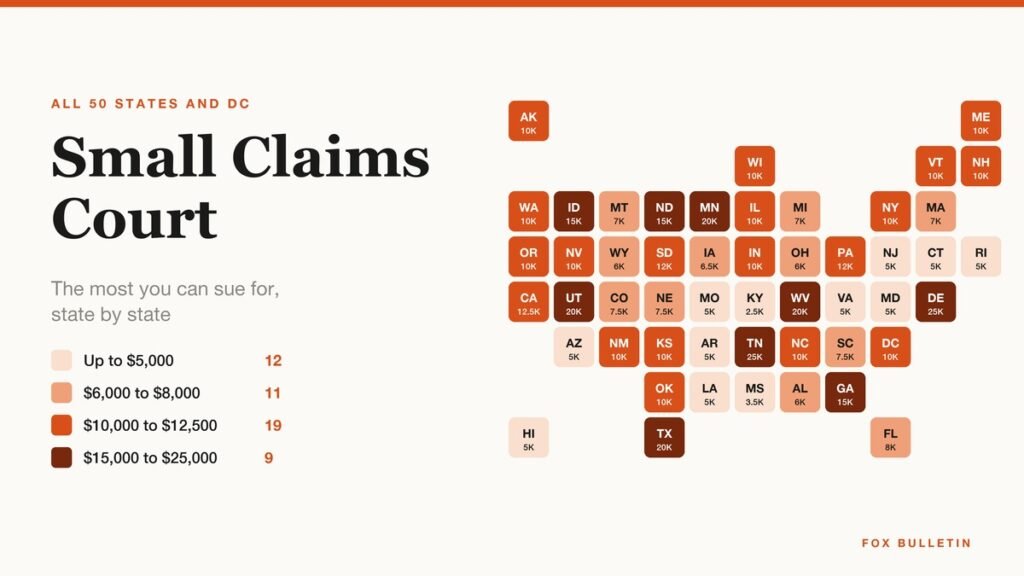
Small Claims Court: Limits in Every State and How It Works
Small claims court settles money disputes quickly and cheaply. Here is the dollar limit in every state, what it costs to file, who can bring a lawyer, and how collection works.
Living Will: What It Covers and How to Make One
A living will tells doctors which treatments you want if you cannot speak for yourself. Here is what it covers, how signing rules differ by state, and how to make one.