

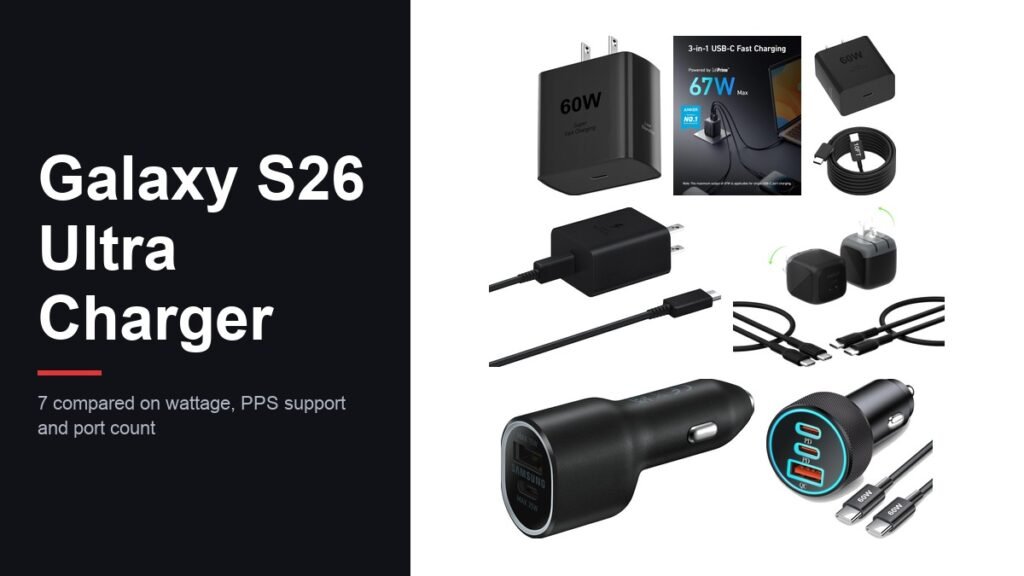
The number on the box is not the number you get. A galaxy s26 ultra charger has to support USB Power Delivery with PPS before the phone will charge at its full rate, and plenty of high-wattage bricks do not. ELITEED’s 60W single-port is the direct replacement for Samsung’s own adapter, Anker’s Prime 67W the one to take travelling, and Samsung’s 45W brick the honest baseline.
Samsung’s comparison of the S26 and S25 series puts the Galaxy S26 Ultra at 60W wired, up from 45W on the S25 Ultra, with a 5,000mAh typical battery. Samsung quotes up to 75 per cent in around 30 minutes and sells the adapter separately. If you want portable power instead, our S26 Ultra power bank roundup covers that, and the S26 Ultra case guide the rest.
Galaxy S26 Ultra Charger Picks by Wattage, PPS and Ports
Charge times below are each maker’s published claim for its own product and were not measured here.
| # | Charger | Rated output | PPS stated | Ports | Best for |
|---|---|---|---|---|---|
| 1 | ELITEED 60W | 60W | Yes, PD 3.0 PPS | 1 USB-C | Matching the phone |
| 2 | Anker Prime 67W | 67W | Yes, PPS | 2 USB-C, 1 USB-A | Travelling light |
| 3 | LKBeau 60W | 60W | Not stated | 1 USB-C | A ten-foot cable |
| 4 | Samsung 45W | 45W | Samsung protocol | 1 USB-C | The official brick |
| 5 | Belkin 45W 2-Pack | 45W | Not stated | 1 USB-C each | Home and office |
| 6 | Samsung 40W Car | 40W total | Samsung protocol | USB-C and USB-A | The official car option |
| 7 | KENHAO 67W Car | 67W total | Not stated | USB-C and USB-A | Two phones in a car |
1. ELITEED 60W: The Direct Stand-In for Samsung’s Own Adapter
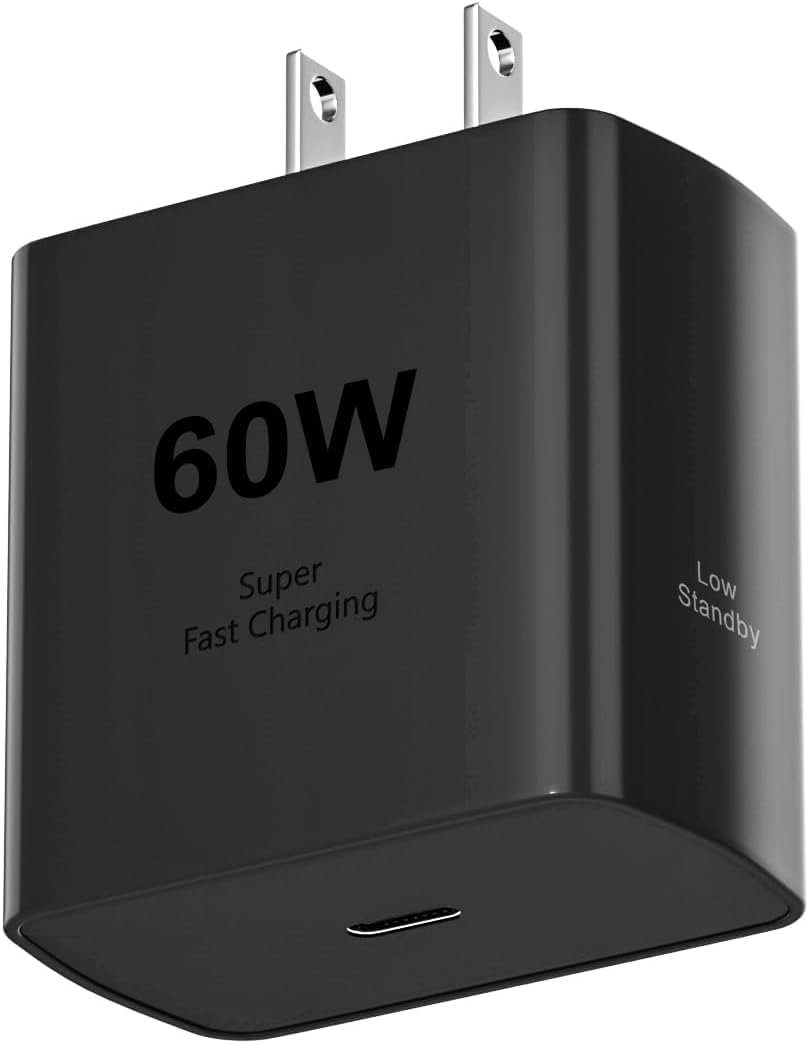
This is the one that matches the phone. A single USB-C port rated at 60W with PD 3.0 and PPS stated explicitly, which is the combination the S26 Ultra needs before Super Fast Charging 3.0 engages. ELITEED positions it as an alternative to Samsung’s own 60W adapter and lists the Galaxy S-series back to the S22.
The claim is zero to 50 per cent in about twenty minutes, which is ELITEED’s own figure rather than a measured one, and sits in the right region next to Samsung’s published 75 per cent in around thirty minutes. Single-port is a feature here rather than a limitation: nothing else can steal wattage from the phone.
What it does well
- 60W with PD 3.0 and PPS both named in the specification.
- Single port, so the phone never shares the budget.
- Compatible back through the S22 generation.
- Compact enough to live in a bag.
What to know before buying
- The twenty-minute claim is ELITEED’s own.
- One port means one device at a time.
- No cable is the usual trade at this size.
2. Anker Prime 67W: Three Ports in a Brick Half the Usual Size
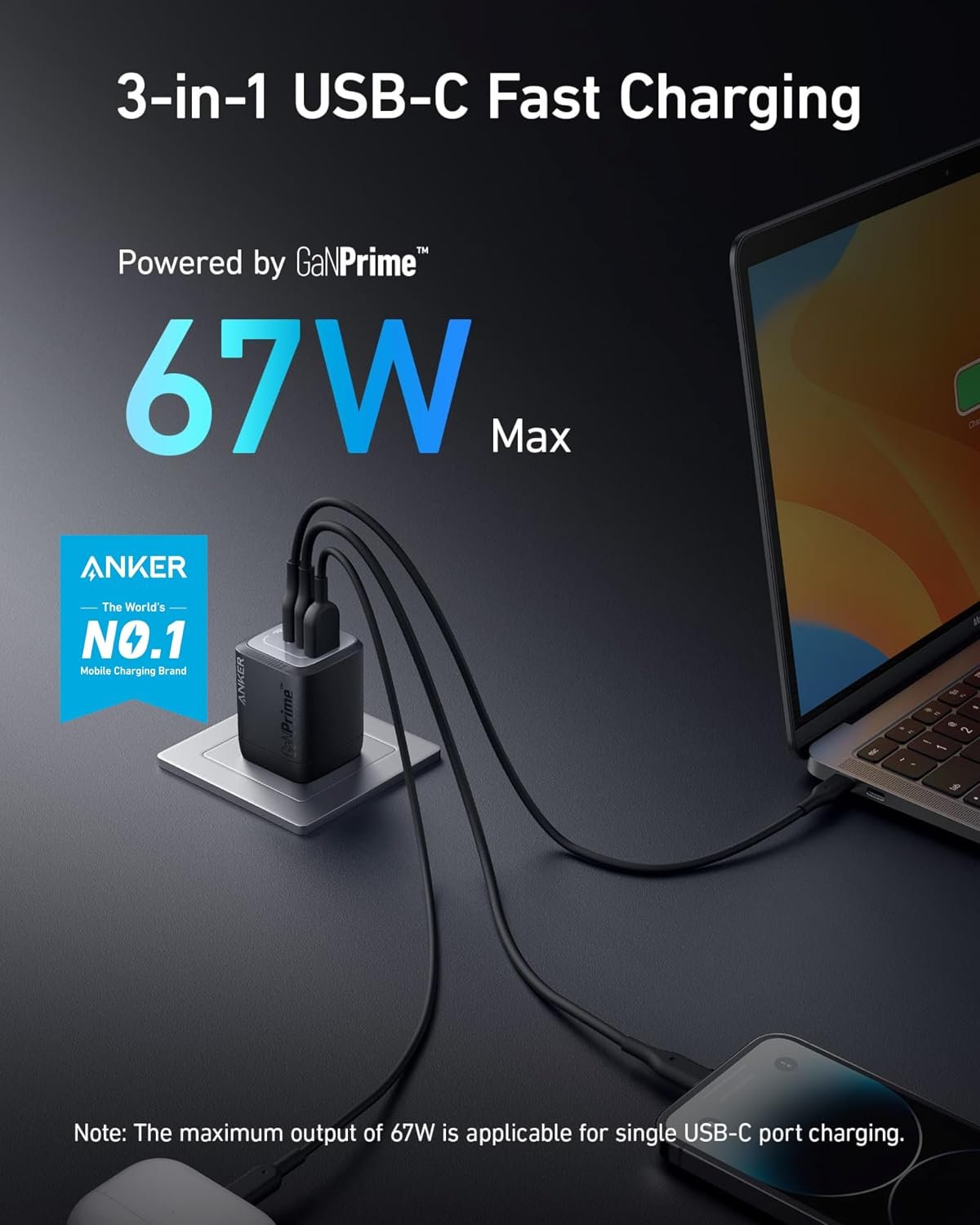
Anker builds this on gallium nitride, which is why it comes in at around half the size of the original 67W laptop chargers it is benchmarked against. Two USB-C ports and one USB-A cover a phone, a tablet and a laptop from one plug, which is the whole case for carrying it instead of three separate bricks.
PPS is stated, which is the specification that matters for a Galaxy, and a USB-C cable rated to 5,000 bends comes in the box. Note that 67W is the total across all three ports, so a laptop drawing hard will reduce what the phone gets.
What it does well
- GaN construction at roughly half the usual size.
- Two USB-C ports and one USB-A from a single plug.
- PPS support stated for Galaxy fast charging.
- Cable included and rated to 5,000 bends.
What to know before buying
- 67W is shared across three ports, not per port.
- A laptop on the same brick will slow the phone.
- Larger than a single-port 60W block.
3. LKBeau 60W: Rated Output With a Ten-Foot Cable Attached
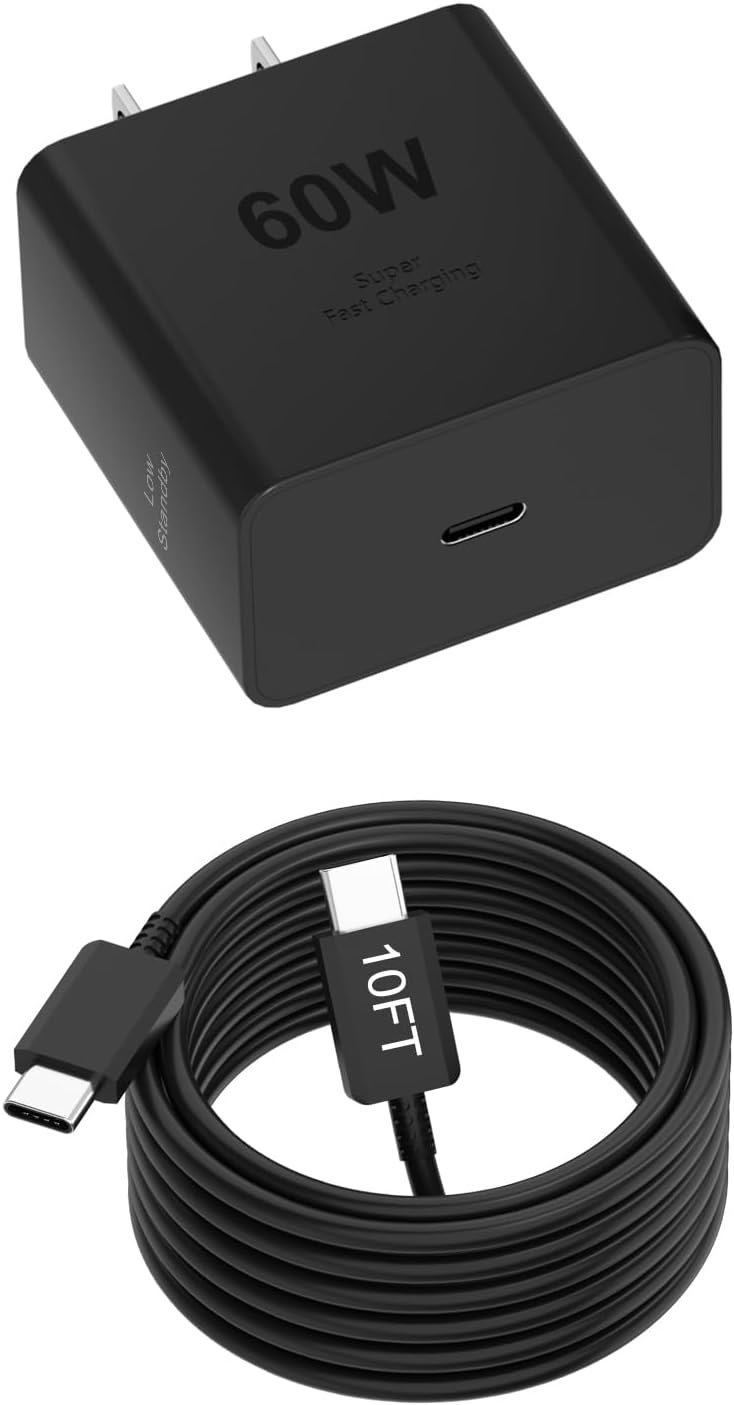
The reason to look at this one is the cable. Ten feet of USB-C to USB-C means charging from a wall socket across a room, which on a phone that spends the night on a bedside table is a more practical upgrade than another five watts.
LKBeau rates the brick at 60W on Power Delivery and lists the S26 Ultra first among compatible devices. It does not name PPS in the bullets, which is the one thing worth checking before you commit, because a PD charger without PPS can drop a Galaxy to normal charging speeds.
What it does well
- Ten-foot USB-C to USB-C cable in the box.
- 60W Power Delivery rating.
- Covers the current Galaxy S line from one block.
- Compact single-port design.
What to know before buying
- PPS is not stated in the specification.
- Long cables lose a little voltage over distance.
- LKBeau publishes no independent test data.
4. Samsung 45W Power Adapter: Official, and Deliberately Not 60W
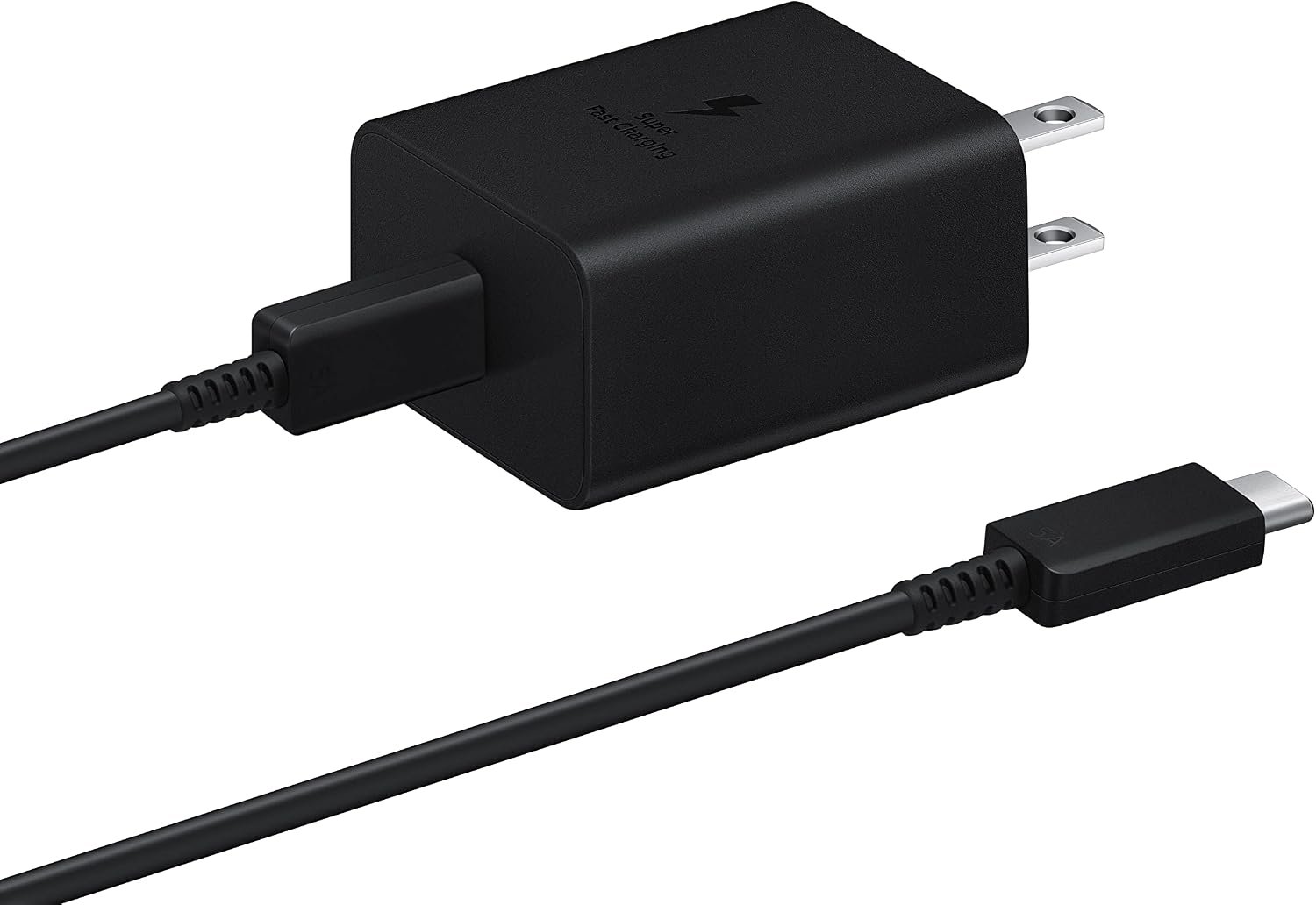
Samsung’s own 45W brick with a C-to-C cable included, and the one most people already have in a drawer. It is guaranteed to speak Samsung’s charging protocol correctly, which removes the entire question of whether the handshake will work.
What it will not do is 60W. Samsung lists the S26 Ultra at 60W wired and sells a separate 60W adapter for it, so this brick caps the phone at the speed the S25 Ultra had. That is a perfectly reasonable place to land if you charge overnight, and the wrong choice if you top up in twenty minutes before leaving the house.
What it does well
- Samsung’s own adapter, so the protocol handshake is certain.
- USB-C to USB-C cable included.
- Works across Samsung, iPhone and Pixel.
- The known quantity in a category full of claims.
What to know before buying
- Caps the S26 Ultra at 45W rather than 60W.
- Single port only.
- Costs more than equivalent third-party bricks.
5. Belkin 45W 2-Pack: One for the Desk and One for the Bag
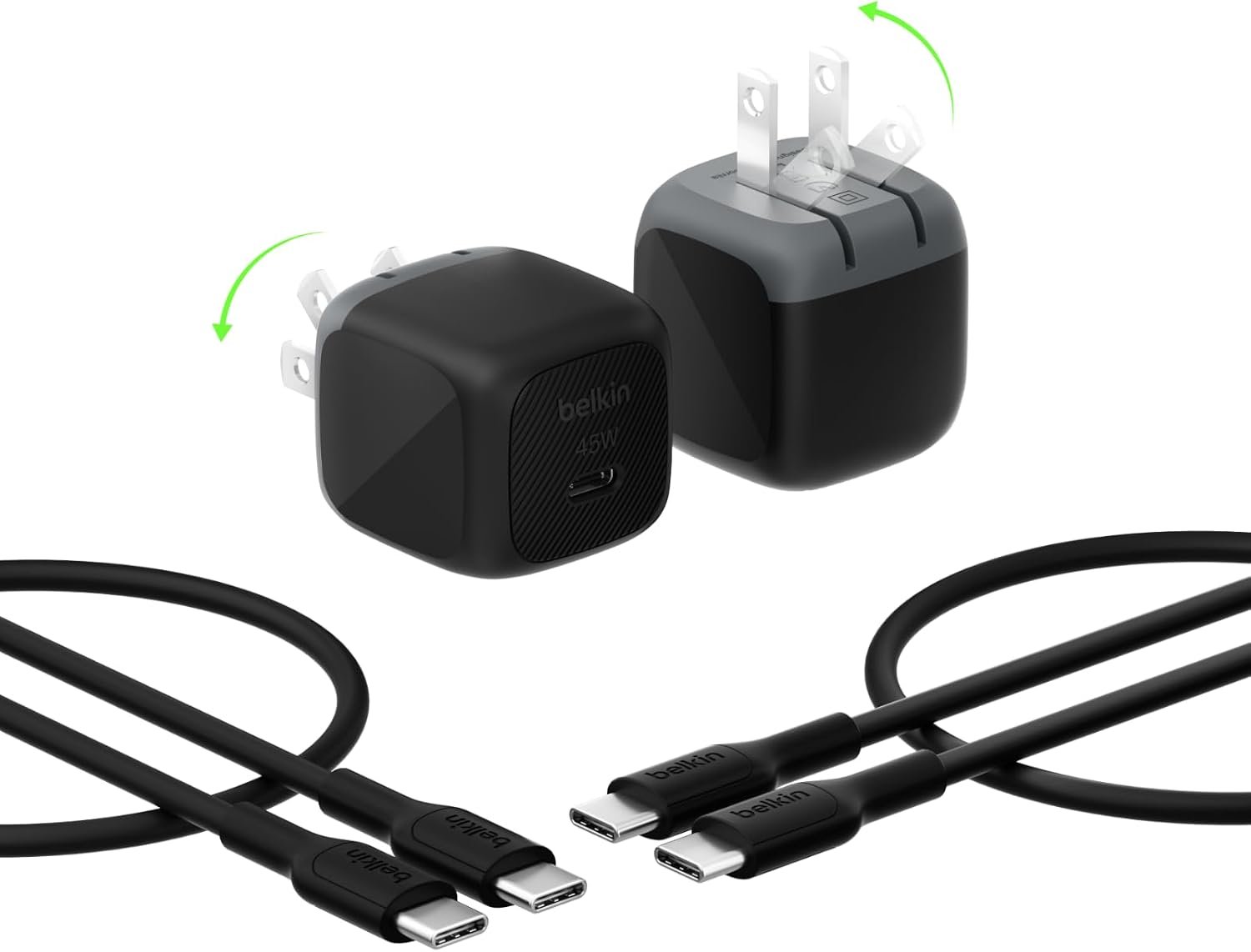
Two identical 45W blocks, which solves the real problem most people have: not enough speed, but a charger permanently in the wrong room. Belkin quotes 0 to 50 per cent in 28 minutes on a modern phone and the blocks are small enough to leave plugged in without blocking a second socket.
At 45W they will also run a Chromebook or a MacBook Air, which makes them more useful than a phone-only brick. Belkin does not name PPS in the bullets, so on a Galaxy treat 45W as the ceiling rather than a guarantee of Super Fast Charging.
What it does well
- Two blocks, so one can live permanently at a desk.
- Compact enough not to block the next socket.
- 45W also runs a lightweight laptop.
- USB-C to USB-C cable included.
What to know before buying
- PPS is not named in the specification.
- 45W rather than the phone’s 60W ceiling.
- Single port on each block.
6. Samsung 40W Car Charger: Official, With 25W to the Phone
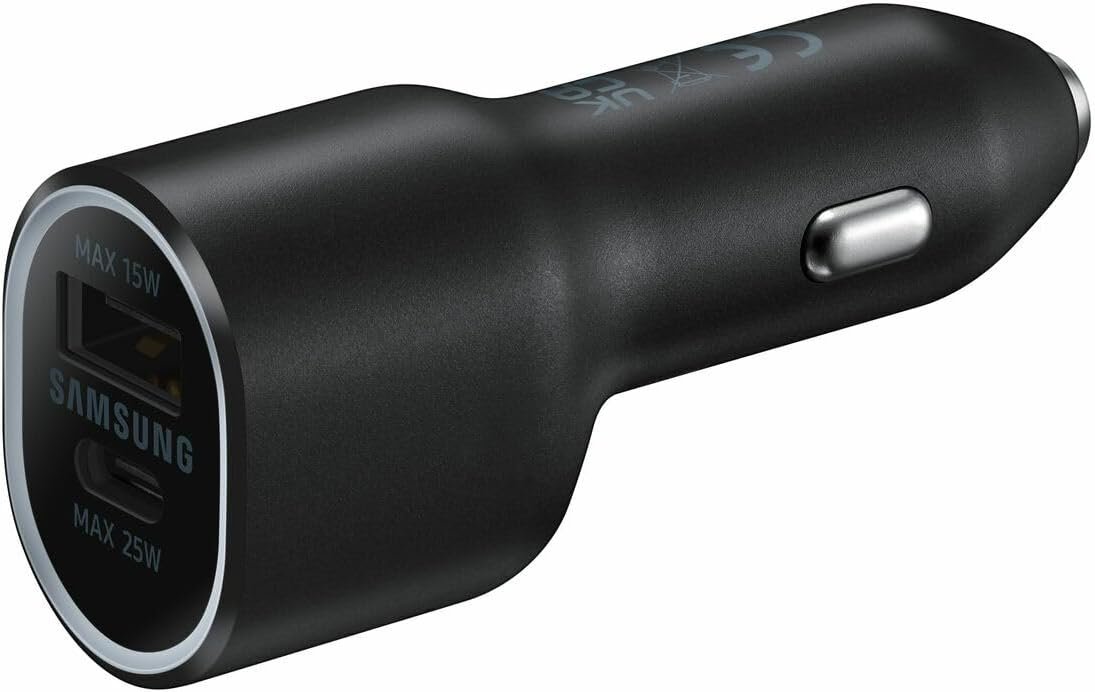
Samsung’s own car charger, and the figures need reading carefully. The headline is 40W, but that is the total across both ports: the USB-C port delivers up to 25W of Super Fast Charging and the USB-A port handles a second device.
For a car that is usually the right trade. Sustained high-wattage charging in a hot cabin heats the battery, and 25W keeps a navigation session comfortably ahead of the drain without cooking the phone. Protection against overcurrent, short circuits and high temperature is built in, which matters more in a car than at a desk.
What it does well
- Samsung’s own accessory, so the protocol is correct.
- 25W Super Fast Charging on the USB-C port.
- Second USB-A port for a passenger.
- Overcurrent, short circuit and thermal protection.
What to know before buying
- 40W is the total, not the per-port figure.
- Well short of the phone’s 60W wired ceiling.
- No cable included in the box.
7. KENHAO 67W Car: More Total Power Than Any Single Port Uses
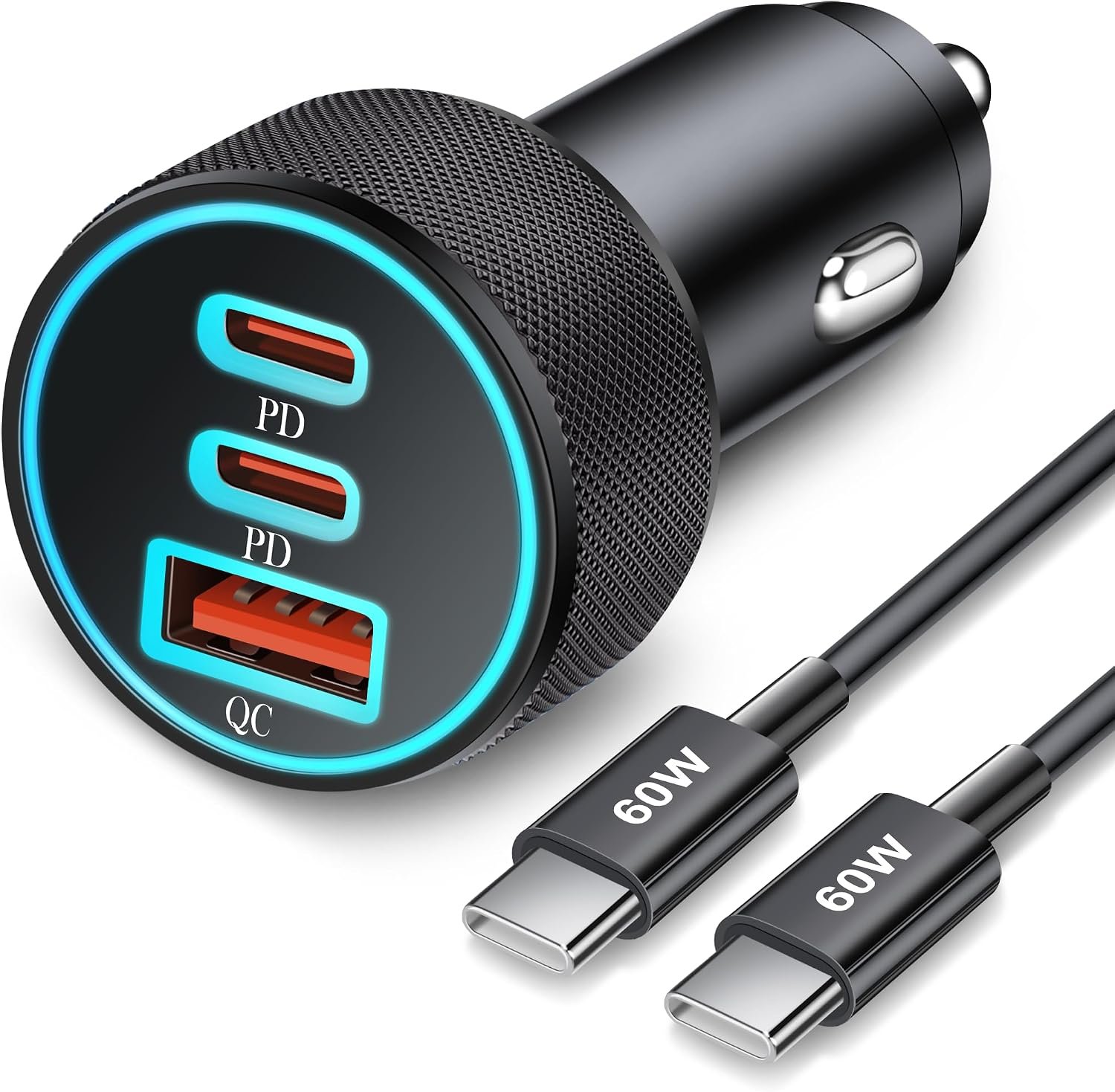
Sixty-seven watts in total across three ports, with up to 37W on USB-C under Power Delivery and up to 30W on USB-A under Quick Charge. The useful consequence is that two phones can charge quickly at the same time rather than one fast and one slowly.
KENHAO quotes 0 to 50 per cent in about thirty minutes, which is its own figure. The compatibility list runs across current iPhones and Galaxy models, which is what you want in a car where whoever is in the passenger seat has a different phone from yours.
What it does well
- 67W total so two phones charge properly at once.
- Up to 37W on USB-C and 30W on USB-A.
- Multiple protection circuits for in-car use.
- Works across iPhone and Galaxy alike.
What to know before buying
- 37W per port is below the phone’s 60W ceiling.
- The charge-time claim is KENHAO’s own.
- PPS is not named in the specification.
A 65W Charger Can Be Slower Than a 45W One
Samsung states the rule on its own 60W power adapter page. That adapter supports USB PD 3.1 with both PDO and PPS, Super Fast Charging requires a USB PD adapter that supports it, and with a third-party or older Samsung charger, charging may proceed as normal charging even if the fast charging option is turned on. In other words, wattage on the box is not a promise.
PPS stands for Programmable Power Supply, an extension of USB Power Delivery that lets the phone request a voltage in small steps rather than picking from a handful of fixed levels. Samsung’s Super Fast Charging rides on it. A 65W brick with only fixed PDO steps will negotiate something the phone accepts and then charge at an ordinary rate, while a 45W brick with PPS will run at 45W properly.
So the specification to look for is the one ELITEED and Anker print and several rivals do not: PD with PPS, stated in the text rather than implied by a wattage. While you are in Settings, check Battery, then Charging settings, and confirm fast charging is switched on. It is the setting people forget and then blame the charger for.
Sixty Watts Earns Its Keep in Short Bursts, Not Overnight
Samsung puts the S26 Ultra at up to 75 per cent in around thirty minutes on a 60W adapter, charging a 5,000mAh battery. The step up from the S25 Ultra’s 45W is real but not transformative, and both numbers are far beyond what an overnight charge needs.
Where it earns its keep is the twenty-minute top-up before leaving the house, and that is a genuine use case rather than a spec-sheet argument. If you charge while you sleep, Samsung’s own 45W brick or Belkin’s pair of them is the sensible purchase and the extra fifteen watts buys you nothing. If you charge in bursts, the 60W single-port blocks are worth the swap.
One thing worth knowing about the car: sustained high-wattage charging in a hot cabin is harder on a battery than the same charge at a desk, which is part of why Samsung’s own car charger tops out at 25W on its USB-C port. Fast charging in a car is a convenience, not a target. Our Galaxy S26 screen protector guide covers the other accessory decision worth getting right.
Which Galaxy S26 Ultra Charger to Buy
ELITEED’s 60W single-port is the direct answer, because it names PD 3.0 and PPS explicitly, matches the wattage Samsung quotes for this phone, and keeps the whole budget on one port. Anker’s Prime 67W is the one to buy if a single charger has to cover a phone, a tablet and a laptop, with the caveat that the total is shared.
Samsung’s own 45W adapter is still the safest purchase if you charge overnight and want no doubt about the handshake, and Belkin’s two-pack is the better value if the real problem is not owning enough chargers. LKBeau is worth it only for the ten-foot cable. In a car, Samsung’s 40W unit is the conservative choice at 25W to the phone, and KENHAO’s 67W three-port is the one that genuinely charges two phones at speed.
Frequently Asked Questions
How fast does the Galaxy S26 Ultra actually charge?
Samsung lists it at 60W wired, up from 45W on the S25 Ultra, and quotes up to 75 per cent in around 30 minutes on a 5,000mAh battery. The adapter is sold separately, so the phone ships without anything that reaches that speed.
Will my old Samsung 45W charger still work?
Yes, and it will charge the S26 Ultra at 45W rather than 60W. Samsung’s own 45W adapter speaks the right protocol, so you lose speed rather than function. For overnight charging the difference is academic.
What is PPS and why does it matter on a Galaxy?
Programmable Power Supply is a USB Power Delivery extension that lets the phone request voltage in fine steps instead of fixed levels, and Samsung’s Super Fast Charging depends on it. Samsung states that a charger without it may charge at normal speed even with fast charging switched on.
Does the number of ports change charging speed?
Yes, on most multi-port chargers. Anker’s 67W and KENHAO’s 67W are totals shared across their ports, so a laptop or a second phone reduces what yours receives. A single-port 60W block always gives the phone everything it has.
Related Articles
- Best Power Banks
- Best MagSafe Chargers
- Best Galaxy S26 Cases
- MagSafe Accessories for Galaxy S26 Ultra
As an Amazon Associate, Fox Bulletin earns from qualifying purchases.

Get the Fox Bulletin briefing
The stories that matter, in your inbox. No spam, unsubscribe anytime.
Newsletter signup will be available soon.
Related stories
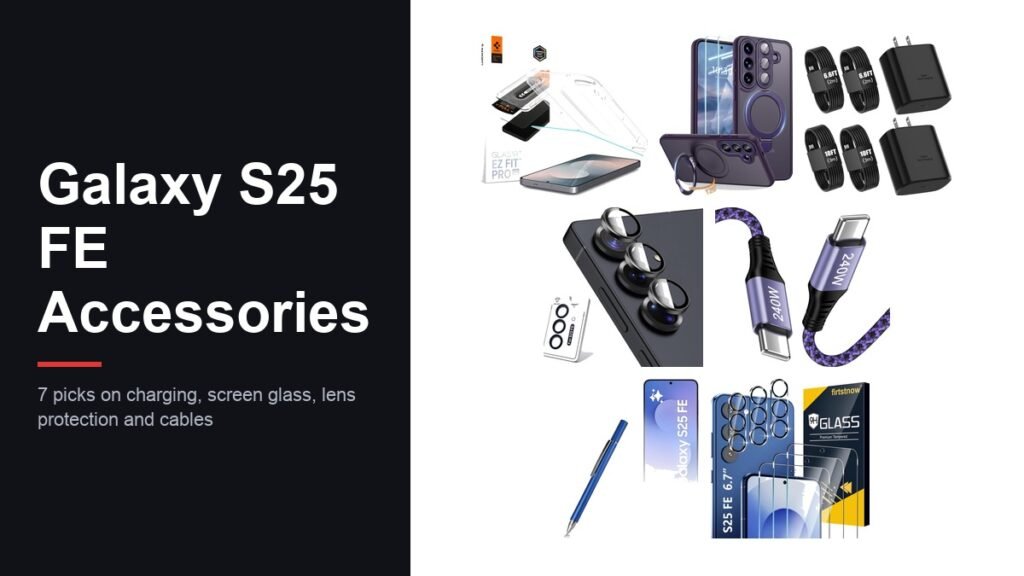
Best Galaxy S25 FE Accessories: 7 Picks Compared
Seven Galaxy S25 FE accessories compared across charging, screen glass, lens protection, cases and cables, with Samsung's own published figures for context.
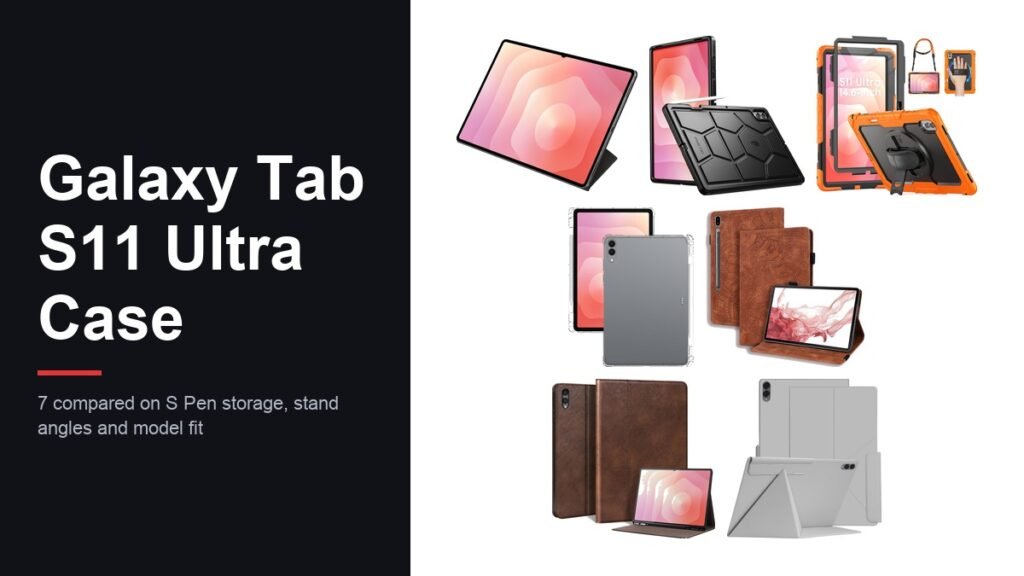
Best Galaxy Tab S11 Ultra Case: 7 Picks Compared
Seven Galaxy Tab S11 Ultra cases compared on S Pen storage, stand angles, hand straps and which of them also fit the Tab S12 Ultra.
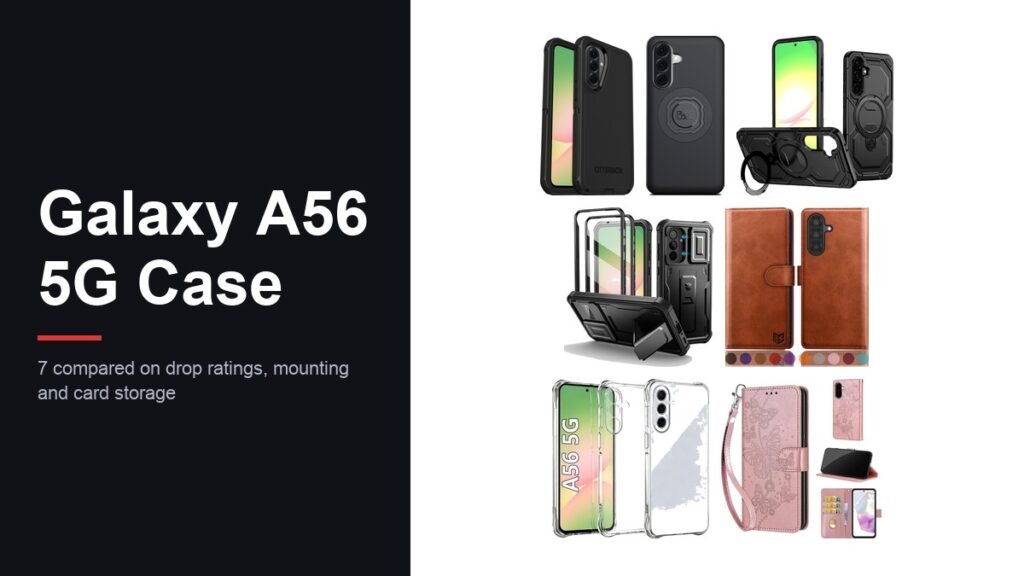
Best Galaxy A56 5G Case: 7 Compared on Drops and Mounts
Seven Galaxy A56 5G cases compared on drop testing, mounting systems, camera covers and wallet storage, with Samsung's own durability figures for context.