

WhatsApp Business API providers resell access to Meta’s Cloud API, and every one of them bills you in two layers: Meta’s per-message rate, then a fee of their own. Telnyx, Plivo and Twilio publish the clearest per-message fees, 360dialog charges a flat monthly licence per number instead, and Meta’s Cloud API stays the zero-markup baseline for teams that can build without help.
That second layer now lands on far more traffic. Since October 1, 2026, Meta charges again for replies inside the 24-hour customer service window once a number passes 1,000 in a month. The ten options below are ordered by how plainly each states its fee.
How Meta and the Provider Split a WhatsApp Bill
Meta sets the message price and the provider adds its fee on top. Since July 1, 2025, Meta charges per delivered message, by category and by the recipient’s country code, and never for messages customers send to you. No provider can lower Meta’s rate. It can only add a per-message fee, a monthly fee, or both.
Meta’s North America rates (US and Canada), effective October 1, 2026, per delivered message:
- Marketing: $0.025, though WhatsApp does not deliver marketing templates to US numbers, so in practice this applies to Canada.
- Utility: $0.0034, with volume tiers that lower it as monthly counts rise.
- Authentication: $0.0034, also with volume tiers.
- Service: $0.0034, after the first 1,000 delivered per business phone number each month.
- Meta Business Agent: $2.00 per 1 million tokens, or roughly 4 to 5 cents a message.
The market changes the bill more than the provider does. A marketing message costs $0.1365 to Germany, $0.0635 to the United Kingdom and $0.0118 to India. Meta can change its 47-market rate card only on January 1, April 1, July 1 or October 1.
WhatsApp Business API Providers and the Fee Each Adds to Meta
| # | Provider | Best for | Starting price | Free plan or trial | Fee on top of Meta |
|---|---|---|---|---|---|
| 1 | Meta Cloud API | Developers building in-house | Meta rates only | Test number; 1,000 free service messages per number | None |
| 2 | Telnyx | Teams already on Telnyx voice or SMS | $0.004 a message | Free sign-up; credit not published | $0.004 a message, no monthly fee |
| 3 | Plivo | The lowest per-message fee | $0.001 a message + $10 a month | Free sign-up; credit not published | $0.001 in and out, $10 per account monthly |
| 4 | Twilio | One API for SMS and WhatsApp | $0.005 a message | Free sign-up; limits not published | $0.005 in and out, $0.001 per failed message |
| 5 | 360dialog | High volume on a few numbers | $59 per number a month | None stated | $0 a message |
| 6 | Infobip | Enterprises wanting one all-in rate | All-in rate; custom plans via sales | Try-for-free button; limits not published | Built in (US utility $0.0048 all-in) |
| 7 | Vonage | Multi-channel Messages API users | From 0.00016 USD a message | Try-it-free button; credit not published | From 0.00016 USD, varies by volume and region |
| 8 | Bird | Teams also sending email and SMS | $0.005 per US marketing message | Free to start on some products | Published for US marketing only |
| 9 | Sinch | Large firms needing SMS fallback | Quote only | Try-for-free button; limits not published | Not published |
| 10 | Gupshup | No-code bots and campaigns | No monthly platform fee | Prepaid wallet; 1,000 AI messages free monthly | Not published in USD |
The 10 Providers, From Direct Access to Full Platforms
1. Meta Cloud API: The Zero-Markup Baseline

Price: Meta’s rates only; US utility, authentication and service $0.0034 a message from October 1, 2026. Fee on top: none. Free option: an automatic test account and test number, plus 1,000 free service messages per business number a month. Built with: Graph API for sending, webhooks for receiving.
Going direct means Meta is the only bill. Cloud API includes messaging, calling and groups, and Meta Business Agent is available only here. The test number sends templates with no payment method on file.
The catch is everything a provider would otherwise do. There is no inbox, no support desk and no one between you and Meta when a template is rejected or an invoice looks wrong. You also keep the opt-in records yourself: the WhatsApp Business Messaging Policy allows contact only with people who gave you their number and agreed to receive further messages.
2. Telnyx: A Flat $0.004 With No Monthly Fee
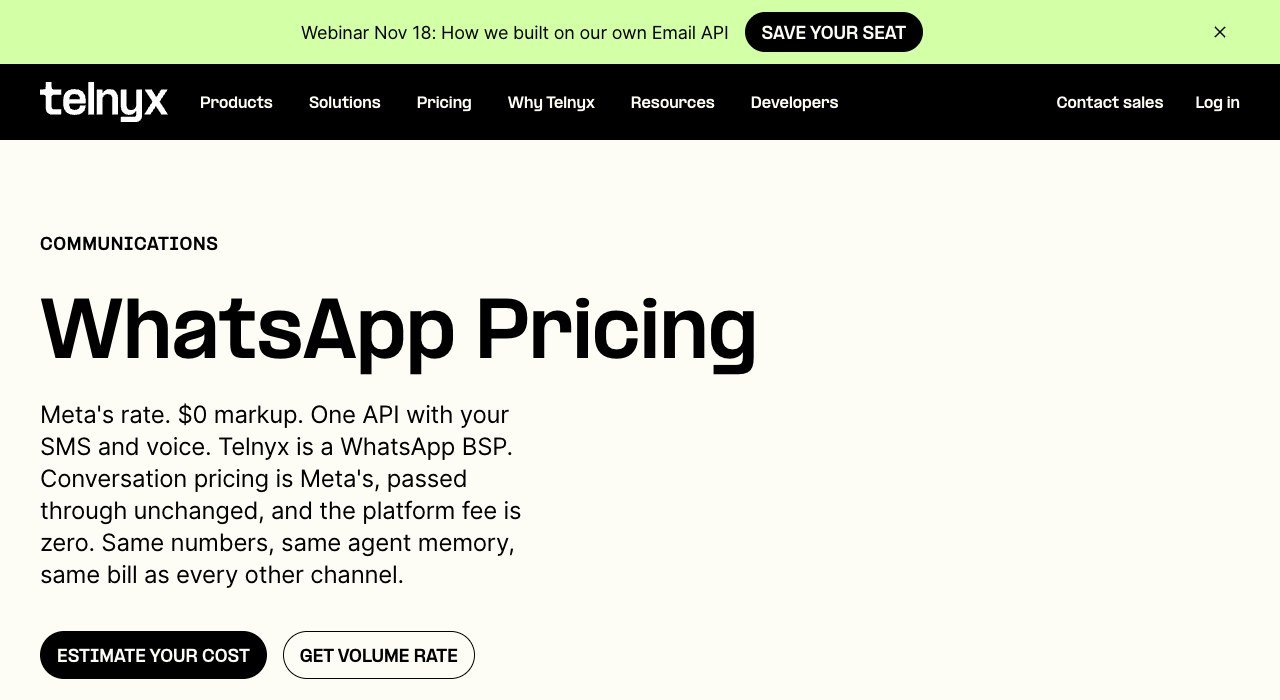
Price: $0.004 a message plus Meta’s rate; calls $0.0025 a minute. Fee on top: $0.004, no platform fee, minimum or contract. Free option: a start-building-for-free sign-up. Built with: REST API and the Mission Control portal with embedded signup.
Telnyx runs its own carrier network and puts WhatsApp messaging and calling on the same number as SMS, voice and SIP. Meta’s fees pass through unchanged and Telnyx adds $0.004 per message, so a US utility message totals $0.0074 ($0.0034 plus $0.004). Discounts apply automatically as usage grows.
Read the headline with care. Telnyx says the platform fee is zero, yet lists $0.004 per message as platform usage, so budget that figure on every send. Running an AI agent on WhatsApp adds model and speech usage.
3. Plivo: The Lowest Published Per-Message Fee
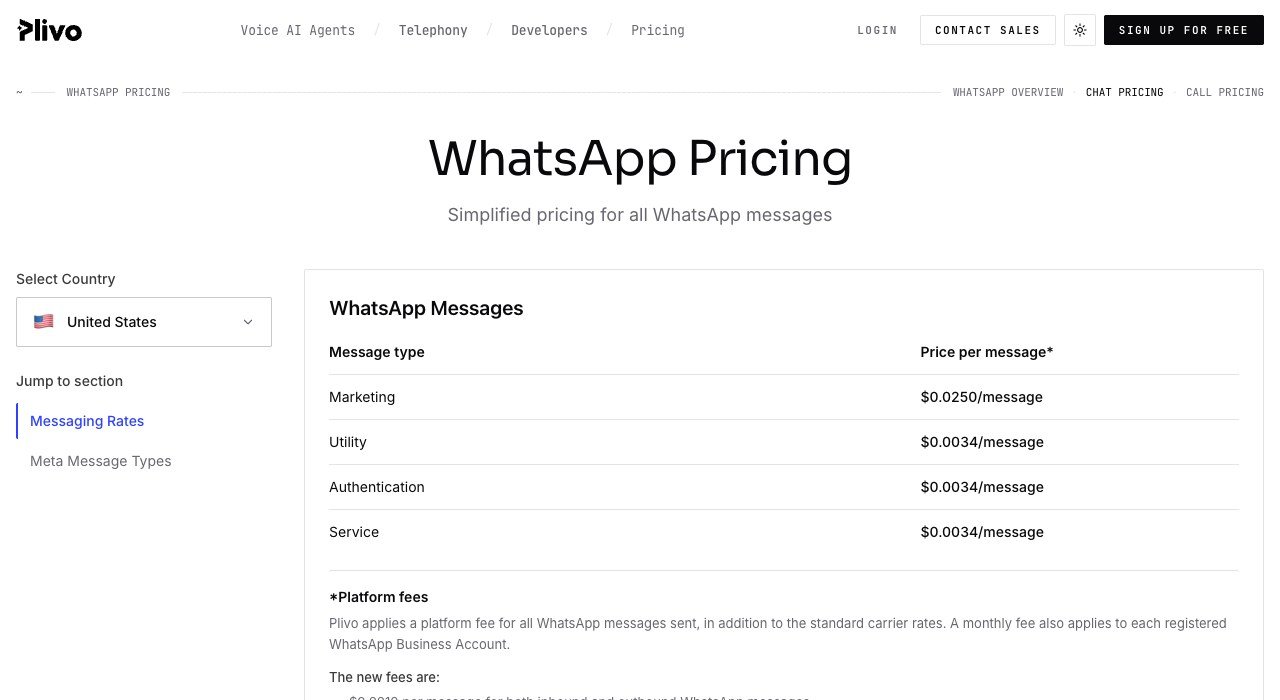
Price: $0.001 a message, inbound and outbound, plus $10 a month for each WhatsApp Business Account. Fee on top: both of those. Free option: free sign-up; Meta’s 1,000 free service messages still apply. Built with: API and console.
Plivo’s per-message fee is a quarter of Telnyx’s and a fifth of Twilio’s, which makes a US utility message $0.0044 in total. At 2,000 messages a month, $10 of Plivo’s $12 is the account fee.
Plivo describes a three-layer setup in which Meta owns the platform, Plivo hosts Cloud API as the BSP, and resellers work as Tech Providers through an embedded signup API. A number can connect in three ways: an existing Plivo number, a number from the WhatsApp Business app, or an account moved from another provider. Volume discounts are available on request.
4. Twilio: One API, a Fee in Both Directions

Price: $0.005 a message plus Meta’s fee, passed through. Fee on top: $0.005 inbound or outbound, and $0.001 for each message that ends as Failed. Free option: free sign-up; WhatsApp limits not published. Built with: the Messaging API shared with SMS, SDKs and Console.
Twilio sends WhatsApp through the same Messaging API it uses for SMS, so one integration covers both channels. A US utility message comes to $0.0084 with Meta’s $0.0034 included.
The inbound fee is the line to model. A support desk that receives 5,000 customer messages and sends 5,000 replies pays Twilio $50 a month, not $25, before Meta’s share.
- Messaging Engagement Suite (link shortening, click tracking, scheduling): $0.015 a message, first 1,000 free each month.
- WhatsApp Business Calling: $0.005 a minute inbound and outbound, plus Meta’s connectivity fee.
5. 360dialog: A Flat Licence, No Message Markup

Price: Regular $59, Premium $119, Scale $500 per number a month, plus Meta’s fees. Fee on top: $0 a message. Free option: none stated. Built with: REST API, plus Zapier, Make and n8n connectors.
360dialog works only on WhatsApp and states no markup on Meta fees, no setup fees and no minimum volumes. Regular includes 24/7 human support with a first response under 4 hours and a direct Meta escalation path. Premium cuts that to under 30 minutes and adds business verification in 48 hours.
Because the licence is per number, the maths turns on volume. Against Telnyx’s $0.004, the $59 Regular plan pays off above 14,750 messages a month on one number; against Twilio’s outbound fee, above 11,800. Five numbers cost $295 a month before a single message. The Zapier, Make and n8n connectors suit teams already running workflow automation software.
6. Infobip: One All-In Rate for Enterprises
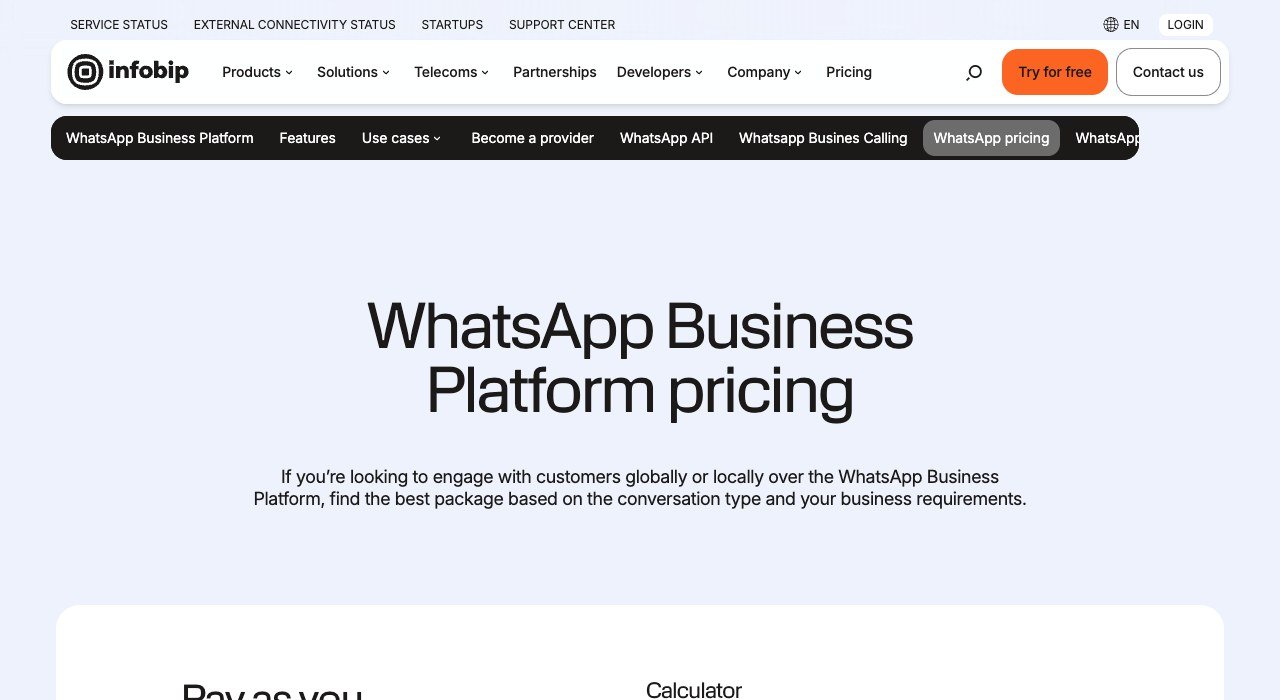
Price: all-in US rates of $0.0048 for utility, authentication and service; per-message rates run from 0.001083 to 0.227221 USD by country and type. Fee on top: built into the rate; the US utility figure sits $0.0014 above Meta’s $0.0034. Free option: a try-for-free button. Built with: API, a broadcast tool and sales-built plans.
Infobip quotes one number per message with Meta’s fee folded in, which suits finance teams that want a single line per country. The rates are indicative, refreshed daily, and final pricing varies by volume, contract and account. Separate rows cover marketing through the Marketing Messages API.
Skip the US marketing rows when you budget: WhatsApp does not deliver marketing templates to US numbers. Infobip also runs a Tech Provider Program for software vendors that want to resell access.
7. Vonage: A Fee From 0.00016 USD Across Six Channels

Price: a Vonage platform fee that starts as low as 0.0001 EUR (0.00016 USD) a message, plus Meta’s fee. Fee on top: adjusts by volume and region. Free option: a try-it-free button. Built with: the Messages API for WhatsApp, RCS, SMS, Viber, Messenger and email.
Vonage, part of Ericsson, says higher volume to a region lowers its incremental fee. Since October 1, 2026, in-window service replies and utility templates are charged by Meta, and the Vonage platform fee applies to them too.
Regulated buyers get extra options: HIPAA-supportable builds with a signed BAA, an Audit API at $550 a month and Auto-redact at $1,100 a month. Only the fee floor is stated, so request a quote for your markets.
8. Bird: WhatsApp Beside Email and SMS

Price: $0.005 per US marketing message plus Meta fees; other types priced by destination. Fee on top: published for US marketing only. Free option: a free-to-start tier on some products. Built with: API and the Studio template builder.
Bird, formerly MessageBird, runs one prepaid wallet across its products. Studio builds cards, carousels and authentication templates, and analytics break failures down by template, business number and country, then reconcile them against Meta’s billing categories.
The one published WhatsApp fee covers US marketing messages, a type WhatsApp does not deliver to US numbers. Ask Bird for its utility and service fees before you compare it with Telnyx or Twilio.
9. Sinch: Conversation API With SMS Fallback
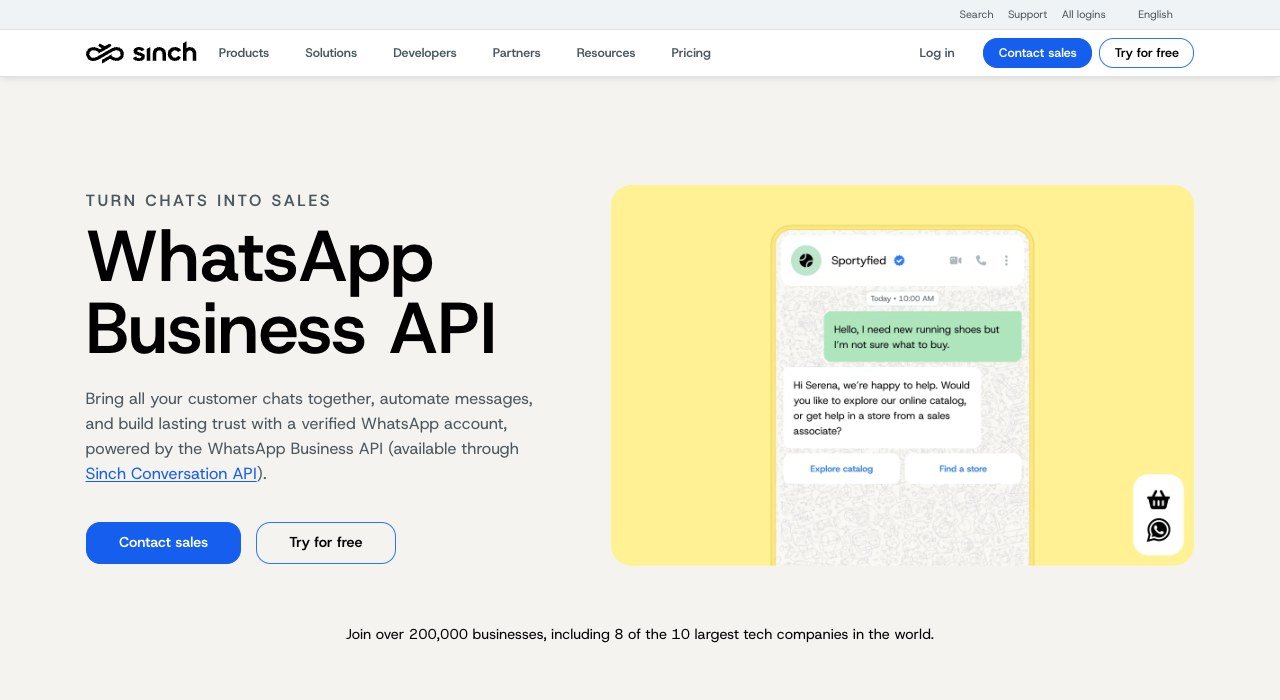
Price: quote only. Fee on top: not published; Sinch says pricing is per message and depends on the initiator, template category and market. Free option: a try-for-free button. Built with: the Conversation API.
Sinch exposes WhatsApp through its Conversation API with templates, Flows, Payments, voice calling and max-price support for the Marketing Messages API. SMS fallback is built in. Sinch calls itself an official Meta Premier Partner and says over 200,000 businesses use it.
WhatsApp is missing from the main Sinch pricing hub, which lists SMS, voice and RCS, so budgeting starts with a sales call. It fits existing Sinch SMS or voice customers.
10. Gupshup: No-Code Bots With No Monthly Fee
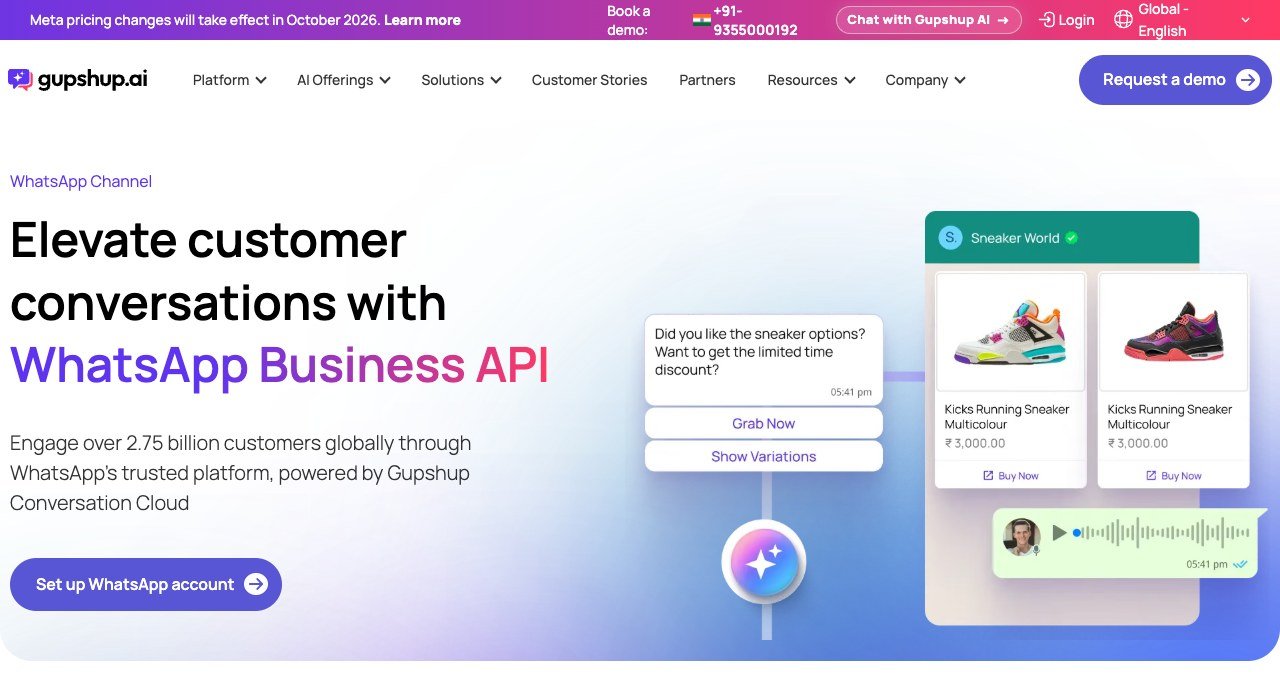
Price: no monthly platform fee on pay-as-you-go; prepaid wallet; Enterprise gets a custom rate card. Fee on top: not published in USD. Free option: 1,000 AI messages free every month. Built with: API, a no-code bot builder and a live agent dashboard.
Each Gupshup account includes 10 agent seats, 5 chatbot flows and 5 AI agents, with integrations for Shopify, Zoho, HubSpot, Salesforce, MoEngage, CleverTap, Bloomreach and Braze. Gupshup says it handles 120 billion+ messages a year for 50,000+ customers in 130+ countries.
It is the entry here best suited to teams that do not write code. Ask for a rate card in your billing currency before comparing it with the APIs above.
What 10,000 US Utility Messages Cost Through Each Provider
Take one US number sending 10,000 utility templates a month at Meta’s $0.0034 list rate, before volume tiers. Meta’s share is $34 whichever route you pick.
- Meta Cloud API direct: $34.
- Infobip all-in rate: 10,000 times $0.0048, or $48.
- Plivo: $34 plus $10 in message fees plus the $10 account fee, or $54.
- Telnyx: $34 plus $40, or $74.
- Twilio: $34 plus $50, or $84, before any inbound replies.
- 360dialog Regular: $34 plus $59, or $93, and the $59 stays flat as volume grows.
At 50,000 messages the order shifts. Telnyx’s share rises to $200 and Twilio’s to $250, while 360dialog stays at $59 and Plivo reaches $60. Twilio and Plivo also bill inbound messages, so two-way support traffic doubles their share.
The October 2026 Change That Raised Support Costs
On October 1, 2026, Meta resumed charging for two kinds of message that had been free. Service messages, the non-template replies inside the 24-hour window, had been free since November 1, 2024. Utility templates sent inside an open window had been free since July 1, 2025. Both now bill per message.
- Each business phone number gets 1,000 free delivered service messages a month. The allowance does not roll over and resets at midnight in the Messaging account’s timezone.
- An account with no payment method keeps delivering service messages only until that free tier is used.
- Eligible government and non-profit organisations keep service messages free beyond 1,000 through December 31, 2027.
- A Free Entry Point window, opened when you reply to someone who came from a Click to WhatsApp ad, can stay open up to 7 days, and Meta charges nothing for marketing, utility, authentication or service messages inside it. Meta Business Agent messages are still charged.
Per-message fees from Telnyx, Twilio, Plivo and Vonage now sit on top of replies that used to be free. A help desk that pairs its WhatsApp queue with one of the CRM platforms priced per seat now pays a message cost on top of its seat count.
Dates That Decide What an API Provider Must Support
- October 23, 2025: the final On-Premises API client expired, and On-Premises can no longer send messages. Any account now runs on Cloud API.
- April 13, 2027: Messaging accounts created on or after this date cannot send marketing messages through Cloud API.
- October 13, 2027: Cloud API stops supporting marketing messages for everyone, and marketing moves to the Marketing Messages API for WhatsApp.
- No date: WhatsApp does not currently deliver marketing templates to US numbers (error 131049), and no end date is given.
The 2027 dates make Marketing Messages API support a question for every provider. Infobip already publishes separate rates for it, and Sinch supports its optional max price per message.
How to Pick a WhatsApp API Provider for Your Stack
- You have developers and want the lowest bill: start on Meta Cloud API directly; there is no fee on top.
- You want a provider but low volume: Telnyx at $0.004 with no monthly fee, or Plivo if one account sends enough that its $0.001 rate offsets the $10 a month.
- You already run SMS: stay with that platform if it is Twilio, Telnyx, Plivo, Vonage or Sinch.
- You send high volume from a few numbers: 360dialog’s flat licence beats per-message fees above roughly 12,000 to 15,000 messages a number.
- You need one all-in contract: Infobip or Sinch, priced through sales.
- You have no developers: Gupshup’s no-code builder.
Frequently Asked Questions
Do WhatsApp Business API providers charge less than Meta?
No. Meta’s per-message rate is the same through every provider, and the provider adds its own fee. Infobip folds both into one figure, but its $0.0048 US utility rate is still above Meta’s $0.0034.
Can I use the WhatsApp Business API without a provider?
Yes. Meta’s Cloud API is open to any business with a developer, and it creates a test account and number automatically. You give up an inbox and a support team.
Are replies to customers still free?
Only the first 1,000 delivered service messages per business number each month. After that, US replies cost $0.0034 each from Meta, plus any provider fee.
Can I send WhatsApp marketing messages to US customers?
No. WhatsApp does not currently deliver marketing templates to US phone numbers. Utility and service messages still reach them.
Related Articles

Get the Fox Bulletin briefing
The stories that matter, in your inbox. No spam, unsubscribe anytime.
Newsletter signup will be available soon.
Related stories

How to Add Your Business to ChatGPT Business Hub
Add your business to ChatGPT through Business Hub: find or create the listing, verify by phone, email, DNS or Shopify, pass Persona and fill in your profile.

WhatsApp Marketing Software: 10 Tools by Broadcast Plan
WhatsApp marketing software ranked by the plan that adds broadcasts: Zoko has them from $49.99, respond.io from $159 and Brevo only at $499 a month.
Website Screenshot Software: 10 Tools From Free to API
Website screenshot software in four types: Chrome and Firefox capture full pages free, GoFullPage has 11 million users, and hosted APIs start at $15 a month.