

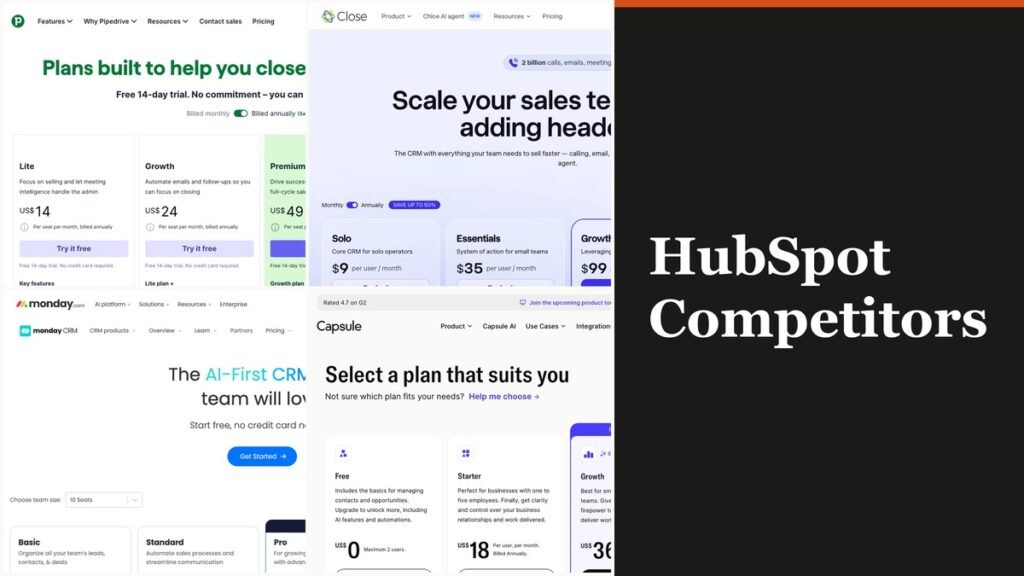
HubSpot competitors get searched for one reason, and it is rarely the features. HubSpot does not charge a single per-user price. It charges for a Core Seat and then, for anyone who actually sells, a Sales Seat on top, and the two stack.
At Professional that is $50 plus $100, so $150 a month for one seller. Five of them is $750 a month before a single marketing contact is counted. The ten platforms below are priced against that figure rather than against the headline on a comparison page.
How HubSpot Seat Pricing Actually Adds Up
HubSpot publishes its seat rates in a product catalog, and they are worth reading before any comparison. A Core Seat grants access to whatever you have bought. A Sales, Service or Revenue Seat grants the full hub on top of it.

| Seat type | Starter | Professional | Enterprise |
|---|---|---|---|
| Core Seat | $20 | $50 | $75 |
| Sales Seat | Not available | $100 | $150 |
| Service Seat | Not available | $100 | $150 |
| Revenue Seat | Not available | $95 | $140 |
| View-Only Seat | No extra cost | No extra cost | No extra cost |
The free tier is genuine and covers up to two users, which is more than most rivals give away. The jump comes at the third person and again at the first seller who needs sequences, because that is a Sales Seat rather than a Core Seat. View-only access costs nothing, which is the one lever most teams miss.
Credits are the other line. They are charged at $0.010 each, with capacity packs at $10 for a thousand, and they meter the AI and automation features rather than the seats. A quiet month and a busy month do not cost the same.
HubSpot Competitors Compared on Entry Price and Pricing Model
All ten, with the cheapest paid tier each publishes and the way each one meters. The pricing model column matters more than the entry price, because it decides what happens when the team or the list grows.
| # | Platform | Best for | Entry price | Free tier | Priced by |
|---|---|---|---|---|---|
| 1 | Pipedrive | Pipeline management without the suite | $14 per seat a month | No, 14-day trial | Per seat, flat |
| 2 | Less Annoying CRM | One price, every feature | $15 per user a month | No, 30-day trial | Per user, single tier |
| 3 | Capsule CRM | Small teams that want a free start | $18 per user a month | Yes, 2 users | Per user, tiered |
| 4 | Attio | Data-led teams that build their own model | $35 per user a month | Yes, 3 seats | Per user, tiered |
| 5 | monday CRM | Teams already running monday boards | $12 per seat a month | No, free trial | Per seat, seat minimums |
| 6 | EngageBay | Marketing and CRM on one cheap bill | $12.74 per user a month | Yes, 250 contacts | Per user, contact tiers |
| 7 | Insightly | CRM tied to project delivery | $29 per user a month | No, 14-day trial | Per user, tiered |
| 8 | Close | Outbound teams that live on the phone | $9 per user a month | No, free trial | Per user, tiered |
| 9 | ActiveCampaign | Automation-heavy marketing | $15 a month at 1,000 contacts | No, free trial | By contact count |
| 10 | Salesforce | Growing past what a light CRM holds | $25 per user a month | Yes, Free Suite | Per user, editions |
The Ten Platforms in Detail
1. Pipedrive: Pipeline management without the suite

Entry price: $14 per seat a month. Free tier: No, 14-day trial. Priced by: Per seat, flat.
Pipedrive sells one thing and prices it like one thing. There is no marketing hub bolted alongside and no second seat type to buy. Lite is $14 a seat, Growth $24, Premium $49 and Ultimate $69, each billed annually.
Five sellers on Premium is $245 a month, all in. The deliberate narrowness is the point: if your problem is that deals fall out of the pipeline rather than that marketing and sales cannot see each other, you are paying for the suite you do not use.
2. Less Annoying CRM: One price, every feature

Entry price: $15 per user a month. Free tier: No, 30-day trial. Priced by: Per user, single tier.
Less Annoying CRM charges $15 a user a month and gives everyone everything. No tiers, no feature gates, no seat types, no annual commitment required to reach the headline number. The pricing page is one figure.
Five users is $75 a month, which is the cheapest serious entry on this list by some distance. What you give up is depth: no marketing automation, no sequences, no forecasting. For a small team that wants contacts, notes and follow-ups to stop living in a spreadsheet, that is enough.
3. Capsule CRM: Small teams that want a free start

Entry price: $18 per user a month. Free tier: Yes, 2 users. Priced by: Per user, tiered.
Capsule starts free for two users and 250 contacts, which is a real starting point rather than a countdown. Paid tiers are Starter $18, Growth $36 and Advanced $54 a user a month on annual billing.
The free tier matters here because it matches the shape of HubSpot’s own free offer, two users, without the pull toward a paid seat the moment you add a third person. Capsule’s ladder climbs gently, and the top tier costs less than a single HubSpot Sales Seat.
4. Attio: Data-led teams that build their own model

Entry price: $35 per user a month. Free tier: Yes, 3 seats. Priced by: Per user, tiered.
Attio is the newest shape in this list: a CRM you model yourself, built around records and relationships rather than a fixed deal pipeline. Free covers three seats, Plus is $35 and Pro $79 a user billed annually, rising to $44 and $99 month to month.
It suits teams whose sales motion does not fit a standard pipeline, which is exactly where HubSpot’s opinionated objects start to chafe. The trade is that you do the modelling work yourself, and there is no marketing side to the product at all.
5. monday CRM: Teams already running monday boards

Entry price: $12 per seat a month. Free tier: No, free trial. Priced by: Per seat, seat minimums.
monday CRM is the sales layer on top of monday’s work platform, so it makes most sense for teams already running boards there. Basic is $12 a seat, Standard $17 and Pro $28 on annual billing, against $18, $25 and $41 paid monthly.
The monthly premium is around 45 percent, among the steepest here, so the advertised figure assumes a year up front. Seat minimums apply, which means the three-person team quoting itself $36 a month should check the smallest bundle it is allowed to buy.
6. EngageBay: Marketing and CRM on one cheap bill

Entry price: $12.74 per user a month. Free tier: Yes, 250 contacts. Priced by: Per user, contact tiers.
EngageBay is the closest thing on this list to HubSpot’s actual shape, marketing, sales and service in one account, at roughly a tenth of the price. Free covers 250 contacts; Basic is $12.74, Growth $55.24 and Pro $101.99 a user a month.
Pricing is by user and contact count together, so both numbers have to be checked against your list. The product is less polished than HubSpot and the integrations are thinner, which is the honest reason the price is where it is.
7. Insightly: CRM tied to project delivery

Entry price: $29 per user a month. Free tier: No, 14-day trial. Priced by: Per user, tiered.
Insightly joins the CRM to project delivery, so a won deal becomes a project with tasks and milestones rather than a closed record. Plus is $29, Professional $49 and Enterprise $99 a user a month billed annually.
That makes it a fit for agencies and services businesses where the work starts when the sale ends. Marketing automation and support are sold as separate products, so the per-user figure is the CRM alone rather than the whole platform.
8. Close: Outbound teams that live on the phone

Entry price: $9 per user a month. Free tier: No, free trial. Priced by: Per user, tiered.
Close is built for teams that sell by calling. The dialler, email sequences and SMS are in the product rather than bolted on, and the whole interface assumes a rep working a list. Solo is $9 a user a month, Essentials $35, Growth $99 and Scale $139.
Growth at $99 is the tier most outbound teams land on, which puts five reps at $495 a month. That is real money, and still a third less than the same five on HubSpot Sales Hub Professional once both seat types are counted.
9. ActiveCampaign: Automation-heavy marketing

Entry price: $15 a month at 1,000 contacts. Free tier: No, free trial. Priced by: By contact count.
ActiveCampaign prices on contacts rather than people, which flips the arithmetic completely. Starter is $15 a month at 1,000 contacts, Plus $49, Pro $79 and Enterprise $145, all billed yearly at that contact tier.
A ten-person team with a small list pays the same as one person with the same list, so it rewards headcount and punishes list growth. If the reason HubSpot got expensive was marketing contacts rather than sellers, this is the swap that addresses it directly.
10. Salesforce: Growing past what a light CRM holds

Entry price: $25 per user a month. Free tier: Yes, Free Suite. Priced by: Per user, editions.
Salesforce is on this list because teams leaving HubSpot often leave upward rather than downward. Free Suite is $0, Starter $25, Pro $100, Core $195 and Advanced $395 a user a month.
Starter at $25 undercuts a HubSpot Professional Core Seat, and Pro at $100 sits where a HubSpot Sales Seat sits. The difference is what the number buys: Salesforce assumes you will configure it, and the configuration is usually where the real cost shows up.
What Five Sellers Cost on Each Platform
One seat tells you almost nothing. Five sellers on a working tier is the figure that decides a migration, and the spread is wider than any feature difference.
- HubSpot Sales Hub Professional: $750 a month, being five Core Seats at $50 plus five Sales Seats at $100.
- Close Growth: $495 a month at $99 a user.
- Salesforce Pro Suite: $500 a month at $100 a user.
- Insightly Professional: $245 a month at $49 a user.
- Pipedrive Premium: $245 a month at $49 a seat.
- Capsule Growth: $180 a month at $36 a user.
- monday CRM Pro: $140 a month at $28 a seat on annual billing.
- Less Annoying CRM: $75 a month at $15 a user, with nothing withheld.
The gap between the top and the bottom of that list is tenfold. Some of it buys real capability, and some of it buys a marketing hub the sales team never opens. Work out which seats in your own account are Sales Seats and which could be Core or view-only before you price a replacement at all.
Three Pricing Models Hiding Behind One Word
Every platform here says it charges per user, and three of them mean something different by it. The model decides which direction your bill grows.
- Per seat, flat: Pipedrive, Close, Insightly, Less Annoying. Adding a person adds a fixed amount and the list size is irrelevant.
- Per seat with types: HubSpot. The same person costs $50 or $150 depending on what they do, and the account mixes both.
- By contact count: ActiveCampaign, and EngageBay partly. Headcount is nearly free and list growth is what bills you.
A sales team of twelve with 800 contacts and a marketing team of two with 80,000 contacts are opposite problems, and the cheapest answer for one is the most expensive answer for the other. Teams reviewing their whole software bill tend to find the same pattern in payment management systems.
What Leaving Costs Before You Save Anything
A CRM holds the one dataset a business cannot rebuild. Contacts, deal history, email threads and call notes are the record of every relationship you have, and they do not all export cleanly.
Customer data also carries obligations that follow it to the new platform. California’s Consumer Privacy Act gives residents rights over records a business holds about them, and the General Data Protection Regulation applies the moment a contact sits in the EU. A migration is a processing activity, not a file copy.
- Export contacts, companies, deals and notes as separate files. A single combined export loses the associations between them almost every time.
- Pull email and call logs before the account closes. These are usually the first thing a downgrade withholds and the hardest to recreate.
- Record which automations are running and what triggers them. Workflows never migrate, and rebuilding them from memory is where the real time goes.
- Keep the old account on a free or view-only tier for a quarter rather than cancelling, so the history stays readable while the new system beds in.
Budget the rebuild rather than the subscription. The platforms here that look cheapest are generally the ones with the least to rebuild, which is a large part of why they are cheaper. Businesses sizing up their other recurring software often start with the QuickBooks alternatives for the same reason.
How to Choose a HubSpot Competitor
The right shortlist comes from the reason the bill grew, not from a feature matrix. Four reasons cover nearly everyone.
- Too many Sales Seats: Pipedrive or Close, where one seat is one price.
- Too many marketing contacts: ActiveCampaign or EngageBay, priced on the list rather than the team.
- You only ever used the CRM: Less Annoying CRM or Capsule, and stop paying for the hubs entirely.
- You are outgrowing it upward: Salesforce, with the configuration cost budgeted honestly.
Check the billing period before comparing anything. monday CRM is $12 a seat annually and $18 monthly, Attio $35 against $44, and those gaps are larger than most of the feature differences people agonise over. Sales teams that also rely on prospecting data should price that separately, because the ZoomInfo alternatives are a different budget line with its own per-seat trap.
Frequently Asked Questions
Why is HubSpot so expensive per user?
Because most sellers need two seats, not one. A Core Seat at Professional is $50 a month and a Sales Seat is another $100, so a working salesperson costs $150. Rivals that charge a single flat rate per user look far cheaper at the same headcount for that reason alone.
Is there a free HubSpot competitor?
Capsule is free for two users and 250 contacts, Attio for three seats, EngageBay to 250 contacts, and Salesforce publishes a Free Suite. HubSpot’s own free tier covers up to two users, so free alone is rarely the reason to move.
Which HubSpot competitor is cheapest for a five-person team?
Less Annoying CRM at $75 a month, being $15 a user with every feature included. monday CRM Pro is next at $140 on annual billing, then Capsule Growth at $180. The same five on HubSpot Sales Hub Professional is $750.
Can I move HubSpot data to another CRM without losing anything?
Contacts, companies and deals export reliably. Email threads, call recordings and workflow logic usually do not, and the associations between records often break when everything is exported in one file. Export each object separately and keep the old account readable for a quarter.
Related Articles

Get the Fox Bulletin briefing
The stories that matter, in your inbox. No spam, unsubscribe anytime.
Newsletter signup will be available soon.
Related stories
DocuSign Alternatives: 10 E-Signature Tools Priced
DocuSign Personal allows five envelopes a month for $11. Ten DocuSign alternatives compared on sending limits, per-seat cost and free tiers.
QuickBooks Alternative: 10 Options Priced and Ranked
QuickBooks Online starts at $38 a month. Every QuickBooks alternative here is compared on list price, free tier and what each one quietly withholds.
Cross-Border Payments: How Businesses Cut Cost and Delay
The average business-to-business cross-border payment costs 1.6% of the amount sent and only 2.2% land within an hour. Where the friction comes from and how a finance team removes it.