

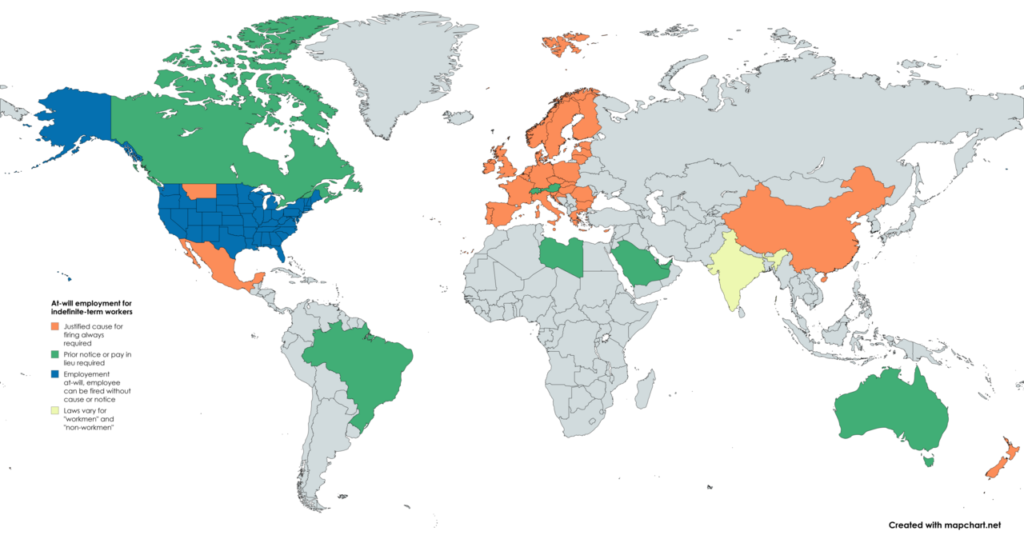
Employment at Will Explained by State, At‑will employment means either the employer or the employee can end the relationship at any time, for any lawful reason, with no advance notice required. In practice the rule is the default in 49 states and the District of Columbia, but each state has carved out exceptions that limit an employer’s freedom to fire. Those exceptions-public‑policy, implied‑contract, and good‑faith-vary widely, and Montana stands alone with a statutory “just cause” requirement. We think the patchwork of state rules makes it essential for both workers and managers to know exactly where the line is drawn. See also: dying Without a Will: Who Inherits Under State Law
How does at‑will employment actually work in most states?
When a new hire signs an offer letter that says “employment is at‑will,” courts start from the presumption that the employer can terminate without cause. The presumption can be knocked down by a written contract, a clear handbook promise, or a state‑specific statutory exception. For example, the California Labor Code §2922 explicitly states the at‑will presumption, yet California also recognizes an implied‑contract exception when an employer’s policies suggest job security. The rule’s flexibility is meant to let businesses adapt quickly, but it also leaves employees vulnerable unless they understand the local carve‑outs.
What are the three major exceptions that limit at‑will firing?
Across the country, three legal doctrines temper the at‑will rule:

- Public‑policy exception, prohibits termination that violates a clearly established public policy, such as firing someone for filing a workers’ compensation claim or serving on a jury.
- Implied‑contract exception, arises when an employer’s handbook, offer letter, or verbal assurances create a reasonable expectation of continued employment.
- Covenant of good faith and fair dealing, recognized in a minority of states, it bars terminations made in bad faith, such as firing an employee to avoid paying a commission.
Each state decides whether to adopt one, two, or all three exceptions, and the strength of each varies. In Wikipedia’s entry on at‑will employment you’ll see that roughly 43 states recognize the public‑policy exception, while about 38 states apply the implied‑contract rule.
Which state does not follow the at‑will default?
Montana is the sole non‑at‑will jurisdiction. Under the Wrongful Discharge from Employment Act (WDEA), an employer must show “good cause” to terminate an employee after the probationary period, which is typically 12 months. The WDEA also provides the exclusive remedy for wrongful discharge, meaning an employee cannot bring a separate common‑law claim. Montana’s approach forces employers to document performance issues more rigorously than in neighboring states.
How does at‑will compare to contract employment?
| Aspect | At‑Will Employment | Contract Employment |
|---|---|---|
| Termination notice | No statutory notice required; either side may quit instantly. | Notice period defined by contract; breach may trigger damages. |
| Cause requirement | None, except for illegal reasons or state exceptions. | Usually “for cause” as defined in the agreement; otherwise termination may be wrongful. |
| Legal protections | Relies on statutory exceptions (public‑policy, implied‑contract, good‑faith). | Contract terms can add additional protections, such as severance. |
| Typical use | Most private‑sector jobs, especially small businesses. | Executive roles, union positions, or jobs with specialized duties. |
In California, for instance, an at‑will employee who receives a handbook promising “no‑layoff without cause” may be able to treat that promise as an implied contract. By contrast, a software engineer in New York who signs a two‑year agreement with a severance clause can’t be fired without risking a breach‑of‑contract lawsuit, even though New York is an at‑will state. The Tinyteam guide notes that “the freedom cuts both ways”, employers gain agility, while employees lose the security that a contract provides.
Where does the public‑policy exception apply?
The public‑policy exception blocks terminations that contravene well‑established public interests. Common examples include:
- Firing an employee for filing a discrimination complaint under Title VII.
- Terminating someone for taking Family and Medical Leave Act (FMLA) leave.
- Dismissal for refusing to break the law, such as refusing to falsify safety reports.
According to Recording Law’s at‑will employment analysis, roughly 43 states have adopted this exception, but the scope can differ. In Texas, the courts have been reluctant to find a public‑policy violation unless the employee can show a “clearly established” policy, while Washington State’s courts apply the rule more liberally, especially for whistle‑blower claims.
What are the implied‑contract rules that can override at‑will status?
An implied contract can arise from several sources:
- Employee handbook language, If the handbook states that employees “will not be terminated without cause,” a court may read that as a contract, unless the handbook includes a strong disclaimer.
- Offer‑letter promises, Specific statements about job security, performance reviews, or tenure can create enforceable expectations.
- Oral assurances, Verbal promises from a supervisor may be enough if the employee relied on them, though proving them is harder.
Many employers counteract this risk by adding a disclaimer that “nothing in this handbook alters the at‑will nature of your employment unless signed by the CEO.” The National Labor Relations Board has warned that such blanket language can be unlawful if it masks an actual promise of security.
How does the covenant of good faith and fair dealing affect termination?
Only about a dozen states recognize a covenant of good faith and fair dealing in employment. In those jurisdictions, an employer cannot fire an employee for reasons that are “malicious, in bad faith, or motivated by a desire to avoid obligations.” For example, in Missouri, a court found that firing a sales rep just before a large commission payout violated the covenant, awarding damages. The exception is narrow, but it adds another layer of protection for employees who might otherwise be vulnerable to purely arbitrary dismissals.
Common Misunderstandings
Myth 1: At‑will means I can be fired for any reason, even illegal ones. The rule never overrides federal anti‑discrimination statutes, the FMLA, or state public‑policy exceptions. Employers who try to hide an illegal motive behind “at‑will” risk costly lawsuits.
Myth 2: A signed at‑will acknowledgment eliminates all rights. While the acknowledgment strengthens the presumption, courts will still enforce an implied contract or public‑policy exception if the employer’s actions contradict the disclaimer. See also: right-to-Work States: All 26 Listed and Explained
Myth 3: I must give notice when I quit because the employer can quit without notice. No state requires an employee to give notice under at‑will doctrine, though professional courtesy and contractual obligations may dictate otherwise. See also: types of Power of Attorney: All 5 Explained
Further Reading

Frequently Asked Questions
Can an employer change my at‑will status without my consent?
Only if the change is documented in a new written agreement signed by both parties. A unilateral policy update in a handbook does not convert an at‑will employee into a contract employee.
Do I need to give two weeks’ notice if I’m leaving an at‑will job?
Legally, no. The at‑will doctrine imposes no notice requirement on the employee. However, many industries expect a two‑week heads‑up, and failure to provide it could burn bridges or affect future references.
What happens if my employer fires me for “poor performance” but I think it’s a pretext?
If you can show that the “poor performance” claim masks an illegal motive-like discrimination or retaliation-you may invoke the public‑policy or anti‑discrimination exception. Documentation of performance issues and a clear timeline are crucial to prove or disprove the employer’s stated reason.
Are there any states where at‑will does not apply to public‑sector employees?
Yes. Many states require “just cause” for civil service employees, teachers, and police officers, regardless of the private‑sector default. For example, New York’s civil service rules demand cause for dismissal of most public employees.
How does the at‑will rule intersect with right‑to‑work laws?
Both concepts promote labor market flexibility, but they address different issues. Right‑to‑work statutes prevent unions from requiring membership as a condition of employment, while at‑will governs the employer’s ability to terminate. Some right‑to‑work states also have strong at‑will presumptions, but the two doctrines are independent.
Can I negotiate an at‑will employee handbook to include severance?
Yes. If the employer agrees in writing to provide severance upon termination, that provision becomes a contractual term that overrides the at‑will presumption. The key is to have the agreement signed by someone with authority, typically the CEO.
The Bottom Line
At‑will employment is the default across the United States, but state‑specific exceptions and Montana’s “just cause” rule can dramatically alter an employee’s rights. Know which exceptions apply in your state, keep written agreements clear, and document any promises made by your employer.
Related on Fox Bulletin
- dying Without a Will: Who Inherits Under State Law
- right-to-Work States: All 26 Listed and Explained
- types of Power of Attorney: All 5 Explained
Frequently Asked Questions
Who is #1 in Employment at Will Explained by State?
The #1 entry leads on the core metric (explained with state-by-state rules). See the full ranking above for the verified figure and context.
How was this top 10 ranked?
We used independently verifiable figures and broke ties by longevity and breadth of sources.
How often is this list updated?
We review Fox Bulletin rankings regularly and update when new certified figures are published.

Get the Fox Bulletin briefing
The stories that matter, in your inbox. No spam, unsubscribe anytime.
Newsletter signup will be available soon.
Related stories

Italy Moves Toward Paid Leave for Workers With Sick Pets
Italy is set to approve paid leave for workers caring for sick pets, marking a rare step in European labor law. The government plans to introduce a minimum of three days of paid sick‑pet leave, with t

Right-to-Work States: All 26 Listed and Explained
Twenty-six US states have right-to-work laws, meaning no worker can be required to join a union or pay union dues as a condition of employment.

Common Law Marriage States: Where It Still Exists
Only seven US states and the District of Columbia still allow couples to enter a common law marriage.