

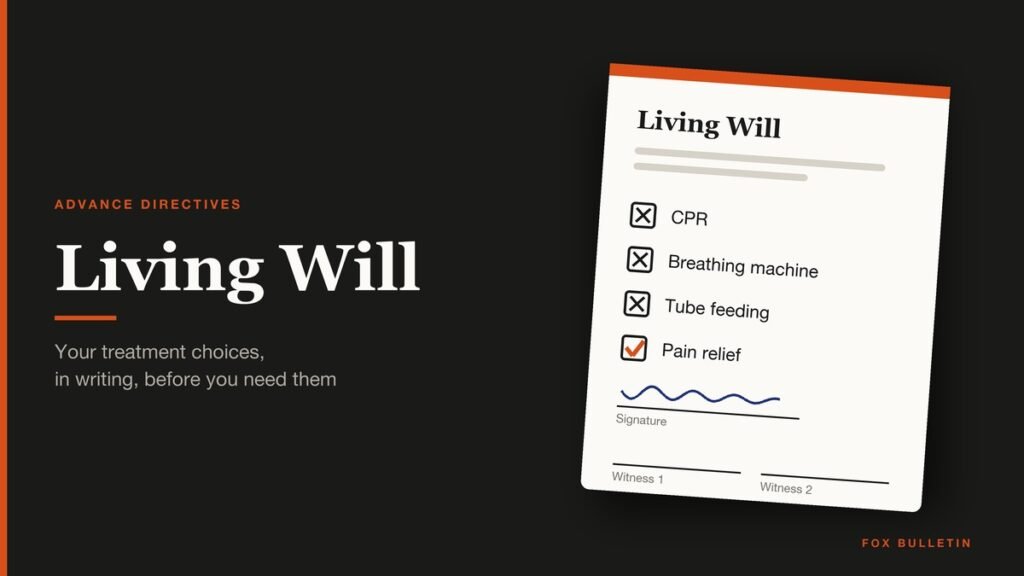
A living will is a legal document that tells doctors which medical treatments you want, and which you refuse, if you become too ill to speak for yourself. It takes effect only when you cannot communicate, and in many states only once you also have a qualifying condition such as a terminal illness or permanent unconsciousness. It covers choices such as CPR, breathing machines and tube feeding.
Fewer Americans have one than you might expect. A 2017 Health Affairs review of 150 studies published from 2011 to 2016 found that 36.7% of the U.S. adults studied had any advance directive and 29.3% had a living will. This guide covers what the document does, the treatments it should address, the real signing rules in six places, and how to change it later.
What Is a Living Will?
The National Institute on Aging describes a living will as a legal document telling doctors how you want to be treated if you cannot make your own decisions about emergency care. It can list the treatments you want, the ones you would avoid, and the conditions under which each choice applies.
A living will is one type of advance directive. The other common type is a durable power of attorney for health care, which names a person, often called a health care proxy, to make decisions for you. NIA says you can choose a proxy in addition to a living will or instead of one. Our guide to the types of power of attorney explains how the health care version differs from the financial ones.
The name causes confusion. A living will has nothing to do with property. A last will and testament controls your estate after death, while a living will speaks only to medical care while you are alive. If you die without the property document, state law decides who inherits, as our explainer on dying without a will shows.
The idea goes back more than half a century: lawyer Luis Kutner set out a model for it in the Indiana Law Journal in 1969.
Treatments a Living Will Should Address
A vague instruction such as "no heroic measures" leaves doctors guessing. NIA walks through the treatments a living will should address one by one:
- CPR: repeated chest compressions with air pushed into the lungs, sometimes with electric shocks and drugs. The force can break ribs, and NIA notes it is less likely to work for older adults with chronic illness.
- Mechanical ventilation: a machine breathes for you through a tube in the throat. Long-term use may require a tracheotomy, a tube placed through an opening in the neck.
- Artificial nutrition and hydration: fluids by IV or a feeding tube. NIA says studies show it does not meaningfully prolong life near the end, and hand feeding is an alternative for people with dementia.
- Pacemakers and ICDs: an implanted defibrillator can be turned off. Say what you want done if a doctor suggests it.
- Organ and tissue donation: a living will can record whether you want to donate.
Medicare's own definition adds dialysis to that list. Some state forms frame the choice more simply. California's statutory form offers a "Choice Not To Prolong Life" or a "Choice To Prolong Life," plus a clause asking for pain relief even if it hastens death.
Living Will Signing Rules: Witnesses and Notaries in Six Places
Every state sets its own signing formalities, and a document that misses them may not hold up. The table shows the rules in five states and for the VA form, each taken from the state statute or the form itself.
| Where | Document | Signing rule | Source |
|---|---|---|---|
| California | Advance health care directive | Two qualified witnesses or a notary; a notary is required for an electronic directive | Probate Code 4673 |
| Texas | Directive to Physicians and Family or Surrogates | Two witnesses, one of them disinterested, or a notary | Health and Safety Code 166.032 |
| Florida | Living will | Two witnesses, at least one not a spouse or blood relative | Fla. Stat. 765.302 |
| South Carolina | Declaration of a Desire for a Natural Death | A notary or other oath officer and two witnesses; the officer may be one of the two | S.C. Code 44-77-40 |
| New York | Health care proxy | Two adult witnesses; the named agent cannot be one | Public Health Law 2981 |
| Veterans (VA) | VA Form 10-0137 | Two witnesses; a notary is optional but may be needed outside VA care | VA Form 10-0137 |
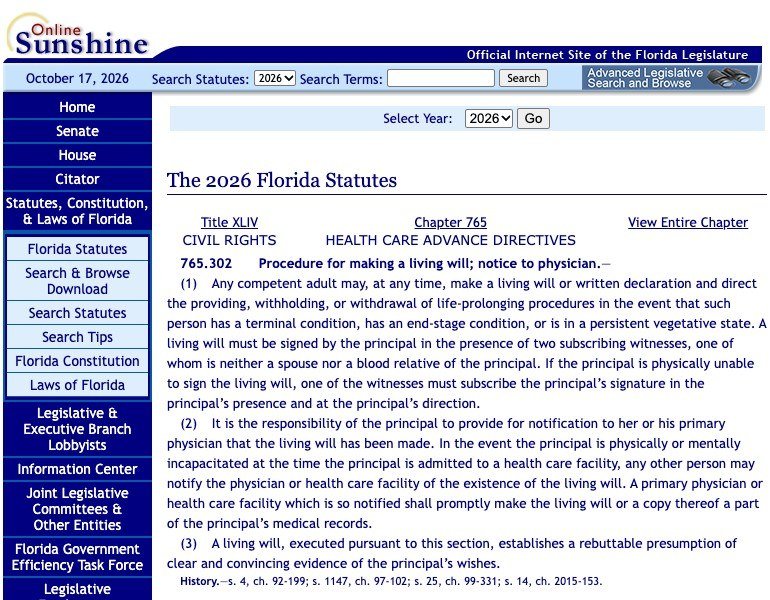
Florida is a typical example. Under Florida Statutes 765.302, the living will must be signed in front of two witnesses, and at least one cannot be your spouse or a blood relative. If you are physically unable to sign, one witness can sign your name at your direction.
A few details from the other states are worth knowing:
- Texas: a doctor or hospital cannot require you to notarize the directive or to use its own form.
- California: at least one witness must be unrelated to you and not entitled to your estate, and a patient in a skilled nursing facility needs a patient advocate or ombudsman as a witness.
- South Carolina: the declaration has no effect while the person is pregnant. Texas has a similar pregnancy rule.
- New York: witnesses for a health care proxy can watch by audio-video link, and the proxy lasts until you revoke it unless you set an expiration date or condition.
How to Make a Living Will in Five Steps
NIA lays out the process, and none of it requires a lawyer. A lawyer can help, but NIA says one is not necessarily needed:
- Think about your values. Decide what quality of life matters most and which outcomes you would not accept.
- Talk to your doctor. Ask how treatments such as CPR or ventilation work for someone with your health conditions.
- Get your state's form. Free forms are available from your state attorney general's office, your Area Agency on Aging through the Eldercare Locator at 800-677-1116, or the VA if you are a veteran.
- Sign it correctly. Follow your state's witness or notary rules exactly.
- Share copies. Give them to your proxy, your doctors and anyone likely to be called in an emergency.
Online form sites are an option, but NIA warns that some charge fees and advises checking that their forms are legally recognized in your state. If you are writing a last will at the same time, our comparison of online will makers covers the property side. If you split time between two states, NIA suggests completing a form for each and keeping a copy in both homes.
What Hospitals Must Tell You About Advance Directives
A federal law, the Patient Self-Determination Act, requires hospitals, nursing homes, home health agencies, hospices and Medicare health plans that take part in Medicare or Medicaid to raise the subject with you. It became law on November 5, 1990, as part of that year's budget act, and took effect on December 1, 1991. The requirements sit in 42 U.S.C. 1395cc(f).
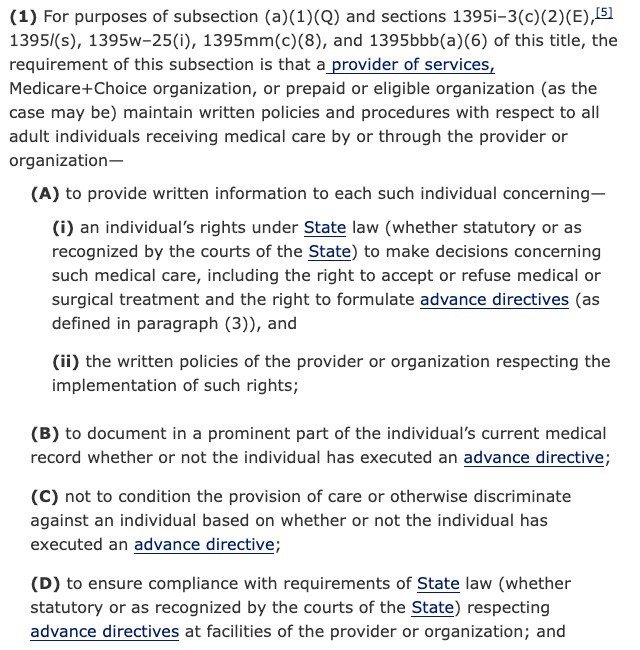
Covered providers must:
- Give adult patients written information about their right under state law to accept or refuse treatment and to make an advance directive.
- Record in a prominent part of the medical record whether you have one.
- Never make your care depend on whether you have signed one.
Timing depends on the setting. Hospitals ask at inpatient admission, nursing facilities when you are admitted as a resident, home health agencies before care begins, and hospices when hospice care starts. The law does not apply to individual physicians.
A living will also has limits. NIA calls an advance directive legally recognized but not legally binding: a provider can decline to follow it for reasons of conscience, facility policy or accepted medical standards, but must tell your proxy right away and consider moving your care. That is one more reason to choose a health care proxy who can speak up for you.
Updating, Storing and Revoking a Living Will
NIA suggests reviewing your directive at least once a year and after any major change, such as retirement, a move, a divorce or a new diagnosis. Date each version and keep the old ones so it is clear which is current.
Revoking one is easier than making one. In Florida you can revoke a living will with a signed and dated writing, by destroying it, by saying so out loud, or by signing a new one that differs materially. Texas allows revocation at any time regardless of your mental state; after a written or spoken revocation, once the doctor is told, they must write "VOID" on each page of the directive in your record.
Some states run registries so the document can be found in an emergency. Two examples:
- California: the Secretary of State's Advance Health Care Directive Registry stores a copy, or just its location, and releases it only to your provider, public guardian or legal representative.
- North Carolina: since February 17, 2022, the state's registry cards carry a QR code that opens your filed directive.
Frequently Asked Questions
Does a living will need to be notarized?
It depends on the state. California and Texas accept either two qualified witnesses or a notary, Florida requires two witnesses, and South Carolina requires a notary or other oath officer plus two witnesses, and the officer can count as one of them. The VA form needs two witnesses, with notarization optional.
Is a living will legally binding?
It is legally recognized, but NIA says it is not strictly binding, because a provider can decline for reasons of conscience or policy and must then tell your proxy. In Florida, a properly signed living will creates a rebuttable presumption of clear and convincing evidence of your wishes.
What happens if I do not have a living will?
State law decides who makes medical decisions for you, usually a spouse, parent or adult child. NIA warns that an unmarried partner who is not named as a proxy could be left out of those decisions.
Is my living will valid if I move to another state?
Often, but not always. Texas, for example, honors advance directives validly signed in another state. To be safe, NIA suggests completing a new form when you move, or one for each state if you live in two.
Related Articles

Get the Fox Bulletin briefing
The stories that matter, in your inbox. No spam, unsubscribe anytime.
Newsletter signup will be available soon.
Related stories

Lemon Law: How a Car Qualifies and What You Get Back
A lemon law makes the manufacturer buy back or replace a new car it cannot fix. Here are the real tests in nine states, the refund formulas, and the steps to file a claim.

Statute of Limitations: What It Means and How Long You Have
A statute of limitations is the legal deadline to sue or bring charges. Here are the real time limits in four big states, the crimes with no limit, and how old debts work.

Small Claims Court: Limits in Every State and How It Works
Small claims court settles money disputes quickly and cheaply. Here is the dollar limit in every state, what it costs to file, who can bring a lawyer, and how collection works.