

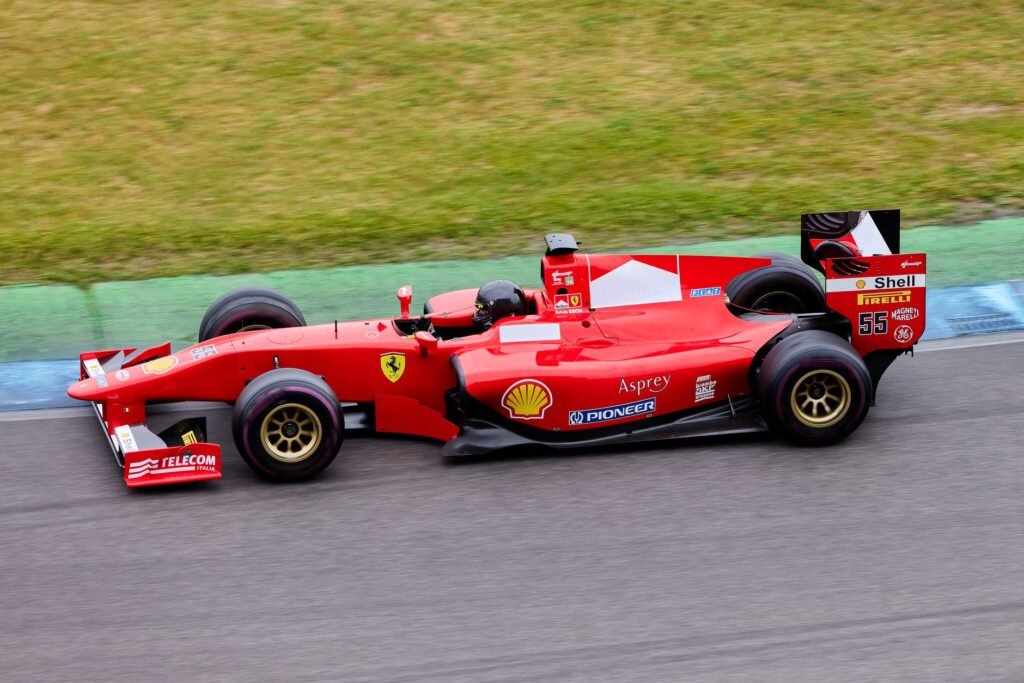
Michael Schumacher and Lewis Hamilton share the Formula One record with seven World Drivers’ Championships each, and no one else has more than five. Between them they account for 14 of the 76 titles awarded since the championship began in 1950.
Only 17 drivers in the sport’s history have won more than once, and those 17 hold more than three quarters of every title ever contested. Here is every multiple Formula One world champion, ranked.
| Rank | Driver | Titles | Country | Years Won |
|---|---|---|---|---|
| 1 | Michael Schumacher | 7 | Germany | 1994, 1995, 2000-2004 |
| 1 | Lewis Hamilton | 7 | United Kingdom | 2008, 2014, 2015, 2017-2020 |
| 3 | Juan Manuel Fangio | 5 | Argentina | 1951, 1954-1957 |
| 4 | Alain Prost | 4 | France | 1985, 1986, 1989, 1993 |
| 4 | Sebastian Vettel | 4 | Germany | 2010-2013 |
| 4 | Max Verstappen | 4 | Netherlands | 2021-2024 |
| 7 | Jack Brabham | 3 | Australia | 1959, 1960, 1966 |
| 7 | Jackie Stewart | 3 | United Kingdom | 1969, 1971, 1973 |
| 7 | Niki Lauda | 3 | Austria | 1975, 1977, 1984 |
| 7 | Nelson Piquet | 3 | Brazil | 1981, 1983, 1987 |
| 7 | Ayrton Senna | 3 | Brazil | 1988, 1990, 1991 |
| 12 | Alberto Ascari | 2 | Italy | 1952, 1953 |
| 12 | Graham Hill | 2 | United Kingdom | 1962, 1968 |
| 12 | Jim Clark | 2 | United Kingdom | 1963, 1965 |
| 12 | Emerson Fittipaldi | 2 | Brazil | 1972, 1974 |
| 12 | Mika Hakkinen | 2 | Finland | 1998, 1999 |
| 12 | Fernando Alonso | 2 | Spain | 2005, 2006 |
The Most Successful Drivers in F1 History
1. Michael Schumacher: 7 Titles
Schumacher won back-to-back titles with Benetton in 1994 and 1995, then took five consecutive championships with Ferrari from 2000 to 2004. That run of five in a row has never been matched.
He joined Ferrari in 1996 when the team had not won a drivers’ title since 1979 and spent four seasons rebuilding it before the wins came. His career spanned a decade from first title to last.
1. Lewis Hamilton: 7 Titles
Hamilton equalled the record in 2020, winning his first with McLaren in 2008 and six more with Mercedes, including four consecutive titles from 2017 to 2020.
His titles are spread across 12 years, two years longer than Schumacher’s span. He is the only driver to win a championship in each of three separate decades.
3. Juan Manuel Fangio: 5 Titles
Fangio won five championships in the 1950s, taking four in a row from 1954 to 1957 with a first title in 1951. He won with four different constructors, which no other multiple champion has done.
His record of five stood for 45 years until Schumacher equalled it in 2002 and passed it the following season. He achieved it in an era when driver fatalities were common and seasons were far shorter.
4. Alain Prost: 4 Titles
Prost won titles in 1985, 1986, 1989, and 1993, three with McLaren and one with Williams. He was nicknamed the Professor for a calculating style built on tyre management and finishing races.
His rivalry with Ayrton Senna defined the late 1980s and produced two championship-deciding collisions. Prost retired immediately after his fourth title.
4. Sebastian Vettel: 4 Titles
Vettel took four consecutive championships with Red Bull from 2010 to 2013, becoming the youngest champion in history at 23 with the first of them.
His subsequent move to Ferrari never produced a fifth title despite two strong campaigns. All four of his championships came before he turned 27.
4. Max Verstappen: 4 Titles
Verstappen won four in a row from 2021 to 2024, the third driver to achieve that after Schumacher and Vettel. His first came in a final-lap finish at Abu Dhabi that remains the most contested title decision in the sport’s history.
He is the only driver in the top six still competing, and at his age a fifth title would put him level with Fangio.
Five Drivers Are Tied at Three Titles
Jack Brabham, Jackie Stewart, Niki Lauda, Nelson Piquet, and Ayrton Senna all won three championships, forming the largest group anywhere on this list apart from the two-time winners.
Brabham remains the only driver to win a championship in a car bearing his own name, taking the 1966 title with a Brabham. Stewart won three between 1969 and 1973 and then became the sport’s leading safety campaigner at a time when drivers were dying regularly.
Lauda’s three span nine years and include the most remarkable comeback in the sport, returning six weeks after a crash at the Nurburgring that left him with severe burns, then winning again in 1977 and 1984. Piquet took three in the 1980s, and Senna won three in four seasons with McLaren before his death at Imola in 1994.
Six Drivers Won Exactly Twice
Alberto Ascari won consecutively in 1952 and 1953, the first driver to take back-to-back titles. Graham Hill and Jim Clark were British rivals through the 1960s, Hill winning in 1962 and 1968 and Clark in 1963 and 1965.
Emerson Fittipaldi took two in the 1970s, Mika Hakkinen won consecutively in 1998 and 1999 as the last driver to beat Schumacher in his prime, and Fernando Alonso won in 2005 and 2006, ending Schumacher’s Ferrari dominance. Alonso is still racing two decades after his second title.
Seventeen Drivers Hold 76% of All Titles
These 17 drivers account for 58 of the 76 championships awarded since 1950, or 76.3% of the total. The remaining 18 titles went to 18 different drivers who won exactly once each.
That means 35 drivers have won a Formula One championship in 76 seasons. The concentration is comparable to what our ranking of the most NBA championships shows at team level, and the cause is similar: in both sports the best competitor tends to be attached to the best equipment, and that advantage persists across seasons rather than resetting each year.
Britain Has Produced the Most Champions
Four of these 17 drivers are British: Hamilton, Stewart, Graham Hill, and Clark. Brazil follows with three in Piquet, Senna, and Fittipaldi, and Germany has two with Schumacher and Vettel.
The remaining eight countries have one each. Britain’s presence reflects where the sport is built rather than only where drivers come from, since most Formula One teams have been based in southern England for decades, giving British drivers earlier access to competitive machinery.
Why Repeat Champions Are the Norm
Formula One rewards continuity more than almost any other sport because the car matters enormously. A driver in a dominant car will usually beat a better driver in a slower one, and design advantages carry over between seasons rather than disappearing.
That is why titles arrive in clusters: Schumacher’s five straight, Vettel’s four, Hamilton’s four, Verstappen’s four. Each represents a team getting a regulation cycle right and holding the advantage until the rules change. Regulation resets are the main thing that ends a run, which is a very different dynamic from individual sports where our ranking of the most Olympic gold medals tracks athletes rather than machinery.
Two Drivers Won Nine of the 2010s Titles
Between 2010 and 2019 only three men were champion, and two of them took nine of the ten. Vettel won four in a row for Red Bull, Hamilton won five for Mercedes, and the single exception was Nico Rosberg in 2016, who retired days after winning and never appears on a multiple-champions list.
No other decade in the sport’s history is that concentrated. It reflects two long spells of car dominance running back to back, Red Bull’s from 2010 and Mercedes’ from 2014, each lasting until a major regulation change ended it. The pattern of the 2020s so far looks similar, with Verstappen taking four consecutive titles before Norris broke the run in 2025.
How We Counted F1 Championships
Drivers are ranked by World Drivers’ Championships won, covering every Formula One season from the championship’s first year in 1950 through the completed 2025 season. Constructors’ championships are counted separately and are not included here.
Tied drivers share a rank, so the two seven-time champions both rank first and the next driver ranks third. The cutoff is two titles, which captures every multiple champion. Lando Norris won the 2025 championship, his first, so he does not appear on this list. The 2026 season was still in progress at the time of writing.
Frequently Asked Questions
Who has won the most F1 world championships?
Michael Schumacher and Lewis Hamilton are tied with seven each. Hamilton equalled Schumacher’s record in 2020, and no other driver has more than five.
Who won the 2025 F1 championship?
Lando Norris, his first world title. He is not on this list, which covers only drivers with two or more championships.
Has anyone won five titles in a row?
Michael Schumacher, from 2000 to 2004 with Ferrari. It is the longest consecutive run in the sport’s history, ahead of the four-in-a-row achieved by Fangio, Vettel, Hamilton, and Verstappen.
Which country has the most F1 champions?
The United Kingdom, with four multiple champions in Hamilton, Stewart, Graham Hill, and Clark. Brazil is second with three.
How many drivers have won an F1 championship?
Thirty-five drivers across 76 seasons. Seventeen won more than once, and the other 18 won exactly one title each.
Related Articles

Get the Fox Bulletin briefing
The stories that matter, in your inbox. No spam, unsubscribe anytime.
Newsletter signup will be available soon.
Related stories

Best Soccer Players of All Time: Top 10 Ranked
Pele won three World Cups, a feat no other player has matched. Lionel Messi holds eight Ballon d'Or awards. This ranking of the ten greatest players is built on countable honours rather than highlight reels.
How Long Is a Soccer Game? Halves, Stoppage and Extra Time
Ninety minutes is the scheduled figure, not the real one. What the referee adds, when extra time applies, and how much of a match is actually live football.
NFL Salary Cap: How It Works, Dead Money and Franchise Tags
The cap is a cash flow puzzle, not a spending limit. Proration, dead money, void years and the 89 percent floor, with the current numbers.