
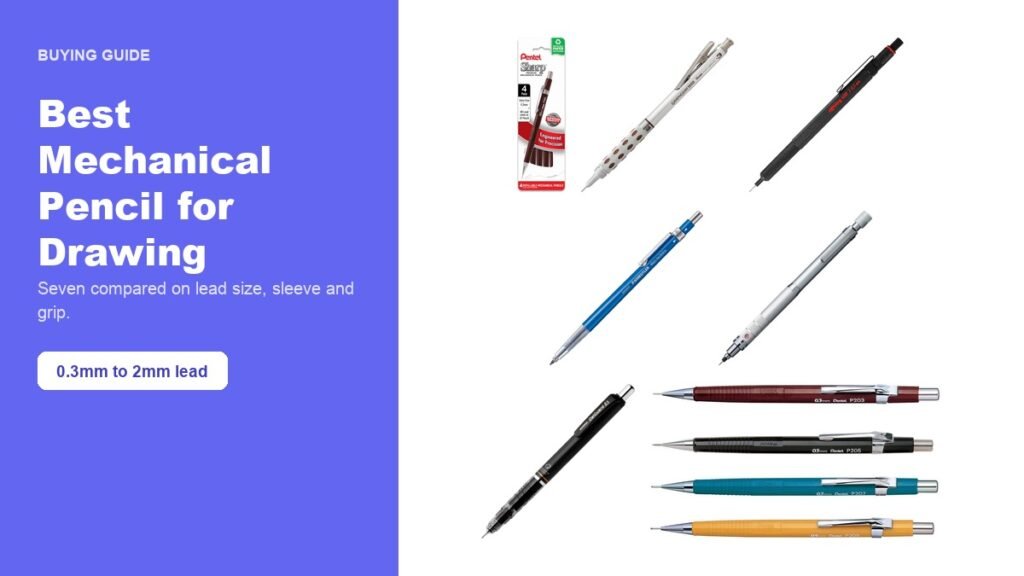
The best mechanical pencil for drawing is not the one with the cleverest mechanism. It is the one whose lead width matches the marks you want to make, because a 0.3mm line and a 2mm sketching lead are two completely different tools that happen to share a name.
Seven are compared below across that full range, from an extra-fine technical pencil to a clutch lead holder with a sharpener built into the button. Lead sizes, sleeve design and grip are the things that decide which one suits your work, and all three are covered for each.
The Best Mechanical Pencils for Drawing Compared
| # | Pencil | Lead | Sleeve | Best for |
|---|---|---|---|---|
| 1 | Pentel Sharp P203 | 0.3mm | 4mm fixed | Fine detail and hatching |
| 2 | Pentel GraphGear 1000 | 0.3mm | Retractable | Technical work on the move |
| 3 | rOtring 600 | 0.5mm | Fixed, full metal | Ruler and template drawing |
| 4 | Staedtler Mars technico 780 C | 2mm clutch | Clutch jaws | Sketching and broad tone |
| 5 | uni Kuru Toga Roulette | 0.5mm | Rotating lead | Line weight that stays even |
| 6 | Zebra DelGuard | 0.5mm | Cushioned | Pressing hard without snapping |
| 7 | Pentel P200 Set | 0.3 to 0.9mm | 4mm fixed | Working out which width you want |
The spread from 0.3mm to 2mm is the point. A technical pen-style pencil cannot shade and a clutch holder cannot do fine linework, so most people drawing seriously end up owning at least two.
1. Pentel Sharp P203: Fine Lines Without Spending Much
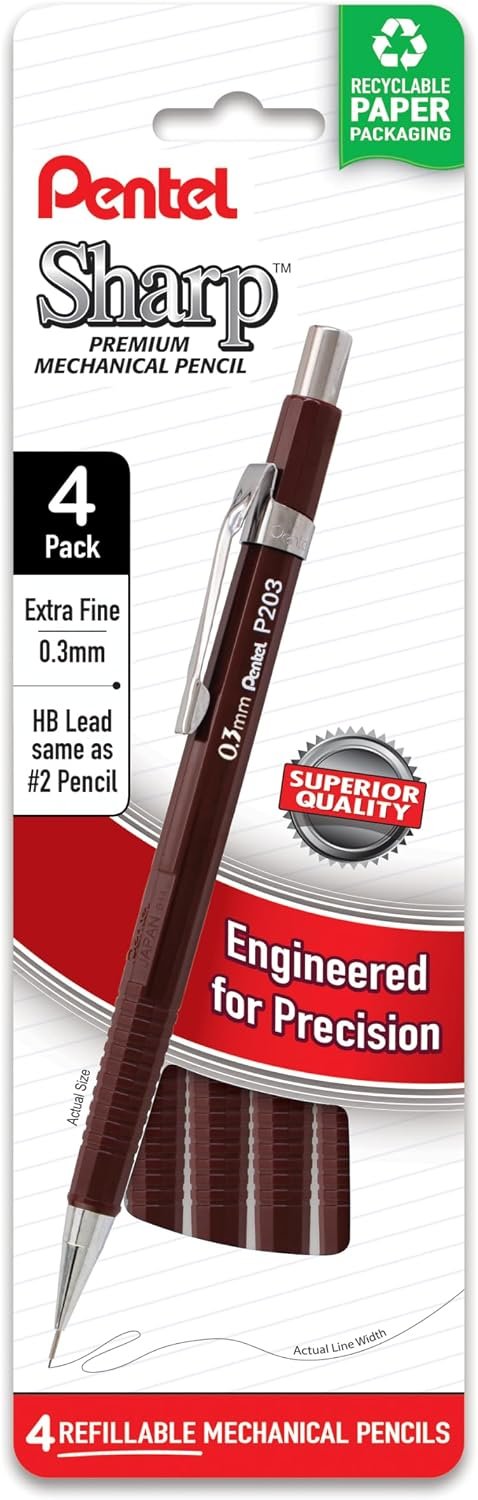
The 0.3mm version of Pentel’s long-running Sharp is the cheapest sensible way into extra-fine drawing. A plastic barrel, a metal tip and nothing else to go wrong, in the same shape the range has used for decades.
The 4mm lead sleeve is what makes it a drawing pencil rather than a writing one. That thin tube runs along a ruler or a template edge with the barrel kept clear of the line, which is exactly what hatching and technical work need.
- Good for: hatching, cross-hatching and detail where a broader line would fill in.
- Watch: 0.3mm lead breaks easily, so a light hand is not optional.
2. Pentel GraphGear 1000 in 0.3mm: Fine Lead That Survives a Bag
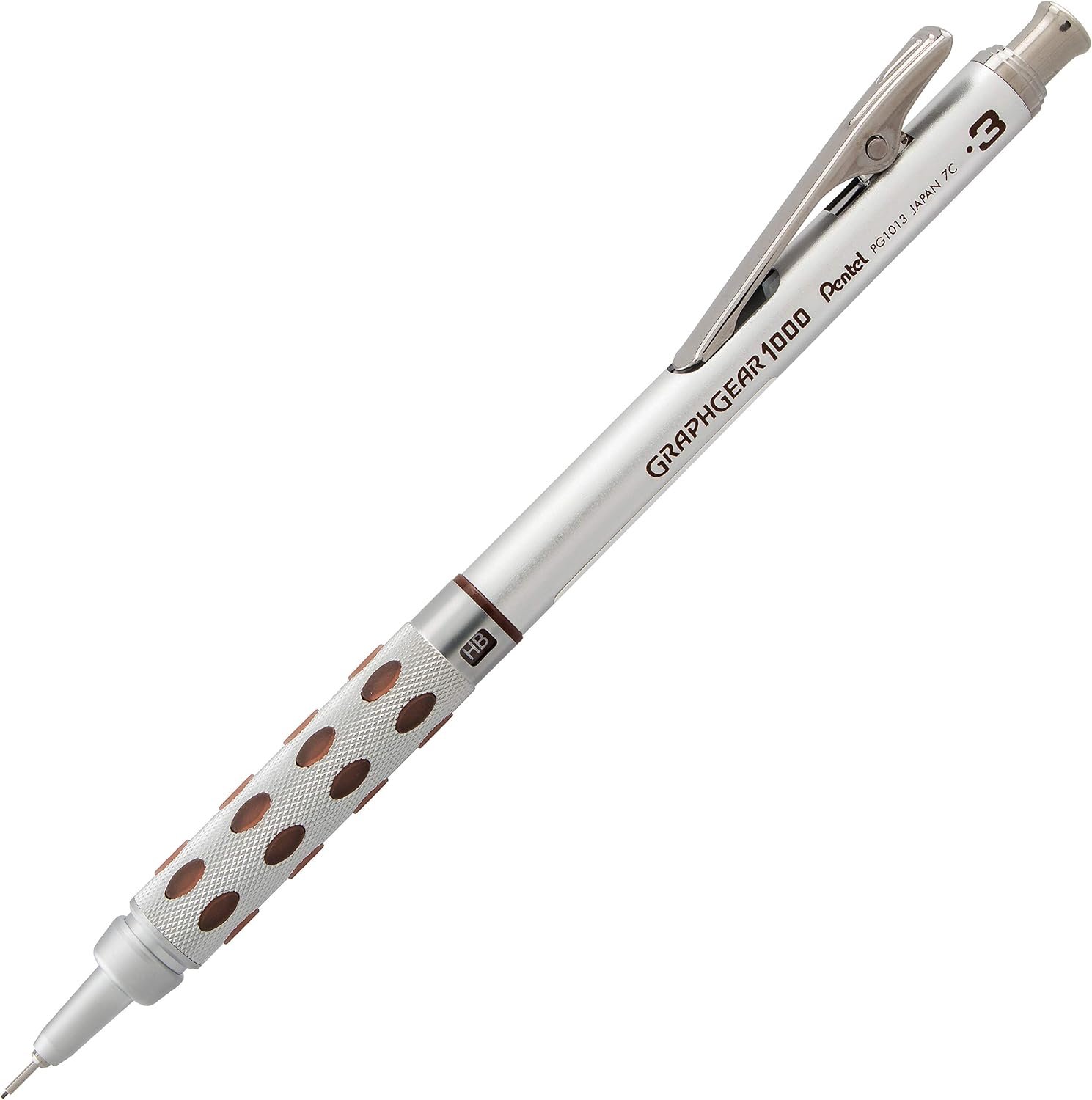
An exposed 4mm sleeve and a sketchbook bag are a bad combination. The GraphGear 1000 answers that with a dual-action retractor: click the clip and the tip withdraws into the barrel.
Pentel’s own description covers the rest of the drafting features, including the lead hardness indicator on the barrel and a chiselled metal grip inlaid with soft latex-free pads for long sessions.
It is heavy and front-weighted. For drawing that is often an advantage, since the tip stays planted without a tight grip, but it is worth handling one before buying if you sketch for hours.
- Good for: carrying a genuine drafting pencil without wrecking your bag.
- Watch: the weight suits some hands and tires others, and the mechanism adds failure points.
3. rOtring 600: The Ruler and Template Pencil
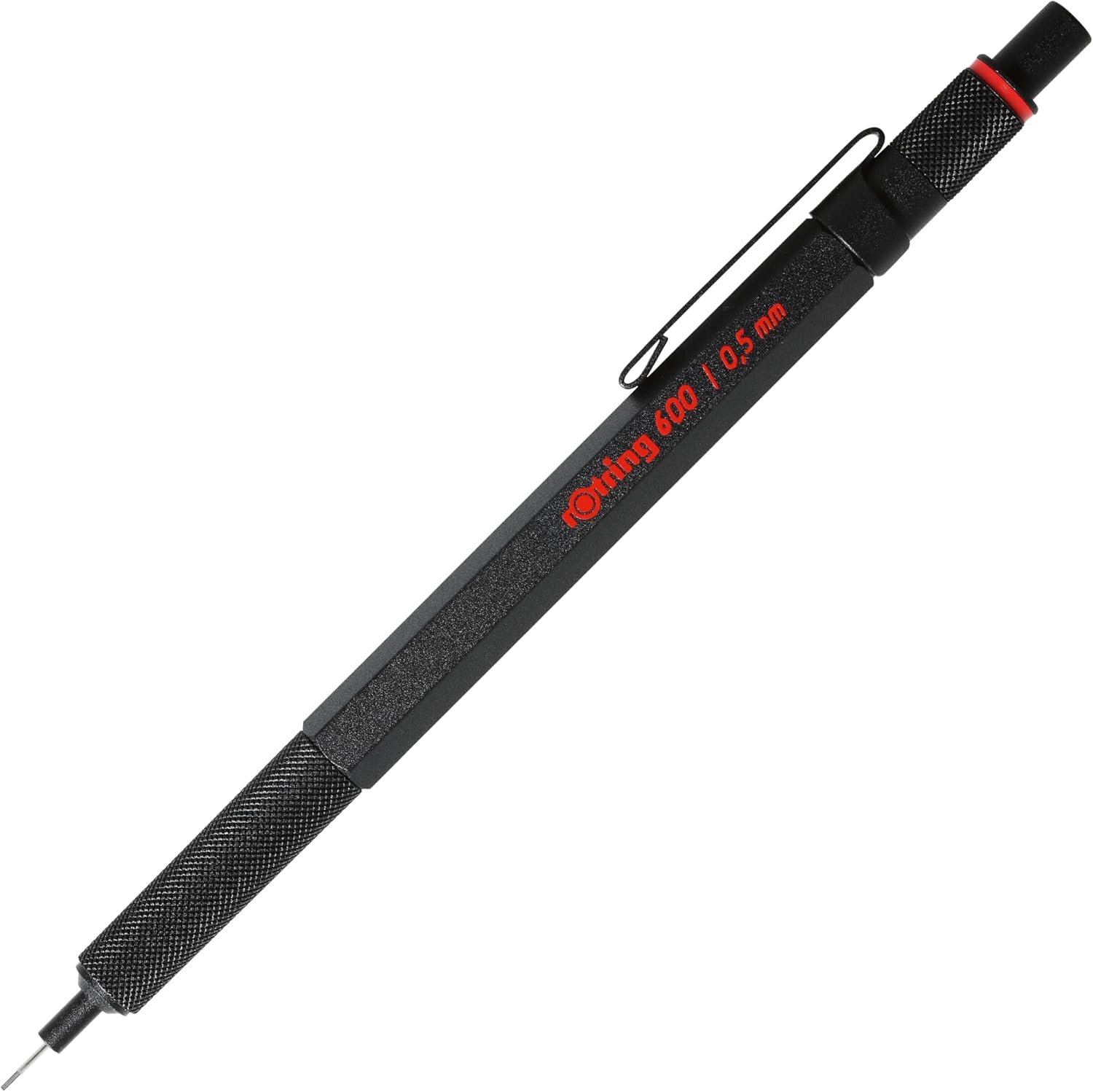
The 600 is machined metal throughout, with a knurled grip and a hexagonal barrel. It is the pencil people buy once and then use for twenty years, and the weight makes plastic pencils feel insubstantial afterwards.
rOtring describes a brass mechanism for precise lead advancement and a fixed lead guidance sleeve that keeps an unimpeded view of the page for ruler-based drawing. The hexagonal barrel stops it rolling off a sloped drawing board, which is a practical detail rather than a styling one.
- Good for: technical drawing where the sleeve has to sit flush against a straight edge.
- Watch: the fixed sleeve is exposed and the pencil costs many times what a plastic one does.
4. Staedtler Mars technico 780 C: A Clutch Holder for Shading
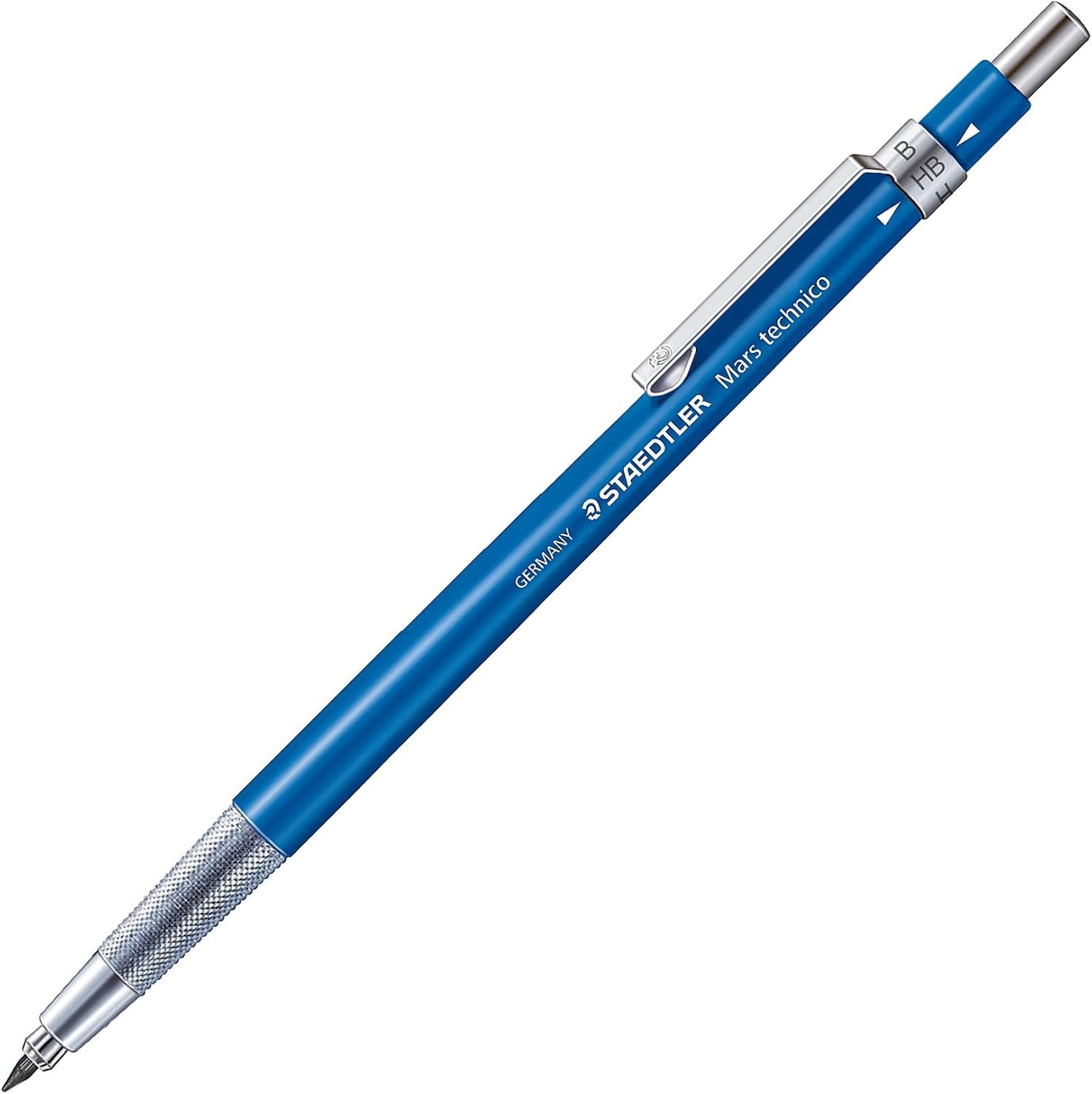
This is not a mechanical pencil in the clicking sense. It is a lead holder: jaws grip a single 2mm lead and release it when you press the button, so the lead drops under its own weight and you sharpen it yourself.
Staedtler lists it as a leadholder for drawing, sketching and writing, taking 2mm leads, with an integrated lead sharpener in the push-button and a hardness-degree indication on the clip.
The 2mm lead is the reason to own one. Sharpened to a chisel it lays broad tonal strokes no 0.5mm pencil can manage, and turned on its point it still draws a line. It is the closest thing to a wooden pencil that never gets shorter.
- Good for: shading, tonal blocks and loose sketching with a wooden-pencil feel.
- Watch: you must sharpen it, and it is useless for fine technical linework.
5. uni Kuru Toga Roulette: Line Weight That Does Not Drift
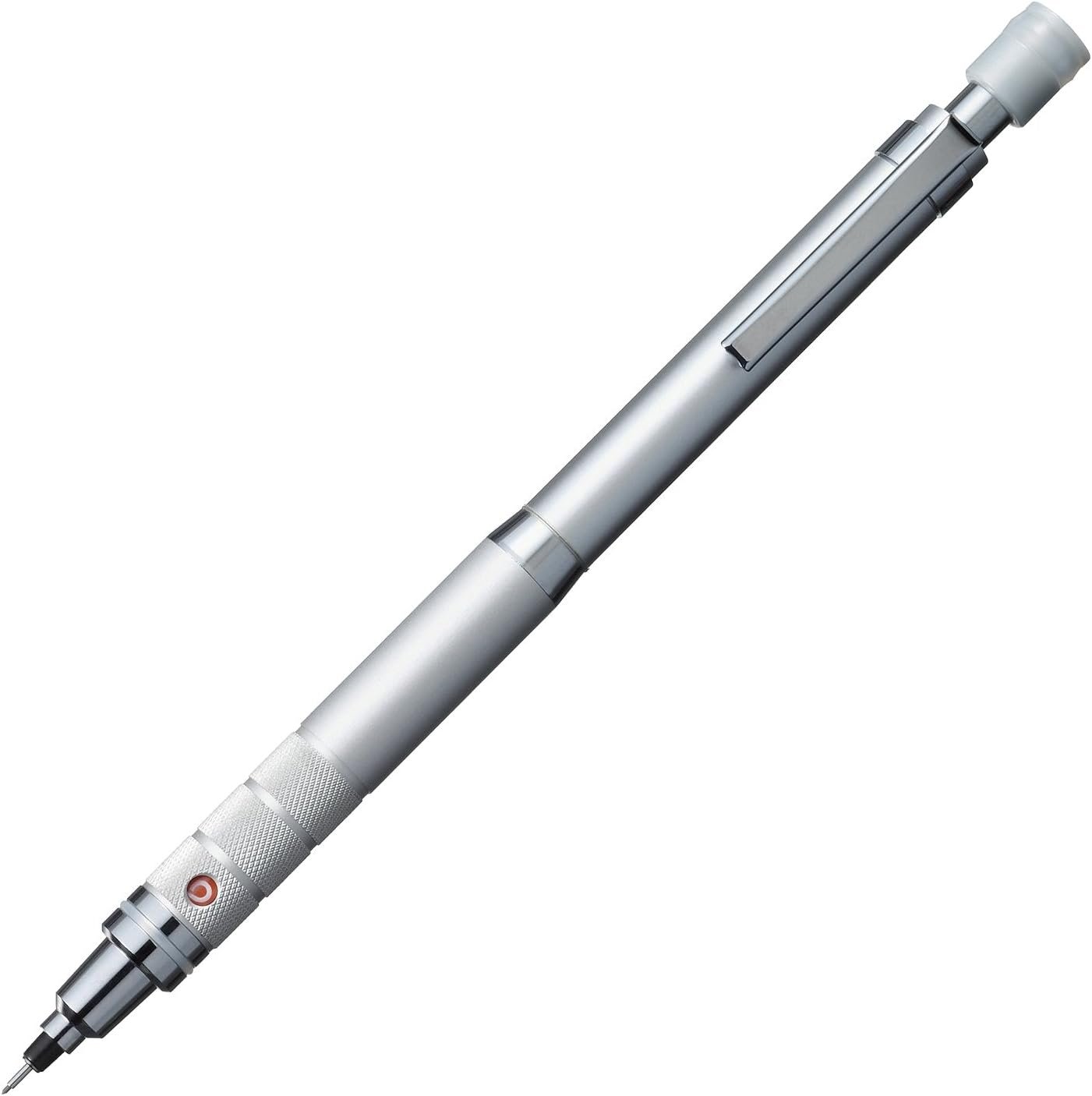
Ordinary lead wears to a wedge, so a line that starts fine ends up broad and your hatching thickens without you noticing. The Kuru Toga rotates the lead a fraction each time it leaves the paper, so it wears evenly and keeps a cone.
Mitsubishi Pencil records the launch of Kuru Toga pencils with automatic lead core rotation in its company history. The Roulette adds a knurled metal grip and extra weight over the plastic original, which suits drawing better.
- Good for: consistent line weight across a long drawing session.
- Watch: the rotation relies on lifting the pencil, so continuous shading strokes benefit least.
6. Zebra DelGuard: For Anyone Who Presses Too Hard
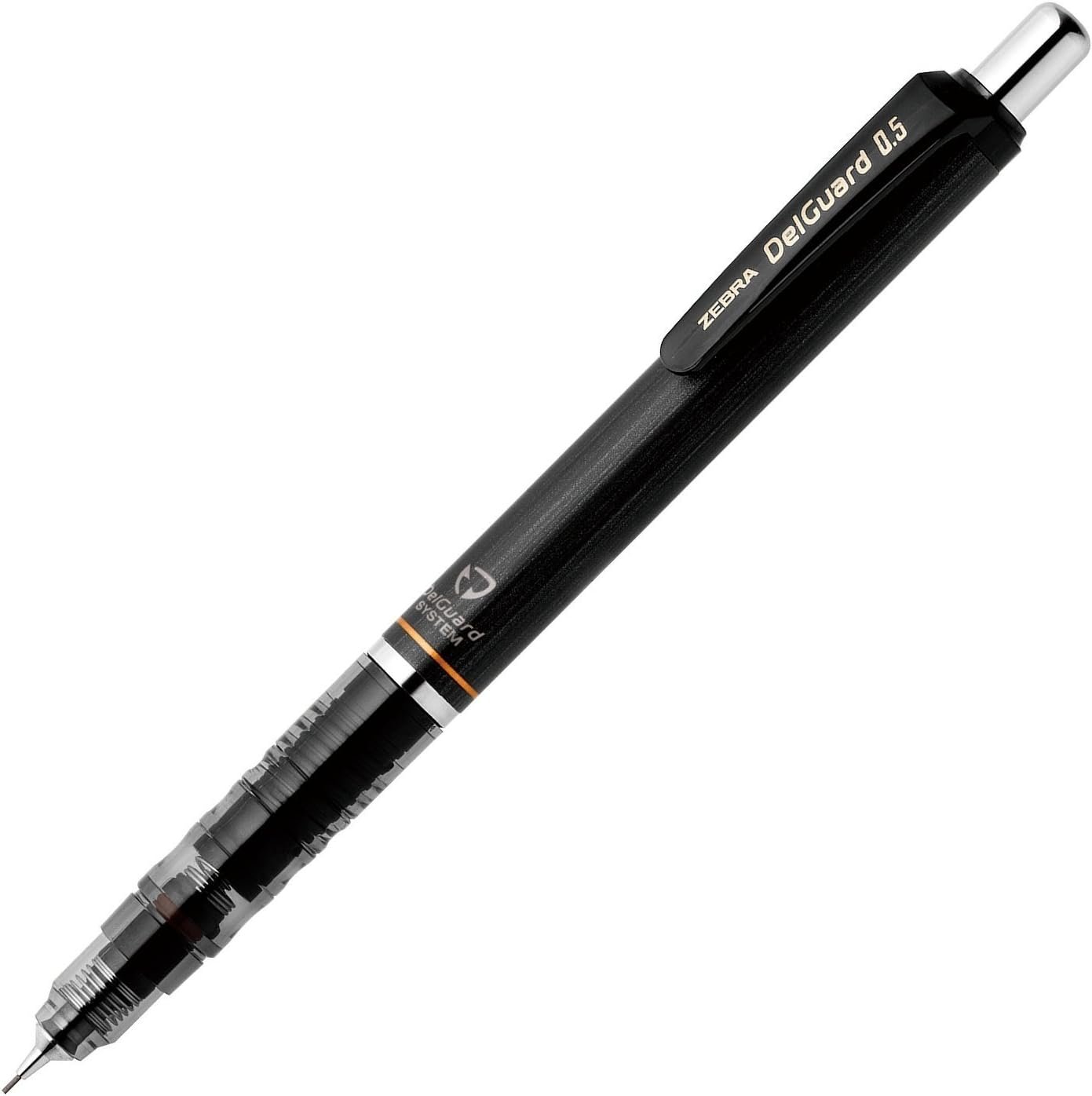
Beginners and anyone drawing with energy break a lot of lead. The DelGuard uses a spring that absorbs downward force and a sleeve that shifts to take sideways force, which together soak up the pressure that normally snaps a 0.5mm stick.
Zebra puts it as protecting the lead so it does not break no matter the angle or the pen pressure. It will not make lead indestructible, but it removes most of the everyday breakages.
- Good for: heavy-handed drawing and anyone still learning pressure control.
- Watch: the cushioning gives a slight softness at the tip that precision users notice.
7. Pentel P200 Set: The Cheapest Way to Find Your Width
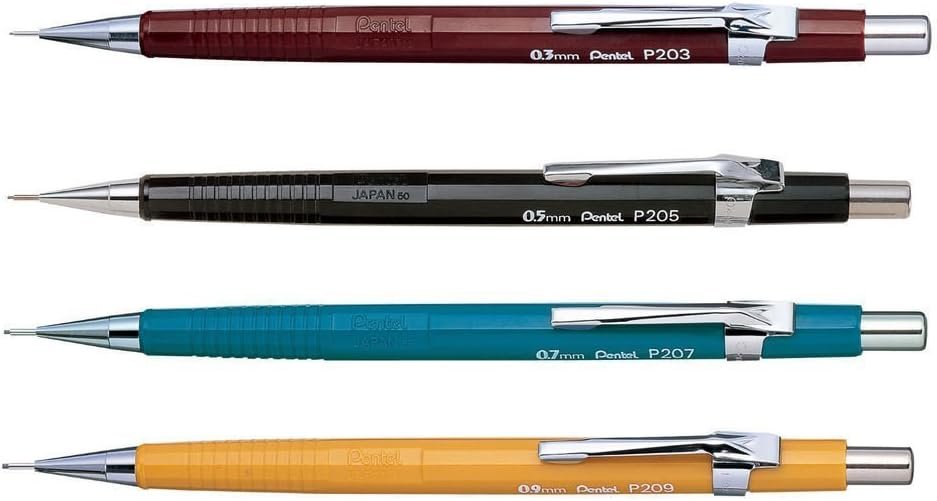
If you do not yet know whether you want 0.3mm or 0.9mm, buying four pencils to find out is the sensible move. This set is one each of the P203, P205, P207 and P209, which is 0.3mm, 0.5mm, 0.7mm and 0.9mm.
Each comes with six Super Hi-Polymer HB leads and an eraser, so all four are usable from the box. They are the same plastic-bodied Sharp design throughout, which means the only variable between them is the one you are testing.
Colour-coded barrels make it obvious which is which on a desk, and the 0.9mm is the quiet surprise: broad enough for loose sketching while still being a clicking pencil, and a useful stop between 0.7mm and a 2mm clutch holder.
- Good for: deciding your preferred lead width without guessing.
- Watch: plastic bodies throughout, so this is a test kit rather than a keepsake.
Matching Lead Width to the Marks You Want
Every other decision follows from this one. Width sets the finest line you can draw and the broadest tone you can lay down, and no mechanism compensates for picking the wrong one.
- 0.3mm: fine detail, hatching and technical linework. Breaks readily under pressure.
- 0.5mm: the general-purpose choice for drawing and writing alike.
- 0.7mm: sketching and note-taking, darker and much harder to snap.
- 0.9mm: loose sketching and light shading, still in a clicking pencil.
- 2mm clutch: tone, broad strokes and chisel edges, sharpened by hand.
Grade sits alongside width. HB ships with almost everything here, B and 2B give darker, softer marks for shading, and H grades hold a crisper edge for technical drawing. Refills are sold by both numbers, so both have to match your pencil.
Sleeve Design Matters More Than It Sounds
The little metal tube the lead comes out of is the difference between a drawing pencil and a writing one, and it is the spec most product pages bury.
- Fixed 4mm sleeve: sits flush against a ruler or template, which is what technical drawing needs.
- Retractable sleeve: the same length when working, withdrawn when carried, as on the GraphGear 1000.
- Cushioned sleeve: moves under pressure to protect lead, as on the DelGuard.
- Clutch jaws: no sleeve at all, holding a thick lead you shape yourself.
A short conical tip, the kind on most cheap writing pencils, hides the exact point where lead meets paper. That is fine for handwriting and a genuine problem when you are trying to land a line precisely, much as a cramped interface gets in the way in drawing software.
Which Drawing Pencil to Choose
For fine detail on a budget, the Pentel Sharp P203 in 0.3mm. For the same fine lead in something you can carry safely, the GraphGear 1000. For technical drawing against rulers where you want to buy once, the rOtring 600 is the pencil people still own decades later.
For shading and tone, nothing here competes with the Staedtler clutch holder and its 2mm lead. The Kuru Toga Roulette is the answer if your line thickening mid-drawing is the thing that irritates you, and the DelGuard if you are still snapping lead. If you genuinely do not know yet, the P200 set answers the question for the price of one good pencil. Artists working across paper and screen may also want our comparison of iPad note taking apps.
Frequently Asked Questions
What lead size is best for drawing?
0.5mm is the general-purpose choice. Drop to 0.3mm for fine detail and hatching, accepting that it breaks more easily, and go to 0.9mm or a 2mm clutch holder for sketching and shading. Most people drawing regularly end up owning a fine pencil and a broad one rather than compromising on one width.
Is a lead holder better than a mechanical pencil for sketching?
For tone and broad strokes, yes. A 2mm clutch lead like the Staedtler Mars technico takes a chisel edge that no 0.5mm pencil can reproduce. For fine linework it is the wrong tool, since you cannot hold a precise point without sharpening it constantly.
Do mechanical pencils come in different lead grades?
Yes, and the grade is bought with the refills rather than the pencil. Almost everything here ships with HB. Softer B and 2B leads give darker marks for shading, harder H leads keep a crisper line for technical work, and the refill tube has to match your pencil width as well as the grade.
How do you keep mechanical pencil lead from breaking?
Advance less lead at a time, hold the pencil at a lower angle and ease off the pressure. If that is not enough, the Zebra DelGuard is designed for the problem, with a spring that absorbs downward force and a sleeve that gives under sideways pressure. Moving up from 0.3mm to 0.5mm also helps immediately.
Related Articles
- Graphic Design Programs Compared
- Internal Communication Tools: 7 Team Chat Apps Compared
- Dropbox Alternatives: 3 Worth Switching To
- Best Desk Pad: 7 Compared on Size, Material and Finish
As an Amazon Associate, Fox Bulletin earns from qualifying purchases.

Get the Fox Bulletin briefing
The stories that matter, in your inbox. No spam, unsubscribe anytime.
Newsletter signup will be available soon.
Related stories

Best Oversized T-Shirts for Women: 7 Compared
The best oversized t-shirts for women differ from each other in three places: what the fabric is made of, where the shoulder seam sits and how the hem is shaped. Those three…
Best Oversized T-Shirts for Men: 7 Picks Compared
The best oversized t-shirts for men are not simply large t-shirts. The shape comes from where the shoulder seam sits and how much the fabric weighs, which is why a Pro Club…
Best Adjustable Dumbbells: 7 Picks by Weight Range
Seven adjustable dumbbell sets compared on weight range, adjustment mechanism and increments, from a 90lb selector pair to a plate-loaded starter set.