

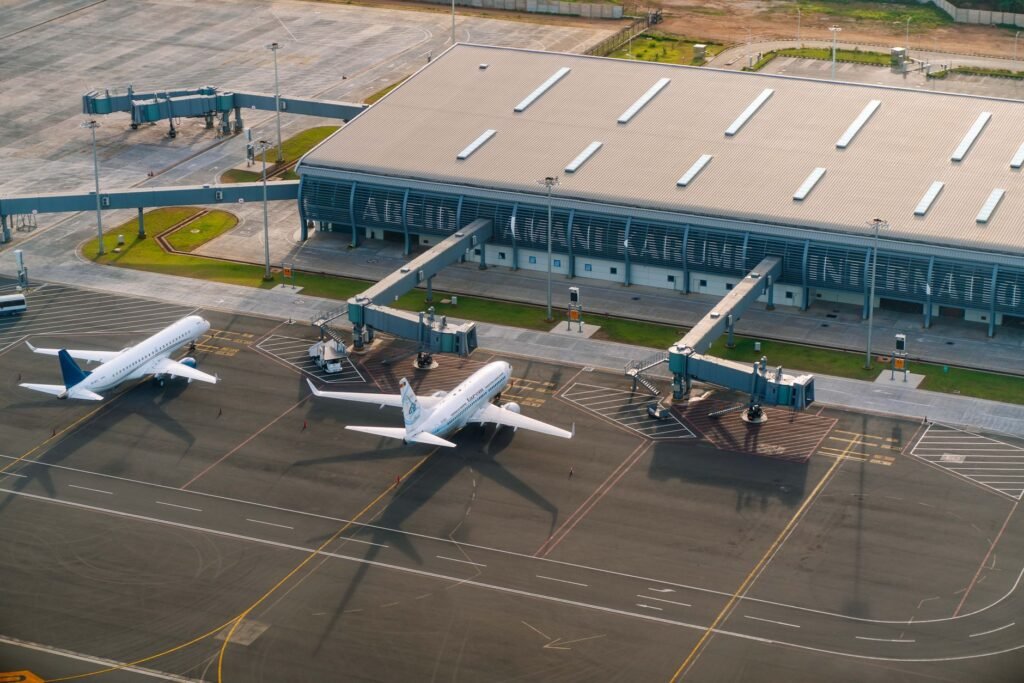
Hartsfield-Jackson Atlanta is the busiest airport in the world, handling 106.3 million passengers in 2025. It is the only airport on Earth to pass 100 million, and it has held the top spot almost every year since 1998.
Yet Atlanta is not the busiest airport for international travel, where Dubai leads and has done for more than a decade. Below are the 10 busiest airports in the world by total passengers, using Airports Council International figures for 2025.
| Rank | Airport | Code | Passengers (2025) | Location |
|---|---|---|---|---|
| 1 | Hartsfield-Jackson Atlanta | ATL | 106.3 million | Atlanta, USA |
| 2 | Dubai International | DXB | 95.2 million | Dubai, UAE |
| 3 | Tokyo Haneda | HND | 91.7 million | Tokyo, Japan |
| 4 | Dallas Fort Worth | DFW | 85.7 million | Dallas-Fort Worth, USA |
| 5 | Shanghai Pudong | PVG | 85.0 million | Shanghai, China |
| 6 | O’Hare | ORD | 84.8 million | Chicago, USA |
| 7 | Heathrow | LHR | 84.5 million | London, UK |
| 8 | Istanbul | IST | 84.4 million | Istanbul, Turkey |
| 9 | Guangzhou Baiyun | CAN | 83.6 million | Guangzhou, China |
| 10 | Denver | DEN | 82.4 million | Denver, USA |
The 10 Busiest Airports in the World
1. Hartsfield-Jackson Atlanta: 106.3 Million
Code: ATL | Location: Atlanta, USA
Atlanta has been the world’s busiest airport in nearly every year since 1998, interrupted only in 2020 by the pandemic. Its dominance comes from geography rather than size, sitting within a two-hour flight of most of the US population.
It is primarily a connecting hub, where the majority of passengers change planes rather than begin or end their journey. That transfer traffic is what pushes it past 100 million while airports serving bigger cities fall short.
2. Dubai International: 95.2 Million
Code: DXB | Location: Dubai, UAE
Dubai is the busiest international airport in the world, a title it has held for more than a decade. Every one of its passengers is on an international flight, because the airport has no domestic routes at all.
That makes its 95.2 million the largest purely international passenger count anywhere. Dubai’s position as a connecting point between Europe, Asia, and Africa built the airport into a global crossroads in barely thirty years.
3. Tokyo Haneda: 91.7 Million
Code: HND | Location: Tokyo, Japan
Haneda climbed to third in 2025, overtaking Dallas as Japanese travel surged on the back of a weak yen and record inbound tourism. It is the busier of Tokyo’s two major airports.
Unusually for a hub of this size, it sits close to the city center, which is why airlines and passengers prize its limited slots so highly.
4. Dallas Fort Worth: 85.7 Million
Code: DFW | Location: Dallas-Fort Worth, USA
Dallas Fort Worth is the largest airport in the top ten by land area, covering more ground than the island of Manhattan. It serves as the primary hub for American Airlines.
Like Atlanta, it thrives on connecting traffic through the center of the country, and it has consistently ranked among the three or four busiest airports for years.
5. Shanghai Pudong: 85.0 Million
Code: PVG | Location: Shanghai, China
Shanghai Pudong is the busier of the two Chinese airports in the top ten and the country’s main international gateway. Its traffic rebounded strongly as China’s international travel restrictions eased.
It handles a large share of the freight moving between China and the rest of the world, on top of its passenger numbers.
6. O’Hare: 84.8 Million
Code: ORD | Location: Chicago, USA
Chicago O’Hare was the busiest airport in the world for decades before Atlanta overtook it, and it remains a central hub for both United and American Airlines. Its position in the northern United States makes it a key connecting point.
It is one of four US airports in the top ten, the most of any country by a wide margin.
7. Heathrow: 84.5 Million
Code: LHR | Location: London, UK
Heathrow is Europe’s busiest airport and the only European entry in the top ten. It operates at close to full capacity with just two runways, fewer than most airports of its scale.
That constraint has fueled decades of debate over a third runway, since Heathrow handles more passengers per runway than almost any major airport in the world.
8. Istanbul: 84.4 Million
Code: IST | Location: Istanbul, Turkey
Istanbul Airport opened only in 2018 and has already reached the top ten, one of the fastest ascents in aviation history. It replaced the city’s older Ataturk airport as the main hub for Turkish Airlines.
Its location bridging Europe and Asia mirrors Dubai’s strategy, positioning it as a connecting point for long-haul traffic between continents.
9. Guangzhou Baiyun: 83.6 Million
Code: CAN | Location: Guangzhou, China
Guangzhou Baiyun is the second Chinese airport in the top ten and the main hub for southern China. It serves the manufacturing heartland of the Pearl River Delta.
Much of its traffic is domestic, reflecting the enormous internal travel market that sets Chinese airports apart from Dubai or Heathrow.
10. Denver: 82.4 Million
Code: DEN | Location: Denver, USA
Denver completes the top ten and is the fastest-growing major airport in the United States, climbing the rankings steadily over the past decade. It has the largest land area of any airport in the Western Hemisphere.
Its central position makes it a natural connecting hub, and it is the fourth and final US airport on the list.
Atlanta and Dubai Both Claim the Title
Ask which airport is busiest and the honest answer is that it depends on what you count. By total passengers, Atlanta leads at 106.3 million. By international passengers, Dubai leads and has for more than a decade, because every traveller through Dubai is flying across a border.
The two airports represent different models. Atlanta’s total is inflated by domestic connections across a huge country, while Dubai built its entire business on international transfers with no home market to fall back on. These figures come from Airports Council International’s 2025 data, and the ranking here uses total passengers, the most common basis, which is why Atlanta sits first.
Only One Airport Passes 100 Million
Atlanta is alone above 100 million passengers, clearing the mark by more than six million while no other airport reaches it. Dubai in second is 11.1 million behind.
That gap at the top is unusually wide for a ranking otherwise defined by narrow margins. Atlanta’s lead reflects a decades-old advantage as the connecting point of the US domestic network, the largest air travel market in the world, which no single international hub can yet match on raw volume.
Seven Airports Are Separated by Three Million
Below the top three, the ranking is remarkably tight. The airports from fourth to tenth, Dallas Fort Worth down to Denver, are separated by just 3.3 million passengers, close enough that a single strong or weak year can reorder them entirely.
This is why airport rankings move so much between years. Tokyo Haneda jumped from below Dallas to third in a single year, and the cluster of airports in the mid-80-million range trade places regularly. Only the top two positions have been stable over time.
The United States Has Four of the Ten
Atlanta, Dallas Fort Worth, O’Hare, and Denver give the United States four of the ten busiest airports, more than any other country. China has two in Shanghai and Guangzhou, and the remaining four are spread across the UAE, Japan, the UK, and Turkey.
The American presence reflects the scale of its domestic market rather than international reach. US airports fill their terminals with travellers flying between cities within the same country, a volume of internal travel matched only by China, a pattern that echoes our ranking of the most visited countries in the world, where the United States ranks far higher on spending than on arrivals.
Why the Order Changes From Year to Year
Airport traffic is reported annually by Airports Council International, the global trade body for airports, and the figures here are for 2025, the most recent full year. Because these are yearly totals, the ranking shifts as travel patterns change.
The pandemic scrambled the list completely in 2020 and 2021, when Chinese domestic airports briefly topped it while international hubs sat nearly empty. The order has since returned to something like its pre-2020 shape, though Istanbul’s rapid rise and Haneda’s 2025 jump show the list is never fixed. Only Atlanta’s hold on first place has proven durable, tracking the sheer size of the US market visible in our look at the largest economies in the world.
Frequently Asked Questions
What is the busiest airport in the world?
Hartsfield-Jackson Atlanta, with 106.3 million passengers in 2025. It is the only airport to pass 100 million and has been the busiest almost every year since 1998.
Is Dubai or Atlanta busier?
It depends on the measure. Atlanta is busier by total passengers, while Dubai is the busiest by international passengers, since all of Dubai’s traffic is on international flights and it has no domestic routes.
Which country has the most airports in the top ten?
The United States, with four: Atlanta, Dallas Fort Worth, O’Hare, and Denver. That reflects the size of the American domestic travel market rather than international traffic.
Why do airport rankings change every year?
The figures are annual totals, and the airports from fourth to tenth are separated by only about three million passengers. A single strong or weak year can reorder them, as happened when Tokyo Haneda rose to third in 2025.
What is the busiest airport for international travel?
Dubai International, which has led international passenger traffic for more than a decade. With no domestic flights, its entire total of 95.2 million passengers is international.
Related Articles

Get the Fox Bulletin briefing
The stories that matter, in your inbox. No spam, unsubscribe anytime.
Newsletter signup will be available soon.
Related stories

Internal Communication Tools: 7 Team Chat Apps Compared
Seven internal communication tools compared on price per user and free plan limits, starting with whether your existing subscription already includes one.

Best Inventory Management Apps: 8 Compared for Small Business
Eight inventory apps compared on free plans, item and order caps, and what each one costs once add-ons and per location charges are included.
Types of Business Insurance: What Each Policy Covers and Who Must Carry It
General liability, professional liability, workers' compensation, property, BOP, cyber, commercial auto, product liability and D&O: what each covers, when the law requires it, and what small firms pay.