

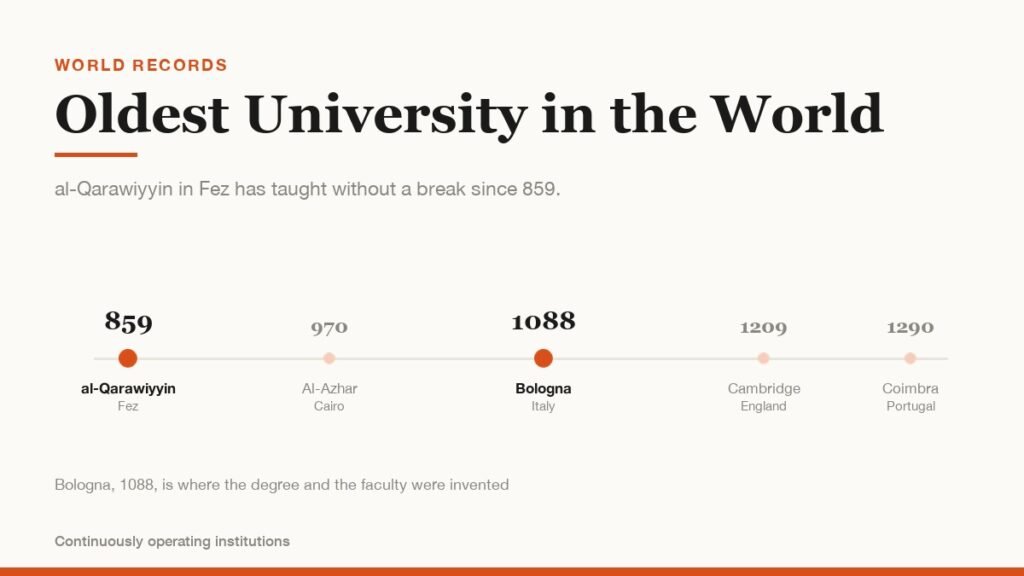
The oldest university in the world is al-Qarawiyyin in Fez, Morocco, founded in 859 and still teaching today. Guinness World Records lists it as the oldest existing and continually operating educational institution, and it has been running for more than 1,160 years.
The answer changes if the question means a university in the European sense of the word. On that reading it is Bologna, founded in 1088, which is where the degree, the faculty and the student body as a legal corporation were invented.
The 10 Oldest Universities in the World
| # | Institution | Location | Founded | Founded as |
|---|---|---|---|---|
| 1 | al-Qarawiyyin | Fez, Morocco | 859 | Mosque school |
| 2 | Al-Azhar | Cairo, Egypt | 970 | Mosque school |
| 3 | Bologna | Bologna, Italy | 1088 | Studium |
| 4 | Oxford | Oxford, England | by 1096 | Teaching guild |
| 5 | Cambridge | Cambridge, England | 1209 | Scholars from Oxford |
| 6 | Salamanca | Salamanca, Spain | 1218 | Royal charter |
| 7 | Padua | Padua, Italy | 1222 | Scholars from Bologna |
| 8 | Naples Federico II | Naples, Italy | 1224 | Imperial charter |
| 9 | Siena | Siena, Italy | 1240 | Studium |
| 10 | Coimbra | Coimbra, Portugal | 1290 | Royal charter |
Everything after Bologna is European, and seven of the ten were founded within 200 years of each other.
Every Institution in the Top 10, in Order
1. al-Qarawiyyin, Fez: 859
Morocco · founded 859 · mosque school, now a state university
Fatima al-Fihri founded al-Qarawiyyin as a mosque with a teaching function, using an inheritance from her father. It taught Islamic law, grammar, astronomy and mathematics.
It was brought into Morocco’s state university system in 1963 and still operates. Guinness World Records lists it under the spelling Karueein.
2. Al-Azhar, Cairo: 970
Egypt · founded 970 · mosque school, now a university
Al-Azhar was built by the Fatimid dynasty, with the first prayer held in the mosque in 972. It became the leading centre of Sunni learning and remains so.
Its own account dates the mosque to 970 and the modern university to a reorganisation in 1961, which is the gap between a teaching institution and a university in the administrative sense. That history is set out in the mosque’s own account.
3. Bologna: 1088
Italy · founded 1088 · studium
Bologna is where the word university comes from. Students organised themselves into a universitas, a legal guild, and hired their own teachers, which is the opposite of how every modern university works.
On its own history pages, Bologna describes 1088 as the year conventionally taken as its foundation. There is no founding charter from that year, and the first imperial privilege dates from 1158.
4. Oxford: teaching by 1096
England · teaching recorded by 1096 · teaching guild
Oxford has no foundation date at all. Teaching existed there in some form by 1096 and grew rapidly after 1167, when English students were barred from Paris.
The university describes itself as the oldest in the English-speaking world rather than claiming a founding year, which is the most honest formulation on this list.
5. Cambridge: 1209
England · founded 1209 · scholars leaving Oxford
Cambridge began when scholars fled Oxford after a dispute with the town in which two students were hanged. They settled in Cambridge and carried on teaching.
On its own history pages, Cambridge dates itself to that migration, which makes it the only institution here whose founding is a datable event rather than a convention.
6. Salamanca: 1218
Spain · founded 1218 · royal charter
Alfonso IX of Leon granted the charter that established Salamanca, making it the oldest university in the Spanish-speaking world and the first in Europe to hold the formal title of university.
Pope Alexander IV granted it universal licence to teach in 1255, which allowed its degrees to be recognised across Christendom.
7. Padua: 1222
Italy · founded 1222 · scholars leaving Bologna
Like Cambridge, Padua was founded by academics walking out of an existing university, in this case Bologna, over questions of scholarly freedom.
Galileo taught there from 1592 to 1610, the period in which he built his telescope and observed the moons of Jupiter.
8. Naples Federico II: 1224
Italy · founded 1224 · imperial charter
Frederick II founded Naples by imperial decree, making it the first university in Europe established by a state rather than by a church or a guild of scholars.
It was built to train administrators for the Kingdom of Sicily, which is why it is the earliest institution on this list with an explicitly secular purpose.
9. Siena: 1240
Italy · founded 1240 · studium
Siena began as a studium funded by the commune, which paid the salaries of teachers directly in order to attract them away from Bologna.
It gained imperial recognition in 1357. Its medical school is the part that has run continuously for longest.
10. Coimbra: 1290
Portugal · founded 1290 · royal charter
King Denis of Portugal founded Coimbra, though it spent its first 250 years moving between Coimbra and Lisbon before settling permanently in 1537.
It is the oldest university in the Portuguese-speaking world and taught much of the administrative class of the Portuguese empire.
What Counts as a University
Three institutions can each be called the oldest, and the disagreement is about definition rather than dates.
- Oldest continuously operating institution of any kind. al-Qarawiyyin, 859. This is the Guinness World Records category, and the wording is about an educational institution rather than a university specifically.
- Oldest university in the European sense. Bologna, 1088, where the faculty, the degree and the student corporation originate. Guinness lists Bologna separately as the oldest in Europe.
- Oldest with a continuous charter. Salamanca, 1218, the first to be granted the title of university by a monarch.
UNESCO has described Fez as home to the oldest university in the world in its listing for the city’s medina, though that wording no longer appears in the current version of the page.
There is a fourth group that fails only on continuity. Nalanda in India taught from the fifth century and Takshashila earlier still, but both were destroyed and neither ran without interruption into the present, which is the test every institution above passes.
Why the Oldest Dates Are Approximate
Medieval institutions did not open on a particular morning. They accumulated, and the founding dates attached to them were mostly fixed centuries afterwards.
- Bologna’s 1088 was chosen retrospectively. A committee of historians settled on it in the nineteenth century, and the university has used it since.
- Oxford has no date because none can be found. Teaching is recorded by 1096 but no act created the university.
- Charters record recognition, not beginnings. Salamanca and Coimbra were teaching before the documents that are now treated as their foundations.
- Mosque schools were never chartered at all. al-Qarawiyyin and Al-Azhar grew out of places of worship, which is why their dates come from chronicles rather than legal records.
The pattern matches the way founding dates work for countries, where the moment of origin is usually a later decision about which event mattered most. The same argument runs through the list of the oldest countries in the world.
What survives the argument is the continuity. Whichever definition is used, teaching has gone on at Fez for more than eleven centuries and at Bologna for more than nine, through plague, war and the collapse of the states that chartered them.
The Oldest Universities Outside Europe and North Africa
The list above is dominated by two regions, and the first universities elsewhere arrived much later and usually by import.
| Region | Oldest institution | Founded |
|---|---|---|
| Latin America | Universidad de San Marcos, Peru | 1551 |
| North America | Harvard University, United States | 1636 |
| South Asia (modern) | University of Calcutta, India | 1857 |
| Oceania | University of Sydney, Australia | 1850 |
San Marcos in Lima predates Harvard by 85 years and every other university in the Americas. It was chartered by Spain in 1551 on the Salamanca model, which is how the medieval European template reached the New World.
Cost has moved in the opposite direction to age. The institutions on this list charge a fraction of what the newest private universities do, as the ranking of the most expensive colleges shows.
What the First Universities Taught
The medieval curriculum was narrow and nearly identical everywhere, which is part of why degrees transferred between institutions at all.
- Law came first at Bologna. The revival of Roman law drove the whole enterprise, and students were often adults training for administrative careers rather than teenagers.
- Theology dominated Paris and Oxford. It was the senior faculty, and a theology doctorate took longer than any other degree, often more than a decade.
- Medicine belonged to Salerno, Montpellier and Padua. Padua’s anatomical theatre, built in 1594, is the oldest surviving one in the world.
- The arts faculty came before all of them. Grammar, rhetoric, logic, arithmetic, geometry, music and astronomy were the prerequisite, and most students never went further.
al-Qarawiyyin and Al-Azhar taught a parallel syllabus of jurisprudence, grammar, astronomy and mathematics, and the transmission ran both ways. Arabic translations and commentaries on Greek texts reached Bologna and Paris through Spain and Sicily.
Frequently Asked Questions
What is the oldest university in the world?
al-Qarawiyyin in Fez, Morocco, founded in 859 and still operating. Guinness World Records lists it as the oldest existing and continually operating educational institution.
What is the oldest university in Europe?
The University of Bologna, founded in 1088. It is where the European model of the university began, with faculties, degrees and a student body organised as a legal corporation.
Is Oxford older than Bologna?
No. Teaching at Oxford is recorded by 1096, eight years after the date Bologna uses. Oxford has no formal founding date and describes itself as the oldest university in the English-speaking world.
What is the oldest university in the United States?
Harvard University, founded in 1636. The oldest in the Americas is the Universidad Nacional Mayor de San Marcos in Lima, Peru, chartered in 1551.
Related Articles

Get the Fox Bulletin briefing
The stories that matter, in your inbox. No spam, unsubscribe anytime.
Newsletter signup will be available soon.
Related stories

Beer Types: 17 Styles Sorted by Ale and Lager Family
Every beer type sits on one side of a yeast line: ale yeast working warm, or lager yeast working cold. This page groups 17 styles by family and gives each its strength, bitterness, colour and origin, with Kolsch as the one style that straddles the line.

Bra Sizes: What the Letters Mean and How to Check Fit
No standards body defines a bra size, so the band number and cup letter on a label belong to the brand that printed them. This page shows what the letters measure, how one body gets four different sizes from four sets of instructions, how sister sizes work, and nine signs that a bra does not fit.

Cheese Types: 7 Classes and How to Spot Each One
Every cheese at the counter belongs to one of seven classes: fresh, soft-ripened, semi-soft, semi-hard, hard, blue or processed. This guide shows how to recognise each by feel, rind and age, with milk, moisture limits and ageing times for 16 familiar cheeses.