

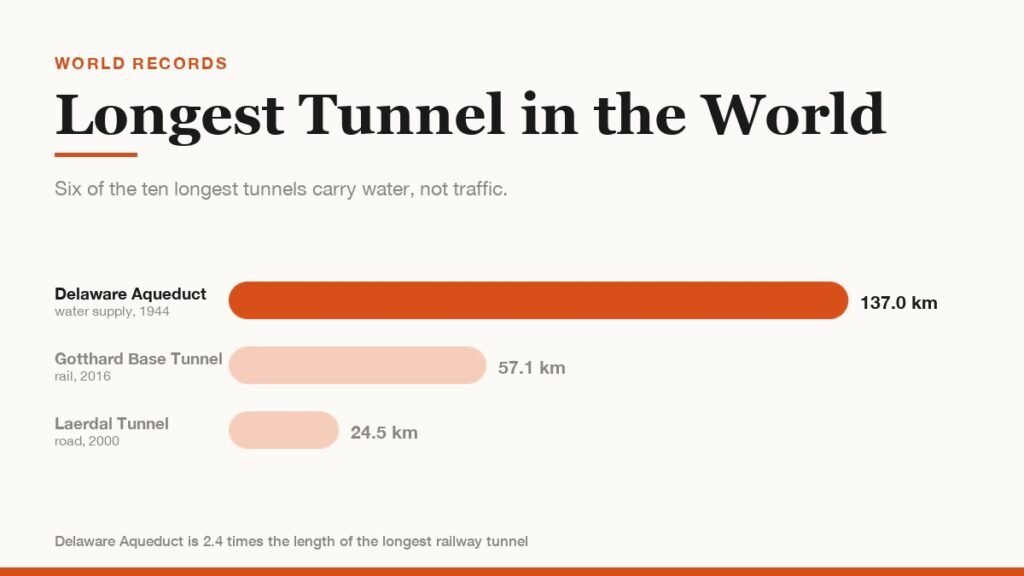
The longest tunnel in the world is the Delaware Aqueduct, which runs 137 km (85 miles) under the Hudson Valley to carry drinking water into New York City. It was built between 1939 and 1945 and has been in service since 1944, and it is more than twice the length of the longest railway tunnel ever dug.
The answer changes with the category. Count only the tunnels people travel through and it becomes the Gotthard Base Tunnel in Switzerland, at 57.1 km, the longest railway tunnel ever built. Count road tunnels alone and it is the Laerdal Tunnel in Norway at 24.5 km.
The 10 Longest Tunnels Ranked by Length
| # | Tunnel | Country | Length | Opened | Type |
|---|---|---|---|---|---|
| 1 | Delaware Aqueduct | United States | 137 km (85.1 mi) | 1944 | Water supply |
| 2 | Paijanne Water Tunnel | Finland | 120 km (74.6 mi) | 1982 | Water supply |
| 3 | Dahuofang Water Tunnel | China | 85.3 km (53.0 mi) | 2009 | Water supply |
| 4 | Orange-Fish River Tunnel | South Africa | 82.8 km (51.4 mi) | 1975 | Water supply |
| 5 | Bolmen Water Tunnel | Sweden | 80 km (49.7 mi) | 1987 | Water supply |
| 6 | Tunel Emisor Oriente | Mexico | 62.1 km (38.6 mi) | 2019 | Wastewater |
| 7 | Gotthard Base Tunnel | Switzerland | 57.1 km (35.5 mi) | 2016 | Rail |
| 8 | Seikan Tunnel | Japan | 53.9 km (33.5 mi) | 1988 | Rail |
| 9 | Channel Tunnel | UK and France | 50.5 km (31.4 mi) | 1994 | Rail |
| 10 | Yulhyeon Tunnel | South Korea | 50.3 km (31.3 mi) | 2016 | Rail |
Six of the ten move water rather than traffic. No road tunnel appears anywhere in this list, and the longest of those is less than half the length of the tenth entry.
Every Tunnel in the Top 10, in Order
1. Delaware Aqueduct: 137 km
United States · 137 km (85.1 mi) · in service 1944 · water supply
The aqueduct carries water from the Rondout Reservoir in the Catskills to the Kensico and West Branch reservoirs north of New York City. It supplies roughly half the city’s drinking water.
It runs as a single pressurised bored tunnel up to 460 m below the surface, and it leaks. A bypass to seal two cracked sections under the Hudson was connected in 2022, the first time the aqueduct had been shut down since it opened.
2. Paijanne Water Tunnel: 120 km
Finland · 120 km (74.6 mi) · commissioned 1982 · water supply
The Paijanne tunnel brings water from Lake Paijanne to the Helsinki metropolitan area, running through solid bedrock between 30 and 100 m underground. It is described by the utility that runs it as the second longest continuous rock tunnel in the world.
It serves about a million people. The tunnel was drained for inspection and repair in 2001 and again in 2008, each time requiring the region to fall back on reserve supplies.
3. Dahuofang Water Tunnel: 85.3 km
China · 85.3 km (53.0 mi) · boring completed 2009 · water supply
The Dahuofang tunnel carries water from the Dahuofang Reservoir across Liaoning province to Shenyang, Fushun and five other cities in the industrial northeast.
Three tunnel boring machines worked the bore simultaneously from separate headings. It supplies a region where groundwater extraction had already caused measurable subsidence.
4. Orange-Fish River Tunnel: 82.8 km
South Africa · 82.8 km (51.4 mi) · 1975 · irrigation and water supply
This tunnel moves water from the Orange River, South Africa’s largest, into the Great Fish River valley in the Eastern Cape, turning semi-arid farmland into irrigated land.
It was the longest continuous enclosed aqueduct in the world when it was finished, and it still ranks among the longest. The bore is 5.3 m across and falls at a constant gradient for its whole length.
5. Bolmen Water Tunnel: 80 km
Sweden · 80 km (49.7 mi) · inaugurated 1987 · water supply
The Bolmen tunnel carries water from Lake Bolmen in Smaland to around 900,000 people in western Scania, including Malmo, Lund and Helsingborg.
Construction ran from 1975 to 1987, twelve years for 80 km through hard crystalline rock. The operator, Sydvatten, gives the length as 80 km.
6. Tunel Emisor Oriente: 62.1 km
Mexico · 62.1 km (38.6 mi) · inaugurated 23 December 2019 · wastewater
The Emisor Oriente drains storm water and sewage out of the Valley of Mexico, relieving a drainage system that Mexico City had outgrown and that was failing as the city sank.
Mexico City subsides by as much as 40 cm a year in places, which had reversed the gradient of the older drainage tunnels. The new tunnel was dug deep enough to keep working as the ground above it drops.
7. Gotthard Base Tunnel: 57.1 km
Switzerland · 57.1 km (35.5 mi) · commercial service 11 December 2016 · rail
The Gotthard Base Tunnel is the longest railway tunnel in the world and the longest tunnel anyone travels through. It runs flat and straight under the Alps between Erstfeld and Bodio, with up to 2,300 m of rock overhead.
Seventeen years of construction cut the journey between Zurich and Milan by about an hour. A derailment closed it in August 2023 and it returned to full service in September 2024.
8. Seikan Tunnel: 53.9 km
Japan · 53.9 km (33.5 mi) · opened 13 March 1988 · rail
The Seikan Tunnel links Honshu and Hokkaido under the Tsugaru Strait, and 23.3 km of its length runs beneath the seabed.
It was the longest rail tunnel in the world for 28 years, until Gotthard opened in 2016. It now carries Hokkaido Shinkansen services as well as freight.
9. Channel Tunnel: 50.5 km
United Kingdom and France · 50.5 km (31.4 mi) · opened 6 May 1994 · rail
The Channel Tunnel runs between Folkestone and Coquelles under the Strait of Dover. According to its operator, about 37 km of it lies beneath the sea, which is the longest undersea section of any tunnel in the world.
It is three bores rather than one: two running tunnels and a smaller service tunnel between them, which doubles as the escape and ventilation route.
10. Yulhyeon Tunnel: 50.3 km
South Korea · 50.3 km (31.3 mi) · opened 9 December 2016 · rail
The Yulhyeon tunnel carries the Suseo high-speed line south out of Seoul, running under the capital’s southeastern suburbs and the satellite cities beyond.
It opened within days of the Gotthard Base Tunnel in December 2016 and attracted almost none of the attention, which is usual for tunnels that run under cities rather than mountains.
Longest Tunnel by Category
Three different structures can each be called the longest tunnel in the world, depending on which category is being counted.
| Category | Holder | Length | Opened |
|---|---|---|---|
| Any type, water included | Delaware Aqueduct, United States | 137 km (85.1 mi) | 1944 |
| Rail | Gotthard Base Tunnel, Switzerland | 57.1 km (35.5 mi) | 2016 |
| Road | Laerdal Tunnel, Norway | 24.5 km (15.2 mi) | 2000 |
| Undersea section | Channel Tunnel, UK and France | about 37 km (23 mi) | 1994 |
The Laerdal Tunnel in Norway runs 24,509 m between Laerdal and Aurland, a figure the Norwegian Public Roads Administration gives on its own project page. No road tunnel anywhere comes close to the rail or water figures, because ventilating exhaust fumes over that distance is the harder engineering problem.
Metro lines are left out of the ranking above. Several run longer than Gotthard end to end, but a metro line is a series of separate bores between stations rather than one continuous tunnel, so counting it alongside the Delaware Aqueduct compares two different things.
Why the Longest Tunnels Carry Water
Six of the top ten move water, and that is not a coincidence. A water tunnel is the cheapest long tunnel it is possible to build.
- No ventilation. Water needs no air supply, no smoke extraction and no emergency refuges, which is most of the cost and nearly all of the complexity in a traffic tunnel.
- A smaller bore. Orange-Fish is 5.3 m across. A twin-track rail tunnel needs roughly double that, and the volume of rock removed rises with the square of the diameter.
- No safety case for passengers. Gotthard has two bores plus cross-passages every 325 m purely so people can get out. A water tunnel needs none of it.
- Gravity does the work. A constant gradient from source to city needs no pumping, which is why these tunnels run so far rather than lifting water over the terrain.
The same economics appear above ground, where elevating a railway costs less than tunnelling or embanking it. That is how the longest bridges in the world came to be built, and why most of them carry trains across flat country rather than crossing water.
Cities reach this far for water when the nearby supply runs out or sinks. New York, Helsinki, Shenyang, Malmo and Mexico City all built their tunnels for that reason, and the pattern tracks the growth of the largest cities in the US.
Tunnels That Will Change This List
Three projects now under construction will rewrite the rail and road records within about a decade.
- Mont d’Ambin Base Tunnel, France and Italy, 57.5 km, due 2033. It would pass Gotthard as the longest railway tunnel.
- Brenner Base Tunnel, Austria and Italy, 55 km, due 2032. It would sit just behind Gotthard.
- Rogfast, Norway, 26.7 km, due in the mid 2030s. It would take the road record from Laerdal, and at 392 m below sea level it would be the deepest road tunnel as well.
None of them threatens the Delaware Aqueduct. New York is building Water Tunnel No. 3 at about 60 miles, a project begun in 1970 and still unfinished, and even that would not pass it.
Frequently Asked Questions
What is the longest tunnel in the world?
The Delaware Aqueduct in New York, at 137 km (85 miles). It is a water supply tunnel. The longest tunnel people travel through is the Gotthard Base Tunnel in Switzerland, at 57.1 km (35.5 miles).
What is the longest railway tunnel in the world?
The Gotthard Base Tunnel in Switzerland, at 57.1 km (35.5 miles), which entered commercial service on 11 December 2016. It took seventeen years to build and runs under as much as 2,300 m of Alpine rock.
What is the longest road tunnel in the world?
The Laerdal Tunnel in Norway, at 24,509 m (15.2 miles), opened in November 2000. It connects Laerdal and Aurland on the route between Oslo and Bergen, and it is lit in sections to reduce driver fatigue.
Is the Channel Tunnel the longest undersea tunnel?
It has the longest undersea section of any tunnel, at about 37 km (23 miles) beneath the Strait of Dover. The Seikan Tunnel in Japan is longer overall at 53.9 km, but only 23.3 km of it runs under the seabed.
Related Articles

Get the Fox Bulletin briefing
The stories that matter, in your inbox. No spam, unsubscribe anytime.
Newsletter signup will be available soon.
Related stories
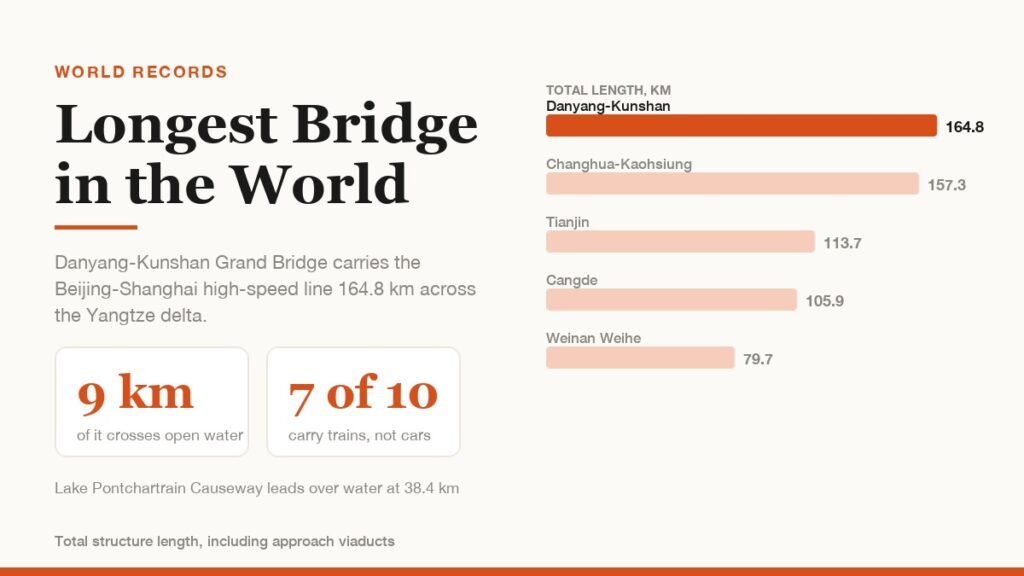
Longest Bridge in the World: Top 10 Ranked by Length
The longest bridge in the world is the Danyang-Kunshan Grand Bridge in China, which runs 164.8 km (102.4 miles) across the flat country between Shanghai and Nanjing. It carries the Beijing-Shanghai high-speed…

Lossless Music Streaming: Which Services Offer It
Six of the seven major services now stream lossless audio, with top quality running from 24-bit/44.1 kHz to 24-bit/192 kHz. This page sets out the format, maximum quality and plan placement for each service, then covers what lossless means, why Bluetooth changes the picture and which gear matters.

Music Streaming Services by Country: Coverage Chart
Spotify states 184 markets and Deezer says 185+, while Apple Music is named under 172 of the 175 countries and regions on Apple's page. This reference sets six services side by side with their counts, notable gaps and regional strengths, adds a 12-country matrix, and explains why China, India and Africa split the field.